by Diletta Di Marco | Dec 2, 2015 | The Urban Media Lab
“Collaborare è Bologna” is a project of the City of Bologna, managed with the Bologna Urban Center and various partners to promote a “culture of collaboration” with continuous and consistent community involvement,and to make technologies, resources, spaces, knowledge, skills and information more accessible. In this framework, on 19 May 2014, the Municipality of Bologna approved the “Regulations on the collaboration between citizens and the Administration”, for the treatment and regeneration of the commons. This is an instruction manual for a collaborative dialogue between the public, private and community spheres, a tool that seeks to simplify and promote forms of collaboration in the management of the commons, implementing the principle of subsidiarity provided for by the Constitution in its 118 article.
The project is divided into three sub-projects, designed by listening the citizens and letting them cooperate with associations, institutions, firms and interest groups:
> Fare_insieme: projects for the treatment of public spaces (i.e islands for underground waste collection, new lighting and upgrading of the main public spaces of the center, projects for cleaning the urban spaces, contrasting graphic vandalism, teaching citizens the shared care of open spaces).
> Vivere_insieme: projects with an innovative approach on many issues. Starting from mobility, for a city in which citizens are moving on foot, by bike and on public transport until the creation of projects in areas with specific problems (Pilastro and Bolognina are the interested zones).
> Crescere_insieme: projects in which public places become collaborative spaces and engines of economic development. The project provides a digital network infrastructure in step with Europe, to promote Bologna as a City of Food and renew the relationship between the university and the city.
From October 22 to December 3, 2015 a series of meetings will take place in different neighborhoods and with an online consultation for the citizens to define the priorities of the city.
The path was created in order to strengthen the collaborative ties and develop priorities, to implement the energy of the city and the ability of citizens to collaborate.
The Municipality is organizing six meetings, one for each district to activate a digital platform where citizens, schools, businesses and associations of Bologna will contribute to the emergence of the urban commons and draw a map of the urban regeneration projects and future actions. The aim is to design together a view of the commons to implement the available European funds, with the support of the regional and municipal authorities.
The round tables are organized with the direct participation of the citizens; the focus is on discovering the priorities of citizens and neighborhoods. Which are the places that need special attention?
Each meeting tries to answer to practical questions, and the participation of Neighborhood Presidents and the Mayor is an unique opportunity to present the measures already implemented and funded (relative to the district headquarters of the meeting) with a strong focus on the regeneration projects in progress and current demographic changes.
Each meeting is built on working groups, and for two hours all present citizens can intervene and bring out, area by area, problems and potential solutions.
The project “collaborare è Bologna” is organized by the city of Bologna with the collaboration of the Neighborhoods, Urban Center Bologna, ASP – Company Public Services for the person, IES – School Education Institution and the Institution for Social Inclusion and Community. The official hashtag is #collaborarebologna— search it on Social Media. For more information, write an email to gestionecomunita@comune.bologna.it. The next meeting’s programme of December 3rd is already online on the website: www.urbancenterbologna.it. Change begins with participation, and participation begins with you!


by Diletta Di Marco | Oct 27, 2015 | Luiss LabGov 2015-2016
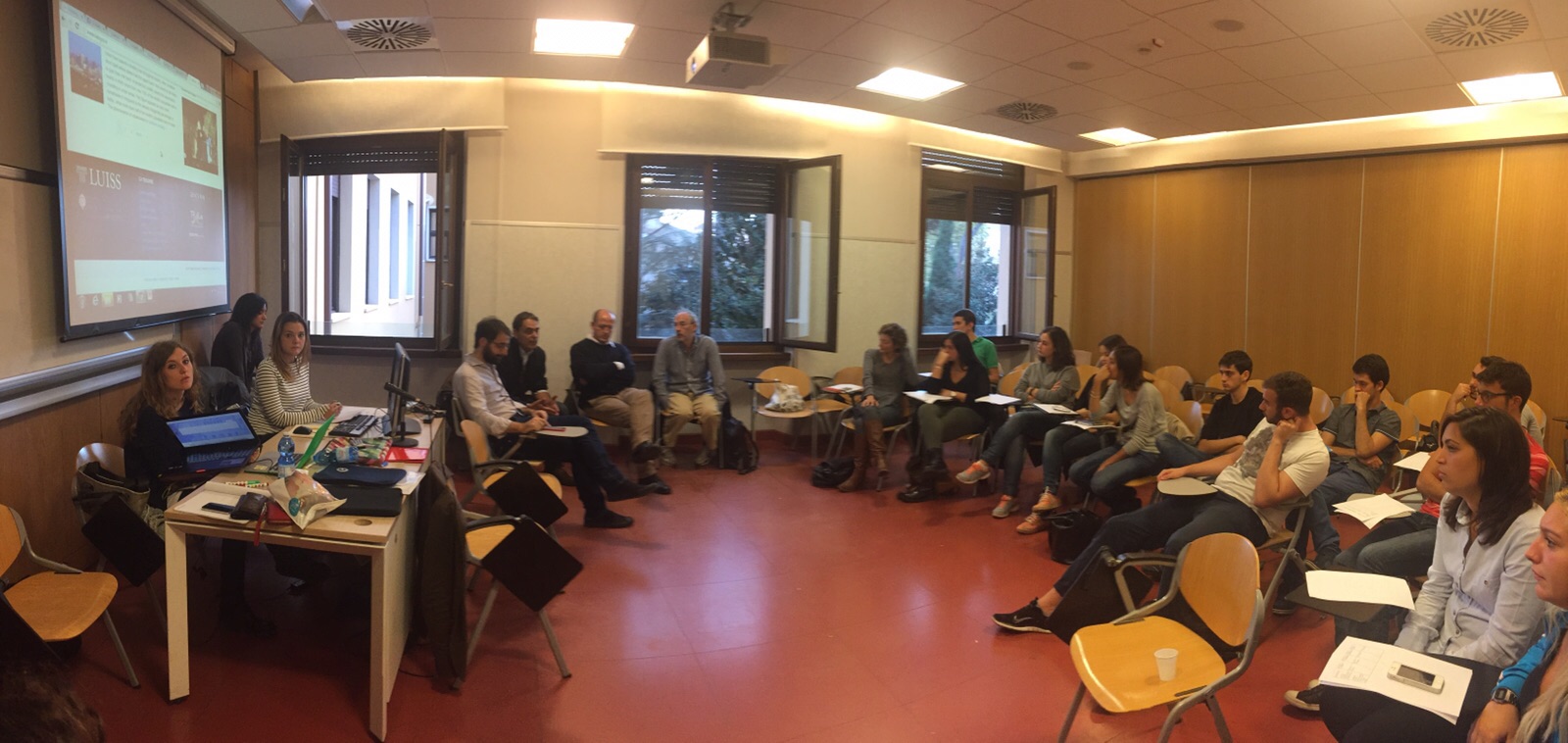
Last weekend, on 16 and 17 October LabGov held the first co-working session for 2015-2016. On Friday afternoon, the new LabGovers came together to discuss and to co-design a new idea for Rome together. Students were inspired by foremost experts in the field of regeneration and care of the commons. Each expert, with his or her own particular approach, could make an important contribution to the discussion.
The afternoon began with the intervention of the famous architect Massimo Alvisi, promoter of the project CO-Battipaglia and G124. The intervention has shown, through its key points for urban regeneration and using as example the cities of Turin, Catania and Rome, how collaborative relationships between the city and its inhabitants can stimulate active citizenship in the care for the commons. Massimo Alvisi told of the importance of working in a multidisciplinary environment and acting with determination in the territory. Because public buildings are a common good, participation is a key issue, especially for citizens. His method for participation was simple, with small interventions that have created wealth and stimulated energy. The focus is how citizens who are reclaiming their places in the city should not transform the territories but synthesize impactful solutions for the things that have gone wrong. Massimo Alvisi also demonstrated how a city can be developed through simple ideas in the service of its people to really meet the needs of a city. It can care of all its participants, where every small stimulus is a big step towards a path of cooperation. It is precisely in the areas most abandoned and suffering, that the presence of basic services can activate citizenship. That is where you have the key role of urban regeneration and the creation of a barrier-free city.
The second intervention involved Professor Sheila Foster, Professor of Law and Faculty Co-Director, Fordham Urban Law Center. She told the student how being an an activist and at the same time an expert could impact on things at different levels. She worked with environmental groups in New Jersey, Philadelphia, and New York and she reported to the students with energy her experiences. At LabGov, she discussed how the city can benefit from new forms of collaboration and participation through a new administrative approach. The creation of links is the basis of trust in a smart city.She focused on there the difference between “planning vs. doing” things, in order to help the administrations with experts to re-design and plan the commons.According Sheila Foster, collaboration is already a practice but we should push that to the next level, especially here in Rome.
The afternoon dedicated to building a new Rome, also had the pleasure of hosting a prominent communication expert. Michele D’Alena currently works at the Press and Communications Office of the City of Bologna, for which he also coordinated the process of the Digital Agenda and the project of the new civic network. Michele trasmetted to LAbgov students the basic know-how to enable them to change the administration with a buttom-up process, for Michele, that means first of all change the connection between citizens and the communication and transparency of their legislators and public policers. The proper communication, the marketing and the co-design of the processes shoulb be aimed at creating an active citizenship and an open-government.
The last guest was Flavia Barca, former commissioner of the culture of Rome, who gave us a very personal contribution on how, in Rome, to overcome the crisis, we must recognize the importance of cultural heritage. The impact that cultural heritage can have on economic, cultural and social, is the cornerstone of a new way of doing politics. This idea of culture for us is new, and we must rethink and revive the historical memory. Re-inhabiting the ruins, the past must be reconsidered and switched to instrument. The 1st part of the session was also attended by Lavinia Pastore, Paola Cannavò, Enrico Parisio for Mille Piani and Sara Seganti for Human Foundation.

The second part of the session was held on Saturday morning, from 10 am to 5 pm. Students spent their first hour in the garden with expert Zappata Romana. Strategists organized lectures with students in which they explained the three stages of analysis, mapping and testing. During the first co-working session, LabGovers they split into groups to co-create and start the process. The sustainability group led by Professor Luigi Corvo and Lavinia Pastore had the goal of making feasible the economic-financial, social and environmental ideas of the design group.
During this first session, it was considered necessary to dwell on the economic-financial profile, specifically analyzing the cost items and revenue to be leveraged to make the project sustainable. In particular to do so, after highlighting the various categories of stakeholders potentially affected, we focused on tools for fundraising, to the increase revenue of the project, and crowdsourcing, to reduce their costs. The former included mainly spontaneous donations, especially necessary to start a communication campaign that can reach large groups of people, and corporate investments, both civil and institutional. The latter are needed to lower start-up costs of the project.Special thanks also goes to the point of view reported by Sara Seganti for Human Foundation, thanks to her our students understand the importance of a proper evaluation for investments, and more than anything else the impact that these have on the whole society.
The design team, with the help of Eloisa Susanna, Serene Baldari and Paola Cannavò, worked on areas in which to intervene, reviewing areas and imagining solutions to get in touch with the people. One of the objectives that arose in this group was identifying the potential and the critical places. Another key thing that this group set out to do was to analyze existing structures, in particular those that are already based on collaborative structures such as co-working spaces and fablabs. A short-term objective essential for the group is mapping the area by taking a cue from existing best practices.
The third group worked on the difference between assets and assets not mappable mappable with Guglielmo Apolloni, especially, on how to experience an active search for these on the territory. The Communication’s role more sensitive in the process of starting the project, work on their balance is based on the purpose of receiving more visibility and transparency as possible.
The meeting gave the students a chance to take to the field, having acquired the know-how. The next goal is to go and visit the site to review its territory and its needs. Students have identified the managers of several sites to develop with them a relationship of partnership and trust. On November 13, the group will launch the second module of LabGov 2016 where all the students will report their experiences in comparison with the “collaboration-yards” studied.


by Diletta Di Marco | Oct 14, 2015 | EducationLabs
On 16 and 17 October, Labgov will present the first co-working session for Labgov 2016.
This two-day workshop is based on the proposal to imagine Rome in an innovative way.
The project CO-ROMA is focused on the idea that a city should learn to share, collaborate and cooperate with the institutions, the civil society, universities and all the possible stakeholders in order to create a collaborative community, that wants to improve the quality of life and save the Italian cognitive and cultural heritage.
The programme of this first co-working-day will be structured into four working groups, which will be: urban design; communication; community organization through service design, and sustainability.
The most competent experts in every field will hold the round tables; they will transfer their know-how to the neo-labgovers, and they will imagine all together this transformation for Rome.
Several forces are already present in this new collaborative city: active citizens, voluntary associations, schools, urban gardens, co-working spaces, fab-labs, business leaders, and professionals for the common good.
Moreover, on Saturday morning at 9.00 am, the 2016 Labgov students will work for the first time in the garden, with our technical partner for horticulture, Zappata Romana. It will be a fantastic weekend, full of experiences and adventures. The detailed programme will be published as soon as possible.
For further information, please write to our official address.
by Diletta Di Marco | Oct 7, 2015 | EducationLabs
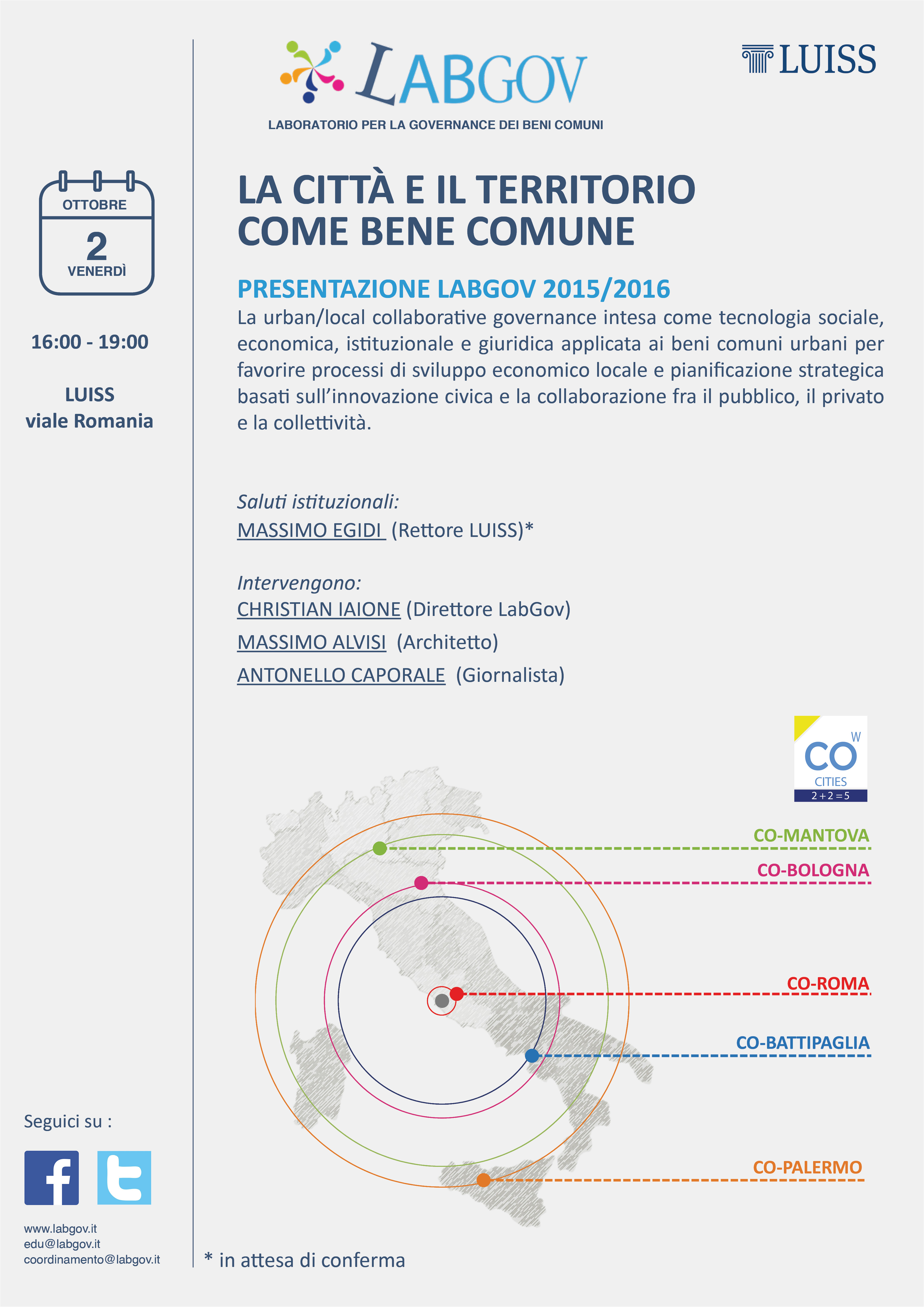
October 2nd we launched LabGov once again for the new academic year 2015/2016! On our first afternoon of the year, full of emotions and debates, we started with a very ambitious and challenging project. In the presence of the new LabGovers (Law, Economics, and Political Science students)several professors, staff members and illustrious experts had the chance to work together, listen to the inspiring words of one another’s previous experiences and imagine a new project for this year. We expect great ambition and willpower, as well as excellent results to share!
The meeting was attended by the Rector of the University Massimo Egidi, the famous Architect Massimo Alvisi and other partners of LabGov, including Luca D’Eusebio for Zappata Romana, Luca Parisio, Serena Baldari and Antonello Caporale. During the afternoon, the new program for the year was introduced by the name of CO-Rome, a project that involves the study of Rome as a city in which we try to build an innovative institutional future, with different and better views . The five souls of the collaborative governance (social innovation, public authorities, schools/universities, businesses, organized civil society) will work together to re-design our own city, making it more economically sustainable.
The goal of LabGov is to form new professional figures: “the practitioners of the commons.” These are people who are able to work in government, in business and in societies. They employ and enhance the resources, ideas, energy, skills and talents of these businesses and societies, which are widespread in the community and in the territories.
Autonomy, accountability, transparency and international openness are the values that make LabGov an incubator of innovative ideas built to establish a new economic and institutional paradigm.
The objects of analysis and experimentation will be as follows: collaborative urban and local governance; and economic, institutional and legal technology applied to the commons (urban, industrial, environmental, cultural, cognitive, digital, etc.). These objects promote processes of local economic development and strategic planning, based on innovation and civic collaboration between the public, private and community.
We will start with an initial mapping phase with a careful reading of the territory and its forms of collaboration. We will then have two phases of design and a follow-up.
As we have already done before, we will apply the CO-Cities approach, based on a strong partnership between institutions, the private sector and the community with significant help on the research side by the academic field.
This year, the co-design will be the fundamental instrument to create a prototype for effective governance and to identify tools based on the needs and characteristics of this city. We have to create a governance tool for the city of Rome that is suitable to the city’s peculiarities. This is our challenge: CO-Roma! In our research, we indentified different areas for testing urban cooperation, which are located on the outskirts of Rome: Garbatella neighborhood, the Appia Antica Park, a high school in Ostia and the V Municipality (Prenestino-Centocelle).
They represent four different types of urban commons to regenerate and invest in. This year, the Lab will focus on a very stimulating challenge for the City. A very stimulating journey cha in the City with many allies, partners and friends who will provide insightful advice to prototype a Commons-based collaborative governance for Rome. The Laboratory stays open to contributions, help and advice. The fourth edition of the Lab will take place in two phases. The former phase will focus on the workshops (October 2/2015, November 13/2015, February 26/2016 and April 8/2016). The latter phase will include co-working sessions (16/17 October 2015, 20/21 November 2015, 04/05 March 2016 and 15/-16 April 2016).
During the project, students will also engage in the field. They will cultivate the garden within LUISS University, a real testing ground of governance. In these 100 hours of pure innovation, together we will discover new stimulating and exciting forms of cooperation! For any information please write to our official account.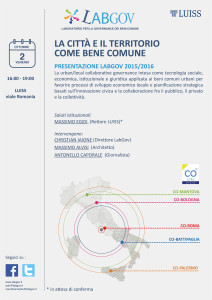

by Marina Bassi | Aug 9, 2015 | The Urban Media Lab
The 1st IASC (International Association for the Study of the Commons) Thematic Conference on urban commons is approaching. The call for abstracts is out until Aug 10th at 12:00 AM PT. The Conference title unveils the complexity and the ambition of an event that wishes to gather for two days the most prominent scholars and practitioners on urban commons, social innovation, sharing economy, to talk about “The City as a Commons: Reconceiving Urban Space, Common Goods And City Governance”. The Conference is organized by LabGov – LABoratory for the GOVernance of Commons, a partnership between the Urban Law Center of Fordham University and the International Center on Democracy and Democratization (ICEDD) of the LUISS University of Rome (http://www.labgov.it/the-city-as-a-commons-the-first-international-conference-on-urban-commons/). It will take place in Bologna on November 6-7, 2015. One of the track of the Conference concerns the Democratic Innovation and how governance of the urban commons could influence it. This is why we decided to interview one of the most prominent international scholars on democratic theory, Professor Nadia Urbinati.
On July the 5th, the Greek citizens went to the polls for the referendum announced by their Prime Minister, Alexis Tsipras. Greek people were asked to reply to a hard question, which then raised countless debates and opinions starting from the decision whether accept, or not, the austerity policies and economic measures proposed by the European Union and international creditors, to solve the issues about the Greek debt.
Many scholars, professors, writers and academics put the stress on the important fact that Greece is the cradle of democracy, the country where were born the most important historical thinkers of democracy.
Nadia Urbinati is one of those we are referring to. She is “Kyriakos Tsakopoulos Professor of Political Theory and Hellenic Studies” at the Department of Political Science of the Columbia University, she is also a political theorist who specializes in modern and contemporary political thought and the democratic and anti-democratic traditions. She co-chaired the Columbia University Faculty Seminar on Political and Social Thought and founded and chaired the Workshop on Politics, Religion and Human Rights.
The day before the Greek referendum, the Italian newspaper “La Repubblica” published an interesting article written by professor Urbinati. The title of the article is Greece and the European democracy myth which briefly but effectively analyses the history of democracy and the development of the political thought around this myth.
Some LabGov editors seized the opportunity and had the chance to build up a dialogue with professor Nadia Urbinati, trying to investigate the intersections between LabGov projects and the academic thought of professor Urbinati:
1) The twenty-first century seems to be identified as “urban century”. Can you create a model of urban democracy in Greece, in Italy, in Europe, or in the world? What features should you get?
Aristotle writes in the collection of the Greek constitutions that there are urban democracies and countryside democracies. However, a good democracy is mostly urban. Democracy, historically speaking, had its roots and developed in urban areas. Cooperation among people is essential to achieve it, regular exchanges are needed. These features are all better achieved in a urban environment. It is even possible to say, that democracy is the best form of an urban policy.
In ancient Greece or during the American or French revolution, participation was limited and fluctuant. Ephialte and Pericles created daily indemnities to allow people to participate. Today the situation is completely different, and there is the co-existence of two apparently opposite trends: on the one hand, physicality is no longer necessary in order to share in power, (the social media allow us to participate without “being there”); but on the other hand, politics lost credibility and attraction at least at the national level. Yet we witness the rise to a re-discover of “locality” and as we know democracy lives in small spaces better than in large ones, closer to us better than far from us.
2) The twenty-first century seems to have also another feature, a prefix. The one of the Latin “cum” or the Anglo-Saxon “CO-“. There are many debate on co-operation, co-working, co-design of the commons (i.e. “beni comuni”), the regained centrality of the community, the importance of communication, the knowledge economy, etc. In Bologna, Mantua, Battipaglia, Palermo, Rome – as well as in other Italian and foreign cities – are emerging examples underlining the need for the community to get involved in public life through public actions and in daily collaboration of citizens. For example, in Battipaglia there is a process of collaborative planning, which puts around the same table to co-design services: citizens, institutions, businesses, civil society organizations, schools and universities. The main goal is to propose a new approach to the city’s development through a fostered channel of both citizens and institutions. In Bologna, we recently celebrated the first year of the Regulation on the collaboration between citizens and Public Administration for the care and regeneration of urban commons (i.e. “Regolamento sulla collaborazione per la cura e rigenerazione dei beni comuni urbani“). In Mantua, it has been built a platform of collaborative governance for a development centered on local culture and knowledge. What kind of role can these experiments have in the broader process of rethinking the local democracy? Could – a model of this kind – be the right approach to give Mediterranean countries back the role of “cradle of democracy”?
The founding fathers had this intuition. Altiero Spinelli thought of the unification starting from the local not only the national. Subsidiarity tells us that what can be solved at the local level, should not be solved at the national level. Take the issue of immigration, which is wrongly always thought as a national problem. However, it is in each municipality that lies the seeds of a possible solution: we should involve marginalized people; there are many things they can do, and many sector in which they can play a big role as participant. But in order to do so, a strong local community is needed.
3) Greece, and even more its citizens need to work in order to reactivate their economy: how can an investment in democratic innovations turn into a positive economic investment for the welfare of the local community?
Let’s think of the referendum recently held in Greece; it did not turn out to be what many believed it ought to, but at least it was a strong statement by the Greek people. Most of us had no idea of the meaning of public debt (who owns what to whom?). We need a stronger Europe, with less bias by Norther States against Mediterranean States. And above all we would need bright leaders and with strong European belief. In the US, when the State of California when bankrupt, Washington took the lead of a process of economic regeneration — we have to do the same in Europe too. Innovations, even democratic ones, may have a positive impact on our life; and so we would need to invest in our community, and unleash all their potentiality. Cooperation is the only way forward.
4) According to Professor François Garçon, author of Knowing Switzerland, the debt crisis reflected the indifference of the sovereign people. Greece, which has already taken a first step through a referendum, towards a model of direct democracy on economic and financial choices, could now explore new ways to regain possession of their relays and by doing so revive the economy itself, starting from small urban and regional economies. What is your opinion on that?
On an European dimension: we can and we must criticize the actual governance in Europe. The member states have no equal power and have no equivalence among them. There is not a European demos capable of expressing beyond the states. Treaties are no longer enough, especially in a time of economic crisis. The whole European construction was allowed by very lucky circumstances, like economic growth and reconstruction after WW2. Unfortunately, today’s circumstances are dramatically different. We must return to strengthen the local even more than the national if we want to have a political EU. The state should be an enabler of this change, and lately a partner.
5) How would it be possible, for local community inspired by the Rules of Bologna to interact with each other, and so give their contribution in the creation of democratic and horizontal network of local communities? Can they really change democratic and economic premises
It is a matter of education. Legality begins in interpersonal relationships, and cooperation is already a sign of education. American pragmatist thinkers had understood that for the management of a public good coordination was necessary to make everyone fell responsible. We often use the wrong words. For example the word “owner” is improper. We use the word for understanding reasons, but we rarely “own” something; we rather “borrow” or “share”. The key to success is to set good rules so as to make all the people who are involved in some communal enterprise feel they are partners on a equal foot.