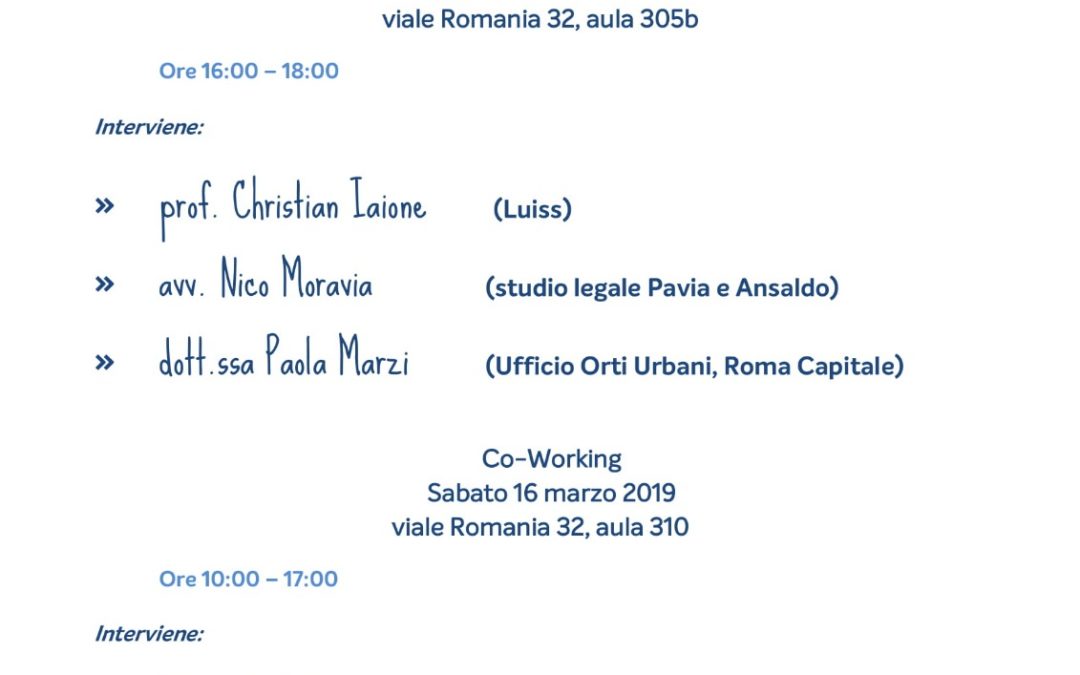
The third workshop of the Urban Clinic EDU@LabGov 2019 took place on Friday the 15th of March into the Viale Romania Campus of LUISS University. The workshop has inaugurated the start of the third module of the course. The module was dedicated to “Urban Law and Policy”. Indeed, the Laboratory hosted three important experts on these themes: prof. Christian Fernando Iaione, lawyer Nico Moravia, and dr. Paola Marzi.
Prof.
Iaione, the scientific co-director of LabGov, teaches Urban Law and Policy and
Urbanistic Law at LUISS University.
Lawyer
Moravia is partner of the law firm Pavia-Ansaldo (administrative law department).
Dr. Paola
Marzi is an official of the municipality of Rome as Head of the office for the
Urban Gardens, and has a long experience on these themes since she has
participated in the drafting of the Regulation of Urban Gardens of Rome.
The
workshop was introduced by the speech of Prof. Iaione, who talked about his
experiences in the urban regeneration field. He exposed the project of
Co-Bologna (http://co-bologna.it/): the
program started 7 years ago and its effects were such as to spread his
principles in Italian cities like Turin, Rome and Reggio-Emilia, but also in
others parts of the world like New York, Amsterdam and Sao Paulo.
All these
experiences demonstrated how important is to rewrite administrative and
urbanistic legislation in order to face all the problems brought in the cities
by the changes of the third millennium. What is fundamental in this process is
the participative paradigm, that means involving as much as possible all the
different urban stakeholder in order to re-define the way of living the urban
centers.
Indeed, lawyer
Moravia showed how it worked in the roman context, by showing the case of the
Ex-Dogana: an un-used space, owned by Cassa Depositi e Prestiti, brought back
to life by the efforts of four young entrepreneurs. The cohesion of legal,
human and economics competences, made possible to find a new and simple
solution, like a temporary leasing contract, and create what now is one of the
most important experiences of this kind in Rome.
One of the
sectors where the participative paradigm is more successful and better applied
is the urban garden’s one. Dr. Marzi explained how gardens are the place where
it is possible to focus all the energies and differences of a neighborhood, not
only as a place where plants grow, but as an instrument of social inclusion,
that generates wellness and new solutions to co-live the city by building up new
forms of community.
Co-Working
The 3rd
Module of the Urban Clinic LabGov EDU 2019 continued with the Co-Working
session, held on March 16th. The co-working session is facilitated
by Chiara De Angelis, Friends of LabGov’s ex-president.
The
Co-Working session took place in the LUISS Campus of Viale Romania and it started
at 10 am with Pasquale Tedesco’s testimony, expert of Confagricoltura (http://www.confagricoltura.it/ita/).
He talked about
the importance of the relationship between Earth and Nature and the fortune to
enjoy some products that Earth offers.
After this
inspirational session, Chiara De Angelis explained the Labgovers service
design, an important passage to complete and improve the idea that they’re
developing during this A.A. of LabGov EDU. For this reason, the LabGovers were
divided into groups in order to select the “personas” (consumer type) of their
product/service, basing on their previous research.
In the afternoon, the LabGovers developed the user journey map to describe the possible experience consumers might have through the platform that they are developing.
Save
the date: next Saturday, 9th March we will host the first EDU@LabGov
community gardening session in Luiss Community Garden from 10 am to 12am.
The
LabGovers will work with recycled materials in order to build a prototype that
they will install in Luiss and in the city of Rome. If you are interested in
following their work, follow our official social network!
During
the community gardening session, the LabGovers will put into practice what they are learning during the forms in the classroom
therefore it will represent ahead important footstep in the realization of
their project.
The assisted gardening is not only a didactic
moment but an activity of practical collaborative among the boundaries of the University
Luiss Guido Carli, that then the students will experiment on the field in the
city of Rome.
Stay tuned!
Save the date: Sabato 9 marzo si terrà
il primo community gardening della Clinica Urbana EDU@LabGov presso l’#OrtoLuiss
dalle 10:00 alle 12:00.
Durante la sessione di community
gardening i LabGovers, divisi dapprima in quattro gruppi sulle diverse aree di
lavoro, dovranno presentare i dati raccolti nel corso della settimana e
iniziare a dar forma al loro progetto. Inizieranno quindi un laboratorio di
auto-costruzione che, tramite l’utilizzo di materiali riciclati, li porterà a
realizzare un prototipo che installeranno nella città di Roma. Se volete
saperne di più rimanete connessi ai nostri account social ufficiali quel
giorno!
L’obiettivo
è mettere in pratica ciò che gli studenti stanno apprendendo durante i moduli
in aula, quindi rappresenterà un importante passo avanti nella realizzazione
della loro idea.
Il gardening assistito non è solo un
momento didattico ma un’attività di pratica collaborativa tra le mura
dell’Università Luiss Guido Carli, che poi gli studenti sperimenteranno sul
campo nella città di Roma.
In fact, among the difficulties faced by the various urban contexts, there is the one concerning poverty.
This article, written after the seminar on 11 October 2018, during the European Week of Regions and Cities, quotes as an example the six cities Barcelona, Birmingham, Lille, Nantes, Pozzuoli, Turin, which participate in the first call for proposals on the theme of urban poverty and which are adopting, with the support of UIA, innovative solutions to tackle this problem.
One of the most interesting aspects that emerges from the article is the one concerning the Public-private-community partnerships. In these particular types of partnership there is a more specific focus on what concerns the local foundation and the local development. In fact, the various target groups have been involved in the projects since the beginning.
A good example of how the Public-private-community partnerships can be particularly effective in combating the poverty is in the Co-city project from Turin where the municipality collaborates in the governance of the Commons with the various local associations and residents through the “Pacts of collaboration “. These are described by Christian Iaione, professor at Luiss Guido Carli and expert of the Co-City project, as “legal tool through which the forms of cooperation between city inhabitants and the City administration address urban poverty through an urban commons-based approach i.e. stimulating collective use, management, ownership of urban assets, services, the way infrastructure is implemented”.
In occasione dei 50 anni dall’approvazione del Decreto Interministeriale 1444/1968, meglio noto come Decreto sugli standard urbanistici, si terrà a Venezia presso il palazzo Badoer il seminario nazionale del SIU (Società Italiana degli Urbanisti), “CINQUANT’ANNI DI STANDARD URBANISTICI (1968-2018)”.
Nel seminario ci sarà occasione di rileggere la norma sugli standard urbanistici in correlazione al tema del welfare urbano, per poter così riflettere su quelle pratiche e discorsi che hanno determinato i suoi enunciati e i ruoli.
Sarà inoltre dibattuto il ruolo che il decreto ha avuto nella edificazione delle città, nel patrimonio di suoli e manufatti pubblici, nel benessere collettivo e nella democratizzazione dello spazio urbano.
Vi sarà poi modo di analizzare la nuova rotta che sta prendendo la società e la città contemporanea nella indagine sperimentale di nuove dimensioni del benessere individuale e collettivo, e di conseguenza come il decreto possa essere considerato ancora attuale e in grado di far fronte alle prorompenti novità, oppure si debba cominciare a pensare a una sua revisione.
Nella due giorni prenderà parte, in rappresentanza di LabGov, la dottoressa Elena De Nictolis, la quale parlerà dei nuovi usi e gestioni delle attrezzature di interesse comune.
In 2010 the City of Ghent, together with other four cities – Aberdeen, Rotterdam, Montreuil, Ludwigsburg – engaged in the European project Music, aimed at catalyzing and mainstreaming carbon and energy reduction in urban policies, activities and the build environment. The project represented an opportunity for decisive local actions to address sustainability challenges. In particular, the City of Ghent pointed at becoming a climate-neutral city. To implement the project, the City gathered around twenty people of Ghent society, who were involved or interested in topics such as pollution, sustainability, urban livability, though in different ways and with different roles. After the first meeting the civil servants in charge of conducting the brainstorming within the group realized that the topics mentioned above were not cause of concerns, while mobility and the way through which urban streets get used by their inhabitants were fundamental in the conception of a livable city. Addressing these topics, indeed, the group found the inspiration to think about different possibilities to approach urban space, reducing parking slots and car access to streets, implementing socialization spaces and outdoor activities. Therefore, new ideas and proposals were presented at the final event of Music, with the hope to see them realized, but the reaction of the City and its representatives was cold and doubtful for a lack of resources and for the proximity to municipal elections.
Therefore, the group of frontrunners decided to set up the organization Lab Van Troje, in order to try out one of their proposals using their own resources and their own energies. The chosen idea was Living Street– Leefstraat in Dutch – with the aim to turn Ghent into a sustainable, liveable and climate-neutral region. Concretely this was translated into planning a different way to live the street of residence for few months: the street was closed, usually during the summer months, reducing the area dedicated to the traffic and the parking but increasing the green areas and creating spaces for socialization activities.
Living Street in Maurice Verdoncklaan, Ghent. Source: interviewed resident.
One of the fundamental aspects of Living Street is the voluntary engagement in the project. The first group of frontrunners gathered by the City accepted to meet and to spend time on the issue for free; as well the citizens were involved only if they were interested in the experiment. Lab Van Troje, indeed, never opens applications or contacts anyone, it just receives the request of citizens. The latter, after a first informative meeting, are asked to ring the bell of all their neighbours collecting dreams and fears related to the street, on basis of which a plan is projected and then proposed again to every resident. If everyone agrees, hence, it is possible to organize the activities to create the Living Street. As the website reports, Living Street functions as a common project and a learning-by-doing process. Citizens, indeed, have to communicate, collaborate and interact with many different actors living and experiencing urban spaces daily. Both the implementation of the idea and the concrete realization of the Living Street become processes of commoning[1], as the practice of the creation, preservation, and use of commons is called.
Citizens working for the realization of structures to install in Kozijntjesstraat, Ghent. Source: interviewed resident.
The activity duration of Lab Van Troje has been settled for five years until 2017, hoping in the meantime to spread its insights into Living Street to the current system of residential street design. In total 50 Living Streets have been experimented from 2012 to 2016, with an increasing involvement of the City of Ghent, that acted more as a spectator in the beginning, while it took part into the project as an active partner in the last few editions. Considering the imminent end of Lab Van Troje, in 2017 the latter and the City of Ghent collaborate for the transition of Living Street under the guide of the City. The Meeting and Engaging Department has been appointed to continue building on the experiment by creating a new Living Street 2.0 project. The intention is to try out the experience implemented by Living Street in different environments or situations, by involving partners with diverse roles and functions and focusing also on the social aspects of urban life. One of Lab Van Troje’s volunteers has been hired by the Department, together with another dedicated civil servant, in order to give continuity to the project. Moreover, citizens who already implemented Living Street in their streets are involved in the transition from Lab Van Troje to the City, during a completely accountable process used to explaining them the reasons of the change and to collect by them past experiences of the experiment, suggestions and ideas for the future, and expectations towards the City.
Taking a look at the type of actors involved from the beginning – UE, City of Ghent, Lab Van Troje, research institutes, private companies, citizens – it is notable that the project crossed many different levels, depicting the concept of multi-level governance. In this particular case, I believe it is possible to use the notion of bottom-linked governance, achieved when bottom-up initiatives combine with top-down policies, including alternative mechanisms of negotiation between various groups and networks, potentially empowering local government and embracing alternative creative strategies[2]. I add, though, that the subdivision of society in top-down and bottom-up actors is not sufficient anymore to explain the current complexity and therefore it needs to be substituted by another representation. A complementary and parallel process can be identified in the conception of citizenship: in the last twenty years, debates about the re-scaling of individual rights and duties at transnational[3] or local levels[4] different from the nation-state level, have increasingly arisen; connected with the movement of the right to the city[5], also the vision of citizens claiming actively rights and responsibilities is more acknowledged. However, I argue that neither an idea of citizenship received as a “package” from the State or an idea of citizenship achieved by citizens as consequence of their activation in the making of the city[6] are fully satisfactory. Citizenship is, nowadays, a set of rights/duties co-shaped by different actors, tracing various dynamics at multiple scales to obtain or to concede benefits and responsibilities in the public arena. Thus, it is necessary to find a model that, always maintaining the idea of peer actors, interacting on horizontal basis, with principles of subsidiarity and accountability, in a reflexive and dynamic process, can better help in representing both this type of governance and this perception of citizenship.
L’articolo riflette su processi di governance urbana e sulle trasformazioni riguardanti il concetto di cittadinanza attraverso il progetto Living Street, implementato dal 2010 ad oggi nella città di Ghent, Belgio. Principale scopo del progetto è trovare soluzioni innovative al fine di rendere la città maggiormente vivibile da un punto di vista socio-ecologico. Dopo aver descritto lo sviluppo del progetto come pratica di commoning, viene sottolineata la necessità di andare oltre sia la ripartizione, ormai inadeguata, tra attori bottom-up e top-down sia l’idea di cittadinanza concessa dallo Stato o ottenuta attivamente dai cittadini. È indispensabile, infatti, trovare un nuovo modello che descriva la complessità attuale delle dinamiche sociali e la diversità degli attori che ne prendono parte.
References:
[1] Linebaugh P. 2008, The Magna Carta Manifesto. Liberties and Commons for all, London: University of California Press.
[2] Eizaguirre S, Pradel M., Terrones A., Matinez-Celorrio X., Garcìa M., 2012, Multilevel Governance and Social Cohesion: Bringing Back Conflict in Citizenship Practice, Urban Studies, 49(9), 1999-2016.
[3] Isin, E., 1997, Who is the new citizen? Toward a genealogy, Citizenship Studies, 1, 115–132; Sassen S., 2000, The global city: strategic site/new frontier, in: E. Isin, Ed. Democracy, Citizenship and the Global City, New York: Routledge;
[4] Baubock R., 2003, Reinventing urban citizenship, Citizenship Studies, 7, 139–160; Smith M. P., McQuarrie M. Eds. 2012, Remaking Urban Citizenship. Organizations, Institutions and the Right to the City, London: Transaction Publisher.
[5] Lefebvre H., 1996, Writing on Cities, Cambridge (MA): Blackwell; Harvey D., 2003, The Right to the City, International Journal of Urban and Regional Research, 27(4), 939-941; Purcell M., 2003, Citizenship and the Right to the Global City: Reimagining the Capitalist World Order, International Journal of Urban and Regional Research, 27(3), 564-590.
[6] Dahlgren P., 2006, Doing Citizenship. The Cultural Origin of Civic Agency in the Public Sphere. European Journal of Cultural Studies, 9(3), 267-286.