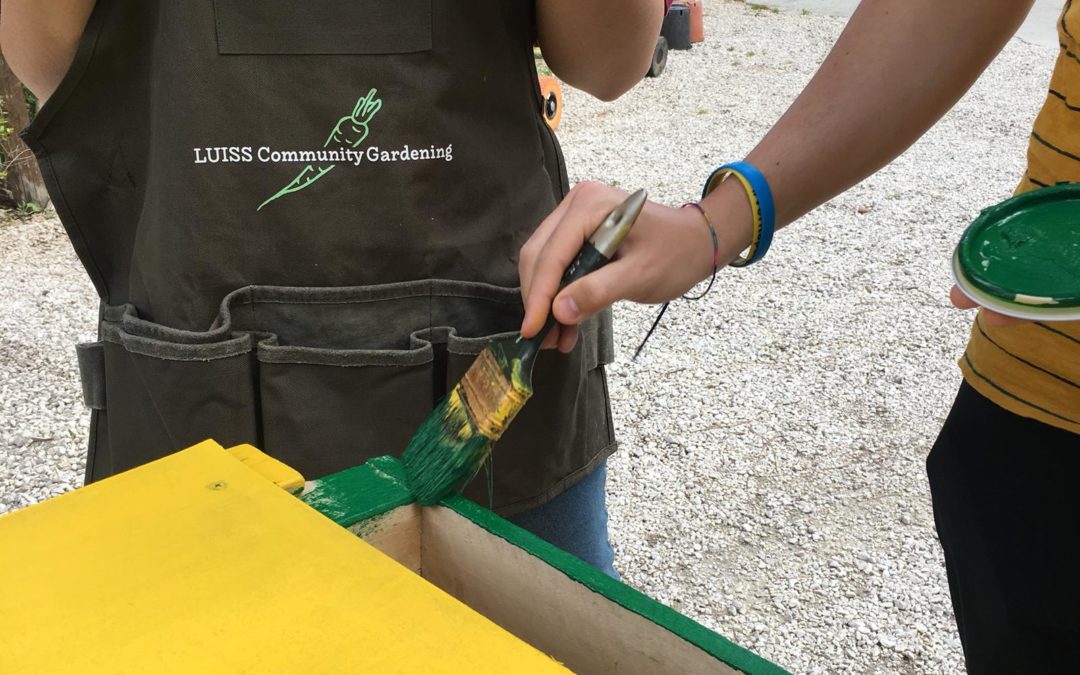
Save the date: next Saturday, 4th May 2019, Luiss University will host the last meeting of EDU@LabGov in Luiss Community Garden from 10 am to 12am.
In this occasion the LabGovers (students of the Urban Clinic of LabGov) will work to make the last adjustments to the prototype of the project that they have designed during these months. In particular, they will work on inserting the technological elements that respond to the challenges related to sustainable agriculture, energy, tech justice and many more. Furthermore, they will co-design the event in which they will present their ideas to the public!
This appointment will represent the last moment to put into practice definitively the topics they have discuss during this Urban Clinic of LabGov A.A 2018/2019.
As always, if you are interested in following their work, follow our official
social networks!
This is a very last moment before the final event.
The co-created
story of Jardim Nakamura neighbourhood
Image: Sofia Croso Mazzuco. The welcoming of Jardim Nakamura map showing the local context.
Jardim Nakamura is a peripheric community
in the city of São Paulo, in Jardim Ângela neighbourhood, and the lucky place
chosen for an urban signalling project that aims to tell the story of the territory
in order to bring a new sense of appropriation and belonging to the area. The
project called “Passeia, Jardim Nakamura”- which means “stroll, Jardim Nakamura”
– was developed by two NGO’s; SampaPé! (1), which promotes the appropriation of
the city through the genuine act of walking and occupying public spaces; and COURB
(2), which promotes the encounter between organizations that aim to strengthen
collaboration for development in the urban environment.
On a hands-on effort that occurred on
December 7 and 8, 2018 in the streets of the community, different people
participated on what is called mutirão
in Brazil (meaning bottom-up, collective action) to install three types of urban
signalling:
– the first one aiming to point directions
and walking distance to specific places within the area;
– the second one showing where people are
within the big community map;
– and the third one telling the history of
specific places (for example where the neighbourhood started or stories about
the local culture). (3)
The project clearly made it possible for
the neighbourhood to be reinserted in the history and territory of the city of
São Paulo in a different manner, since the acknowledgement that there are
stories worth being registered invites a different outlook towards Jardim
Nakamura. Children who live in the neighbourhood also participated in the
installation of the signalling through a treasure hunt game, where the finding
of a signalling spot was linked to the painting of that area with a project
symbol. Involving children in this activity aimed to help promote appropriation
of the place and the awareness of being a citizen and helping build the local
history.
The area already received many visitors before
the project was completed, for hosting a local community institution which is
an example of sustainability and circular economy – namely the institute Favela
da Paz (4), which explores different projects linked to local culture,
citizenship, music, clean energy production and the well known cooking project
Vegearte (5). This institute also partnered and gave support to the “Passeia,
Jardim Nakamura” project, for believing in the value it could bring to the
territory.
Image: Sofia Croso Mazzuco. Jardim Nakamura seen from above.
Besides the direct influence of the project
in the community, it has also contributed to the discussion of how telling the
story of a place through different lenses can help heal and bring new meaning
to a territory; something worth considering when understating the power urban
design has to influence the life of communities.
Image: Sofia Croso Mazzuco. One of the signalling showing the distance to interest places.
Save the date: next Saturday, 23rd March we will host the second EDU@LabGov community gardening session in Luiss Community Garden from 10 am to 13am.
The LabGovers will work in order to improve and complete the prototype of the platform that they are building. This session will represent a fundamental moment to practically apply what they have learnt during the first three modules in the classroom. This is not only a didactic moment, it is a collaborative practice that they will see to bud a project on which the LabGovers (students of the Urban Clinic of LabGov) are assiduously working and with passion. If you are interested in following their work, follow our official social networks!
The third workshop of the Urban Clinic EDU@LabGov 2019 took place on Friday the 15th of March into the Viale Romania Campus of LUISS University. The workshop has inaugurated the start of the third module of the course. The module was dedicated to “Urban Law and Policy”. Indeed, the Laboratory hosted three important experts on these themes: prof. Christian Fernando Iaione, lawyer Nico Moravia, and dr. Paola Marzi.
Prof.
Iaione, the scientific co-director of LabGov, teaches Urban Law and Policy and
Urbanistic Law at LUISS University.
Lawyer
Moravia is partner of the law firm Pavia-Ansaldo (administrative law department).
Dr. Paola
Marzi is an official of the municipality of Rome as Head of the office for the
Urban Gardens, and has a long experience on these themes since she has
participated in the drafting of the Regulation of Urban Gardens of Rome.
The
workshop was introduced by the speech of Prof. Iaione, who talked about his
experiences in the urban regeneration field. He exposed the project of
Co-Bologna (http://co-bologna.it/): the
program started 7 years ago and its effects were such as to spread his
principles in Italian cities like Turin, Rome and Reggio-Emilia, but also in
others parts of the world like New York, Amsterdam and Sao Paulo.
All these
experiences demonstrated how important is to rewrite administrative and
urbanistic legislation in order to face all the problems brought in the cities
by the changes of the third millennium. What is fundamental in this process is
the participative paradigm, that means involving as much as possible all the
different urban stakeholder in order to re-define the way of living the urban
centers.
Indeed, lawyer
Moravia showed how it worked in the roman context, by showing the case of the
Ex-Dogana: an un-used space, owned by Cassa Depositi e Prestiti, brought back
to life by the efforts of four young entrepreneurs. The cohesion of legal,
human and economics competences, made possible to find a new and simple
solution, like a temporary leasing contract, and create what now is one of the
most important experiences of this kind in Rome.
One of the
sectors where the participative paradigm is more successful and better applied
is the urban garden’s one. Dr. Marzi explained how gardens are the place where
it is possible to focus all the energies and differences of a neighborhood, not
only as a place where plants grow, but as an instrument of social inclusion,
that generates wellness and new solutions to co-live the city by building up new
forms of community.
Co-Working
The 3rd
Module of the Urban Clinic LabGov EDU 2019 continued with the Co-Working
session, held on March 16th. The co-working session is facilitated
by Chiara De Angelis, Friends of LabGov’s ex-president.
The
Co-Working session took place in the LUISS Campus of Viale Romania and it started
at 10 am with Pasquale Tedesco’s testimony, expert of Confagricoltura (http://www.confagricoltura.it/ita/).
He talked about
the importance of the relationship between Earth and Nature and the fortune to
enjoy some products that Earth offers.
After this
inspirational session, Chiara De Angelis explained the Labgovers service
design, an important passage to complete and improve the idea that they’re
developing during this A.A. of LabGov EDU. For this reason, the LabGovers were
divided into groups in order to select the “personas” (consumer type) of their
product/service, basing on their previous research.
In the afternoon, the LabGovers developed the user journey map to describe the possible experience consumers might have through the platform that they are developing.
Save the date: on 15th and 16th March will take place the third weekend of the EDU@LabGov Urban Clinic in Luiss Guido Carli University!
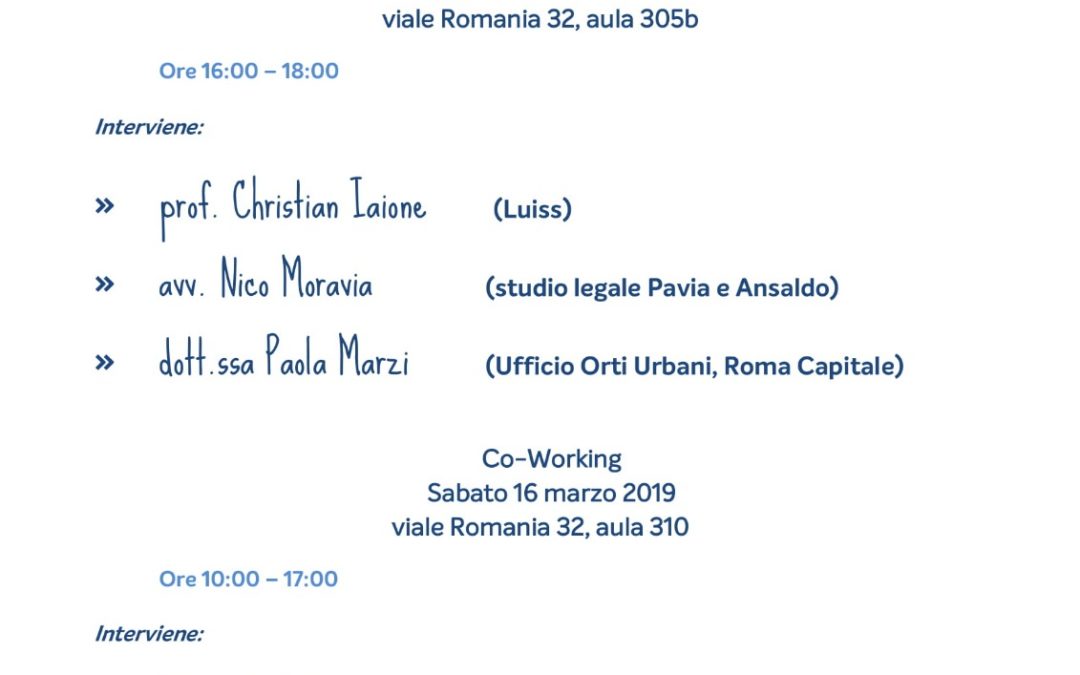
Friday 15th March from 16pm to 18pm in the Luiss Campus, we will host a lecture of professor Christian Iaione about Urban Law and Policy, and we will hear the testimony of lawyer Nico Maravia from law firm Pavia & Ansaldo and of the dr. Paola Marzi from the Municipality of Rome, who will speak about the Regulation on the urban gardens that she wrote for the Municipality of Rome.
Saturday 16th march from 10am to 17pm, will be held the third session of co-working. It will be divided into two part. First, we will hear Pasquale Tedesco’s experience: he is an expert in environmental sustainability, sustainable and synergic agriculture and in the field of urban and social gardens. In the second part of co-working the EDU LabGov team, thanks to the guide of Chiara De Angelis and Daniela Patti, we will speak about the process of design focusing on the user journey maps. In this way, the LabGovers will analyze all the passages of their project, they will answer to the needs of the ‘personas’ (the users object of their project) and they will define the various sections and the categories of contents of the platform that they are developing.
The next meetings are very important in order to complete and improve the
idea that it is taking form more and more.