The process of the Edu@LabGov Urban Clinic’s action on the city/university territory continues with the Community Gardening session which took place last Saturday the 9th of March 2019 in the LUISS Community Garden from 10 am to 12 am.
Labgovers, at
first divided into three groups, started working to the construction of three prototypes
of their project, using waste/recycled. Following the project’s idea elaborated
during the Co-Working sessions in class, and also thanks to the advices of agronomist
and botanist, dr. Barbara Invernizzi, the students completed the structure with
fruitful outcomes.
These two
hours of Community Gardening represented the starting point of a process of
collaborative action which aims to concretize the principles of sustainability
and circular economy which are central for the Urban Clinic. Nevertheless, the self-construction
Lab is still a fundamental collaboration-gym to understand the importance of
respecting the timeline in a project.
The project
is not over yet: others two meetings are scheduled in the LUISS Community
Garden, one for the 23th of March and one for the 27th of
April.
Stay tuned!
Gli appuntamenti della
Clinica Urbana EDU@LabGov continuano con la seconda sessione di Community
Gardening che si è svolta lo scorso sabato 9 marzo 2019, presso l’#OrtoLUISS,
dalle 10:00 alle 12:00.
I LabGovers, dapprima
suddivisi in tre gruppi, hanno iniziato a lavorare alla realizzazione di tre prototipi
creati attraverso il riuso di materiali destinati allo scarto. Seguendo l’idea
progettuale frutto delle sessioni di Co-Working in aula, ed i consigli dell’agronoma
e botanica Barbara Invernizzi, gli studenti hanno completato lo scheletro della
struttura con ottimi risultati.
I principi della
collaborazione, la sostenibilità e l’economia circolare giocano un ruolo
cardine negli appuntamenti di community Gardening nell’orto universitario della
Luiss. Il laboratorio di autocostruzione (che si svolge in parte degli
appuntamenti di Community Gardening) continua ad essere una palestra di
collaborazione essenziale anche per comprendere l’importanza del saper
rispettare i tempi di una progettualità (allenando alla lentezza), e al fine di
raggiungere obiettivi comuni.
Il lavoro giungerà a conclusione
nel giro delle due prossime sessioni di Community Gardening, previste per il 23
marzo e il 27 aprile.
Nowadays, we are witnessing an ever-changing[1] evolution of ordinary citizens’ position. Individuals and groups are no longer mere beneficiaries of administrative acts and procedures but – in a way – parts of them. In this very context, the regeneration of urban commons can be located, not only in renewal purposes, but as well in the involvement of city inhabitants. More specifically, urban regeneration is described[2] as «the recycling, transformation and innovation process of urban commons», contributing to promoting “urban creativity”, with the aim of ensuring and improving quality and accessibility.
Particularly, this writing wants to tackle the problem of “final use” of confiscated urban assets which are in a state of disrepair and neglect.
Before getting into the issue in question, it is necessary to clarify the meaning of confisca and “urban commons”.
In the Italian legal system, the antimafia confisca is a preventative property measure, introduced in 1965 and currently regulated by the so called Antimafia Code[3].
According to code provisions, in order to apply antimafia confisca two elements are required.
Starting
from the subjective element, the individual who acquires the relevant asset must
be recognized as “socially dangerous” at the moment of acquisition,
irrespective of whether such status ceases or the person dies.
There
are two objective elements: direct or indirect accessibility by the individual
to the asset and existence of sufficient evidence in relation to the unlawful
origin of the confiscated asset (such as the disproportion between the asset’s value
and the income declared by the individual for tax purposes, as established by
the legislator).
On the other hand, the “urban common assets” are generally defined[4] as «material, intangible and digital assets recognized by citizens and Public Administration as useful for individual and collective well-being.»
In the light of the foregoing, considering that confiscated assets are (usually) private assets which can be classified as “urban commons”, ordinary citizens’ involvement to administrative acts can be applied and procedures can play a role.
Pursuant to what discussed above, if it is true that private assets (both real estate and companies) can be classified as “urban commons”, the question is: Is it possible to apply the same art. 190, Codice dei contratti pubblici to confiscated assets so that they could be subject to the contract on social partnership and its procedure?
Art. 190, Codice dei contratti pubblici[5], introduced in the Italian legal system the so-called contract on social partnership, whose criteria and conditions can be defined by local authorities «on the basis of projects presented by individuals or groups as long as with regard to a specific territorial scope.»[6]
As clarified also by Antonella Manzione[7], the contract on social partnership provides for a call for tender where “a competition of ideas” occurs for the final use of common assets. It must be borne in mind, though, that this must happen within the limits established by the Italian Court of Auditors[8], which requires compliance with some elements previously identified by the local authority itself, such as the ratione personae scope.
More precisely, whereby there are “urban common assets” in a state of disrepair and neglect and the local authority intends to ensure their exploitation «through cultural initiatives, urban renewal, restoration and refurbishment for general interest objectives»,[9], it should issue a call for applications and then conclude the contract on social partnership.
Carlo Pezzullo
[1] In this connection, CHITI E., La rigenerazione di spazi e beni pubblici:
una nuova funzione amministrativa?, in DI LASCIO F., GIGLIONI F., La rigenerazione di beni e spazi urbani.
Contributi al diritto delle città, Il Mulino, Bologna, 2017.
[2] According to art. 2.1, Regolamento
del Comune di Bologna.
[3] The d. lgs. 159/2011 as reformed
by the Law 161/2017.
[4] According to art. 2.1, Regolamento
del Comune di Bologna.
[5] The d. lgs. 50/2016, as revisited
by d. lgs. 56/2017.
The Launch
of the National OFS Network and the Cosmopole
Project in Lille
On 15
and 16 November 2018 Sciences Po Lille hosted an event to celebrate the launch
of the French National Network of the Organismes
de Foncier Solidaire (OFS) and the signature of the first baux réel solidaire (BRS) between the recently
established OFS Metropole Lilloise
(OFSML) and the future residents of the project Cosmopole. The celebration occurred in the presence of the French
Ministry for Housing and Town Planning and was met with great enthusiasm by a
large audience of representatives of housing cooperatives and social housing
associations (HLM), regional and municipal housing delegates, and the
presidents of the seventeen OFS federated in the Network. The event also
brought together property developers, representatives of financial
institutions, such as the Crédit Foncier
and the Caisse de Depot, and
prominent figures of the French Conseil
Supérieur du Notariat.
Fig 1: Logo of the event, Métropole de Lille
Fig 1: Logo of the event Ó Métropole de
Lille
The
reason for this widespread interest and support by such a diverse range of
French housing stakeholders lies in the potentially far-reaching beneficial
effects that the OFS-BRS scheme may have on the French housing market in terms
of increasing its stock of permanently affordable housing, a mission which is
altogether similar to that of Community Land Trusts in the United States. We
have already described here the origins and the main features of
the CLT model and have presented here the
practical implementation of the model in the case of Dudley Street Neighbourhood Initiative,
where it has resulted in fostering long-term housing affordability and
revitalising the neighbourhood. We have also observed here that the
concept and features characterising the CLT model did not remain confined to
the United States but spread to several countries in Europe, including the
United Kingdom, Belgium, and France, urging serious reflections on the most
appropriate legal tools to adapt it in the different legal systems. In France, growing concerns over long-term
housing affordability have hit the political and legislative agenda during the
past five years and resulted in the legal
introduction of the OFS-BRS scheme, whose functioning is inspired by the
CLT model in the United States. Understanding how the OFS and BRS work together
in practice was the main focus of the several workshops held during the event
in Lille.
The first
element of the scheme, the Organisme
de foncier solidaires (OFS), was introduced by the Loi ALUR in 2014.
Article L329-1, Code de l’Urbanisme describes the OFS
as non-profit
organisms totally or partially devoted to the acquisition and the management of
improved or unimproved land, and whose main goal – as part of the broader
housing promotion strategy set out in article L301-1 of the Code de l’Urbanisme – is to provide affordable homes to be rented out or
sold to income-qualified persons. Two workshops during the event focused on the
most appropriate legal formats and the procedure for the implementation of OFS.
It emerged that the OFS may be set up by local and regional public
authorities or by private housing stakeholders as non-profit entities, such as fondations reconnues d’utilité publique,
sociétés anonymes de droit privé, groupements d’intérêt public, or as one of
the legal entities mentioned
in articles
L411-2 and L481-1 of the Code de la
Construction et de l’Habitation (CCH), and notably sociétés d’économie mixte de construction et de gestion de logements
sociaux or organismes HLM.Different legal formats may better work
in different local contexts and the choice may depend on the characteristics of
the particular housing project(s) envisaged and on the nature and number of the
stakeholders involved. However, identifiable common traits of the OFS are i)
their non-profit nature and ii) their capacity to permanently devote land to
affordable housing purposes. It should be also stressed that the OFS does not
represent a new legal format, but a status recognised to an already existing
legal entity. Indeed, according to articles R329-6 to R329-10 of the Code de l’Urbanisme, the OFS shall be
approved by the local Prefect on behalf of the State after verifying that all
the requirements established by the law are complied with. And the Prefect can
at any time revoke or suspend the OFS status if found that the OFS no longer
respects the conditions prescribed by the law or where it has contravened its
main obligations.
The event in
Lille also represented the opportunity to launch the Réseau
National des OFS: « Foncier Solidaire – France », which takes
inspiration from the UK and the United States National CLT
Networks. Seventeen OFS recently set up or under creation have gathered in the
Network with a view to support and promote the realisation of OFS-BRS projects.
According to its Charter, the Network aims to i) sharing experiences and
promote collaboration throughout the country, ii) put forward proposals to the
Government and to other housing stakeholders, iii) facilitate the connection
with new different forms of housing (eg habitat
participatif), and iv) ensure large-scale communication to the public and
foster the knowledge of the model. The Network may also involve other housing
stakeholders, which are not OFS, such as local authorities, social housing
promoters, financial institutions. In particular, the Fédération des Coopératives HLM and the National Association of the
Etablissements Publics Fonciers Locaux
have already decided to join this initiative.
How do the OFS work
in practice? Further workshops during the two-day event focused on the second
element of the BRS-OFS scheme, the bail réel solidaire (BRS), that is
the legal mechanism through which the OFS can realise housing affordability
goals. As para 3 of article L329-1 clarifies, the OFS-BRS scheme relies on a
split in the ownership of land and improvements: the OFS are set to retain
ownership of the land in perpetuity while homes built or renovated on the land are
sold or rented out to income-eligible purchasers. In this way, the price for purchasing
or renting homes is kept affordable to the extent that the cost of land is
borne by the OFS. To this purpose, a major legislative intervention in July
2016 devised a new type of contract for the lease of land, the BRS, specifically
tailored to be used by the OFS in furtherance of their mission. The BRS is regulated by articles L255-1 to L. 255-19 of the Code de la construction et de
l’habitation (CCH) and by the decree of the Conseil d’Etat n°
2017-1038. The BRS is modelled after the structure of
pre-existing types of ‘long leases’, notably the emphyteutic and the building
lease, and allows to separate interests in the property for up to 99 years.
However, some specific features make it the perfect instrument for the OFS to
achieve housing affordability goals. In particular, the law precisely sets
income-eligibility criteria for prospective occupants, strictly regulates their
ability to transfer their rights over OFS homes by way of sale or by will, and
grants the OFS a right of pre-emption in any case of resale; moreover, in case
of transfer of OFS homes, the law establishes that the price must comply with a
fixed formula which aims to limit speculation.
Thanks
to this enabling legislative framework and to the support of a vast range of
housing stakeholders, Lille Métropole
has set up its OFS in February 2017 (OFSML). The OFSML has been set up together with the Métropole Européenne de Lille (MEL), the Fondation de Lille, and the federation of real estate developers Nord Pas-de-Calais; other organisms,
notably Action Logement and the
regional HLM association, will be soon integrated in the board of directors of
the OFSML. In December 2017 the OFSML launched its first project, Cosmopole,
which offers a good practical illustration of how the OFS-BRS scheme works. The
different stages of the realisation of this project were presented during one
of the workshops and a visit to the site was arranged during the event.
Fig.2: Author’s picture of the Cosmopole site
Fig.3: Author’s picture of Cosmopole’s blueprint
The Cosmopole project is located on the site
of former university buildings in the city centre; the buildings were previously
owned by the municipality of Lille and then bought by the OFSML thanks to a
financial loan granted by the Caisse de
Dépôt. For the realisation of the project, the OFSML has worked in
partnership with a real estate developer (selected after a call for projects).
The OFSML first sold the whole site to the developer and, subsequently, the
developer sold back to the OFSML the land on which the 15 BRS homes were to be
built, against payment of a symbolic price[1].
At this point, the developer entered into a BRS contract (called BRS-Initial) with the OFSML and acquired
temporary ownership of future homes against payment of a peppercorn ground
rent; at the same time, the developer undertook the obligation to build the homes
and was granted the right to sell them according to the criteria already defined
by the OFSML.
Households
wanting to buy one of the homes have to i) comply with the eligibility criteria
and be approved by the OFSML; ii) enter into a contract with the developer (Vente en état futur d’achèvement, or VEFA) where all the terms (eg price,
income ceilings) are already set by the OFSML; and iii) simultaneously enter
into a 99-year BRS contract with the OFSML, called BRS-Utilisateur, against payment of a ground rent (eg 1euro/m2/month).
In this way, the households acquire ownership of the homes and become
leaseholders of the OFSML land upon which they are located. At the same time, as
the homes are sold by the developer the rights conferred to it via the BRS-Initial are withdrawn and, once the
last home is sold, the contract expires. And now, if the BRS households ever
want to sell their homes, they are bound by precise terms (set by the law and by
the OFSML itself) concerning the resale price and their rights; equally,
prospective purchasers will need to meet income eligibility criteria and be
approved by the OFSML in advance. However, new purchasers will not have to
enter into a new BRS with the OFSML, as they will substitute the former
occupants and the original BRS-utilisateur
will be automatically ‘recharged’ for another period of 99 years.
The Cosmopole project is in the latest
stages of its completion: the first contracts BRS-utilisateur were signed between the OFSML and the purchasers in
November 2018. According to the CEREMA’s report, the Cosmopole project is expected to be
completed in early 2019, while another project of the OFSML, Bourse du Travail, is under construction
and homes are expected to be ready in 2020. But the practical implementation of
the OFS-BRS scheme is not confined to Lille. As highlighted in other CEREMA’s reports, several
projects have been launched throughout the country by the OFS Rennes Métropoles, the OFS
Avignon, the Coopérative Foncière
Francilienne, the Foncière
Haute-Savoie, and by the COLs Foncier
Solidaire in Biarritz and in L’Espelette. Although each of these projects
is supported by several different housing stakeholders and may have slightly
different characteristics and targets, they all rely on the OFS-BRS scheme and
pursue the goal of increasing the stock of permanently affordable housing.
Fabiana Bettini
Hulme Postdoctoral Fellow in Land Law,
University of Oxford
[1] It should be
mentioned that the whole site measures 20,000 m2 and will host 210
housing units. Along with the 15 units available for purchase by low-income
households via the BRS scheme, the site will feature 49 social housing rental
units, 9 housing units for moderate-income households, and 54 units under the pret locatif social-usufruit locatif social
schemes (PLS-ULS). The site will also host 214 parking lots, a hotel, an art
gallery, and the English Cultural Centre.
LabGov, together with LUISS University, is part of the interdisciplinary consortium for the realization of the H2020 project “Open Heritage”.
Figure 1. Consortium partners at the end of the second consortium meeting, Barcelona. Credits to: Open Heritage team
As already analyzed in a previous article [1] and as can be seen from the name of the project, it is based on an open definition of culture and cultural heritage, according to which not only listed assets and historic buildings, but also all buildings, spaces and goods which have a symbolic or practical value for the local communities are considered cultural resources to preserve and valorize. The community dimension is one of the main pillars of the project, as well as resource and regional integration, and it is based on the definition of heritage community contained in the Article 2b of the Council of Europe Framework Convention on the Value of Cultural Heritage for Society (Faro, 27th October 2005) [2]. In the project, indeed, local communities, together with all the other actors part of the quintuple helix model (public institutions, businesses, social innovators, cognitive institutions) [3], are called to play an active and fundamental role in the regeneration and governance of cultural heritage.
Culture and cultural heritage, on the one hand, represent important tools to foster a local sustainable development and to create a more inclusive and fairer environment. On the other hand, a participatory governance of cultural resources, as also highlighted by the United Nations (2007), is one of the best strategies to boost social and economic development, due to the decisive contribution that participation makes in reinforcing democracy, empowering citizens and their social capital by guaranteeing more efficiency and equity through the community participation [4].
Second consortium meeting in Barcelona (28 – 29 November 2018)
The second consortium meeting has been hosted by Platoniq, one of the project partners, at La Fàbrica de Creació de Barcelona, an interesting example of urban regeneration. It was, indeed, an old industrial building which was abandoned at the end of the 70s and recovered in 2009 into a meeting and working point for all the artists of the city.
During these two full and inspiring days, partners have worked in group to co-design new governance and funding models for community-run heritage regeneration. It has been an important occasion to share the progresses of each WPs work and research, and to define together the solutions to the main challenges partners are facing in carrying out their research activities.
Figure 3 Working session during the 2nd consortium meeting, Barcelona. Credits to: Open Heritage team
The birth of the first neighborhood cooperative in Rome: the first important result of the Roman CHL
On the 19th of December 2018 the first neighborhood cooperative was born in Rome, more precisely in a complex urban area of the periphery of Rome composed by the neighborhoods of Alessandrino, Centocelle, and Torre Spaccata, characterized by the lowest human development index and the highest rates of poverty. It is the first important result among the activities conducted by the Roman Cooperative Heritage Lab, that LUISS – LabGov team is coordinating. It is also the result of an intense work conducted by LabGov, in collaboration with ENEA, within the wider project Co – Roma in order to create a smart collaborative district . Three main strands of work have been individuated by the cooperative: cultural activities and integrated tourism, circular economy, and collaborative neighborhood services. The cooperative, named CooperACTiva, is entirely managed by a group of active local citizens, and is aimed at offering more and better job opportunities and to overcome the digital, social and economic divide which strongly affects those areas.
Figure 4 The members of CooperACTiva, Rome. Credits to: Elena De Nictolis
[3] The model of the quintuple helix system of urban governance is available in C. Iaione, The Co-city, The American Journal of Economics and Sociology, 2016
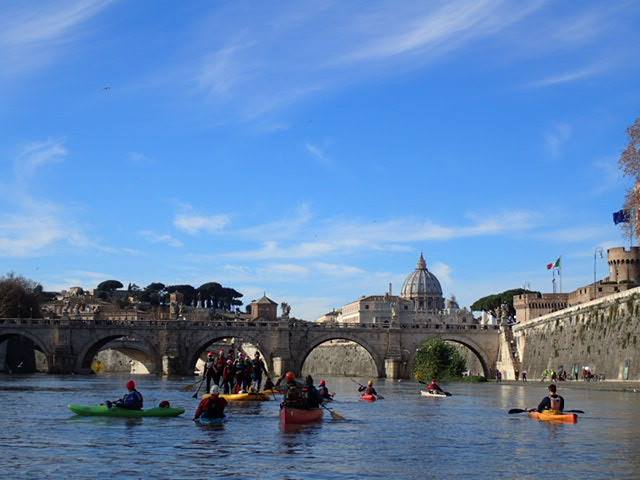
Agenda Tevere has started the procedure that will conduct to the creation of the first river’s contract dedicated to the Tiber in the urban area of Rome (the Contract will involve the area of the river that goes from Castel Giubileo – north part of the city – to the Foce – the final part of the river, in Fiumicino).
I have already analysed Agenda Tevere (hereinafter AT) and its genesis [1].
In this article I will focus on the tool that AT promotes and wants to apply to the roman river: the river’s contract. I will analyze the tool of the river’s contract and the benefits deriving from its creation, and then I will describe the procedure that AT (and the Committee for the promotion of the River’s Contract) is following in order to achieve this result and the actual state of the art of the abovementioned procedure.
The river’s contracts
The river’s contracts (hereinafter RC) are new tools based on the voluntary agreement between local authorities and privates as a form of negotiated and shared planning procedure[2]. This tool aims to the realization of a participated planning concertation and to the elaboration and implementation of water resources management [3]. The river’s contract is a tool specific for fluvial area’s recovery. It develops a path that leads to the definition of a contract and whose pillars are[4]:
sharing a clear objective;
signing an agreement among citizens (both civil society organizations and social innovators are involved in the definition of citizens), municipalities (public administrations), privates and the other partners involved;
finding sponsor who are available to fund the actions in order to reach the set objective.
This tool is born in France in the ‘80s of the twentieth century (the first RC – Contrat de Rivière was signed in 1983[5]). The creation of the RCs was promoted also by the EU (by the European Parliament and the Council), that sanctioned the Water Framework Directive, in which was provided a framework for the implementation of integrated policies for water resources management[6]. This document promotes the start of processes for citizens’ consultation and active participation.
The Italian experience
In Italy the first RCs were sanctioned in the first years of 2000. In 2003 the General Management for Water Resources and Public Utility Services of Lombardy Region started the procedure for the signing of the RC of River Olona’s basin. From that moment other RCs were started for many rivers of the Region. Then the Lombardy Region was emulated by other regions of Northern Italy, first of all by the Piedmont Region (that in 2007 started thinking the RCs as a possible way to implement the Water Protection Plan), and then by many others.
In Italy the RC is defined as an agreement between subjects that have competence in the management (and the use of) the water resources, in territorial planning and in the environmental protection. The process generated by the RC has a strong impact on the management and care of the water resources and the territory surrounding the rivers, contributes to hydraulic risks prevention and to the local development. This tool aims to achieve the objectives established in the European framework of the EU Water Framework Directive (2000/60/CE)[7] and of the Directive on the assessment and management of flood risks (2007/60/CE)[8].
coordinating public intervention by the several institutional levels;
rationalizing and integrating public resources;
stimulating and boosting private investments.
At the national level, in 2007 was created the first Italian “National Table of the River’s Contracts”, in a period in which the diffusion was limited to the Northern regions. In 2010 was adopted a National Chart of the River’s Contracts” and in 2017 the Italian Ministry of the Environment created a “National Observatory of the River’s Contracts”.
RCs and Co-governance
The RC is based on the principles of horizontal and vertical subsidiarity and promotes Co-governance processes. In facts the RCs often involve the five actors of the quintuple helix model[10]. In this process of urban governance are involved: 1) active citizens, commoners, social innovators, city makers, local communities; 2) public authorities; 3) private actors (national or local businesses; small and medium enterprises; social business); 4) civil society organizations and NGOs; 5) knowledge institutions (schools and universities).
Those five actors are well represented in the case taken into consideration in this article, the one of the Tiber’ RC.
credits to: Paola Verdinelli, President of Agenda Tevere
The procedure for the Tiber’ RC
Agenda Tevere (AT) has promoted the creation of the Committee of the RC’ promoters and the drafting of the Declaration of Intent that has started the procedure that will conduct to the RC for the Tiber in the urban area of Rome. The procedure started on 28th June 2017. On 29th November 2017 the Lazio regional authority gave its official assent to the start of the procedure.
I will now briefly describe the meetings of the Committee of the RC’ promoters:
the first meeting was hosted on the 20th December 2017 by the Rome municipality, the Campidoglio, and represented a crucial turning point for AT and for the Committee of the RC’ promoters. It represented the official starting point of the procedure and a moment of public dissemination of the expected results and the state of the art of the Tiber. This was an important moment because it included the Tiber in the governmental agenda and allowed the inhabitants of Rome to know the ongoing process.
Credits to: Alessandro Antonelli, author of the article
the second meeting took place on the 30th January 2018. During this meeting the promoters have defined and formalized the structure and the governance rules of the procedure for the RC. AT has proposed to the Committee a governance structure that foresees the creation of an Inter Institutional Committee and a Technical Secretariat. The Committee of the RC promoters ratified this proposal. This meeting intended to let the work of the Committee begin. It has been successful in defining the governance scheme of the procedure.
Credits to: Alessandro Antonelli, author of the article, and Paola Cannavò, member of the Agenda Tevere Board of Directors
the third meeting took place on 19th March 2018. The agenda of the meeting included: the analysis of the programmatic decision in which were listed the priorities and objectives of the first working phase of the procedure; the formulation of the proposal of hypothesis for the creation of the working groups that had to implement the actions and to achieve the results expected during this first phase. During this meeting was underlined the importance of coordinating this RC with the others of the Lazio region. It was also proposed the drafting of a programmatic decision.
Credits to: Alessandro Antonelli, author of the article
the fourth meeting of the Committee of the RC’ Promoters was held on the 9th July 2018. During this meeting the pillars of the Programmatic Document were discussed and amended by the Promoters. The approval of this document was important in order to define the roadmap of the procedure that will bring the Committee to the drafting of the RC. The steps enounced in the document are: the creation of the governance organisms (already discussed and approved during the meeting held on the 30th January 2018), the phase of data survey (in which the Committee has to identify the potential and the criticality of the area taken into account by the RC, by examining the existing data), the consequent definition of the strategy at the basis of the action plan. The procedure was at that point in the phase prior to the survey phase.
Credits to: Alessandro Antonelli, author of the article
the fifth meeting was held on the 9th November 2018 in the offices made available by the Rome Municipality for the RC. During this appointment the composition of the two governance bodies, the Inter Institutional Committee and the Technical Secretariat, was defined. LabGov.City – LABoratory for the GOVernance of the city as a commons was appointed as one of the members of the Inter Institutional Committee. Professor Christian Iaione, scientific co-director of LabGov, was appointed as the coordinator of one of the working tables of the Technical Secretariat, the one that will develop the Governance model of the projects that will start along the banks of the Tiber. This meeting was very important because it marked the real start of the working phase.
Credits to: Alessandro Ricca, Secretary of Agenda Tevere
Inter Institutional Committee:
the first meeting of the Inter Institutional Committee was held on 7th December 2018 in the headquarter of the municipality of Fiumicino. The Committee ratified the internal Rules of Procedure and defined the calendar of meetings, in line with the one of the Technical Secretariat. Paola Cannavò, member of the Board of Directors of AT, of the Scientific Committee of LabGov and of the Co-Roma working team, as the coordinator of the Technical Secretariat, reported the results of the first meeting of the Secretariat, in which had been scheduled the timelines of the Secretariat work plan and the connected objectives. The Committee ratified the proposals of the Secretariat.
Credits to: Alessandro Antonelli, author of the article
Technical Secretariat:
the first meeting of the Secretariat took place on the 20th November 2018. During this appointment the Secretariat defined the timelines and the connected objectives. The Secretariat also defined the thematic issues of the various working groups composing the structure and identified the coordinators for each working group.
The second meeting was held on 7th December 2018. During this meeting each working group presented the objectives and members of the w.g. itself.
The third meeting was held on 11th January 2019. During this meeting each group presented the documentation available for each issue and the work plan.
Dissemination
AT has narrated the ongoing process on public occasions, such as for example during the meeting organized in Fiumicino (the Municipality near Rome that is involved in the procedure and is signatory oh the Declaration of intent for the RC of the Tiber) and held on the 4th June 2018, or in occasion of the first Conference of the National Observatory of the RCs.
AT has also narrated the ongoing process and the tool of the RC to the academic community and the university. An example is given by the workshop organized by EDU@LabGov, the non-formal educational platform based on the model of the in-house clinic organized by LabGov at LUISS University of Rome[11]. The workshop, that took place on 17th November 2018, was entirely dedicated to the narration of what AT was doing at the time, to the state of the Tiber (and of the whole city of Rome) and to the RC[12].
The procedure that will bring to the conclusion of the RC for the Tiber will be composed by two phases.
The first phase will be a data survey (based on the existing data on the state of the river). During this phase each working group composing the Technical Secretariat will study the available data and identify the criticalities. Action guidelines will also be defined. Finally, the Technical Secretariat will identify a place of experimentation along the riverbanks, where to launch a pilot project.
During the second phase the working groups will define a common strategy and a series of pilot projects that will be included in the first three-year Action Plan.
LabGov coordinates the working group which focuses on the governance model of the projects that will be launched on the floodplains of the Tiber. If you are interested in contributing to this working group you can contact me at: alessandro.antonelli@labgov.it or staff@labgov.it .
[3] S. Guerra, Disputed or Shared Territory? The Italian Experience of River Contract: New Relationship between River and its Region, Planum – The Journal of Urbanism, 2012.
[4] The following list is provided in S. Guerra, 2012.
[9] The following list was extrapolated by S. Guerra, 2012.
[10] The model of the quintuple helix system of urban governance is available in C. Iaione, The Co-city, The American Journal of Economics and Sociology, 2016