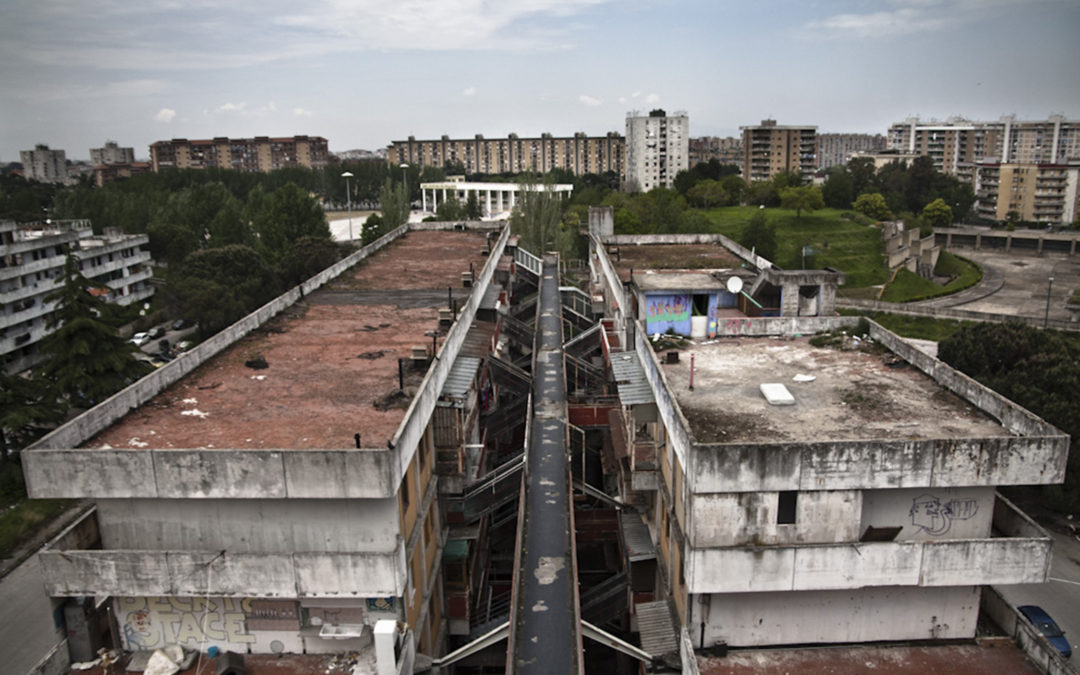
In fact, among the difficulties faced by the various urban contexts, there is the one concerning poverty.
This article, written after the seminar on 11 October 2018, during the European Week of Regions and Cities, quotes as an example the six cities Barcelona, Birmingham, Lille, Nantes, Pozzuoli, Turin, which participate in the first call for proposals on the theme of urban poverty and which are adopting, with the support of UIA, innovative solutions to tackle this problem.
One of the most interesting aspects that emerges from the article is the one concerning the Public-private-community partnerships. In these particular types of partnership there is a more specific focus on what concerns the local foundation and the local development. In fact, the various target groups have been involved in the projects since the beginning.
A good example of how the Public-private-community partnerships can be particularly effective in combating the poverty is in the Co-city project from Turin where the municipality collaborates in the governance of the Commons with the various local associations and residents through the “Pacts of collaboration “. These are described by Christian Iaione, professor at Luiss Guido Carli and expert of the Co-City project, as “legal tool through which the forms of cooperation between city inhabitants and the City administration address urban poverty through an urban commons-based approach i.e. stimulating collective use, management, ownership of urban assets, services, the way infrastructure is implemented”.
Chiara Prevete (LabGov researcher and legal team) has published an article about foreigners’ access to public management on the journal “Observatory of the Italian Association of Constitutional Law scholars”, “Osservatorio AIC”[1]. This question had a key turning point with the Plenary Session of the Italian Council of State decision in June 2018. The question refers in particular to museum directors. In this respect, changes have been recently made in the legal framework by Minister Franceschini’s reform (legislative decree 31 May 2014, No. 83). The heart of the sentence is linked to the well-known question about the ‘reservation of citizenship’ connected to the nature and functions of public management in the Italian legal system. In fact, this issue refers to the Nineteenth Century distinction between ‘acts of imperio’, the expression of the puissance publique, and iure gestionis (the private, merchant-like, commercial acts of the government of a state), where the possession of Italian citizenship is traditionally necessary for the exercise of public functions. The case law moves in particular from a hermeneutic diatribe on 1994 rule, the D.P.C.M. 7 February 1994, n. 174, which provides the exclusion for people without Italian citizenship from managers of public administrations roles. However, this topic can only be tackled considering the European principle of freedom of movement for workers, by art. 45 T.F.U.E. and its interpretation by the European Court of Justice.
The Author in particular emphasizes the role of museums’ immaterial and digital resources. In this way the Italian cultural heritage was opened for foreign museum directors. Above all, the administrative decision contributes to social development and the integration of different cultures according to art. 1 of the Faro Convention[2]. Indeed, also the concept of ‘Nation’, by art. 9 of the Italian Constitution, peacefully referred to the Community-State and not to the State-Apparatus, is nowadays interpreted as a ‘heritage clause’. As clarified by Häberle[3], the concept of an identity and inheritance clause is identified as ‘a characteristic element of developing countries’. He has highlighted the fact that the link to the cultural heritage would be unsuccessful if only the status quo is guaranteed and not the aspect of the multiplicity of past and future cultures. In this sense the term ‘Nation’, in the second paragraph of art. 9 of the Constitution, alludes to an ‘intergenerational pact’ or ‘synthesis of past, present and future generations’. Furthermore, this judgment demonstrates the importance of the judges’ interpretation also in civil law. In this sense, the legal system seems more authentic[4] because it observes changes in society.
[3] P. Häberle, Potere Costituente (teoria generale), in Enc. Giur. Treccani, IX, 2000, 32.
[4] P. Grossi, Le comunità intermedie tra moderno e post-moderno, Genova, 2017, 66.
—-
La complessa vicenda sull’accesso degli stranieri alla dirigenza pubblica trova un importante punto di svolta nella pronuncia dell’Adunanza Plenaria del giugno 2018. La questione affrontata si riferisce segnatamente ai direttori dei musei, la cui disciplina è stata di recente oggetto della riforma c.d. Franceschini, di cui al d.l. n. 31 maggio 2014, n. 83, attuata con numerosi decreti. Il cuore della controversia dinanzi all’Adunanza Plenaria è legato alla oramai nota questione sulla ‘riserva di cittadinanza’ connessa alla natura e alle funzioni della dirigenza pubblica nell’ordinamento italiano. Si legge nella sentenza, infatti, il richiamo all’ottocentesca distinzione tra atti di imperio, espressione questi della puissance publique, e atti di gestione, ove per l’esercizio dei primi è tradizionalmente necessario il possesso della cittadinanza italiana. La vicenda processuale muove in particolare da una diatriba ermeneutica su una disposizione del 1994, il D.P.C.M. 7 febbraio 1994, n. 174, la quale prevede l’esclusione dai posti dirigenziali delle amministrazioni pubbliche di soggetti privi della cittadinanza italiana.
LabGov wishes you a wonderful holiday season with a non-exhaustive list of movies and documentaries, old and new, that will make your holidays more entertaining!
The list below does not follow an order and is the result of various consultations with friends and colleagues, if you wish to send us some suggestions, don’t hesitate to contact us on FB or twitter!
This week LabGov will be releasing the first section of the Co-Cities Open Book, a publication that is the result of years of research and experimentations on the field to investigate new forms of collaborative city-making that is pushing urban areas towards new frontiers of participatory urban governance, inclusive economic growth and social innovation. .
This open book has roots in our conceptualization of the ‘City as a Commons,’ the emerging academic field of urban commons studies, and the work developed in 5 years of remarkable urban experimentations in Italy and around the world [1]. Structured around three main pillars, the Co-Cities open book will first provide scholars, practitioners and policy-makers with an overview of the theory and methodology of the Co-City with the “Co-Cities Protocol”.
The open book also presents the “Co-Cities report”, the results of an extensive research project in which we extracted from, and measured the existence of, Co-City design principles in a database of 400+ case studies in 130+ cities around the world. Ultimately, thanks to the Co-cities report we were able to create the first index able to measure how cities are implementing the right to the city through co-governance. Thus, the Co-Cities index serves as a fundamental tool for the international community in order to measure the implementation of some of the objectives that have been set by the New Urban Agenda and the Sustainable Development Goals.
The last section of the book presents a collection, or annex, of articles of some of the most important researchers and practitioners studying the urban commons. These essays were conceived and offered as part of “The City as a Commons” conference, the first IASC (International Association for the Study of the Commons) conference on urban commons, co-chaired by Christian Iaione and Sheila Foster that took place in Bologna on November 6 and 7, 2015.
Don’t miss the publications of the Co-Cities Open Book sections on our website and social media pages in the coming weeks. A complete version of the open book, downloadable from our website, will be available at the beginning of January on our website.
[1] The theoretical background and literature of this project, and the conceptual pillars of the Co-City are based on the analytical framework developed in the following publications: Sheila Foster, The City as an Ecological Space: Social Capital and Urban Land Use, 82 Notre Dame L. Rev. 527 (2006-2007); Sheila Foster, Collective action and the Urban Commons, 58 Notre Dame L. Rev 57; Christian Iaione, Governing the Urban Commons, 1 It. J. pub. l. 170 (2015); Christian Iaione, The CO-city, 75 The American Journal of Economics and sociology, 2 (2016); Sheila Foster & Christian Iaione, The City as a Commons, 34 yale l. & pol’y rev 81 (2016); Christian Iaione, The Law and Policy of Pooling in the city, Fordham Urban Law Journal 34:2 (2016) and Sheila Foster & Christian Iaione, Ostrom in the City: design principles for the urban commons, The Nature of cities, https://www.thenatureofcities.com/2017/08/20/ostrom-city-design-principles-urban-commons/. (20 August 2017).
The Open Heritage Second Consortium Meeting will be held on the 28th and 29th of November. Open Heritage is an Horizon 2020 research project that identifies and analyses good practices of adaptive heritage re-use, and tests them in selected Cooperative Heritage Labs in six European cities. Open Heritage is formed by a consortium composed of research institutions, universities, financial organisations, developers and community involvement experts that studies existing policies and legal frameworks, development procedures, multi-stakeholder cooperations, crowdsourcing mechanisms, financial instruments and shared management formats. LUISS is a partner of the Open Heritage project, working on both the comparative analysis of observatory case studies and on field experimentation, with the Rome Collaboratory (Centocelle; Alessandrino; Torre Spaccata).
During the two day Consortium meeting the partners will share the progresses of their research and work together on the challenges. During the meeting there will also be a way to talk about Work Package 2, where LUISS is task leader of the comparative analysis of 16 comparative case studies (the “Observatory Cases”). This analysis will be very useful to provide new ideas for the six CHLs, the six Cooperative Heritage Labs where the governance model for the adaptive heritage reuse will be tested. One of the CHL will be carried out by LUISS, the “Rome collaboratory” which will work on the footsteps of the Co-Rome process and develop a sustainability mechanism for innovative adaptive re-use of cultural heritage.
Among others, the Consortium will be attended by: Ania Rok and Iryna Novak (ICLEI), Beitske Boonstra and Karim van Knippenberg (UGENT), Heike Overmann and Markus Kip (UBER), Sofia Dyak (Center for Urban History), Hanna Szemző and Andrea Tönkő (MRI), Loes Veldpaus, John Pendlebury (UNEW), Levente Polyák, and Daniela Patti (EUTROPIAN). Representing LUISS Dr. Benedetta Gillio and Professor Christian Iaione will participate to the meeting.