by Stefano Speranza | Jun 13, 2014 | The Urban Media Lab
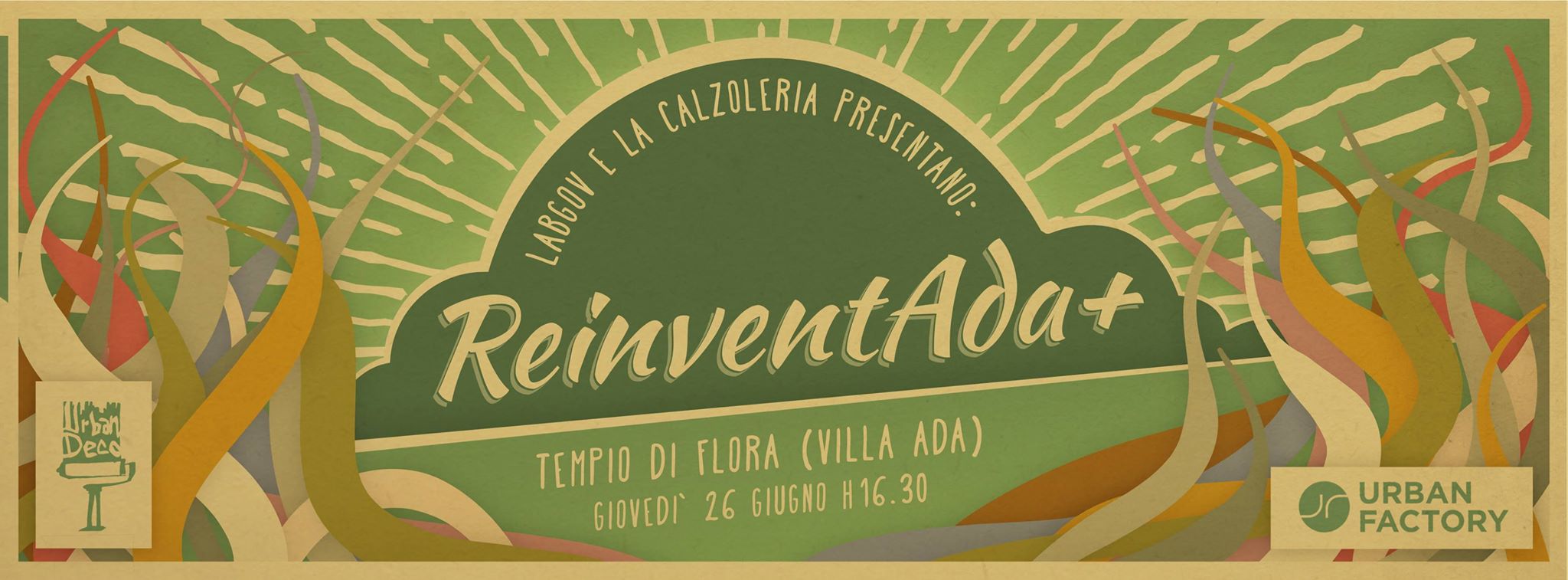
 The next June 26th, 2014 at the Temple of Flora in Rome will be held ReinventAda+, an opportunity of shared regeneration organized by LabGov in the wake of the highly successful ReinventAda, held in October 2013 together with La Calzoleria, club of social and cultural promotion.
LabGov considers as handbook and benchmark the Regulation adopted by the Municipality of Bologna on the “Cooperation among citizens and administration for the care and the regeneration of urban commons” and the urban commons at issue is the Temple of Flora which is in the wonderful park of Villa Ada, in Rome.
The Labgovers will symbolically repossess the Temple on June 26th, for a second edition of shared regeneration that, this time, will also see the presence of artists to animate the event.
In fact, during the first edition of ReinventAda, held on October the 25th, 2013, the Labgovers have cleaned up and restored the Temple and its surrounding area that, despite the restoration works made over the years, were in a state of degradation and abandonment.
During that memorable day it was shown that thanks to the cooperation of the local Administration (the Councillors of the City of Rome Flavia Barca and Estella Marino were actually attending the event) the people willing to roll up their sleeves can easily do it and take care of those urban commons which the Administration often loses sight of.
After eight months, however, the writers (the ones who only soil, not the artists), the waste and the dry leaves are back together with the abandonment, so the Temple of Flora is back to seem an old ruin left alone. But the Labgovers do not accept this situation and they have decided to persist and continue to work actively on the territory.
Thus, on June the 26th will be held ReinventAda+, the second edition of the first ReinventAda event that this time will not only consider the cleaning of the Temple but also moments of entertainment, called “Intimismi”, with music, reading and an exhibition of live painting made by Urban Decoarations. LabGov intends to contribute to the construction of a steering committee that aggregates the various associations, institutional entities, as well as civic and business subjects interested in achieving cultural and amusement activities to enhance the Temple of Flora and restore its former function of meeting place and cultural exchange. For this reason will be presented a Pact of Collaboration to ensure that the Temple of Flora will soon become a meeting and interest place for the local community.
Here the programme of ReinventAda+:
h 2:00 pm – Start of the activities
- Setting up and Regeneration of the Temple of Flora
h 4:30 pm – Arrivals of guests
h 5:00 pm – “A proposal for the shared Governance of Villa Ada”
- Opening greeting from LabGov
- Presentation of the Pact of Collaboration
- Presentation of the Handbook for the Placemaking
- Reading by Professor Sebastiano Maffettone
h 5.00 pm Live painting by Lorenzo Properzi of Urban Decorations
h 5:30 pm – Cultural entertainment “Intimismi”
- Music provided by La Calzoleria with:
- Marcello e il mio amico Tommaso
- Luca Bertelli
h 7: 30pm – End of the activities
For LabGov Group
Stefano Speranza

by Edoardo De Stefani | Jun 5, 2014 | The Urban Media Lab
 In the wake of the event that took place on 4th of June 2014 at Luiss Guido Carli University in Rome “Responsabilità, sostenibilità e innovazione sociale: quale futuro? Il salone della CSR e responsabilità sociale” organized by NeXt Nuova Economia per Tutti, we seek to elaborate the node of social responsibility in light of the participants ‘perspective, including the author’s.
The aim of the workshop was to conceptualize the collaboration as a means to enhance the value of the business chain and to appraise the principles of corporate ethics and cooperative partnership, which stems from a bottom-up innovation.
Developing a network of cooperation and collaboration among citizens, enterprises and public administration (PA) is the first step for defining new roles in the civic society and to demarcate the power of active citizenship on the territory.
The issue of CRS (corporate social responsibility) is crucial and represents the core of the debate since the era of post-capitalism is demanding for a more inclusive growth and for a social enrichment, in light of the promotion of social quality as the new reference-index for business value.
Trustiness toward PA and enterprises is directly linked to CSR policies and the ability to instill a social profit within the framework of institutional debate, could enable the neural activation of the real centers of sustainability, namely cities and citizens.
The social renewal is path-dependent from collaborative processes and from the active sharing of competences and interests through practices of co-working and digital networking, which should bridge knowledge and information to the various poles of participation.
The new paradigm of sustainability shall be recalibrated under the umbrella of a welcoming ecosystem, which should streamline bureaucratic procedures in favor of new agile forms of sharing economy.
It is very important to create and foster communities, as well as to consider the importance of social ties among citizens and civic society as the direct incarnation of a collective assumption of responsibility. Empirical data are showing a growing attitude in developing and applying cooperative models of participation to social, cultural and economic processes. The bottom-up approach could in this sense represent the materialization of the identity of a given society.
The social exclusion is against the necessity to replicate a model of isomorphism at the level of enterprises; the perception is that we need to promote a value of adherence between the business processes, the functioning of the PA and the participation of stakeholders, including consumers: the lines of leadership and the relationships among relevant actors shall be arranged upon a comprehensive system of values that reflect social needs and sensations.
Building up a CSR innovation means to mirror the stakeholders’ interests in view of a pact of social collaboration and cooperative project management, to be intended in the broad sense of territorial inclusion.
Several companies are nowadays committed to an integrated CSR strategy and more importantly, is far more prominent the widespread tendency of investors to commit themselves to actions of social responsibility (SRI: social responsible investors).
Finally, the scope of CSR policies is to foster the creation of a shared value (CSV) and to pursue a new mode of understanding among different generations and civic roles. The virtue of partnership is the new reference for creating an added value, as a double-layered sword that could cut the inefficiencies of economy and society.
We are ready to change as representatives of both the world of the academia and enterprises, but a third pole for triangulation is necessary. In light of this necessity, our hope is to launch the challenge of responsibility to the institutional actors; a wind of change is already blowing.
by Giulia Spinaci | May 22, 2014 | The Urban Media Lab
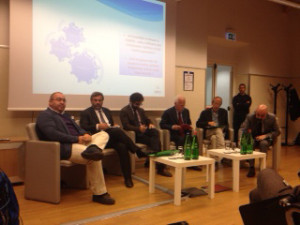 On May 19th 2014, LabGov – Laboratory for the Governance of the commons organized the event “Coltiviamoci” at LUISS Guido Carli University in Rome. In organizing such a meeting, LabGov had the aim to present both the results achieved in the 2013/2014 academic year and the focus of the laboratory for the 2014/2015 session, namely the governance of the environmental commons. However, the event was also an occasion for a panel discussion, as LabGov had the pleasure to host prestigious speakers: Giovanni Lo Storto, LUISS Guido Carli CEO; Carmelo Troccoli, the National Secretary of Coldiretti Giovani Impresa; Luca D’Eusebio from the association Zappata Romana; Albino Ruberti, Managing Director and President of Zètema Progetto Cultura s.r.l. and coordinator of the working group Lazio Expo 2015. Professor Christian Iaione and Professor Gregorio Arena (Labsus) participated at the conference as LabGov founders and promoters.
Four neo-LabGovers, Marina Bassi, Edoardo De Stefani, Federica Maranesi and Leonardo Rossi made an introductive speech and presented the video that has been realized by the LabGovers in collaboration with Doctor Morello and Doctor Sbordoni from Officine GM. The video perfectly expressed the spirit of LabGov: youth, participation, training, and social innovation. Then, they spoke about the goals achieved during this academic year, which are impressive: ReinventAda, ReinventAda + and Human Ecosystem.
ReinventAda consisted in the regeneration of the Flora’s temple in Villa Ada’s park, which took place in October 2013. In that occasion, the LabGovers wanted to create a new form of governance of the commons and for this reason, they decided to practically take care of this site, by giving it new life through a restoration activity, under the supervision of the “Sovrintendenza Capitolina”. It is still an ongoing project and in fact, on June 26th 2014, LabGov will launch the second edition of the event: ReinventAda +. This year, LabGov will be the promoter of a memorandum of understanding open to all those associations willing to take care of Villa Ada, thanks to the model provided by the Bologna’ regulation about the collaboration between citizens and public administration for the cure and regeneration of the urban commons. The translation in English of the latter has been another goal achieved by LabGov 2014 and it will be an important documentation source for all foreigners who have already demonstrated a genuine interest in the LabGov project.
Nevertheless, the most important project that LabGov had the honour to carry out during the last semester has been “Human Ecosystems”. The latter is a new technology that qualitatively and quantitatively measures all information that human beings produce in the main social media and gives us back the real time geography of our relations, ideas and conversations in the form of an ever-changing map. In strict collaboration with the creators of this device, Salvatore Iaconesi and Oriana Persico, and with Roma Capitale, the LabGovers wrote a European project in response to a Horizon 2020 call for proposal.
All participants to the conference positively welcomed these results and after this brief introduction, the conversation with the host speakers began. The conversation revolved around the themes of Expo 2015, which perfectly coincide with those on which LabGov is based. In particular, since LabGov focus of the 2014/2015 academic year will be the environmental commons, the LabGovers asked the host speakers to meditate on possible solutions to the problem of a healthy, secure and sustainable global sustenance and on LabGov proposal of the vegetable garden sharing.
Giovanni Lo Storto, LUISS Guido Carli CEO, expressed his enthusiasm for the goals LabGov achieved during the last academic year. He was fundamental in LabGov creation and without his support, such a great success would not have been even possible. He underlined that the natural resources are finite and that we should welcome this situation as an opportunity for the best energies of the society to create new forms of governance for the commons. Even if he could no longer participate to the conference for institutional reasons, he finally praised the choice of the word “Coltiviamoci” which implies a collective commitment towards a common goal.
Carmelo Troccoli, the National Secretary of Coldiretti Giovani Impresa, picked up the baton and continued the discussion. He praised LUISS Guido Carli University for its commitment towards such important and living matters. He gave a picture of the Italian agriculture, showing how it is one of the most competitive in the world. In fact, even though the country has never invested in new technologies or in the GMOs, it has experimented different innovations, which mainly derive from the capacity to be creative. In Italy, a new development method was born, centred on the concept of diversity and for this reason, the successful idea of “smart territories” was launched.
Luca D’Eusebio, instead, told the experience of an informal association: Zappata Romana. Unconsciously, more than 40 voluntary associations of citizens over time have decided to take care of abandoned gardens and have promoted their regeneration. In this context, Zappata Romana created an on-line map of all these experiences and for the first time, the involved associations could communicate with each other. In addition, Zappata Romana gathered all the success stories in a single Handbook, which has been published on the internet. Nevertheless, Luca D’Eusebio admitted that none of these experiences collaborated with the public administration and consequently, some of them followed a regulation process, which in the case of the XI Municipality of Rome has brought the approval of a Municipal regulation for the governance of the vegetable garden sharing.
Finally, Albino Ruberti, Managing Director and President of Zètema Progetto Cultura s.r.l. and coordinator of the working group Lazio Expo 2015, intervened in the debate. He argued that the experience of the Lazio Region in Expo 2015 has superseded the classic hierarchical method in favour of a universal representation of all trade associations of the territory, with the aim of highlighting the excellence it has reached. Since the Lazio Region will enjoy a prominent position for the whole duration of Expo 2015, the latter represents the perfect opportunity to create long-term paths and to promote sustainability, cultural and tourism valorisation, the international dimension of local enterprises and new start-ups. Moreover, the institutions chose 8 macro-themes that constitute the fundamental prerequisites in order to select the experiences that will presented: the relationship between food and tourism; water; the city-country cleavage; sustainable nutrition; the relationship between genius and innovation; food products; the productive chain of the gastronomic itineraries; centrality of the city of Rome.
In the end, Professor Gregorio Arena (Labsus) and Professor Christian Iaione made the final remarks. In particular, the former informed the audience that the same day, the Bologna’s regulation has been finally approved by a large majority and suggested a reflection on the concept of “sharing”, on which a society should lay its foundations, together with the values of autonomy, trust, responsibility, reputation and transparency. Both professors hope for a radical change of the governance and while thanking all speakers for their participation, they distributed the certificate of attendance to all neo-LabGovers.
“Coltiviamoci” has been an interesting and amazing opportunity to share values and success stories and to lay the foundations of the 2014/2015 LabGov edition. Join LabGov II edition and you will do the most formative experience ever!

by Alessandra Feola | May 18, 2014 | EducationLabs, Luiss LabGov 2013-2014

LuissLab
MEETING MINUTES 9TH MAY 2014
Katia Ballacchino, professor and anthropologist held the meeting about the theme of Intangible Cultural Heritage and Community. Specifically, an attempt was made to discuss ‘an anthropological analysis of the recent conventions starting from ethnographic case studies – a research methodology that provides technological activity by the individual’. This analysis passes through eight years of study. These years proved to be crucial for our country, for they started from a milestone decision of UNESCO of 2003, which recognized intangible goods as proper Cultural Heritage
What is an Intangible Good? It covers a whole range of practices, traditions, folklore, customs, which a community perceives it as a belonging. Moreover, it does not remain static over time, but it changes and becomes dynamic as the community itself changes. Some examples are the Festa dei Gigli di Nola, Santa Rosa in Viterbo, Candelieri Sardi and Carresi del Basso in Molise. First experiment of a participated national inventory has been when the Ministry for Cultural Heritage asked to think about the UNESCO candidacy as an indirect form to catalogue Intangible goods in their new consideration as proper assets. The idea arose from the debate on the food culture in the vicinity of Lake Bolsena
What is the advantage of gaining recognition from UNESCO? It is basically a matter of intangible value. It brings a series of advantages ranging from commercial to political. Just think of how easily a promotion can be built on it, or how strong a political campaign can be starting from this success. As already said participation is today fundamental. Pompei, UNESCO World Heritage since ever, is paradigmatic. In the last years it has been registered a loss of interest from the community.
Ballacchino tell about the case of Festa dei Gigli of Nola in Campania. During the fest eight obelisks (heigt 25 meters and weight 25 quintals) are built and destroyed each year by the community on a self-financed base. They represents the guilds of crafts and an homage to the saint Paulinus of Nola. Today’s obelisks are the result of an evolution of this tradition. St. Paulinus of Nola returns to the city on a boat to save Nola and its citizens. Nola has no sea , but historically extended to Torre Annunziata. Malformations of the shoulder due to the weight of the Gigli (Callus of San Paulinus). Such a disturbing image increases the idea of belonging to the community. The physical sacrifice to carry each Giglio is an honor for every man. In the Campania region a processes of dissemination of the festival occurred. In many others community (Barra, Brusciano, Casavatore, Crispano, Cimitile, Mariglianella, just to name a few, some similar festivals took place every year). The paradox concerns the creation of a conflict between the neighboring towns, rather than a collaboration between areas with similar traditions. Which festival is ‘original’? Is there something as an ‘original festival’?
According to art. 2 of the Agreement of Faro, a convention for the protection of cultural rights, cultural heritage is defined as a group of resources inherited from the past that some people identify, regardless of who owns the property, as a reflection and expression of their values, beliefs, knowledge and traditions. It evolves as time goes by. It includes all aspects of the environment derived from the interaction over time between people and places. A community asset is made up of people who attach value to aspects specific of their cultural heritage which they wish, within the framework of public action, sustain and transmit to future generations.
Other two examples have been given:
The Sicilian Puppets: Since being recognized by UNESCO as world heritage, the families of puppeteers paradoxically had more problems in terms of the traditional technique. After the production of the roof, thousands of young people have started to create “puppets”, although not perfect from in terms of production. This overproduction ended up in creating conflict, competition and lowering the overall quality of the festival.
The Carreri del Basso in Molise: Feast of just few minutes. It encompasses oxen and horses tied together to pull a wagon. Animal rights activists, for some time now, have denounced the violent attitude towards the animals. Horses are told to be doped for the festival, and the bleeding that can happen during the event, is just another alarm bell from this perspective. On the other hand, managers who run the stables are generally very careful towards their animals, and these are treated well all year long. This attitude is a reflection of a spirit of participation and respect towards animals.
by Federica Maranesi | May 16, 2014 | EducationLabs, Luiss LabGov 2013-2014
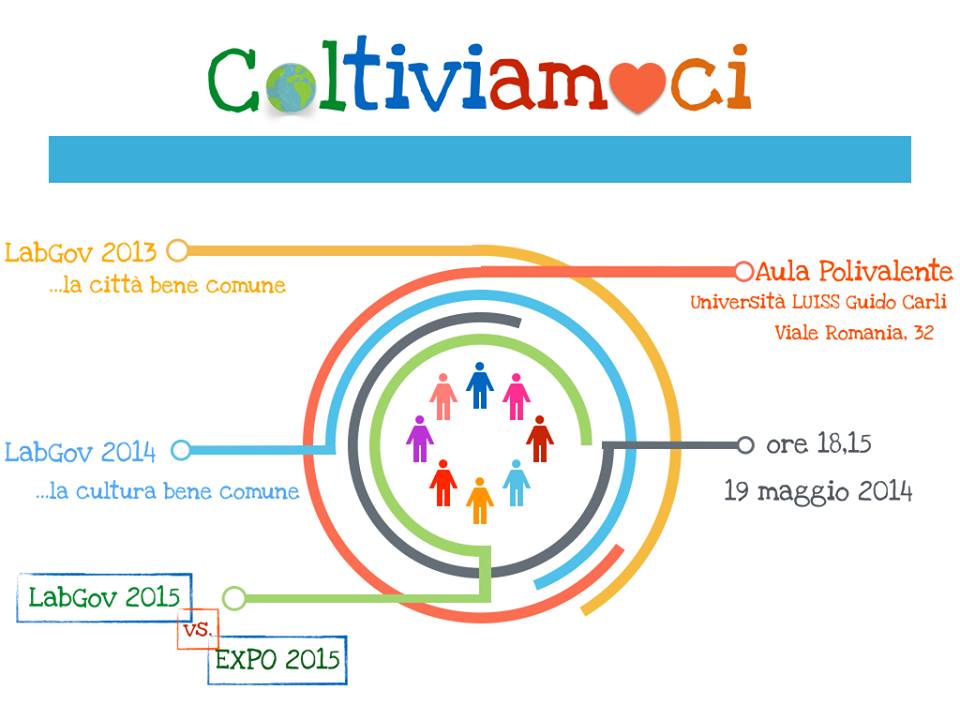
 On Monday, May 19th at Luiss Guido Carli University, will be held the event ‘Coltiviamoci‘. LabGov will host in Viale Romania 32, Aula Polivalente, a workshop focused on collective management of urban and environmental commons and on the development of institutional economic and social innovation. LabGov students will present the results achieved with the Lab’s activities and initiatives of 2014, and they will have also the pleasureto share knowledge, experiences and ideas with representatives from Coldiretti, Zappata Romana and Lazio Region Expo 2015 Steering Committee. This will be a unique event to talk about participatory processes aiming at actively involving actors on Expo 2015 major themes: ‘Feeding the Planet, Energy for Life’. Thus the workshop will focus on concrete, sustainable, technological solutions put forward by active citizens, such as community gardens, and by agricultural entrepreneurs taking care of the land as a commons.
Program:
- h 18.15 video show of LabGov2014 activities
- h 18.20 presentation of LabGov2014 results
- h 18.30 LabGov 2015 vs Expo2015
Speakers:
Giovanni Lo Storto – Luiss Guido Carli General Director
Maria Letizia Gardoni – President of Giovani Coldiretti
Luca D’Eusebio – Zappata Romana/ Hortus Urbis
Albino Ruberti – AD and President of Zétema and Coordinator of the Expo2015 working group for the region Lazio
- Concluding remarks: Gregorio Arena and Christian Iaione (Labsus)
- h 20.00 Awarding of participation certificates for LabGov’ s students; awarding of gratitude certificates for LabGov guest speakers

 The next June 26th, 2014 at the Temple of Flora in Rome will be held ReinventAda+, an opportunity of shared regeneration organized by LabGov in the wake of the highly successful ReinventAda, held in October 2013 together with La Calzoleria, club of social and cultural promotion.

