
by Alessandra Feola | May 16, 2014 | Luiss LabGov 2013-2014

MEETING MINUTES 5th MAY 2014
The Labgovers met the writer and director Giulia Morello of Officinegm. The event has evolved into two main directions: the first explanation on “videomaking” and the second exercise on field.
Videomaking Techniques
In the first part of the meeting Giulia Morello has presented a series of more or less well-known “videomaking” techniques, which are essential for the realization of any type of video. This point have to be emphasize, because the same group of creative people can deal with different targets or concepts (commercials, music videos, movies, etc..), To every type of video corresponds a type of language which can be declined in several ways. In its fundamental aspects, however, it would seem that any video is characterized by:
- TYPE: related to the topic that we are going to tell, and to whom we want to tell, and through which channel (for example, if we choose the web channel, it must be characterized by brevity)
- LINEUP
- SCREENPLAY (it is a mechanism of thoughts that follow each other in a video)
- STORYBOARDS: during the evolution of the script we have to think about what we want to see and feel what is needed to be created, without ever losing sight of times in the story.
If we decode those just listed as features of any video format, the ones listed below, instead, are areas within which it is called upon to choose between alternatives:
- PREPARATION: If we make an outdoor video we have to provide all the possible audio / lighting problems, and prepare a plan B in case it rain for example. Moreover it’s important to test all the tools before recording and make a list of the tools;
- LIGHTING: affects the quality of the final result (better to shoot with a lot of light rather than with a little, because we can always lower), the ideal conditions to record are early morning or late afternoon ( better when the sun is near the horizon) ;
- AUDIO: usually underestimated, is the most difficult thing to fix in the post production;
- SHOTS: they are the basic language of cinema (portion of space took by the camera);
- FIELDS AND PLANS: two families of the frame (field, medium field, long field, very long field; individual plan, first plan, very first plan, half-figure, American plan, entire figure);
- REFERENCE POINTS OF SHOTS – normal, from below, from above;
- THE CAMERA MOVEMENTS: panoramic (vertical, horizontal, circular. It contextualizes the character compared to his action);
- ZOOM AND TRAILER (mechanics-trailer – the camera is moved on a track); steady camera
- EDITING: often underestimated. When we took a lot of scenes, it is always preferable to record the bests footage (that will certainly se) to avoid wasting memories;
- ESSENTIAL ROLES: director, sound engineer, operators, actors, editors, photography director.
Part Two: Exercise
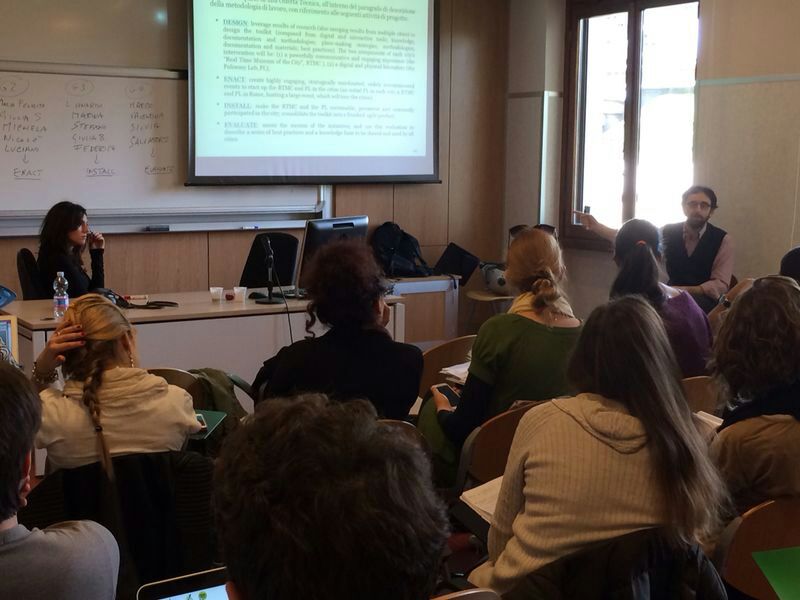
During the second part of the meeting, the director Morello asked to the LabGov group to divide into four subgroups. Then prepare a plan for the construction of a spot that explains the activities of the Laboratory, and to promote the same to the students for the future 2015 initiative.

by Alessandra Feola | May 16, 2014 | Luiss LabGov 2013-2014
 MEETING MINUTES 23rd APRIL 2014
LabGov hosted Federica Fotino, coordinator of Planning and Valorisation of the State Property. The meeting was divided into two main parts: the first one was a general introduction to project management and to those instruments and methods to realize it; the second one was a real workshop to put into practice the new-acquired knowledge.
In the first part of the meeting Fotino explained what is a project, defining it as “a temporary endeavour undertaken to create a unique product, service or result”. The activity of Project Management consists in having the nautical charts (knowing the social, juridical and economic environment in which we come to act), defining the route (defining the objectives), organizing the galley (defining competences, roles, in-depth analysis, activities).In every kind of Project Management, it is fundamental to respect the relation between time and resources, in particular human resources. It is necessary to work bearing in mind the significant difference between objectives and goals; the first ones are different for each part of the project, whereas the second ones are long term intentions. It has been explained what are the methods through which create the Activities/Resources matrix in order to individuate the budget for the project. After the introduction Fotino organized the class in groups for the practical exercise consisting in writing a piece of a project following the instruction received during the meeting.

by Lucia Mosca | Apr 15, 2014 | Luiss LabGov 2013-2014
 MEETING MINUTES 4TH APRIL 2014
On the 4th of April 2014 LabGov hosted a meeting about Social Innovation with Massimo Pellegrino (PriceWaterhouseCoopers’ partner) and Domenico Agnello (Temporary Reasearch Associate of University of Palermo).
Domenico Agnello focused on the theoretical framework that lies behind the idea of “Smart City”, that can be seen both as a eco-social transformation tool binded to the new technologies and the reorganization of the capital (with no negative affection) over new processes. Usually a prescriptive vision is used to describe a modern situation that is always changing.
The first concept of “Smart City” was the Renaissance city, because the university was connected with the city, but nowadays it creates some issues regarding the participation of the citizens, due mostly to the fact that not all of them, mostly on the suburbs area, can benefit equally from the opportunities given by a “Smart City”. Other problems might derive from the difficulties regarding the maintenance of a network of participation and the modification of the language used by the population: a “social” language prevents a pedagogical function about the “Smart City” issue. A way to overcome this problem could be betting more on the social networks in order to create a smart and pedagogical society.
Several authors discussed such arguments, like Moses; his idea can be divided into “Moses I” and “Moses II”.
• MOSES I: architectural planning based on a common sentiment: modern and similar to the Enlightment idea, a Roosveltian planning.
• MOSES II: his planning lost some of its previous “social relation”: keywords are modernism and self-referring progressivism.
Another possible solution could be a limited democratic individualism. The problem lies in the fact that in the modern society every project must be “super-performing” since the beginning, and a smart project got some difficulties to be immediately performing.
Massimo Pellegrino focused on the new technologies that might be used in a “Smart City” and how new technologies affected the perception of the passage of time. He explained the theory, developed in the United States, called “Transhumanism” by Ray Carlswell: the speed of the sequence of changing of technologies can be expressed by the theory of accelerated exponential returns. This changes also affects people’s mind.
So what can be done for the “Smart Cities”? Since it is impossible to plan something in a deterministic way due to the fact that society is continuously changing, the only thing logic to do is to try to orient the population, by creating projects that can adjust to the modern society:
• It is important to define the service models, and this includes define a specific goal, the security standards and identify all the relevant stakeholders.
• Analyze all the possible solutions by also studying all the relevant research made by others.
• Prioritize.
• Fund raising.
• Predict the impacts of what your project will have.
• Create a functional Road Map, a project plan.

by Alessandra Feola | Apr 4, 2014 | Luiss LabGov 2013-2014
 MEETING MINUTES, March, 28th 2014
On 28th of March LabGov hosted the expert in European project management, Silvia Petrosino (Zètema Progetto Cultura srl), who explained the essential instruments to elaborate European cultural projects.
First of all, she specified projects are elaborated in order to respond to tender notices which derive from European policies that are actuated through programs. These projects produce effects on citizens, stakeholders and public institutions. Only legal entities are admitted to respond to calls for proposal.
The current EU Framework Programme for Research and Innovation is called Horizon 2020, and it is the successor of the 7th Framework Programme. Horizon 2020 is divided into three categories: Excellent Science, Industrial Leadership and Societal Challenges. Regarding culture, the most important program is “Erasmus+: changing lives, opening minds”, composed by three key actions: mobility, cooperation for innovation and good practices, support for policies reform. This program is financed for 20% by the Communitarian Agency EACEA (Education, Audiovisual and Culture Executive Agency) and for 80% by national agencies (for Italy they are ISFOL, INDIRE and Agenzia Nazionale Giovani). Another program is “ Creative Europe” which responds to four challenges : overcome fragmentation, digital shift and lack of data and access to finance. This program is financed with 1.46 billion of Euros shared between culture ( 31%), media (56%) and cross sectors (13%). The objects of “Creative Europe” is to support the capacity of the Cultural and Creative Sector (CCS) to operate transnationally, promote the transnational circulation of cultural and creative operators, reach new audiences and enforce the cultural sector. The instruments for realizing these objects are cooperation, literary translations, networks and platforms.
Secondly, we analyzed a cooperation project realized by Zètema in cooperation with Estonia, Greece and Norway called “FolkMus-Folk music in MusEUMS, young musicians and old instruments” (2010-2012). In two years were organized meetings, 12 concerts, educational activities, workshops in museums involving young musicians coming from Italy, Estonia, Norway and Greece. As Petrosino said, an effective communication program was necessary to promote the event (newspapers, internet, posters ). Moreover, they collected the opinions of musicians and users through questionnaires which revealed the strong audience’s satisfaction. The success of this project was determined by a clear and effective idea, a balanced partnership, richness and cultural diversity, a rational working plan and finally personal commitment.
After this brief overview, the Labgovers were invited to put this knowledge into practice responding to a European call for proposal regarding the relationship between administration and young people.

by Alessandra Feola | Apr 3, 2014 | Luiss LabGov 2013-2014

MEETING MINUTES, March, 14th 2014
The meeting was held at LUISS Guido Carli University and hosts Dino Amenduni, New Media consultant of Proforma (www.proformaweb.it), a political communication Agency from Bari. He also writes a blog for Finegil-Gruppo Espresso and he is also a social media marketing and political communication trainer (www.slideshare.net/doonie).
14.00 – 15.15 – Presentation
15.15 – 16.15 Simulation
16.15 – 16.45 Brainstorming
PRESENTATION
“The end of the world is when we stop having trust” (Madeleine Quellette Michalska).
Dino Amenduni showed Censis Data on Italians’ media diet (data on who votes, how we votes, our sources of information). From 2007 to 2013 the percentage of Italians watching TV has increased, with a current average of more than 4 hours a day (we can speak about a real television dependence).
On the contrary there was a decrease of almost all newspapers’ readers and at this decrease in number does not correspond an increase of views on news websites. Where are the readers gone? The answer is “on social networks”. Therefore it becomes essential for senders to know how to communicate effectively and directly on social networks because, differently from the press, in them there is no intermediation.
Furthermore, Censis Data shows that exist a digital divide but also a press divide, which is the divide between people that have never stopped reading newspapers and people that have never read one. Italians who read newspapers are usually over 65 years old and this data must be considered when we chose the way we are going to communicate during the electoral campaign. About 37 million people today use the internet. In this scenario, it is possible to speak about digital natives (those who are born in the internet era), digital adults (those who experienced the birth of the internet) and predigitals (those who didn’t experience the digital era or do not accept it). Nowadays organizing a campaign only on a single communication level it’s unthinkable: a lot of young people use the Internet to keep informed, whereas mature people still read newspapers.
What the Italians do with the Internet? They look for information, watch movies, buy items, carry out civic activities (less frequently). The number of Italians looking for information through the web is increasing. What does this imply? Why the digital age causes difficulties for the printed newspaper? The main risk for newspapers is the loss of readers caused by the fact that they can be anachronistic, like in the case of the Costa Concordia. The recovery of the cruise ship finished at 4:30 a.m and, while the new media covered it in real time, the newspapers were 24 hours late.
Consequences of newspaper sales plummeting consist in a loss of jobs for journalists and a decreased of the possibility to do investigative journalism. Moreover, there is not a corresponding increase in online newspapers readers. So, the role of social networks is now crucial because:
– readers of online articles are directly proportional to the advertisement of the piece on the social networks;
– if online articles are not competitive, they lose readers;
– readers are attracted by emotional approaches: web journalists need to exploit this feature in order not to lose readers.
The concept of information on Facebook is variable, the sources are out of user’s reach and this implies that authoritative contents and gossip can have the same space. The importance of Twitter is less that Facebook one: twitter has 1/6 of users of the ones of Facebook. In other countries differences are far less sensible. In Italy Facebook has primarily a ‘communication’ purpose; Twitter a ‘relationship’ one. Twitter is more used when you want to communicate to elites (politician and journalists) and consequently you want to reach traditional media, whereas Facebook is more used to establish a direct contact with a much wider audience without intermediation.
Significant online interaction BUGS:
– Online reputation is important
– You have to consider young/adult divide
– Functional analphabetism: among OCSE member states, Italy is the country with the highest number of functional analphabets (twice the number of the state in second position)
Case study: Greenpeace
The strength point of Greenpeace actions is that it has no permanent allies or enemies and it has two important consequences: independence and equidistance.
Greenpeace’s most important campaigns are:
– KitKat advertising;
– Save the Artic;
– Fashion duel;
– Io non vi voto (I don’t vote for you);
– Greenpeace vs. Enel (Brindisi)
Considering the first one advertising, the campaign shows a well known Nestlé’s product, the KitKat. Through a very strong and ironic language the campaign is able to communicate the damage that the production of such goods implies, that is the deforestation in Indonesia. Nestlè’s request of removing the video produced the so-called Streisand effect: the effect was contrary to the intentions of the company because in this way an increasing number of people have watched the video due to the fact that was “prohibited”.
SIMULATION
The aim of the simulation was to organize in groups a communication campaign to publicize the Regulation of Bologna between citizens and Public Administration.
GROUP I
Proposal: The first group proposed a communication campaign based on a video and some posters that rise awareness on cooperation between citizens and Public Administration publicizing a contest of ideas about the regeneration of the commons. #comepossoesserciutile? (#howcanIhelpme?)
Problems: Dino Amenduni pointed out that is important to coordinate the different channels if there is a single campaign. The campaign should be recognizable even when different communication channels are used so videos posters must make sense even when viewed separately.
GROUP II
Proposal: The second group proposed the campaign “TUTELACURI” based on two different posters, a video and a Facebook campaign: the first with the superposition of commons like a statue with a human body with the aim to humanize culture and to promote the adoption of a city common.
Problems: Amenduni pointed out the difficulties of the difficulty of carrying out a campaign on too many media with too different languages. The risk is to confuse people who could be not able to attribute them to the same campaign.
GROUP III
Proposal: Masterchef (“this cannot be eaten” – “this is unlivable”). The campaign was based on posters that compare food, something familiar to all, to culture and common goods. The aim was to highlight how food, that no one would want to eat, must be similar to degraded commons that anyone would like to live or have.
GROUP IV
Proposal: ReinventiAMO Bologna
Problems: not fully developed, the idea must be completed with some other elements.
GROUP V
Proposal: LetuemaniperBologna (YourHandsForBologna) Main Slogan + Specific Slogan.
Problems: the message must be more easily understood and there must be a description of the common.
GROUP VI
Problems: need for efficacy increase, the commons must be allocated, the length of the campaign must be expanded.
SIMULATION CONCLUSION
INSTRUCTIONS FOR USE: a message is more easily understood through simple and frequent words and you can not base a campaign only on negative aspects or on what does not work: the positive effects of the proposed activity must be always underscored.


