
by Lucia Mosca | Mar 27, 2014 | Luiss LabGov 2013-2014
 MEETING MINUTES, March, 7th 2014
The meeting was held at LUISS Guido Carli, Viale Romania 32. The purpose was to get to know the artist, engineer and hacker Salvatore Iaconesi and Oriana Persico with their andinternet portal available at www.artisopensource.net.
As reported on the homepage, AOS is an international informal network exploring the mutation of human beings with the wide and ubiquitous accessibility and availability of digital technologies and networks.
We move across arts and sciences, using technology, communication, performance, art and design, to instantiate emotional actions and processes that are able to expose the dynamics of our contemporary world.
We do this in academic, artistic, business and activist domains and, actually, we are focused on moving fluidly among each of these spaces. The portal was born in 2013 with a technical, digital and technological intent. We can refer to it also as a multidisciplinary network of interaction among architects, artists or scientists.
Comparison with LabGov: as a matter of fact, the aforementioned laboratory activity is an example of place where “you can do something with talent”. It is an out-and-out principle of (wiki)subsidiarity – shared digital infrastructure.
How do societies change with technology? – The starting axiom is that technologies are omnipresent ; having acknowledged this, we can thus affirm that their change affects inter-individual relationships.
How do we perceive change? – According to Iaconesi, art can be considered as sensor of contemporaneity (a good artist cannot avoid being contemporary, because as a detector he “senses” things from his perspective. Artists = Scientists).
AOS’s point of view – there currently are many criticisms to technology. Specifically, obscurity, incompleteness, ignorance. Example: open data. The main characteristics of these tools should be set as follows:
- Accessibility
- Completeness
- Celerity
- Formality
The four main characteristics should coexist following the principle of transparency. But the bug is very evident: they cannot, right now, exist simultaneously because, for example, completeness and celerity in finding info represent a paradoxical pair!
What is missing from freedom and accessibility? – Desire. This, more than anything else, originates complete knowledge and has a pivotal position among the sharing network.
Field Example: INCAUTIOUS PORN
It is a fake agency aimed at collecting from all pornography websites the comments of the users who left their phone numbers or email addresses. The agency would have then created paintings with those data and sold hem for 50€. In very few weeks, more than 400.000 users tried to access to the info of the website (for 10€) in order to remove their name from the database (for 1000€).
→ in reality it was a scientific research to demonstrate the perception that individuals have of their own privacy and security.
→ the aim of the research was to present a kit of privacy protection to the administrative offices of the White House.
HUMAN ECOSYSTEMS – it is a family of real-time system capturing information from social networks to visualize the human geography of cities, across space, time and relations. We can talk of Human Ecosystems as “compasses” that detect the feelings of the users who interact. They serve as guidance on maps that make us perceive what kind of role everyone is covering at a given moment. It has been identified several role, such as the Influencer, the Hub, the Bridge, the Simple Node.
– ECM1 space – the Cultural Ecosystem of the city of Rome: Space
– ECM1 time – the Cultural Ecosystem of the city of Rome: Time
What is the aim of those ecosystems? – with this modality, you create named places that are places shared by a community, where you create linguistic contexts decoded for the users as a bottom up approach . After the presentation, professor Arena, professor Iaione and the class have been wondering about the effects that an hypothetical human ecosystem could have on the topic of “care of the commons”. Specifically, professor Arena stated that “supposing we are a municipality in which a community takes care of those commons, is it possible to detect who are the leaders and/or the experts – they may or may not coincide, according to the degree of personality and influence on a group”.
Professor Iaione admitted that the open source model that seemed so futuristic as a mean of interaction is instead at disposal of every national and international position, except citizens that as first users of the service are totally unaware!
Finally Salvatore Iaconesi presented a model of shared activity, focusing on the LAB, an out-and-out knowledge incubator to
– learn how to communicate
– learn how to do (urban) research
– learn how to use the model as an art catalyzer
– learn how to cooperate
– learn how to organize.
To make the model real are necessary three subject of actuation:
– local administration (public subject)
– research (guarantee of the public space)
– museum (LAB – universities with a territorial interest).
by Giulia Spinaci | Mar 13, 2014 | The Urban Media Lab
On Friday 7 March, LabGov had the pleasure to host two talented guests in its weekly meeting at LUISS Guido Carli, Salvatore Iaconesi, hacker and artist, and Oriana Persico, artist and writer, who presented their most recent project: the “Human Ecosystem”.
Salvatore and Oriana created AOS – Art is Open Source, which in their words is “an international informal network exploring the mutation of societies through the ubiquitous digital technologies”.
Their aim is to move across arts and sciences in order to detect all the changes, the paradoxes and the emotional trends of our contemporary reality. The “Human Ecosystem” project is a tool in this sense, which let us “listen” to the emotional side of the city. It qualitatively and quantitatively measures all information that human beings produce in the main social media, such as Facebook, Twitter, Linkedin and Google +, and gives us back the real time geography of our relations, ideas and conversations in the form of an ever-changing map.
The result is not only visually stunning, but also a source of fundamental information that might improve our daily life in the community. In fact, through its Lab, the “Human Ecosystem” provides also consultation services that enable public administrations, universities and private companies to discover how this system might serve their purposes, especially in relation to common issues. As Prof. Gregorio Arena said, it might be an invaluable patrimony for the Labsus – LabGov cause in relation to the care and regeneration of the urban commons.

by Lucia Mosca | Mar 8, 2014 | Luiss LabGov 2013-2014
 MEETING MINUTES, FEBRUARY 28th 2014
The second meeting of the new cycle of seminars of LabGov was held at LUISS – Guido Carli, Viale Romania, 32. The agenda focused on the presentation of the “Regulation on collaboration between citizens and the Administration for the care and regeneration of urban commons”, presented on February 22nd in Bologna. Prof. Gregorio Arena, President of Labsus – Laboratory for subsidiarity, explained how the Regulation is actually the first case in Italy to incorporate concretely the principle of horizontal subsidiarity, as advocated by Art. 118 of the Italian Constitution.
An initial focus has gone immediately to the question: why a regulation rather than a law? As it is explained, there might be in the near future some sort of regional laws governing such matters; however the risk of the so-called institutional bricolage has to be avoided – which often leads to the limitation of the autonomous initiative, rather than to its promotion. Historically, moreover, the need for intermediate organizations has always been registered in each social system – let’s just think of the Corporations in the Middle Ages, or to the encyclical Quadragesimo Anno issued by Pope Pius XI (1931) which called for the administrative decentralization and for the fragmentation of the services provided by the Public sector.
The discussion then moved on the choice between local administrations and the state administration for what concerns the protection of citizens’ activities: after an exchange of views on this issue, it has come to the conclusion that it is the case for the local government to ensure and support these activities in the first place. It is not only the internal debate at the meeting that suggests us this type of approach to the topic: the jurist Sabino Cassese, at the end of the 80s, noted that the 70% of the total amount of resources used for the functioning of the Italian system is monopolized by the services provided by municipalities; in addition to that, the reform of Title V of the Italian Constitution in 2001 represents a further example of this thesis.
The Municipality of Bologna was taken as an example of the fact that Italy is an incubator of priceless public goods and of cities of rare beauty. Today we live in a time of (re-)discovery of such assets. The arcades of Bologna are a good example: they have all the necessary features to be defined by UNESCO as world heritage, as long as someone decides to take care of their maintenance. To date, only 60 owners in the area were successfully mobilized in this way. Why? Due to lack of information and training. In this respect, Donato Di Memmo, currently Head of Administrative Simplification, Institutional Affairs, Decentralization and Metropolitan Cities in the municipality of Bologna, in the June of last year, ‘put down’ a first but articulated Memorandum of Understanding between citizens and the Administration.
What do we mean by the term ‘administration’? An evergreen distinction (Giannini, 1961): Administration as activity and Administration as organization. When we speak of Administration as an organization, we mean a redundant system – in the sense that it has influence – on the functions and activities of the very same Administration; if the administrative organization is hierarchical, the activities of popular initiative will suffer, because they are perceived as secondary. Instead, Art. 98 par. 1 of the Italian Constitution: ‘Public employees are at the exclusive service of the Nation.’ establish a different concept of Administration. It is possible to highlight three major observations: 1) the meaning of public employees listed above assume a paternalistic meaning – which sees citizens as ‘passive’ subjects in providing care and protection; 2) service is here understood as in the civil servant case of Anglo-Saxon derivation, according to which the public employee can not and must not be in a higher position with respect to the citizens; 3) in the final analysis, the term Nation – and not Republic, as is the case of many other articles of the Italian Constitution – has to be intended not as an aggregation of institutions, but as a defined territory to preserve and defend. Once concluded the debate which covered differences and relations between citizens and the Administration according to the Italian Constitution, as well as in the everyday life, we moved to investigate the Regulation on collaboration between citizens and the Administration for the care and regeneration of urban commons’ specifically, by giving some definitions.
– URBAN COMMONS – are those which, if enriched, enrich all, if impoverished, impoverish all: it is the case of goods that are, tangible, intangible and digital that citizens and the Administration, through participatory and deliberative procedures, acknowledge to be functional to the well-being of individuals and of the collectivity. Pursuant to Art. 118 last paragraph of the Italian Constitution, the citizens share the responsibility with the administration (defined as responsiveness – ability to respond) of the regeneration of these goods in order to improve the collective use;
– MEASURES OF CARE: interventions aimed at the protection, preservation and maintenance of the urban commons to ensure and improve their usability and quality – an element that is reactive and proactive in protecting the urban commons;
– MEASURES OF REGENERATION: interventions aimed at the recovery, transformation and innovation of the commons, as a part of social, economic, technological and environmental processes, broad and integrated, which have an impact on improving the quality of life in the city.
CHAPTER I – GENERAL PROVISIONS contains a series of precise and accurate ‘rules’ to which the regulation is harmonized – namely the Constitution, general rules, municipal statute and local rules – and emphasizes the ultimate purpose of the interaction between citizens and Administration: collaboration. Something that can be easily derived, following three principles of the text: freedom, responsibility, and solidarity.

by Lucia Mosca | Mar 8, 2014 | Luiss LabGov 2013-2014
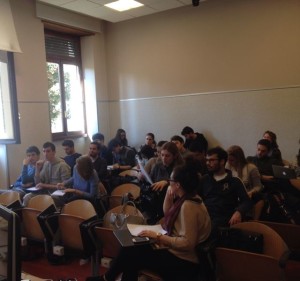
The first meeting of the new cycle of seminars takes is held at LUISS – Guido Carli, Viale Romania, 32. The agenda focused on the presentation of the new cycle of seminars, terms and conditions for the participation to the new cycle, later followed by the presentation of the working group (organizational framework) and the division into categories (mainly cross-sectional): RESEARCH AND DEVELOPMENT, COMMUNICATION and ORGANIZATION.
Prof. Christian Iaione introduced the main concepts and theoretical tools –the new cycle of seminar will deal with starting from the definition of commons. In economic terms commons different from public goods – which non-excludable and non-rival. Commons are both rival and non excludable. But in political and legal terms they are both public and private goods that need to be preserved to ensure their usability for the wealth of everyone and future generations. More precisely, taking the cue from the book ‘Italy of the Commons’, edited by Gregorio Arena and Christian Iaione, we can intend commons as social things – they have a social function or are the result of social processes; natural and man-made assets – i.e goods that are unique or exceptional in terms of high quality; and also, but not only resources – as soon as they become productive inputs for social processes.
What is the trigger that makes us talk today of common goods and the need to protect them? Over the years there has been a gradual decline in the capacity of production, care, safeguard, regeneration, control and supervision by local institutions and also, in some instances, by private institutions or subjects. The consequence of this regulatory slippage, resulted in the deterioration of commons, material and immaterial assets that are essential to the wealth of individals and communities.
What are the solutions?
STRATEGIES: SPECTRUM:
– PRIVATIZATION
– CENTRALIZATION THROUGH PUBLIC INSTITUTIONS
– COOPERATIVE SELF-ORGANIZATION OF COMMONS
Is there space for a fourth strategy?
Possibility of interaction between community, public and private sector through the so-called principle of horizontal subsidiarity which demands public institutions to favour the autonomous initiative of citizens, single or associated, to carry out activities of general interest.
How do we call it?
LOCAL GOVERNANCE OF THE COMMONS (through formalized rules and public-private-commons partnerships);

by Lucia Mosca | Feb 10, 2014 | Luiss LabGov 2013-2014, The Urban Media Lab
 On Friday 25 October LabGov – Laboratory for the Governance of the Commons, presented its first shared regeneration experiment. The event called “ReinventAda” aimed to take care of the Temple of Flora, the XVIII century Pallavicini’s Coffeehouse in Villa Ada in Rome.
LabGov, a project born in the LUISS University of Rome, was ideated and strongly supported by Labsus – Laboratory for the Subsidiary and its President and Director, respectively Professors Gregorio Arena and Christian Iaione. The great challenge that LabGov wants to solve is to find mechanisms that allow citizens, public administrations, associations and business to create alliances in order to find common solutions to common problems and to create the shared administration of the commons.
The Temple of Flora even if has been renovated several times by the Superintendence of Cultural Heritage of Rome, was in decay, above all due to graffiti on the walls and garbage. Institutions needed the help of citizens that in the everyday life can take care of this artistic edifice immersed on the green.
The activity has been to clean up the building and the space around from the garbage and to whitewash the walls from graffiti. The Temple of Flora, Roman deities of the spring, symbolically wants to recall the idea of a new Renaissance, made possible through an alliance between citizens and public administration.
The day spent in Villa Ada, a beautiful city park, formerly the residence of the Italian royal family, saw the Labgovers weave an alliance with the by the Superintendence of Cultural Heritage of Rome, thanks to which the intervention has been possible and that was very enthusiastic of the project. The enlighten manager, Mrs Giovanna Alberta Campitelli, in charge of Villas and Historic Parks, welcomed the project and opened the door of the administration.
Another important alliance established has been that with the Department of Environment and Department of Culture of Rome Capital, of which the representatives, respectively Mrs. Estella Marino and Flavia Barca participated in the initiative by painting walls and picking up garbage. Guest of events also the “Founding Fathers” of LabGov, the General Director of LUISS University Giovanni Lo Storto, and President and Vice-President of Labsus, Professor Gregorio Arena and Mrs. Maria Teresa Rosito.
The primary objective of ReinventAda was to raise awareness of the local community toward a common good that plays an important role in the quality of life of citizens such as this city park, with naturalistic, artistic and cultural heritage.
A second important aspect is to bring together different subject, governmental and non-governmental, interested to the wellbeing of the Villa, and facilitate theirs common work along a path that have to conduct to the shared administration of Villa Ada. Moreover this experiment should be a model for other similar situations in villas and historical parks in the city of Rome.
A strategy based on shared administration could bring a contribution of times, energies, ideas, skills, talents, resources and competences from civil society that represent the real added value of this model, useful for a better management of environmental, artistic and cultural heritage.
This new paradigm of administration, complementary not alternative, that strengthens the classical one, intends to increase the responsibility of all subject willing to take care of the problems of the community. And the event of ReinventAda confirmed how all the subjects involved has been ready and strongly active in supporting, promoting and concretely participate.
On the one hand, ReiventAda, has transformed for one day Villa Ada in a theater in which active citizens can express all their willingness and awareness of the importance of the space around them. On the other hand public administration can start this transformation in three ways: simplifying the procedures and the rules to allow an easier access for citizens; providing instruments that come from the education, to the organization since the materials necessary for the realization of these kind of projects; coordinating and ensuring the quality of the project.
This has been the first step towards a project that aims to create a shared governance of the Villa, providing institutions mechanism that allow normal citizens to take care of the immense cultural heritage that is all around us.
