by Maria Elena Santagati | Mar 29, 2017 | The Urban Media Lab
From March 21 to April 5 France hosts the first edition of Printemps citoyen, a collaborative initiative gathering 1000 events like meetings, debates and workshops organized on the initiative of citizens and associations. Hosted in 500 informal locations like cafeterias, schools, co-working and association spaces, the events will be an opportunity to debate on different topics proposed by citizens, from culture to economics, from health to history, thus strengthening citizens participation.
The aim is in fact giving a voice and making space to citizens, “populariser la démocratie participative au-delà de celles et ceux qui prennent déjà la parole ou exercent déjà des responsabilités et de dresser une cartographie des préoccupations et des propositions des citoyens”.
Initiated by the cooperative start-up Kawaa and the collective “Le labo du faire ensemble”, a think-tank promoted by different institutions operating for young target, Unis-Cité AFEV, Coexister, Passeport Avenir, Singa and the International Collaborative Foundation, with the financial support of the corporate foundation of Macif group, the initiative represents a unique opportunity for citizens to raise problems and debate proposals, that will be collected and presented in a final dissemination meeting on April 20.
Many partners joined the project, some of them belonging to Démocratie ouverte, an independent citizens collective whose aim is to accelerate democratic transition by promoting transparency and citizens participation with dedicated programs.
Partners provide also digital tools, like the collaborative platform proposed and offered by Kawaa, and some animation formats containing instructions and details to organize and conduct effective meetings/workshops, also according to different contexts and targets. Open Forum, World Café, SenseDrink, Le Café envie d’agir are just few examples of the available formats. A documentary film showing best practices of democratic innovation from around the world is also available on the website. Citizens could choose a topic and a format, search for the available locations, register their event or simply attend the various meetings organized throughout the national territory. Secularity, creativity, political elections, ecological issues, tax avoidance, migration, citizens engagement are some of the topics under debate.
The complete program is available here.
—————————————————————–
Si tiene in Francia, dal 21 marzo al 5 aprile, la prima edizione di “Printemps citoyen”, iniziativa collaborativa che promuove in tutto il territorio nazionale 1000 incontri, atelier e dibattiti organizzati dai cittadini per i cittadini, con l’obiettivo di stimolarne una partecipazione attiva nella società.
by Monica Bernardi | Mar 17, 2017 | The Urban Media Lab
On Wednesday the 8th of March 2017 the Munich Creative Business Week (March 4th-12th) hosted a special panel discussion on smart cities, “Brave New World?”, organized by Schnitzer& and moderated by the designer Sarah Dorkenwald. The panel gathered many experts from different fields to discuss on the Smart City’s ability to offer an answer to the main urban issues that cities have to face nowadays, such as traffic, air pollution, urban heating, economic crises, immigration, sociodemographic problems, social injustice and much more. The topic was debated taking the case of the ubiquitous city of Songdo in South Korea as an example. Among the experts were also some designers and architects directly involved in the masterplan of Songdo, like Brian Girard, principal at Kohn Pedersen Fox (KPF) with over 20 years of professional experience in designing residential, commercial, institutional, and cultural facilities in London, the United States and Asia, and the south Korean Minsuk Cho, an award-winning architect, founder of the Seoul-based firm Mass Studies. The futurist Cornelia Dhaeim, founder of the Future Impacts Consulting (Berlin) and Leiff Huff, executive designer director at IDEO’s Munich studio were also present. Furthermore, from the academia, Gerard Schmitt, professor of Information Architecture at ETH Zurich and Founding Director of the Singapore-ETH Centre in Singapore, and I, from the University of Milano-Bicocca, Department of Sociology and Social Research were called to connect the topic of sharing cities to those of smart cities.
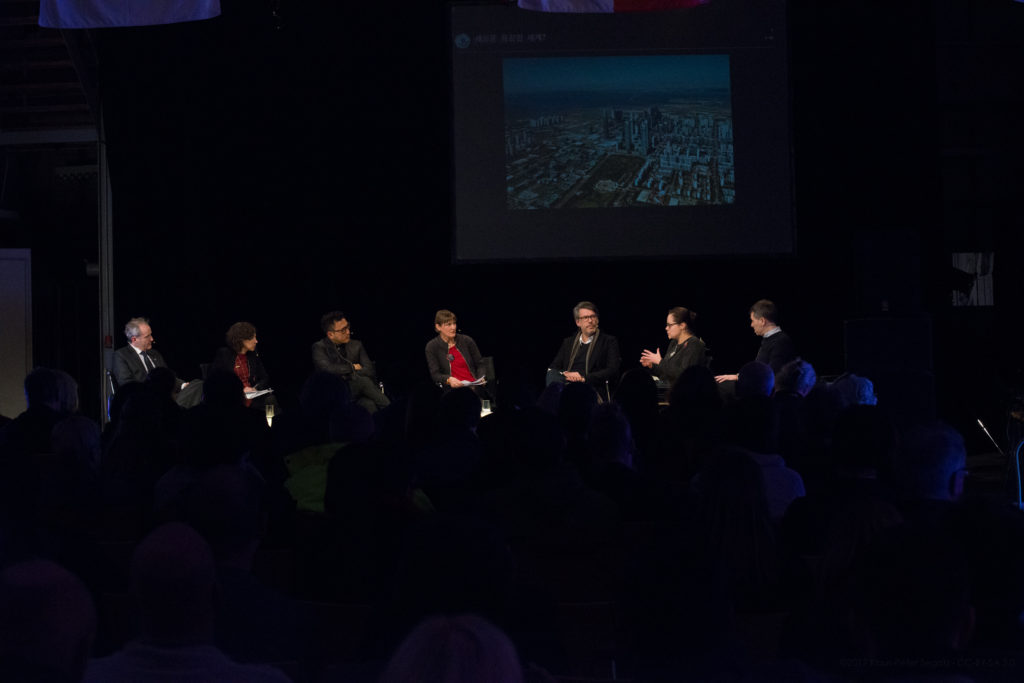
Picture by: @Klaus Peter Segatz, Schnitzer&
The panel discussion questioned the nature and the implications of a city like Songdo, which is being designed since 2001 and is still in progress, built from scratch and hyper technological. Even if other cities were built in the same way, like Brasilia, Abuja or Canberra, Songdo is considered unique for its hi-tech environment integration. It has been designed with sensor to monitor temperature, energy and traffic and all the tech innovations are respectful of the environment (charging stations for electric vehicles, water recycling system, waste disposal system…). It is considered a U-City (ubiquitous), conceived as a future city
where everything is interconnected with everything else at anytime. There is U-Health, U-Governance, U-Education, U-Offices, U-Traffic, U-homes and so on. The core of the U-City is the Urban Management Control Center which controls any activity, maximizing the usage of resources and minimizing their exploitation. In addition, the district was part of the former President Lee Myung-bak’s strategy to promote low-carbon and sustainable growth, as the principal path for development in South Korea. Here 40% of the area is dedicated to outdoor green spaces for leisure; there are 16 miles of bicycle lanes, and a central park and waterways based respectively on New York City’s Central Park and Venice’s canals. Moreover, the Masterplan is organized in a way that makes workplaces, schools and leisure facilities reachable with a 15 minutes’ walk. The “green side” is not the only interesting aspect, since developers describe Songdo also as a “global business hub” “home to a variety of residential and retail developments”: it is situated in a free trade zone, officially part of the Incheon Free Economic Zone, an area of 201km2 along the Incheon coast, which makes it attractive for foreign and domestic investors.
In a similar context many questions emerged spontaneously, and during the panel the participants widely debated about the possibility of this ubiquitous city to become a model for the future.
- Using the words of developer Stanley Gale we are facing the first “city in a box”: the entire urban development can be purchased and replicated for mere $40 billion and the city is completely reproducible; some experts (like Lindsay and Kasarda) referred to Songdo as “the experimental prototype community of tomorrow”. But, as it emerged also during the panel, the solutions “one size fits all” have already proven not to work; the forms of experimentation enacted in this space transform territory, population, truth and risks with implications for representative government, subjectivity and urban form.
- In addition, as discussed, a top-down, technology-infrastructure led smart city cannot be a real urban model for the future. When cities are planned and built by only relying on algorithms an organic approach is lacking, and gaps between the logic of engineers and the logic of the end-users are registered. For this reason, it is better to have an incomplete urban planning, able to change over time and to model itself on the requirements that move along. For this same reason the plan of Songdo is marked by intentional changes of scale, interruptions of geometry, and varieties of open space character. As underlined during the debate, heterogeneity, which normally occurs due to the vagaries of a historical process, here has been deliberately planned.
- Another controversial element is related to the private nature of the investments: the Masterplan and all the interventions are planned and built by the private sector, so they are profit-driven. An important part of KPF, in charge of the Masterplan, is to collaborate with clients and to listen to their needs. But who are the clients here? The clients are Gale International (an American real estate developer) and Posco (a South Korean steel company) and the city of Incheo, but there are also the citizens who will live in the city and that in a way should be considered as clients too…How to consider their needs and requirements if at the time of planning no one is living in the city yet?
- In addition, it seems clear that this kind of city is addressed to a specific target of people. People that decide to move here can of course afford the personal gadgets that smart cities take for granted (laptops, smart phones, reliable internet access). This entails an exclusionary city-making, that can exacerbate spatial segregation and lead to fragmented demographics, resulting in a city accessible only by the affluent class, that can afford international schools and medical centers.
- Leaving aside the issue of which target of people will the city attract, it is still important to focus on ongoing planning, a topic that was touched during the debate on Citizen Design Science, when the speakers underlined the prominence of a planning process able to facilitate a more holistic participatory planning and design approach, starting from big data (big data-informed urban design applied to a combination of citizen science with participatory design that lead to the Citizen Design Science).
- From Smart to Responsive: in this process of people involvement, necessary to have a really smart city, where technologies are the enablers that empower people to be smarter and co-creator of their community, the discussion moved on the topic of the responsive city. This is a city that engages residents and citizens’ prospective from the very beginning in the planning and in the management of their habit, based on smart city technologies, a strategy to put people and their needs at the center of the urban planning. In particular, the responsive city model is seen as some sort of circular system where various stocks and flows of resources (such as energy, water, people and human capital, space and information) circulate and need to be managed in a high-performing, cost-effective, resource-efficient and environmentally friendly way in order to be sustainable. A process that the city of Singapore for example is already experimenting with very good results.
- Talking about people, some questions arose in terms of the construction of the social fabric. In building a city with a computer-driven approach, some relevant aspects such as the social and cultural issues are often neglected, since the attention is on the physical aspects and on industry portfolios, and limited relevance is given to the idea of knowledge culture, social infrastructures and communities’ needs. Public participation become for this reason more and more crucial, since it can allow for the city to be shaped by a mix of technological, social, cultural, economic, political and organizational processes. Moreover, planners and designers should focus on developing an environment that best matches their image of prospective users and shape a sociotechnical environment in which social and technological aspects are intimately related to, and define and redefine, each other.
- In addition, in a planned city it is more difficult to develop an authentic urban identity, since it takes decades to build up. Just think to cities like Chandigarh, Almere, Bhubaneswar, built in the 60s or 70s, they are just starting now to develop a kind of unique urban character. The same will probably happen in Songdo, as people need to feel a sense of belonging to create a community, and it will take time. To favor this process, fueling social participation is of course an important step. At the same time, and always in a responsive dimension, the democratic approach should be playing a central role, also in terms of education (inclusive, free access, share knowledge, learn from feedback….) and should function as a base for a responsive city.
- In terms of participation and sharing of resources, a short reasoning has been made about sharing economy’s practices and services. In a hyper-technological context like Songdo the use of platforms for approaching services will be almost spontaneous, but sharing, in this way, risks to remain just a commercial and for profit advantage, losing its solidarity and community component. Only the ability to build a community among people will led to a real shared use of resources, and in this sense the government action will be a crucial element. In fact, the governance model that the city will decide to implement will make a difference both in terms of democracy and of community creation.
- The last point to be made is on the issue of safety vs privacy: the usefulness of big data in the management of fluxes in the city was one of the critical pints debated. In Songdo, every citizens will have a smart-card house key, to use for everything: pay a parking meter, see a movie, get on the subway, borrow a free public bicycle…it will be anonymous and in case of loss it will be easy to cancel the card and reset the door lock. This omnipresent technology can raise privacy concerns and also the specter of a surveillance society, but in Asia this concept is actually viewed as an opportunity to show off technological progress and attract foreign investments. People that choose to live in this city are aware that this high technological support guarantees safety at 360° and makes every activity easier, which is why people will be willing to pay the social cost of a more controlled existence.
The last open question addressed the future city as each of the panelists imagines it, and in the various answers there was a great agreement on few crucial words: connected, co-created, shared and democratic. The debate ended with the auspices of a future city which will be people-centered and marked by active participation.
The panel opened with the greetings of the South Korean Consul of Munich and closed with a networking Korean dinner and music.

—————————————————-
L’8 marzo, durante la Munich Creative Business Week si è tenuto un panel sul tema delle Ubiquitous Cities, un interessante momento di confronto multidisciplinare tra esperti di diversi campi per ragionare sulla città del futuro guardando a Songdo in Corea del Sud come esempio. Tra high tech urbano, attenzione all’ambiente e infrastrutture sociali, il panel ha evidenziato l’importanza di creare le condizioni per una città comunque a misura d’uomo in cui la partecipazione attiva dei cittadini possa essere favorita e alimentata, anche a livello di pianificazione e co-creazione.

by Francesca Spigarolo | Mar 9, 2017 | The Urban Media Lab
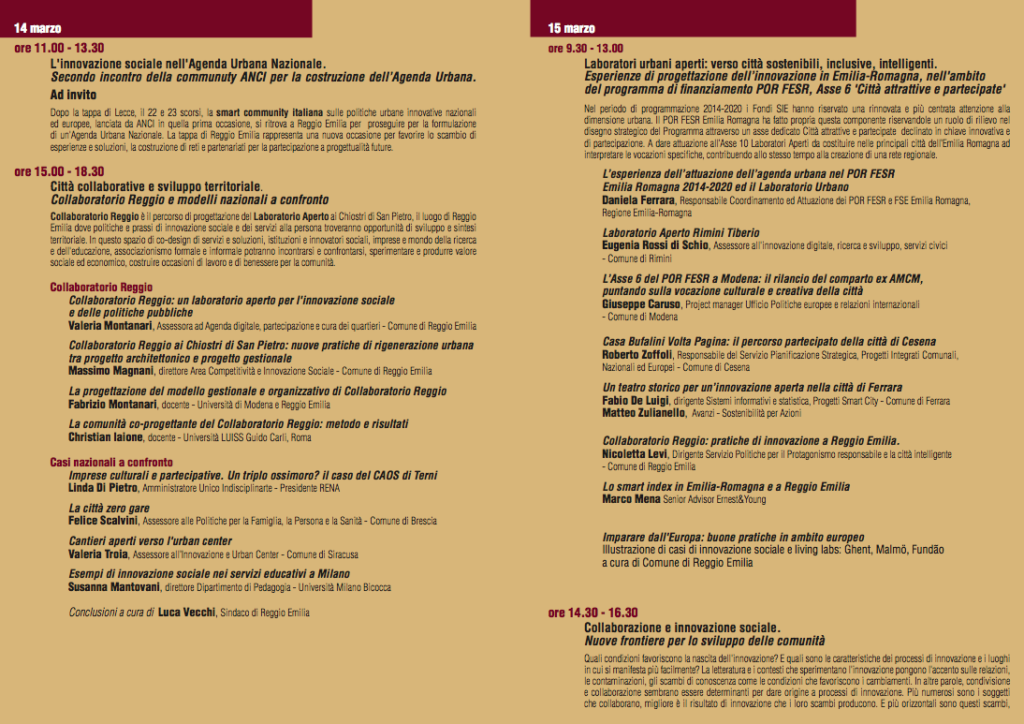
On Tuesday the 15th and Wednesday the 16th of March 2017, the city of Reggio Emilia will host the 2-days conference “Social innovation, commons, collaboration models. Cities and local communities development”.
The event will bring together experts, policy makers, social innovators and citizens, and will be a valuable occasion to reflect on the transformations that contemporary cities are undergoing and on the challenges they are facing. Furthermore, it will be a moment to discover and analyze the numerous practices and experimentations which are being developed by Italian cities, which are trying to provide an answer to the complex and overlapping issues experienced in the urban environment. Cities are being transformed thanks to social, economic and cultural initiatives, which are activated by a variety of urban actors, from institutions to private actors, universities and members of the civil society (associations and citizens). These actors are collaborating and finding new ways to work together in different sectors of urban policies, creating in this way a community of urban innovators.
During the conference, taking as a starting point the experiences of Collaboratorio Reggio and QUA (Quartiere bene comune), activated by the Administration of Reggio Emilia, different topics connected to social innovation, collaboration and urban development will be discussed.
The conference will begin on the 14th of March at 11am with a discussion about the role of social innovation in the national Urban Agenda, which is being promoted by ANCI.
In the afternoon of the same day the discussion will turn to analyze the topic of “collaborative cities and local development” and the experience of Collaboratorio Reggio (a co-design path through which the identity and functions of a new urban actor, the Open Laboratory, were collectively imagined – more information on the path are available here) will be compared and connected to experiences developed all over the country.
The Collaboratorio Reggio path will be illustrated and analyzed thanks to the contribution of Valeria Montanari (Council Member for Digital Agenda, Participation and Care of the Neighborhoods), Massimo Magnani (Director of the Competitiveness and Social Innovation Area), Fabrizio Montanari ( Professor at the University of Modena and Reggio Emilia) and Christian Iaione (LabGov coordinator and Public Law Professor at UNI Marconi and LUISS Guido Carli University in Rome). Other experiences developed in different parts of the country will also be presented: from the case of CAOS in Terni, to that of “La città zero gare” in Brescia, from the development of the Urban Center of Siracusa to the social innovation experimentations activated in the field of education in Milan.
The morning of the second day will be dedicated to the topic of Open Urban Laboratories, which are being financed by the POR FESR Emilia Romagna with the aim of fostering innovation and participation as key components of a transformation process aiming at the creation of sustainable, smart and inclusive cities.
Afterwards, through a roundtable which will see the participation of, among the others, both Christian Iaione and Sheila Foster (LabGov co-founders), it will be possible to analyze the fundamental role of collaboration and social innovation in cities and community development, and in the improvement of citizens’ life.
The complete program of the event is available at the end of this article (in Italian).
———————————————————————————
Martedì 14 e mercoledì 15 marzo 2017, presso il Centro Internazionale Loris Malaguzzi di Reggio Emilia si terrà il convegno “Innovazione sociale, beni comuni, modelli di collaborazione. La città e lo sviluppo delle comunità locali”.
Le pressioni che i sistemi urbani subiscono in ragione dei processi di mutamento demografico, climatico, economico impongono alle città di dare risposta a sfide vecchie e nuove. Le città italiane non si sono fatte trovare impreparate, e hanno messo in campo una pluralità di pratiche e sperimentazioni all’insegna della collaborazione e riguardanti i diversi settori delle politiche urbane, attivando così una community dell’innovazione urbana.
Al protagonismo delle istituzioni si è accompagnato un crescente protagonismo delle comunità nella tutela dei beni comuni urbani. Le città sempre più si vanno trasformando grazie a iniziative sociali, economiche, culturali che nascono e sopravvivono tramite l’attivazione di nuove reti e relazioni. A partire dai progetti Collaboratorio Reggio e QUA – Quartiere bene comune, realizzati dal Comune di Reggio Emilia, parleremo con esperti della sfida dell’Agenda Urbana legata ai temi dell’innovazione.
Ecco il programma dell’evento, disponibile anche qui.
by Chiara De Angelis | Mar 1, 2017 | The Urban Media Lab
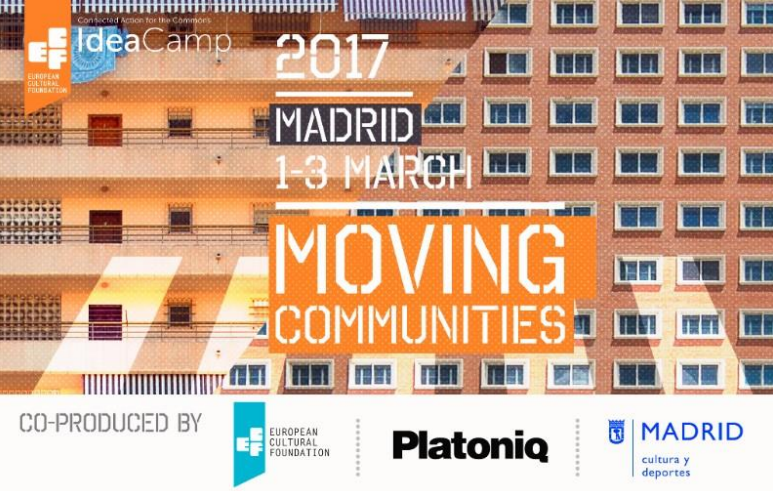
In the framework of the Idea Camp 2017, the City of Madrid, the European Cultural Foundation and the Connected Action for the Commons are organizing the Innovative City Development meeting with municipal and city officials who are working in a progressive approach on cultural and urban related issues, using participatory methods. On March 2nd and 3rd attendees from Poland, Spain, Greece, Moldova will co-exchange about the city as commons and also meet with the Idea Makers.
The meeting will have two fundamental goals:
- To facilitate co-exchange and learning about the city as commons through presentation of practices and experiences
- To engage the participants to broaden knowledge on both activists’ and institutions’ approach to city space and its problems.
Connected Action for the Commons will contextualize the meeting: it is a network and an action research program working mainly on topics linked to the commons such as public spaces, culture and democracy. It is in the process of co-developing and exchanging expertise as a network and engaging its local communities.
Christian Iaione, LabGov’s co-founder, will attend the meeting and facilitate the majority of the sessions.
Further information about the Idea Camp 2017 is available here: http://www.culturalfoundation.eu/connected-action/

by Maria Elena Santagati | Feb 27, 2017 | The Urban Media Lab
On 7th and 8th February 2017 Marseille hosted the seminar “Patrimoines et biens communs au regard des droits culturels”, organized within the framework of the “Chaniter Patrimoine(s) et bien(s) commun(s)”, a research-action site devoted to analyse, debate and exchange knowledge about the phenomenon of heritage communities, defined by the Faro Convention on the value of cultural heritage for society (2005) as:
art.2.b.“Heritage community consists of people who value specific aspects of cultural heritage which they wish, within the framework of public action, to sustain and transmit to future generations.”
Building on this definition, many community-based initiatives have been developed so far, serving as the Faro good practices[1]: Heritage committee, Heritage walk, Residents’ co-operative, Urban revelation workshop, Metropolitan trail.
Among the case studies presented during the seminar was the experience of Hotel du Nord, a residents’ co-operative which offers hosting and touristic opportunities by enhancing local cultural heritage in the northern neighborhood of the city of Marseille. It began as an experimentation in 2009 and was officially founded in 2011, as a result of the mission expérimentale européenne de patrimoine intégré, an interesting project launched in 1995 by the city of Marseille, the Council of Europe, the University and the CNFPT (the National center for the territorial public service, in the framework of the national program of rehabilitation of the inner harbour of the city). This process was carried out as an intense research and action activity, which led to the foundation of 8 heritage communities. In 2009, the mayor of the northern district of Marseilles also signed the Faro Convention and a first experimentation of residents’ co-operation was carried out during the preparatory process of Marseille European Capital of Culture 2013.
Picture from Stories.com, available here: http://stories.coop/stories/hotel-du-nord-the-cooperative-hospitality/
Hotel du Nord now proposes a network of 70 hosts, mainly residents, 60 bedrooms and 50 heritage walks to discover the natural and cultural heritage of the area. It clearly pursues the main aim of the Faro Convention, that is recognizing and promoting the social value of cultural heritage. As a matter of fact, it aims to obtain economic benefits from local heritage, to be reinvested for its preservation and enhancement, while at the same time improving residents’ quality of life and visitors’ touristic experience, through their active participation. All that adopting an experimental approach which tries to mobilize the social and cooperative capital of the local community. A further step is the experimentation of Hotel du Nord practice at the national level, in partnership with different actors from the social tourism and cultural sectors, through the co-operative Les oiseaux du passage.
As Prosper Wanner, director of Hotel du Nord, affirms: “What we need is a new paradigm triggering changes at least on three levels: cultural, economic and institutional. We try to move from a public policy approach to a public service approach. In cultural heritage policies, many efforts are devoted to promote access to culture, while we are interested in promoting citizens’ participation in the policy process. To this end, a new relationship between civil servants and citizens should be developed. The roles of each actor should change in order to lay the foundations for a better cooperation, in which citizens become co-producers, also by having access to civil servants’ competences. With Hotel du Nord, we also experiment and produce new legal provisions and new knowledge which help the Council of Europe to make progress in the Faro Convention implementation”.
The creation of heritage communities and co-operatives deeply relies on the specific territorial context, thus requiring ad hoc supporting processes. According to Prosper Wanner, “There is not a one-size-fits-all solution. There are some principles and methodologies related to the Faro Convention, which mainly rise from ongoing processes. For instance, what we experimented with Hotel du Nord and later on in Pilsen, within the European Capital of Culture experience, and in Forlì, within the ATRIUM-Architecture of Totalitarian Regimes in Urban Managements project, is a process made up of different steps: a training phase, through “The school of hosts”, opened to residents and professionals, a programming phase to identify enhancement activities, for instance heritage walks, and a promotional activity. In this respect, a networking activity is useful to exchange experiences”.
The Council of Europe works at different levels in order to promote, facilitate and strengthen the implementation of the Faro Convention, with many initiatives included in the Faro Action Plan, like Faro Community, Faro in Action, Faro Spotlight and Faro research. As Wanner affirms: “With the Council of Europe, we are working at least in three directions: developing new narratives as regards cultural heritage, beyond the national one, promoting the approach of cultural heritage as a commons and enhancing citizens participation in public policies for an increased cooperation”.
“I am particularly interested in the perspective of commons as democracy spaces” says Wanner. In this direction, he identified a range of suggestions which could be useful for the elaboration of a cultural heritage as a commons policy[2]:
- create a heritage public service in which citizens co-manage culture heritage
- create a cultural heritage open data system
- elaborate a public regulation on cultural heritage commons
- make the European Heritage Days an opportunity to promote the Faro Convention implementation
- experiment participatory governance of culture according to the heritage committees model promoted by the Council of Europe
- develop an observatory of the Faro Convention implementation within the Council of Europe.
The Hotel du Nord experience and the inspiring ideas laying behind it definitely give us some food for thought!
[1] They are identified by the Faro Community and included in Faro in Action, an active learning platform gathering good practices and promoting exchange and dialogue among practitioners, facilitators and heritage actors.
[2] Published here: https://farovenezia.org/2016/02/17/proposte-per-una-politica-pubblica-patrimoniale-in-favore-del-diritto-al-patrimonio-culturale/
—————————————–
Le comunità patrimoniali, nate nell’ambito della Convenzione di Faro sul valore del patrimonio culturale per la società, costituiscono un’opportunità importante per favorire un approccio al patrimonio culturale come bene comune. Tra queste, esemplare è l’esperienza di Hotel du Nord, cooperativa di abitanti della città di Marsiglia che propone ospitalità e interessanti modalità di fruizione turistica, in un’ottica di valorizzazione del patrimonio locale e di massima cooperazione tra cittadini e istituzioni.


