Photograph Line AlgoedLabGov has already talked about CLT (here and here) but this time is different. Fideicomiso de la Tierra, the name of the CLT that we examine today, is the first Informal Settlement Community Land Trust in the world. Created in a participatory way by government, residents and technical professionals, it was born with the purpose to preserve and develop informal communities along the Martín Peña Canal[1], a polluted canal around which a community of nearly 30,000 people lives – San Juan is in fact the most densely populated area in Puerto Rico
The CLT today works to solve land title problems in the Martin Peña Canal District, to avoid involuntary displacement of residents, to acquire and maintain properties for the community’s benefit and to facilitate residents’ involvement. It follows some precise guiding principles, such as the promotion of the residents’ participation in decision-making, the encouragement of equality, safety and access to basic services and the improvement of public spaces and transportation. The main goal remains the housing development and affordability, and for this reason the CLT cannot resell the land and it can only sell or rent housing for the members’ benefit. The CLT is an active actor in the local real estate market: the residents collectively own the land, lease the land in the trust, own the buildings and when they decide to sell the home the CLT can buy it back; in addition, in case of mortgage and problems with the loan payment, the CLT can intervene. It also supports residents with financial education and specific programs to promote citizens’ participation and critical awareness, to address and improve social justice, affordable housing, food security, violence prevention, youth leadership, adult literacy and local entrepreneurship. It should be noted that under the CLT residents are more protected from forced eviction than through individual titles and more safe from market speculation (the land is not owned by individuals, thus the value does not affect the house price). Today the communities along the Martín Peña Canal collectively own 200 acres of land that cannot be sold.
This is the current state of Fideicomiso de la Tierra, but the informal settlement of San Juan has a long history of disinterest and abandonment from the government, which failed during the years in installing proper sewage systems or cleaning systems with the consequence of many floods; the area indeed was originally established on mangrove wetlands without an adequate water drainage system, and every even mild rain storms led to flooding, raising sewage and polluted waters and causing health and environmental problems for the residents; in addition buildings never stopped to discharged row sewage into the canal.
For years the local communities demanded the dredging of the canal while fearing displacement and the rising land values typical of a neighborhood improvement. In 2001 the situation was so awful that the US Army Corps of Engineers intervened to dredge the canal and restore water flow. Finally, the government showed to be committed in revitalizing the canal’s conditions as well as the canal communities. An important process of connection with the communities started, and from 2002 and 2004 the government held 700 participatory meetings. These meetings represented a huge opportunity to connect residents and experts and explore the local concerns, presenting legal tools to preserve affordable housing and formalizing landholdings. Dredging the canal and revitalizing the communities meant to avoid residents’ displacement; and the creation of a collective land title, as the CLT, appeared to be the best idea to maintain alive the community. The meetings helped in collectively drawing up a formal development and land use plan, the Comprehensive Development Plan, then adopted by the Puerto Rico Planning Board. With the help of national and city government support, local residents and organizations set up a collaborative project called ENLANCE to help the implementation of the plan and to reply to some fundamental issues: to restore the environmental integrity of the channel, to protect the health and safety of community residents and to promote an inclusive, democratic city quality public spaces as well as wealth opportunities for the community. The residents created the Group of Eight Communities (G8), in partnership with the government and the private sector, to promote their economic, social, and community development throughout the establishment and maintenance of a CLT[2]. In the same year the Law 489/2004 entered in force and created the Martin Peña Canal Special Planning District[3], a district of 200 acres of public land transferred by the government to the ENLANCE project. The law also established the future incorporation of the CLT. With this law, many informal housing projects were regularized. ENLANCE[4] then became an independent government agency with limited-lifespan; it was and still is a crucial actor, a local intermediate that coordinates the project implementation in terms of housing development, infrastructures, dredging, canalization, and also in terms of urban socio-economic development guarantying the citizen participation and promoting the community empowerment. The ENLANCE’s board of directors (made by representatives from the public and the private sectors and of community residents) is appointed by the Governor of Puerto Rico and by the Mayor of San Juan; the community resident board members should be at least 45% of the board and they are indicated by the G8.
With the law the property rights of any land in the District were transferred firstly to ENLANCE and regularized. Residents gained the right to inherit and maintain ownership of their home, while the title of the land was of ENLANCE, guarantying the stability of the real estate values of the lands. To transfer the land title from ENLANCE to the CLT, from 2006 and 2008, three rounds of community workshops were implemented and the CLT’s General Regulations created, with the support of an Advisory Board for the legally formalization of resident’s needs and requests. Finally, in October 2008 the General Regulations were promulgated and the land transferred to CLT by formal deed on May 2009. The Regulations stressed the important role of the CLT as a “mechanism of collective possession in order to solve the problem of the lack of ownership titles” and to “avoid involuntary displacement” of canal residents.
In the following years CLT, supported by ENLANCE, made significant progress in terms of self-financing and human relocation of residents when required for the canal dredging. The goal is to become independent once relocations are completed and the work of ENLANCE completed. Today CLT makes money from selling homes, renting property, investing in the community and receiving donations. According to the Regulations, it must reinvest profits into the communities following the priorities planned in the Comprehensive Development Plan (such as using a revolving fund for infrastructure projects and buying properties) and when a resident sell the home it receives part of the proceeds. In addition, it can rely on the economic support (subsidies) from both public and private sectors and on a large group of volunteers.
Today the most difficult task is the relocation of residents still living very close to the canal, since their houses should be removed to allow the proper dredge of the canal. The process is quite long and today there are 1090 households to relocate (ENLANCE has already relocated 110), but all steps are made in a participatory way and always keeping in consideration the families’ needs and supporting them throughout the entire process (evaluation of the home, identification of a right offer, assistance on finding a new home for sale, pay moving expenses….).
The San Juan CLT in 2015 won a Building and Social Housing Foundation World Habitat Award, as a recognition for its ability in transforming the informal settlement of San Juan from a polluted and flood prone river channel into a sustainable community, and in providing a new model for improving informal settlement in cities. Fidecomisio de la Tierra represents the primary mechanism through which the local communities surrounding Martín Peña Canal are overcoming poverty; it has completely transformed the area and enabled the local community to legalize the relationship between more than 2,000 families and the land on which they stay, to access to affordable and safe housing, to resettle in a fair way people living close to the canal in risk areas, to improve environmental conditions by developing basic infrastructures and dredging the canal, to ensure ownership, to learn how to collective manage the area and how to favor the community participation.
Fidecomisio de la Tierra is a unique model of social justice in Puerto Rico; it has already proven to be successful in the US where over 247 CLT promote the revitalization of marginalized communities and the development without displacement, and today it is considered a model of self-improvement and sustainability, as well as a model of local participation and collective action, also for other informal communities around the world struggling with development and gentrification.
[1] The news was reported by RioOnWatch, a program to bring visibility to Informal Settlements’ community voices born in 2010.
[2] The G8’s board is composed by representatives of 12 communities organizations annually chosen in community assemblies.
[3] The District refers to an area composed by the seven communities that lived along the canal and wanted the creation of the CLT.
[4] The ENLACE Project is driven by the Caño Martín Peña ENLACE Corporation, the G8 Inc., and the Caño Martín Peña Community Land Trust, as well as a large G8 group of partners that includes universities, foundations, and private and public organizations.
****
A San Juan, Porto Rico, il primo caso di Community Land Trust all’interno di una favela. Creato in modo partecipativo coinvolgendo i residenti e con il supporto pubblico, Fidecomiso de la Terra è nato con lo scopo di preservare e sviluppare le comunità informali (circa 30 mila persone) lungo il canale di Martín Peña. Il CLT di San Juan nel 2015 ha vinto il premio Building and Social Housing Foundation World Habitat come riconoscimento per aver trasformato l’insediamento informale da canale fluviale inquinato e perennemente inondato in una comunità sostenibile. Oggi è considerato un modello di giustizia sociale e partecipazione locale per altre comunità informali che nel mondo lottano per lo sviluppo e contro la gentrificazione.
In the last few years, the commons have enriched themselves with their entry into political institutions at the level of states, large cities or regions, whether in Bolivia, Ecuador, Spain, Britain, France, Italy, and elsewhere in the world. How can this encounter inspire us? How does the commons paradigm fit with other proposals for a post-capitalist alternative, such as de-growth, social and solidarity economy, political ecology, open cooperativism, and much more? How to avoid the “commons washing” and recovery of the project and the values of the commons in the dominant discourse?
Professor Christian Iaione, LabGov coordinator, was between the experts and practitioners interviewed in this occasion. In his speech he touches on different topics: from the experiences that are taking place in numerous Italian cities around the urban commons to the importance of creating a stronger network of cities committed to addressing emerging urban issues; from the understanding of the value of experimentation to development of the capacity to address failure; from the importance to involve all local actors in the care and regeneration of the urban commons to the exigency of rethinking the role of the State and of the local administration.
The city of Reggio nell’Emilia (better known as Reggio Emilia), located in the hearth of Emilia Romagna, counts a population of 172.000 inhabitants. 27.000 of them are involved in activities promoting social cohesion.
These numbers, which highlight the existence of a strong social capital, help us understand the peculiarity of the approach adopted by the city administration. According to Valeria Montanari, Councilor for innovation, administrative simplification, participation and care of the neighborhoods, this peculiarity lies in the idea of “the city as an infrastructure that is made available to people”[1]. In line with this view, the administration guided by Major Luca Vecchi, elected in 2014, has been promoting citizens’ participation in policy making, allowing for “the co-design not only of the actions, but also of the objectives that the city wants to pursue”[2].
The choice to adopt a governance paradigm based on participation and collaboration implies the willingness to challenge and to change the traditional role of the public administration and its relationship with citizens. A process of institutional and bureaucratic innovation is being developed by the administration, which rather than simply providing services to their citizens aims at becoming an enabler for participatory paths and practices, bringing citizens at the center of the decision-making process. As explained by Nicoletta Levi[3], who is in charge of the service Policies for Responsible Protagonism and Smart City, what is being done in Reggio Emilia is strongly experimental, and this requires the administration to continuously stop to understand in which direction they are going. Collaboration might create a strong tension between the rigidity and division that characterize the public administration functioning and the strong flexibility and interconnectedness typical of the reality we live in. To be able to create a dialogue with the civil society the public administration should undergo a transformation and should learn how to work horizontally and be more flexible.
Being aware of this framework allows us to fully understand the innovative processes activated by the city in the last years.
The QUA Program – (Neighborhood as a Commons)
The city of Reggio Emilia has been directly affected by a law that entered into force in March 2010, which prevents cities with less than 250.000 inhabitants to organize their territory into districts (circoscrizioni in Italian). Rather than being an obstacle, this law became an occasion for the city Reggio Emilia to think of new forms of decentralization and city management and to focus on the needs of its citizens. What is particularly interesting about the approach adopted by the city of Reggio Emilia is the choice to work at neighborhood level and to adopt neighborhoods as the unit of measure.
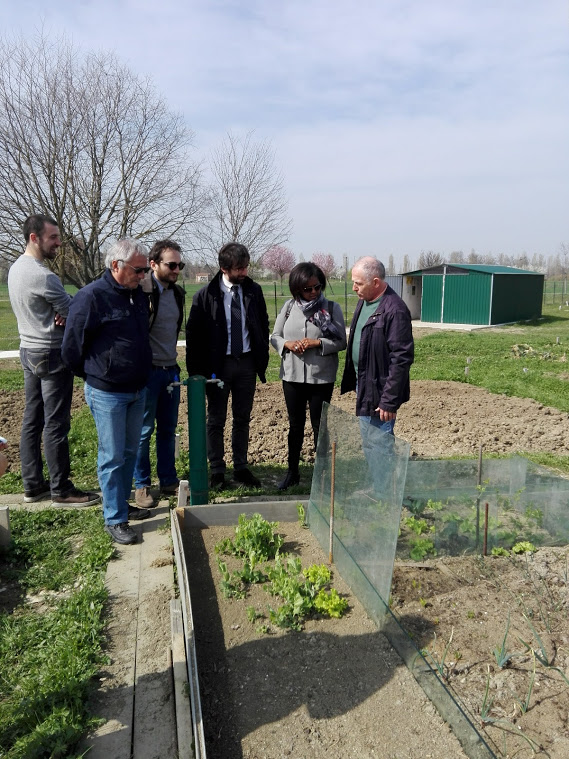
During a visit to the community gardens managed by the cultural center L’Orologio
This is evident when we look at the project QUA (neighborhood as commons) which aims not only at strengthening citizens’ participation, but also at giving citizens a protagonist role, both as single individuals and as associations and informal networks. In December 2015 the City Council of Reggio Emilia approved the Regulation for citizenship labs (full text in Italian is available here). The Regulation establishes collaboration, stimulated and supported through participatory paths, as a crucial feature in the relationship between citizens and the local administration for the care of the city and of the community itself.
As explained on the official website of the city, this document is freely inspired to the Bologna Regulation, but it has a strong territorial connotation as it is adapted to the peculiarity of the local community and environment. Therefore, it underlines how neighborhoods should be understood as commons, meaning with this as fields where associations, informal networks, citizens and administration can connect and can develop together a new idea of participation and active citizenship.
The city has been divided into 19 neighborhoods, or territorial areas (ambiti territoriali), which are being the theater for the establishment of CitizenshipLaboratories and Citizenship Agreements, that are being developed and coordinated by the new figure of the Neighborhood Architect.
The Regulation sets a procedural path, made of 9 phases, to be followed by the Laboratories. The Architect plays a fundamental role in the whole process as he is, using the words of Nicoletta Levi[4], an “activator of social resources and a mediator between center and periphery and between public and private”.
The project has been met with great interest by citizens, and the participation has been high. By December 2016, 9 agreements had already been signed, 896 people had taken part in the participatory paths and 64 projects had been defined. Between these projects we find really different experiences, ranging from the creation of a book-crossing network involving local libraries, community centers and citizens, who imagined and produced structures to be placed in public spaces that allow for the book exchange, to the development of Participation Houses (an example here), places located in the neighborhood that can facilitate interaction and dialogue between a variety of local actors. Furthermore, these projects also include the creation and management of urban gardens (one example are the gardens managed by the cultural space L’orologio) and the development of Wifi communities, like the one that has been put in place in Villa Coviolo, an area located at the South-West of the city .
CO-Reggio Emilia and the path of #CollaboratorioRe
The S.Peter Cloister, object of the #CollaboratorioRe co-design path
The commitment of the Municipality towards participation and collaboration in decision making processes and in city making is at the bases of the CO-Reggio Emilia[5]project, that was promoted by the local administration in collaboration with the University of Modena and Reggio Emilia and with the scientific, strategical and organizational support of LabGov and Kilowatt.
The process began with the activation of the participatory path of #CollaboratorioRe, which brought together citizens, associations, private actors, cognitive institutions and members of the local administration (as envisaged by the quintuple helix[6] approach of urban co-goverance) and allowed them to collaboratively shape the future of the “Chiostri di San Pietro” area, a urban commons holding a particular relevance for the city and for its inhabitants.
As explained by Valeria Montanari “#CollaboratorioRe aimed at creating the first incubator of sharing and pooling economy of Reggio Emilia, a new urban actor that will revolutionize the way we think about the city and will emphasize the role that civic collaboration should play in the care and management of the urban commons”.
What makes the experience of #CollaboratorioRe particularly relevant is that while working on the regeneration of a physical space and on the creation of this new urban actor, the city is also activating a broader reflection on the idea of knowledge and culture as commons[7] by working on the relationship between technology and culture and by attempting to reduce technological inequality through education and informal exchange of information.
Conclusion
The experience of Reggio Emilia shows us that when institutions are willing to accept the challenge and to transform themselves, a paradigm change is really possible. By adopting a view of the city as an infrastructure that is made available to people, institutions and citizens are able to come together and collectively design the future of their neighborhoods, of the urban commons and of the city itself.
[3] Nicoletta Levi presented the experience of Reggio Emilia and of the project QUA – Quartiere Bene Comune in occasion of the CO-city project presentation in Turin,on March the 31st 2017.
[7] Y. BENKLER, Commons and growth: the essential role of open commons in market economies, The University of Chicago Law Review, 2013, and C. HESS, E. OSTROM, Understanding Knowledge as a Commons, from theory to practice, The MIT Press, 2007
……………………………………………………
Reggio Emilia è una città caratterizzata da un grande capitale sociale: su 172 mila abitanti, 27 mila sono impegnati in attività di coesione sociale. Questi numeri ci aiutano a capire la particolarità dell’approccio adottato dell’amministrazione locale che, come ci spiega Valeria Montanari, Assessora ad Agenda digitale, partecipazione e cura dei quartieri, è legata all’idea della città come infrastruttura a disposizione delle persone.
What is the role that public administrations should – and must – have in the creation of a new economic development paradigm able to generate sustainable and equitable wellbeing? This question will be at the heart of the series of conferences and workshops organized within the framework of FORUM PA 2017, which will take place from the 23rd to the 25th of May in Rome.
Within this general framework, the participants will discuss the importance of innovating public administration in order to provide answers to the pressing and ever growing issues faced by citizens. From unemployment to the right to health care, from raising inequalities to concerns about security, and much more. It is important for the PA to speak not only about itself and with itself, but to focus instead on why this innovation is deeply needed.
To be able to address these complex themes, the program of the convention is organized into 4 different kind of events: “scenarios”, “thematic conferences, “workshops” and “academies”. The complete program of the event is available here.
LabGov will take part in several events:
On the 23rd Professor Christian Iaione, LabGov’s coordinator, together with Giovanni Vetritto, from the Presidency of the Council of Ministers, will be chair of a conference titled “Sharing and Local Public Services”, which will take place from 9h30 to 11h30.
In the afternoon, from 14h30 to 18h00, we will be present during the conference“Social Innovation and Municipalities: from experimentations to policies”, promoted in collaboration with ANG, ANCI and RENA.
On the 24th Professor Christian Iaione will be chair of a conference titled “PARTICIPATION: models, policies and interventions in Italian cities”, an event which is developed within the framework of the Integrated project on Participation and Communication promoted by the Municipality of Palermo, which will be represented during the conference by Giusto Catania, Councillor for Participation, Communication, Decentralization, Demographic Services and Migration. The event will take place from 11h45 to 13h30.
On the 25th, during the national meeting of Italian cities participating in the URBACT network, which will go on from 11h00 to 14h00, Professor Christian Iaione will give a speech on the topic “Italian cities, between innovation and participation”.
…………………………………………………………………………………..
FORUM PA 2017 sta per iniziare: dal 23 al 25 maggio a Roma si terranno una serie di conferenze e workshops, attraverso cui si affronterà il tema dell’innovazione nella pubblica amministrazione. L’interrogativo con cui questa edizione di FORUM PA vuole confrontarsi è quello del ruolo che le amministrazioni pubbliche possono e devono avere nella costruzione di uno sviluppo economico e sociale che garantisca benessere equo e sostenibile.
Il programma completo dell’evento è disponibile qui.
We have already presented the Community Land Trust’s model (CLT), as a membership-based, non-profit organization chartered to hold and manage land in trust for the benefit of a given community, underling how the three elements, land, trust and community, are at the core of the model itself. The main goal is to provide long-term model affordable housing to low-income families using a resale-restricted model and to promote community control over development, while revitalizing neighborhoods (Dwyer, 2015). The land is held in trust by the CLT for the benefit of the community in different ways that ensure that homes remain affordable for future buyers over time. A low income individual or family looking for a house becomes member of the CLT, buys a house in the CLT and leases the land on which the house from the CLT lies. The CLT is always in contact with its member (Gray and Galande, 2011), also after the sale, and in case the residents default on the mortgage it can intervene to prevent foreclosure. Its democratic governance structure reflects the idea that the CLT operates within a community, whose members are part of the decision processes.
In Boston, in the Roxbury and North Dorchester area, there is one of the oldest and most acclaimed urban CLT in the US, the DSNI, Dudley Street Neighborhood Initiative. Its history dates back to 1984, when some brave residents, with crucial support from a few local funders and community leaders, decided to revive their neighborhood, which was devastated by arson, trash and disinvestment.
Boston has always been one of the most expensive cities in the US, with the highest income inequality, partially linked to the lack of affordable housing, and in recent years housing prices have not been decreasing (Bluestone et al. 2015); so much so that, even today, the demand for affordable housing far exceeds the city’s supply and recent data reveal that the real estate market is getting even more expansive. As a result, strong processes of gentrification and displacement invested the city, increasing housing costs for low and moderate income families (who have always been the heart of Boston’s neighborhoods) (Cho, Li and Salzman, 2016). According to the Federal Reserve Bank of Cleveland, Boston has one of the highest rates of gentrifying census tracts (Hartley, 2013). Those who used to be affordable neighborhoods went through a gentrification process, becoming inaccessible.
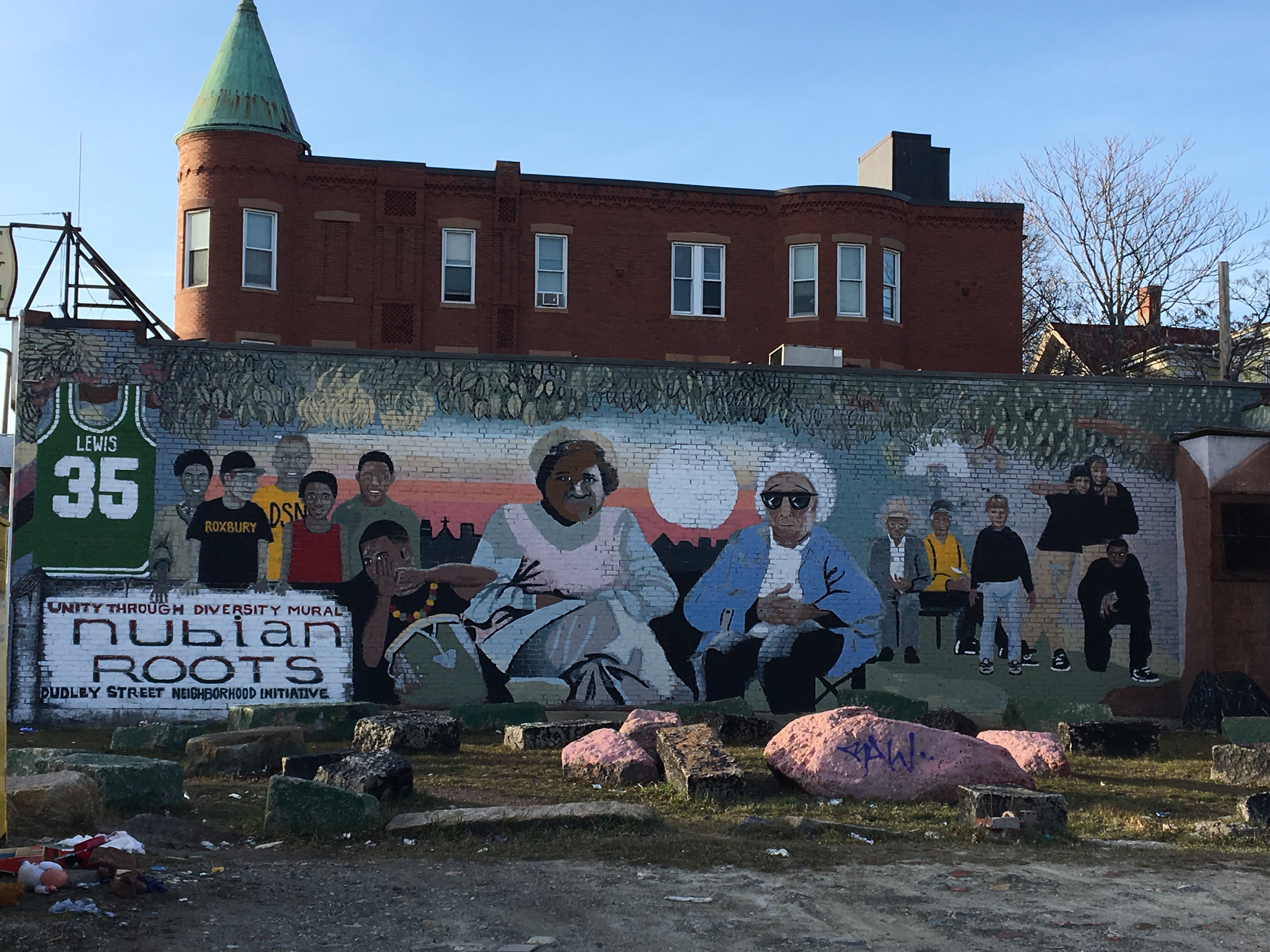
The Dudley Street area was not excluded from these trends and the neighborhood was full of vacant lots and boarded-up buildings, abandoned cars and dumping. The risk was that all these properties could be sold by the city or their private owners and the area, could be cleaned up and converted into high-price condo, hotels, offices and luxury homes serving downtown Boston. This would have pushed out the numerous lower-income residents of the Dudley neighborhood (that is historically a black and latino area[1]).
Source: author’s pic
This was the reason at the origin of the DSNI’s birth. The priority soon became to make “development without displacement” (The Dudley Street Neighborhood Revitalization Plan 1987), building new affordable houses and distributing additional housing vouchers for low-income families, incentivizing long-term ownerships among low-income residents and reducing speculative purchasing of homes and vacant lots. Black, Latinos and Cape Verdeans residents became involved in identity-based organizations expressing an active desire to redevelop the area. A tripartite board of governance was established. It was made of equal numbers of representatives of the four main ethnic groups inside the community (African-American, Cape Verdean, Latino and White) and it had 3 main features:
Sustained emphasis on community organizing and empowerment;
Long-term comprehensive view of planning;
Active community governance.
Each board member could (and still can today) vote about every decision taken for the benefit of the community, none can change the rules or decide in behalf of the community. The focus is always on maintaining culture and building community spirit through new opportunities, housing, and youth involvement, making local residents always the primary beneficiaries. Today the board is composed by 34 members (the number can vary at each election), community-wide elections are held every 2 years and the DSNI holds an Annual Meeting. The structure is so organized: 16 residents from the whole area, and then members of non-profit agencies representing the Health and Human Service fields from the core area, members of the Community Development Corporations from the core area, small businesses representatives from the core area, religious organizations from the core area, youths (15-18) from the core area, non-profit organizations from the secondary area and residents appointed by the newly elected board. To note: John Barros, the longest-serving executive director, involved in the DSNI since the age of 14, is now the City of Boston’s Chief of Economic Development. Another aspect worth underlining is the importance given to youth, an investment that can bring enormous long-term benefit. Furthermore, the DSNI partners also with universities (the Tufts University is the more involved, the Department of Urban and Environmental Policy and Planning is carrying out a specific project with the neighborhood, CoRe, Co-Research/Co-Education Partnerships).
Source: author’s pic
The support of other local entities, at the beginning especially of Community Development Corporations (CDCs) also concerned about both community-building and affordable house (such as Nuestra Comunidad CDC, Dorchester Bay Economic Development Corporation, Madison Park Development Corporation), was crucial. Organizations like the Project Hope also partnered with DSNI and contributed to housing stability in the area, and of great importance was the support of foundations, like the Riley Foundation and the Ford Foundation. The stable affordability of houses is made possible because the land trust owns the land and leases it to the homeowners who just owns the housing structure, but not the land; if they want to move away, the land, property of the CLT, is reassigned to other families (usually through a lottery, in order to avoid discretionary choices). It is important to underline that DSNI is the only community organization in the US to have obtained the city’s power of Eminent Domain, that allows it to manage 64-acre core area (Dudley Triangle) to redevelop it. This allows them to own the land and makes it possible to realize the vision of a development without displacement.
The 1987 comprehensive masterplan in 1996 was updated adding important refinements and renewing the commitment of creating an “urban village”. Today inside the DSNI there are many different groups, communities and institutes working to achieve the community’s goals. The most famous is the Dudley Neighborhood Inc. (DNI), a CLT created in 1988 by DSNI to implement and develop DSNI’s masterplan. Then there are the Resident Development Institute (RDI), the DSNI Sustainable and Economic Development Committee, the FCC – Fairmont Cultural Corridor, the Dudley Real Food Hub, the Dudley Youth Council (DYC), the Greater Boston Community Land Trust Network, the Community Development Children (Dudley Children Thrive – DCT), the College Bound and the Boston Parent Organizing Network, as well as initiatives like the No Child Go Homeless Campaign, the Dudley Workforce Collaborative, the GOTCHA (Get off the Corner Hanging Around) Youth Jobs Collaborative, the Neighborhood Safety and Beautification, and the most famous, the Multicultural Festival that has held every year to celebrate the vibrancy of the community within the Dorchester and Roxbury neighborhoods.
In 30 years the DSNI transformed vacant lots into bike paths, community centers, playgrounds, community gardens fountains, art programs, a town commons, youth programs, parent meeting, college opportunities, a food project, a school: a real and thriving community. There are more than 3,600 members, and over 400 new homes; each program and communication is held in English, Spanish and creole and the projects managed by the CLT are many and touch different topic, from jobs to academic education help, from youth development to children activities to parents training and support, from food, gardening and urban agriculture, to affordable housing, local facilities and community building. In addition, in the last years the Boston Promise Initiative (BPI) was implemented. It is a strategy designed to create a community of opportunity – centered around strong schools, families, and resident leadership – that allows every child to learn, grow, and succeed. The goal is to transform the Roxbury and North Dorchester neighborhoods into the Dudley Village Campus (DVC), “a learning environment where children are wrapped in high-quality and coordinated health, social, educational, and community supports from cradle-to-college-to-career”.
The DSNI’s mission, as one can read on the website, is to empower Dudley Street residents to organize, plan, create and control a vibrant, diverse and high quality neighborhood, in collaboration with community partners. And what the DSNI did in the last 30 years shows that the goal was not out of sight. Of course there are still problems to face, but the success of this model is demonstrated by the decision of the Mayor Walsh to include the land trusts as the first of six goals for Boston neighborhood development, as presented in the planning report “Housing a Changing City: Boston 2030”, that specifically lauds the DSNI model. As explained in the report, through the neighborhood development program Boston will “Mitigate impacts of gentrification through targeted home buying programs, strategic acquisitions, community land trusts, tenant assistance, and expanded outreach to seniors” (2014) (Dwyer, 2011).
Cho, S., Li, K. and Salzman T. (2016). Building a Livable Boston: The Case for Community Land Trusts. Tufts Urban and Environmental Policy and Planning Department. Available at the address: file:///C:/Users/Utente/Downloads/Building+Livable+Boston+final+5.13.16.pdf
[1] Of the neighborhoods 24,000 residents, 40% are African-Americans, 30% Latin Americans mostly from Puerto Rico and the Dominican Republic, 24% Cape Verdeans, from islands off the coast of West Africa, and 6% Whites mostly elderly Irish and Italians who have lived in the neighborhood since the 1950s.
*******************
A Boston, nell’area compresa tra i quartieri di Roxbury e North Dorchester si trova il DSNI – Dudley Street Neighborhood Initiative, uno dei più vecchi e acclamati CLT d’America. Il community land trust (CLT) è una sorta di trust fondiario che mira a garantire alla comunità circostante la disponibilità a lungo termine di alloggi a prezzi accessibili. Nel triangolo intorno a Dudley Street, a partire dal 1984, si è sviluppata una coraggiosa comunità che si è battuta per evitare l’innescarsi di processi di gentrificazione e trasferimento della popolazione locale, a basso reddito, e si è mobilitata per consentire a tutti di avere accesso ad un’abitazione a prezzi contenuti, ripulendo l’area, creando un CLT, e avviando processi di community building incredibili. Oggi, oltre 60 acri sono di proprietà del DSNI, unica organizzazione americana ad aver ottenuto l’eminent domain, la terra è di proprietà del CLT e le case sono date invece ai membri dell’iniziativa a prezzi accessibili. Ma ancor più rilevante è stata la capacità dei residenti di creare in 30 anni una comunità attiva, capace di organizzare, pianificare, creare e controllare un quartiere vibrante ed eterogeneo, in collaborazione coi tanti partner locali, avviando progetti per il sostegno dei giovani e delle famiglie locali.


 This is the current state of Fideicomiso de la Tierra, but the informal settlement of San Juan has a long history of disinterest and abandonment from the government, which failed during the years in installing proper sewage systems or cleaning systems with the consequence of many floods; the area indeed was originally established on mangrove wetlands without an adequate water drainage system, and every even mild rain storms led to flooding, raising sewage and polluted waters and causing health and environmental problems for the residents; in addition buildings never stopped to discharged row sewage into the canal.
 Today the most difficult task is the relocation of residents still living very close to the canal, since their houses should be removed to allow the proper dredge of the canal. The process is quite long and today there are 1090 households to relocate (ENLANCE has already relocated 110), but all steps are made in a participatory way and always keeping in consideration the families’ needs and supporting them throughout the entire process (evaluation of the home, identification of a right offer, assistance on finding a new home for sale, pay moving expenses….).