by Ieva Punyte | Jul 1, 2016 | The Urban Media Lab
On June 29th 2016 academics, practitioners and active citizens gathered at the Auditorium of Saint Apollonia in via San Gallo 25 in Florence for the opening of #CollaboraToscana, the public policy co-design process led by Tuscany Region, supervised by LabGov and managed by SocioLab.
#CollaboraToscana projected to focus on collaboration and sharing economy aiming to co-create a map of regional public policies – a synergy and a proposal for targets, actions and measures which would be co-designed and deployed at different levels to maximize opportunities and minimize risks for the sharing economy and collaborative development of the region. Therefore, the objective of the conference and workshop series was to introduce diverse, yet interconnected approaches and tools for regional collaborative practices. By emphasizing on sustainability, inclusion and the themes of presentations varied from start-ups to infrastructure, territorial regeneration and security, and from participatory governance to digital innovation and communication – all being closely tied to collaboration and sharing economy.
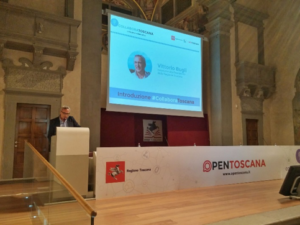
The event was opened by the Deputy President of the Toscana Region Vittorio Bugli who after a warm welcome acknowledged the promising #CollaboraToscana initiative. V. Bugli stressed that in regards to the sharing economy, sustainability and collaborative management of the region the recognition of civic participation is crucial. The Deputy President thus emphasized that it is important to address migration while focusing on collaboration. “In Tuscany we are very attentive to the reception of migrants fleeing from their countries”- said Bugli. “But we have to think of a greater integration, these people can be an important vantage rather than obstacle in terms of collaboration”- after the conference stressed V. Bugli.
 The first keynote Marta Mainieri (Collaboriamo.org), focused on collaboration in terms of innovation and start-ups. M. Mainieri stressed that the new economy model – a collaborative economy – is important first of all because its volumes are rapidly growing. “Gross revenue in the EU from collaborative platform and providers was estimated to be 28 billion in 2015. Growth in recent years has been spectacular with revenues almost doubling from 2014 to 2015”- presented M. Mainieri. Yet, despite of the growing amount of the sharing economy practices, M. Mainieri emphasized the need to recognize the real value of collaboration, which is based on collective knowing, connection, co-planning and communication and therefore is projected to contribute to the construction of open, more inclusive systems that are based on trust and reciprocity, rather than exclusion.
 The second speaker, Massimo Alvisi (Alvisi-Kirimoto, Renzo Piano G124) focused on city requalification and regeneration. By illustrating his presentation with the experiences from Viadotto dei Presidenti in Rome, Via Fossata in Torino, and Librino in Catania, M. Alvisi emphasized that in terms of urban regeneration, collaboration has a great potential to contribute to social wellbeing, security as well as revitalization of deteriorated urban areas (more information related projects: http://renzopianog124.com).
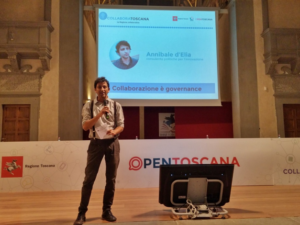 This was followed by the engaging Annibale D’Elia’s presentation. While addressing collaboration A. D’Elia, a consultant for innovation policies, touched upon topics of inclusion and citizens’ engagement. He stressed that collaboration in terms of governance is mainly about the unleashing the energy of the people, who should be enabled and facilitated in order to actively participate and collaborate. Furthermore, the last speaker Michele D’Alena, an expert in e-government processes and social innovation, supported Annibale’s comments by adding that digital means – the information communication technologies (ICT), are essential for sharing economy, collaboration as well as active citizens’ engagement.
The presentations were followed by Silvia Givone who represents Sociolab and works with #CollaboraToscana project. After thanking to all presenters S. Givone introduced the road map and the critical phases of #CollaboraToscana (more about #CollaboraToscana: http://open.toscana.it/).
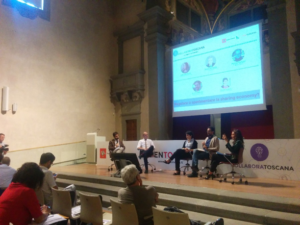
The first part of the conference was followed by the debate between Antonella Galdi, the vice secretary of the National League of Italian Cities, Stefano Bartolini, a professor of political economy at the University Siena, Ernesto Belisario, an expert in law of technology and innovation in public administrations, and Marta Leonori, representing the department of Civil Service.
Lastly, the conference was finalized by the series of workshops on co-planning to co-create concepts of collaboration and sharing economy by mapping (meaning, opportunities and problems) activities. Participants were divided into 4 groups (representing public and private sectors, knowledge institutions, civic social organizations) and were asked to further reflect on prevalent issues (infrastructure, services, goods and governance) and to design possible tools for a regional policies on the economy of sharing and collaboration.
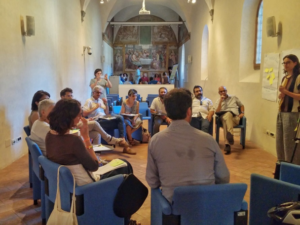
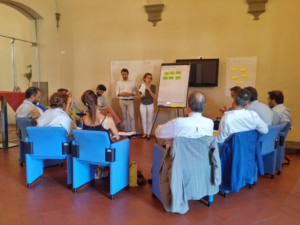
The event was moderated by Christian Iaione, LabGov co-director, who outlined the prevailing currents of collaboration and sharing economy and supported the presentations as well as panel debates by insightful comments.
by Chiara Fratalia | Jun 30, 2016 | Commons Press
This article is a focus on the figure of LabGov’s coordinator, professor Christian Iaione.
Christian Iaione is associate professor of public law at Guglielmo Marconi University of Rome, fellow of the Urban Law Center at Fordham University, and visiting professor of governance of the commons at LUISS Guido Carli. He is an expert of the EU Committee of the Regions and he is member of the Sharing Economy International Advisory Board of the Seoul Metropolitan Government.
Prof. Iaione has published several articles in the field of public and administrative law and, in particular, land use, public goods and the commons, public services and public contracts, urban law and local government. He has authored two books on In house publicly-owned companies. Contribution to the principle of self-organization and self-production of local governments (Jovene, 2007 – 2012, II ed.) and The regulation of urban mobility (Jovene, 2008) and has co-authored Italy of the Commons (Carocci, 2012) and The Age of Sharing (Carocci, 2015).
Here is an anthology of his publications:
Books:
- L’Italia dei beni comuni (with G.Arena), Carrocci, Rome, (2012).
- L’età della condivisione (with G.Arena) Carrocci, Rome (2015).
Recent Publications:
- La città collaborativa: la governance dei beni comuni per l’urbanistica collaborata e collaborativa, published in Agenda RE-CYCLE, Proposte per reinventare la città (Il Mulino, 2017). Available soon.
- The City as a Commons (Yale Law and Policy Review, 2016), together with Sheila R. Foster. “City space is highly contested space. As rapid urbanization takes hold around much of the world, contestations over city space – how that space is used and for whose benefit – are at the heart of many urban movements and policy debates”. Full article here.
- Lo Stato – Piattaforma di immaginazione civica, la politica e le istituzioni nel secolo del CO-, published in 25 anni di riforme della PA: troppe norme, pochi traguardi, 39 (Forum PA, Annual Report 2016). An analysis of how the State should begin to function as a Platform and of how institutions and policies should evolve in the “CO-” age – a period in which the key words seem to be community, collaboration, cooperation, communication, commons, co-design, co-production, co-management, co-housing, co-design, sharing, knowledge, etc. Full article here.
- La quintupla elica come approccio alla governance dell’innovazione sociale, published in I luoghi dell’innovazione aperta, modelli di sviluppo territoriale e inclusione sociale, 74 (Quaderni, Fondazione G.Brodolini, Studi e Ricerche, November 2016). In this paper it is stated that the “Collaborative City” (CO-City) urban co-governance framework, based on the three levels of sharing, pooling and poly-centrism, can facilitate collaborative and open knowledge production and social innovation processes within the city. Furthermore, the CO-City approach further elaborates on the triple helix governance model and develops a more complex and precise version, defined as quintuple helix model, which identifies the five actors of the polycentric governance. Full article here.
- Poolism: sharing economy vs. pooling economy (LabGov website, 2015). Sharing economy builds on new or revived social patterns having important business, legal and institutional implications: the social practices of sharing and collaboration. They both build on the well known social practice of co-operation.
Full article here.
- The Co-City (American Journal of Economics and Sociology, 2015).
This paper introduces an innovative, experimental, adaptive, and iterative approach to creating legal and institutional frameworks based on urban polycentric governance to foster collaborative urban planning. Full article here.
- The Collaborative and Polycentric Governance of the Urban and Local Commons (Urban Pamphleteer #5, 2015), together with Paola Cannavò. “Institutions, designed in a historical era in which the government handed out basic services to citizens, are nowadays required to design new types of services in collaboration with citizens. In order to define better forms of urban and local governance, it’s necessary to study and elaborate a new paradigm, to find new theories, policies and development models”. Full article here.
- Governing the Urban Commons (Italian Journal of Public Law, 2015).
The purpose of this paper is to investigate a fundamental question relating to institutional design in the public sector. After two centuries of Leviathan-like public institutions or Welfare State, do we still need full delegation of every public responsibility and/or exclusive monopoly of the power to manage public affairs? Full article here.
- La collaborazione civica per l’amministrazione, la governance e l’economia dei beni comuni (L’età della condivisione, 2015).
“In Italia i beni comuni sono ormai entrati nel lessico quotidiano. Il rischio è che «beni comuni» diventi un’espressione di senso comune, ma priva di effettivo valore semantico e, soprattutto, di rigore scientifico: casella vuota che chiunque si senta legittimato a riempire con qualunque significato”. Full article here.
- Città e Beni Comuni (L’Italia dei Beni Comuni, 2012).
“Dove va una persona se vive in una città, non ha la fortuna di possedere un giardino e sente il bisogno di immergersi in un ambiente naturale, usufruire di tutti i servizi che uno spazio verde può fornire come correre, leggere un libro su un prato all’aria aperta, respirare aria mediamente più pulita?”. Full article here.
- The Tragedy of Urban Roads: Saving Cities from Choking, Calling on Citizens to Combat Climate Change (Fordham Urban Law Journal, 2009).
This article argues that the best response to the tragedy of road congestion has to rely on market-based regulatory techniques and public policies aimed at controlling the demand-side of transportation congestion.
Full article here.
- Local Public Entrepreneurship and Judicial Intervention in a Euro-American and Global Perspective (Washington University Global Studies Law Review, 2008). “Local public entrepreneurship encompasses a variety of activities carried out by local governments designed to foster local economic development. This article presents local public entrepreneurship as a windfall of the right to local self-government”. Full article here.
A complete list of his publications is available here.
Recent articles and interviews:
- Il Giornale delle Fondazioni, “Spunti per una ri-costruzione” December 13th 2016. Available here.
- Linkiesta, “Non sarà il referendum a cambiare l’Italia, ma le città e il protagonismo delle piccole comunità”, November 26th 2016. Available here.
- New Europe – Cities in Transition, “The Possibility of a Co-city” – November 17th, 2016. Available here.
- Green European Journal, “The City as Commons” (Interview to Christian Iaione by Kati Van De Welde, ) Novembre 2016. Available here.
- Forum PA, “Christian iaione illustra il paradigma della città cooperativa” – Novembre 4th 2016 http://www.forumpa.it/citta-e-territorio/christian-iaione-illustra-il-paradigma-della-citta-collaborativa?utm_source=newsletter&utm_medium=FORUMPANET&utm_campaign=MAILUP
- Vita, “Bologna dove decolla la Pooling Economy”, November 3rd 2016 http://www.vita.it/it/article/2016/11/03/bologna-dove-decolla-la-pooling-economy/141452/
- Collaboriamo, “Co-progettare una policy sull’economia della collaborazione e della condivisione. L’esperienza di #CollaboraToscana” – September 11th 2016 http://www.collaboriamo.org/co-progettare-una-policy-regionale-sulleconomia-della-collaborazione-e-della-condivisione-lesperienza-di-collaboratoscana/
- The Academy of Urbanism, “Co-governance, building a stronger spirit of Collaboration” – July 25th 2016 https://www.academyofurbanism.org.uk/journal-co-governance-building-a-stronger-spirit-of-collaboration/
- European Cultural Fundation, Build the city Magazine, June 2016 “LabGov-Laboratory for the Governance of the Commons. A discussion between Michel Bauwens and Christian Iaione” and “Bologna celebrates one year of a bold experiment in urban commoning, by Neal Gorenflo” http://www.culturalfoundation.eu/library/build-the-city-magazine
- Shareable “Interviewed: Professor Christian Iaione on the City as a Commons” – February 17th 2015 http://www.shareable.net/blog/interviewed-professor-christian-iaione-on-the-city-as-commons
- Zavit (Israeli Environmental News Agency) – Interview with Professor Christian Iaione, 12 Aprile 2016.http://zavit.org.il/%D7%A2%D7%99%D7%A8-%D7%9C%D7%9B%D7%95%D7%9C%D7%A0%D7%95/Video available here http://www.ukayamut.com/Christian-Iaione
- Commons Transition, “The City as Commons, with Professor Christian Iaione” – March 2nd 2015 http://commonstransition.org/the-city-as-commons-with-professor-christian-iaione/
by Chiara Fratalia | Jun 30, 2016 | Commons Press
This document is an official CoR opinion that was drafted by LabGov coordinator prof. Christian Iaione, as an expert of the EU Committee of the Regions. It was examinated in the 115th plenary session of 3-4 December 2015.
The opinion contains some policy recommendations to the European Union in the subject of sharing economy, based on an analysis focused on the potential benefits that could spread from the enhancement of sharing economy on a local basis.
If you are interested in this subject, please explore the full document here.

by Chiara Fratalia | May 21, 2016 | The Urban Media Lab
Prof. Christian Iaione was invited today at SkyTG24 Economia to debate on sharing economy.
Prof. Iaione articulated his speech in two key points. First of all, he highlighted the need of a shift from the on-demand sharing economy to a collaborative sharing economy: sharing economy is much more than the mere contrast and comparison between Uber and taxi drivers or hotels and AirBnB.
Secundarily, there is a very little needs of law production to promote sharing economy. What is really important to spread the sharing is an ensemble of good policies: co-planning, experimentations, numerous multi-level interventions, from the involvement of schools and universities to the proper adaptation of economic sectorial laws.
SkyTG24 Economia will be brodcasted at 18.35. You can follow it here.

by Diletta Di Marco | Mar 18, 2016 | The Urban Media Lab
COST (European Cooperation in Science and Technology) is Europe’s longest-running intergovernmental framework for cooperation in science and technology funding cooperative scientific projects called ‘COST Actions’. With a successful history of implementing scientific networking projects for over 40 years, COST offers scientists the opportunity to embark upon bottom-up, multidisciplinary and collaborative networks across all science and technology domains. They have also enabled the creation of entirely new types of ‘digital’ or ‘virtual’ labour, both paid and unpaid, shifting the borderline between ‘play’ and ‘work’ and creating new types of unpaid labour connected with the consumption and co-creation of goods and services. This affects private life as well as transforming the nature of work and people experience the impacts differently depending on their gender, their age, where they live and what work they do.
Aspects of these changes have been studied separately by many different academic experts including sociologists, economists, geographers, political scientists, psychologists, organisational theorists and people working in such diverse fields as gender studies, management, innovation, development studies and industrial relations.With funding from the European Science Foundation’s COST programme, this Action brings together researchers from all these fields to compare results, survey the evidence and develop an understanding of how these changes in work take place and what their impacts are. The 7th Meeting of Working Groups will take place in Pavia from 21 to 22 March 2016 and Professor Christian Iaione will discuss a panel with the topic “Sharing economy: towards shared rules?” with Ivana Pais (Università Cattolica, Milan) and others speakers as Guido Smorto, (University of Palermo),Ursula Huws and Simon Joyce(University of Hertfordshire Business School) and Cristina Tajani(Municipality of Milan).
Here you can find all the programme: http://dynamicsofvirtualwork.com/wp-content/uploads/2015/12/Sharing-Economy-Panels-Programme2.pdf


 The event was opened by the Deputy President of the Toscana Region Vittorio Bugli who after a warm welcome acknowledged the promising #CollaboraToscana initiative. V. Bugli stressed that in regards to the sharing economy, sustainability and collaborative management of the region the recognition of civic participation is crucial. The Deputy President thus emphasized that it is important to address migration while focusing on collaboration. “In Tuscany we are very attentive to the reception of migrants fleeing from their countries”- said Bugli. “But we have to think of a greater integration, these people can be an important vantage rather than obstacle in terms of collaboration”- after the conference stressed V. Bugli.
 The first keynote Marta Mainieri (Collaboriamo.org), focused on collaboration in terms of innovation and start-ups. M. Mainieri stressed that the new economy model – a collaborative economy – is important first of all because its volumes are rapidly growing. “Gross revenue in the EU from collaborative platform and providers was estimated to be 28 billion in 2015. Growth in recent years has been spectacular with revenues almost doubling from 2014 to 2015”- presented M. Mainieri. Yet, despite of the growing amount of the sharing economy practices, M. Mainieri emphasized the need to recognize the real value of collaboration, which is based on collective knowing, connection, co-planning and communication and therefore is projected to contribute to the construction of open, more inclusive systems that are based on trust and reciprocity, rather than exclusion.
 The second speaker, Massimo Alvisi (Alvisi-Kirimoto, Renzo Piano G124) focused on city requalification and regeneration. By illustrating his presentation with the experiences from Viadotto dei Presidenti in Rome, Via Fossata in Torino, and Librino in Catania, M. Alvisi emphasized that in terms of urban regeneration, collaboration has a great potential to contribute to social wellbeing, security as well as revitalization of deteriorated urban areas (more information related projects: http://renzopianog124.com).
 This was followed by the engaging Annibale D’Elia’s presentation. While addressing collaboration A. D’Elia, a consultant for innovation policies, touched upon topics of inclusion and citizens’ engagement. He stressed that collaboration in terms of governance is mainly about the unleashing the energy of the people, who should be enabled and facilitated in order to actively participate and collaborate. Furthermore, the last speaker Michele D’Alena, an expert in e-government processes and social innovation, supported Annibale’s comments by adding that digital means – the information communication technologies (ICT), are essential for sharing economy, collaboration as well as active citizens’ engagement.


