
by Cristiano Gatti | Mar 22, 2017 | The Urban Media Lab
 The 20th century income distribution system has changed entirely. The traditional framework of value creation based on the interaction of private, public and third sector is irremediably compromised. More and more companies don’t generate profit, as well as public administration doesn’t produce public value, and, thus, the society struggles to generate shared social value.
Given this scenario, where globalization and technological have had a disruptive impact on labor markets and systems of tax and there is growing concern about precariousness and insecurity, new innovative solutions are welcomed and necessary.
One of the most discussed ideas it’s the introduction of universal basic income (UBI). Unusually, basic income has a strength: both the right and the left appreciate that: leftist parties (i.e. Scottish National Party or Green Party in UK) place the emphasis on lower poverty, the rightist ones focus their attention on slimming down welfare system (in Finland it is a warhorse of Prime Minister Juha Sipilä, leader of the liberal and right-leaning Centre Party of Finland. Also, the far-right party Finns Party is interested in this policy).
According to the Basic Income Earth Network (BIEN), “A basic income is a periodic cash payment unconditionally delivered to all on an individual basis, without means-test or work requirement”. Summarizing, basic income is:
- Periodic;
- Cash payment;
- Individual;
- Universal:
- Unconditional.
Although this clear description, a wide variety of different Basic Income proposals are circulating today and there are different opinions: Finland launched a pilot project, Canada and the Netherlands have announced experiments whereas in Switzerland, 75% of voters rejected a basic income in 2016 because it would have meant increasing welfare spending. Let’s try to show the most important projects.
First of all, Finland that is the first country in Europe to applicate basic income to its inhabitants. Here, as elsewhere, the proposal hasn’t fulfilled the five criteria suggested by BIEN. In this case, 2,000 unemployed Finns aged 25 to 58 will receive a guaranteed sum of 560€ for two years. This nationwide pilot basic income project will replace part of their existing social benefits and will be paid even if they find work. According to Kela, the Finland’s social security body, the aim of the trial is to cut red tape, poverty and unemployment that nowadays stands at 8.1% in Finland.
Then, we have India, where about 6,000 men people in eight villages received a small basic income for 18 month. The results were compared with what happened in twelve villages where basic income wasn’t provided. In this case, the project born to reduce poverty has produced several positive effects on welfare (such as improved nutrition, better health and improved schooling) and on equality (the basic income helps the disabled more than others). Plus, basic income has reduced inequality and has driven a growth in productivity, output and in self-employed work.
Finally, we have tech giants in Silicon Valley where the “obsession” with basic income is very high. In a The New York Times article, journalist Annie Lowrey affirms that, “many technologists believe we are living at the precipice of an artificial-intelligence revolution that could vault humanity into a postwork future”. This vision of the future has lead Silicon Valley to invest in basic income projects “as a palliative for the societal turbulence its invention might unleash”.
For example, it is important the case of GiveDirectly, a nongovernmental organization that is not affiliated with any political party and is supported by tech industries. GiveDirectly is based in the United States but started a basic income project in Kenya to show that a basic income is a cheap, scalable way to aid poorest people on the planet. Roughly 6,000 people in Kenya will receive regular monthly payment for 12 years unconditionally. Furthermore an additional 80 villages, with 11,500 residents, will receive a two-year basic income.
Other well-known cases include those of Chris Hughes and Sam Altman. Mr Hughes is a Facebook founder that has started a $10 million, two-year initiative on basic income while, Mr Altman is the president of Y Combinator, a start-up incubator that is planning to hand out money to 1,000 families in Oakland, California. Read here to go into that.
In conclusion, we can assume that the situation is in fieri and is far from being over, especially in Europe. Last month the European Parliament have discussed this topic but rejected universal basic income as a compensatory measure for unemployment in tech sector caused by the use of robots and automation in labor market. For further discussion, it should be recalled what has been said in the Indian Ministry of Finance’s annual survey of the economy: a basic income “gives concrete expression to the idea that we have a right to a minimum income, merely by virtue of being citizens. It is the acknowledgement of the economy as a common project.”
——————————————————————————————————————————————————————
Nonostante l’introduzione del reddito di cittadinanza universale sia un tema divisivo su cui non c’è ancora un accordo su come debba essere portato avanti, qualcosa si sta muovendo in tutto il mondo, con iniziative nate sia da attori privati che da attori pubblici.

by Francesca Spigarolo | Mar 9, 2017 | The Urban Media Lab
On Tuesday the 15th and Wednesday the 16th of March 2017, the city of Reggio Emilia will host the 2-days conference “Social innovation, commons, collaboration models. Cities and local communities development”.
The event will bring together experts, policy makers, social innovators and citizens, and will be a valuable occasion to reflect on the transformations that contemporary cities are undergoing and on the challenges they are facing. Furthermore, it will be a moment to discover and analyze the numerous practices and experimentations which are being developed by Italian cities, which are trying to provide an answer to the complex and overlapping issues experienced in the urban environment. Cities are being transformed thanks to social, economic and cultural initiatives, which are activated by a variety of urban actors, from institutions to private actors, universities and members of the civil society (associations and citizens). These actors are collaborating and finding new ways to work together in different sectors of urban policies, creating in this way a community of urban innovators.
During the conference, taking as a starting point the experiences of Collaboratorio Reggio and QUA (Quartiere bene comune), activated by the Administration of Reggio Emilia, different topics connected to social innovation, collaboration and urban development will be discussed.
The conference will begin on the 14th of March at 11am with a discussion about the role of social innovation in the national Urban Agenda, which is being promoted by ANCI.
In the afternoon of the same day the discussion will turn to analyze the topic of “collaborative cities and local development” and the experience of Collaboratorio Reggio (a co-design path through which the identity and functions of a new urban actor, the Open Laboratory, were collectively imagined – more information on the path are available here) will be compared and connected to experiences developed all over the country.
The Collaboratorio Reggio path will be illustrated and analyzed thanks to the contribution of Valeria Montanari (Council Member for Digital Agenda, Participation and Care of the Neighborhoods), Massimo Magnani (Director of the Competitiveness and Social Innovation Area), Fabrizio Montanari ( Professor at the University of Modena and Reggio Emilia) and Christian Iaione (LabGov coordinator and Public Law Professor at UNI Marconi and LUISS Guido Carli University in Rome). Other experiences developed in different parts of the country will also be presented: from the case of CAOS in Terni, to that of “La città zero gare” in Brescia, from the development of the Urban Center of Siracusa to the social innovation experimentations activated in the field of education in Milan.
The morning of the second day will be dedicated to the topic of Open Urban Laboratories, which are being financed by the POR FESR Emilia Romagna with the aim of fostering innovation and participation as key components of a transformation process aiming at the creation of sustainable, smart and inclusive cities.
Afterwards, through a roundtable which will see the participation of, among the others, both Christian Iaione and Sheila Foster (LabGov co-founders), it will be possible to analyze the fundamental role of collaboration and social innovation in cities and community development, and in the improvement of citizens’ life.
The complete program of the event is available at the end of this article (in Italian).
———————————————————————————
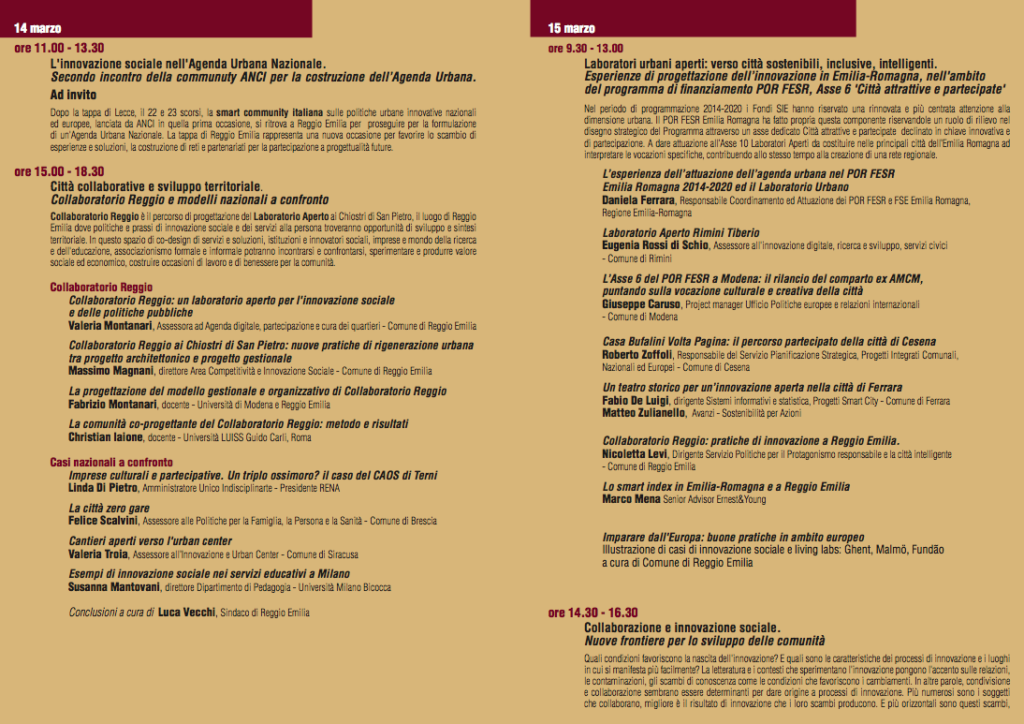
Martedì 14 e mercoledì 15 marzo 2017, presso il Centro Internazionale Loris Malaguzzi di Reggio Emilia si terrà il convegno “Innovazione sociale, beni comuni, modelli di collaborazione. La città e lo sviluppo delle comunità locali”.
Le pressioni che i sistemi urbani subiscono in ragione dei processi di mutamento demografico, climatico, economico impongono alle città di dare risposta a sfide vecchie e nuove. Le città italiane non si sono fatte trovare impreparate, e hanno messo in campo una pluralità di pratiche e sperimentazioni all’insegna della collaborazione e riguardanti i diversi settori delle politiche urbane, attivando così una community dell’innovazione urbana.
Al protagonismo delle istituzioni si è accompagnato un crescente protagonismo delle comunità nella tutela dei beni comuni urbani. Le città sempre più si vanno trasformando grazie a iniziative sociali, economiche, culturali che nascono e sopravvivono tramite l’attivazione di nuove reti e relazioni. A partire dai progetti Collaboratorio Reggio e QUA – Quartiere bene comune, realizzati dal Comune di Reggio Emilia, parleremo con esperti della sfida dell’Agenda Urbana legata ai temi dell’innovazione.
Ecco il programma dell’evento, disponibile anche qui.
by Francesca Spigarolo | Feb 13, 2017 | The Urban Media Lab
On the 16th and 17th of February a 2-days workshop about resourcing and monitoring, organized within the framework of the TRANSIT (TRANsformative Social Innovation Theory) Project, will take place in Maastricht.
TRANSIT is a research project, co-founded by the European Commission, which addresses the question of “How social innovation can interact with other forms of (transformative) change, and how actors are (dis) empowered therein”. The projects aims at developing a theory with practical relevance, and in order to do so it adopts a research method which encourages feedback from social entrepreneurs and innovators, policy makers and academics.
In line with this approach, the workshop organized in Maastricht will bring together experts from TRANSIT with practitioners, funders and change agents working on transformative social innovation. The workshop will focus on the question of resourcing and monitoring, which are key issues we need to address in order to help social innovation initiatives going beyond the local achievements they are collecting, by joining forces in seeking contextual and institutional change. To activate an institutionalization process, resourcing and monitoring – two dimensions which are closely linked – are fundamental. Addressing these two dimensions means addressing 5 sources of tension which are being faced by social innovation initiatives: the question of the internal struggle over growth and direction, the fishing in the same pond issue, the internal and external need for monitoring, the problems of base founding and the co-option from imposed agendas. The workshop will also offer the occasion to review the latest research insights of the TRANSIT project about Social Innovation Initiatives resourcing and monitoring based on in-depth analysis of 20 transnational networks and 80 local manifestations of social innovation.
Professor Christian Iaione, LabGov’s co-founder, will be between the participants in the event, which will be a valuable occasion to exchange insights with other experts and change agents, to discuss and critique different strategies for resourcing, monitoring and sustaining SII, and to develop guidance for policymakers and practitioners on facilitating SII contributions to transformative societal change.

by Chiara De Angelis | Nov 16, 2016 | The Urban Media Lab
On Thursday, November 17th, the MISE will host an event all about cooperatives: “PROGETTI DI FRONTIERA PER LE COOPERATIVE” (“border projects for cooperatives”). The event will focus on feasibility studies for an innovative collaboration between the public sector and the cooperative movement.
During the day, 8 feasibility studies promoted and financed by the MISE will be presented and discussed, in order to promote and develop the cooperative movement. The project, realized in collaboration with Invitalia, has the aim of accompanying cooperatives in their path of growth and consolidation in the market, and of sustaining new projects built by collaborative enterprises in innovative fields.
LabGov will attend the event, with its co-founder Christian Iaione, who is going to intervene in the afternoon, during the presentation of the results of the round tables.
The full program of the event is available here: http://www.sviluppoeconomico.gov.it/images/stories/documenti/Agenda_17nov2016.pdf

by Caterina Gianni | Oct 25, 2016 | Storytelling 2016-2017
The second day of co-working session, held on October the 15th begun with Eloisa Susanna’s general outlook about other  active projects, similar to #coRome, spread all over Italy.Eloisa,a young architect,rapidly commemorated the G124 project,launched by Renzo Piano in which great relevance is given to peripheral areas and the imperative need of maintenance trough micro-surgical interventions,this is what the Otranto project of 1979 was about.In general,this procedure implies two fundamental principles:first of all it has to be interest-based,secondly it has to be performed through a collaborative process that consist in framing and contextualizing the city of Rome and its surrounding territory,focusing on those areas that constitute a patrimonial identity.
Than,Claudio Gnessi explained the explosive role of the Ecomuseo Casino Ad Duas  Lauros (www.ecomuseocasilino.it). This institution owns much to the “comunità di eredità” which actively engaged in several partecipative laboratories,with the common goal to define the space in which cultural and natural sites have previously been identified.The actual plan is focused in Tor Pignattara,a neighborhood where around 130 cultural resources were mapped,thanks to the fruitful work of a social network composed by inhabitants of that neighborhood but also public and private actors.It is important to underline the social consequence brought by this initiative:cooperation was promoted among different religious and cultural realities,unified by a shared interest and motivated by common moral values.
Right after the Labgovers productively engaged in a workshop that consisted in reporting on a widespread map four different topic developed with the aid of expert mentors and of Alessandra and Urio, the co-founders of the newborn Community for the Public Park of Centocelle.The participants were divided into four groups,namely:Mobility, Accessibility, Potentialities and Public Services.
 The first group,”mobility”,identified which public transport are easily available both from the center and the outskirt of Rome:the main one are the “trenino laziale” and the tram “19”.Than the participants focused over the potentialities that the park could offer if,in one hand,the pedestrian accessibility was open on both sides of the park’s perimeter and,on the other side,the bicycle route,know as GRAB, could pass trough the park instead of in its proximity.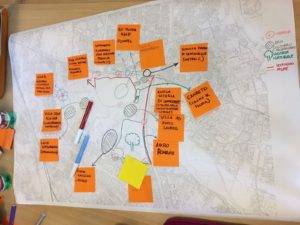
The second group,”accessibility”,listed more accurately all the potential resources that the park could make available.Surprisingly the V Municipal seems to be blessed by so many cultural sites that could re-animate the entire area from a touristic perspective,but also for the sole purpose of embellish the neighborhood.
 A third group ,”potentialities”,brought to light many critical matters such as security and sanitary issues,in fact the park has several abusive occupied zone,not omitting the wasted paper and rubbish that pollutes the park everywhere.
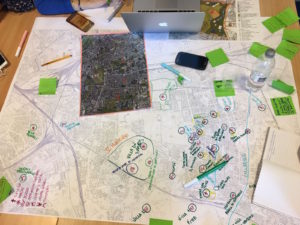 The fourth group;”public services”,classified and mapped all the accessible public services around the PaC zone,such as churches, schools,parks,cultural attractions,theaters and cinemas.-
As it emerges from the images,the V Municipality has extraordinary potentialities,however,due to its marginalized position,its shabby’s first appearance,and the elevate conglomeration of immigrants and religious identities, its efficiency is completely unexploited and its integrity is gradually decreasing and deteriorating running the risk to fall in the oblivion.
 The meeting ended up with Stefania Favorito’s speech over the importance of the park from an archaeological point of view,the park is surrounded by historical sites such as the Villa Ad Duas Lauros,il Forte Casino,la Villa della Piscina,la Vecchio Osteria,all dated back from the republican era until the XIX century,plus the natural resources of l’Agro Romano,il Canneto,l’Agri-Fauna and the whole park of Centocelle.It is important to be mature the awareness to understand what this park does symbolize for the cohabitants of the V Municipality, how this zone reflects their feeling of social marginalization and how this project give them the possibility to join a community in which moral and civic values are promoted and cooperation constantly active.( http://parcocentostelle.net )


