SansJus
stands for “Sensing for Justice”. The project was born after a landmark court
decision released in Texas, on June 27th 2019, in which a judge found the
petrochemical company Formosa Plastics Corporation, liable for violating the
Clean Water Act because of plastic discharge into local waters. The case was
brought by a civic group based in part on citizen sensed-evidence which
involved volunteer observations performed over years. This practice entailing
grassroots-driven environmental monitoring could be qualified as ‘Citizen
Science’ and, more specifically, ‘Citizen Sensing’. The contamination could not
be proved through existing data held by competent authorities since the company
never filed any record of pollution with the competent authority. Rather, the
monitoring and data collection was almost entirely conducted by local
residents.
The key
objective of the Sensing for Justice project is to fill the knowledge gap to
avoid a possible scientific and legislative vacuum and provide newly required
research capacity in the EU. The research will be hosted by the European
Commission Joint Research Centre, currently the leading actor in the research
on Citizen Science for environmental monitoring and reporting, which will allow
us to play a crucial role in the enactment of measures to release Citizen
Science for litigation and mediation’s potential across the EU.
Nowadays
it is essential to redefine Citizen Sensing as a manifestation of the broader
Citizen Science practice having a potential source of evidence acceptable in
environmental litigation, as an exercise of the right to contribute to
environmental information and even as a method to foster environmental
mediation.
Give a
look to SensJus website to discover the news and upcoming actions of the
project!
The City
Science Initiative aims to strengthen how science and research can help address
the urban challenges and to develop a structured approach to evidence-informed
policy-making at cities’ level.
Recently,
the report reflecting on the CSI pilot phase has been finalized and published,
by the name of ‘City Science for Urban Challenges’. The report of the mission
board for climate-neutral and smart cities is accessible through this link.
“The
introduction of a Climate City Mission is a radical new way of achieving
climate neutrality – and of doing so faster, by 2030. The Mission aims to
promote system innovation across the value chain of city investment, targeting
multiple sectors such as governance, transport, energy, construction and
recycling, with support from powerful digital technologies. As such, it
requires a change in regulations, approaches and instruments combined with the
willingness to go beyond existing schemes and habits. The Mission also demands
a change of attitude towards practical aspects of implementation, but also as
concerns people and organisations working together: citizens, local
governments, central and regional governments, and European institutions. We
expect citizens, city administrations and political leaders to show commitment,
imagination and determination. We expect you to implement this Mission with the
same determination as the Americans did with their Moonshot. The climate minded
transformation of cities goes far beyond the idea of the Man on the Moon. This
is The Mission of our times!” (Hanna Gronkiewicz-Waltz, Chair of the Mission
Board for Climate Neutral and Smart Cities)
Food
policy has not usually represented a mainstream domain for urban planning.
However, as Professor Kevin Morgan argued now ten years ago, this “puzzling
omission” is not justifiable anymore given the multifunctional character of the
food system with his effects on different policy sectors and the now recognized
belief that it cannot be automatically relegated to the rural policy domain
(2010: 341). Accordingly, Thomas Forster et Al. collected best practices from
cities around the world to demonstrate the breadth of food policy and programmatic
work that is occurring in urban areas, proposing a wide range of solutions for
Mayors (2015). Their collection of policy solutions showed how “cities are
moving towards an integrated approach to food systems and there are wide
interest and experimentation in inter-departmental institutional mechanisms”
(Forster et Al. 2015:17)
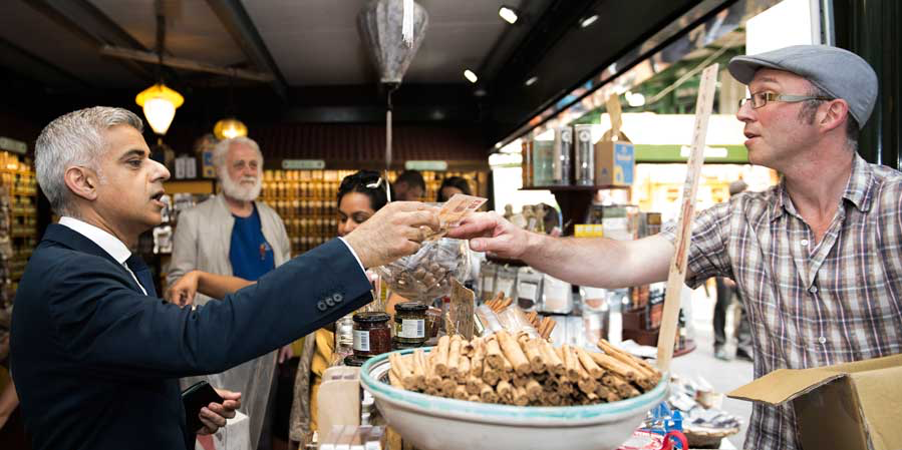
London Mayor Sadiq Khan buying food in a London Market (source Sustain)
In
this context, the city of London shows a complex governance system (Travers
2002: 787) which at a first sight does not seem to leave much space to food
policy. Thus, London has a two-tier structure with 32 boroughs plus the City of
London representing local interests and the Greater London Authority (GLA),
consisting of the Mayor and the Assembly, in charge of the London region
(Travers 2018: 340). The London boroughs are responsible for local services
delivery. In terms of policy competences, they run social care, environmental
policies, road management, public health, social housing, waste management and
they can supervise local schools (Travers 2018: 348). Whilst the Mayor
establishes the strategic framework for the boroughs and the London plan, he
also holds executive powers over transport – chairing the executive board of
Transport for London – policing, fire, emergency services, London’s growth and
economy. He even has a shared competence in housing and regeneration policy
(Burdett and Rode 2015). By contrast, food policy in the UK appears fragmented
amongst different policy sectors and layers. In particular, the multilevel
nature of the food sector led food to be considered a “wicked issue” for
policymaking and apparently unable to fit the policy system (Parsons, Barling
and Lang 2018: 212). Consequently, an evident policy opportunity emerged for
urban food policy, with the city of London experimenting new policy structures
and promoting policy change.
In
the last years, the city of London has strengthened its commitment to food
policy. The increased powers of the Mayor and the GLA enabled them to find new
policy opportunities and address relevant issues for the capital, even in
absence of strategic responsibilities. And food is one of these cases. Indeed,
the Mayor and the GLA “consult widely and work closely with London
organizations – boroughs, the private sector and voluntary bodies, in a new
inclusive style of politics” (Pilgrim 2006: 226). Moreover, the Mayor has to
enhance residents’ health and wellbeing, by also promoting social and economic
development (Halliday and Barling 2018: 186). Hence, food policymaking can be
enlisted within this duty. However, the creativity of Mayors in using their
powers (Blick and Dunleavy 2017: 4) explicitly manifested concerning food. In
fact, the current Mayor Sadiq Khan promoted a very interventionist policy
campaign banning junk food advertisements from Transport for London, relying on
its strategic direction over transport policy (Hawkes and Parsons 2019: 5).
This policy action was firstly developed on-the-ground knowledge released by
London boroughs (Hawkes and Parsons 2019: 5) and it showed how the complexity
of London governance provides several policy opportunities encouraging the
emergence of a complex urban food governance system. Additionally, the current
London Plan provides support for food growing, local food production,
encourages food waste management, aims to improve Londoners’ access to quality
and healthy food (GLA 2016). Moreover, the plan intends to tackle food poverty
by increasing the provision of land for food growing in London (GLA 2016: 323).
Finally, it calls for the implementation of a new London Food Strategy (GLA
2016: 323). This strategy exemplifies the pan London commitment to food
policymaking. The most recent – promoted by Mayor Sadiq Khan – was finally
approved in 2018 (Hawkes and Parsons 2019: 4). It openly aims to guarantee that
“all Londoners have access to healthy and sustainable food” (GLA 2018: 9) and
“highlights how food is connected to everything we do as a society: it affects
the environment, it drives our economy, affects our health and it is a central
part of our cultural life” (GLA 2018: 7). Among its policy objectives, it
differs from past food strategies in its promises to “tackle food poverty,
child obesity and unhealthy food environments” (Hawkes and Parsons 2019: 4).
The
implementation of the London Food Strategy has been supported by the London
Food Programme, which is part of the GLA Regeneration and Economic Development
Policy Unit. The Food Programme team also cooperates with food partners in the
private, public and third sectors to deliver and monitor a wide range of
projects which may concern public health, social welfare and environmental
policy issues. It also works closely with the London Food Board. The board
counsels the Mayor on food priorities for London and it is composed of experts
from academia, the third and the private sector. Finally, London boroughs’
voice is heard through the Borough Food Sub-Group of the London Food Board
(BFSG), which is primarily composed of officials from London boroughs’ public
health teams (Hawkes and Parsons 2019: 5). It aims to strengthen the
relationship between the GLA and London boroughs as regards food policymaking
and reduce policy fragmentation. Since the Mayor has limited powers on
food-related issues and boroughs have no obligation to follow his
recommendations, the subgroup offers a more democratic arena for discussion
(Halliday and Barling 2018). Moreover, the London Food Programme works in
partnership with Sustain, an alliance of food and farming organizations, which
supports London boroughs developing Food Poverty Action Plans (GLA n.d.). Sustain
also releases every year the report “Beyond the Food Bank” to assess boroughs’
signs of progress in meeting food objectives over the year. The report shares
every year what each London borough is doing on food to generate positive competition
among each other.
In
this context, London Boroughs – like other local authorities in the UK – have a
wide range of policy levers to produce long-term food policy change, and
address social, economic and environmental issues as well (Marceau 2018: 3). Food
Poverty Action Plans represent one of these levers through which local
authorities can work with local partners to tackle food poverty at the local
level (Marceau 2018: 3). Here, the limited Mayoral powers and resources as
regards food policymaking explain how several food policy networks and
partnerships emerged, especially in London, to fill the gaps that neither city
nor local politics managed to compensate. Thus, a food partnership represents a
consortium of organizations, ideally from the public, voluntary, faith and
community sectors, who locally commit to working together and tackling food
poverty (Sustain 2020). In 2017 around 50 cross-sector food partnerships have
been set up in the UK as part of the Sustainable Food Cities movement (Davies
2017: 3). Once established, they are generally constituted by cross-sector
bodies. Davies reports that food partnerships may take different shapes,
relying on a more formalized or more informal structure. Some are directly
housed by public sector organizations and are generally staffed by government’s
employees. Others may be staffed and funded by third sector organizations or
even fully independent, with minimal available resources and mostly composed by
volunteers (Davies 2017: 3).
Ultimately,
the complexity of London’s urban governance represented a fertile environment
for food policymaking, especially considering the policy vacuum left by the UK
central Government as regards food. Thus, food policies have been recently
added to London’s local and city-region agendas. Firstly, the Mayor made food a
relevant component of its London Plan and launched the third London Food
Strategy. Then, London boroughs started implementing local food policies as
food poverty action plans and cooperating with local food partnerships.
Evidently, if urban planning neglected food policy for a long time, the case of
London shows how an increasing number of local actors from the public, private
and third sector have finally recognized the strategic significance of the food
system for urban areas and, more in general, of food for communities’ health
and wellbeing
References
Blick,
A. and Dunleavy, P. (2017), Audit 2017: How democratic is the devolved
government of London? London: Democratic Audit UK.
Forster,
T. et Al. (2015), Milan Urban Food Policy Pact: Selected Good Practices from
Cities, Utopie/29 Globalizzazione, Milan: Giangiacomo Feltrinelli Foundation.
Halliday,
J. and Barling D. (2018), The Role and Engagement of Mayors in Local Food
Policy, In Rethinking Food Policy: A Fresh Approach to Policy and Practice.
London: Centre for Food Policy.
Morgan,
K. (2010), Feeding the City: The Challenges of Urban Food Planning,
International Planning Studies, 14: 4, pp. 341-348.
Parsons,
K. and Hawkes, C. (2019), Brief 4: Embedding Food in All Policies, In
Rethinking Food Policy: A Fresh Approach to Policy and Practice, London: Centre
for Food Policy, pp: 1-8.
Parsons,
K., Barling, D. and Lang, T. (2018), UK Policymaking Institutions and their
implications for integrated Food Policy (Chapter 7), Advances in Food Security
and Sustainability, Volume 3, pp. 211-251.
Pilgrim,
M. (2006), London Regional Governance and the London Boroughs, Local Government
Studies, 32:3, pp.223-238.
Travers,
T. (2002), Decentralization London-style: The GLA and London Governance,
Regional Studies, 36:7, pp. 779-788.
Travers,
T. (2018), London: government and politics in the boroughs, in Dunleavy, P et
al (Eds.), The UK’s Changing Democracy: The 2018 Democratic Audit. London: LSE
Press.
Save the date! Tuesday, May 5 at 4 pm, there will be the final event of the Interdisciplinary Urban Clinic of LabGov 2020 on the platform Cisco Webex.
For those who are discovering our project, this year we addressed the issue of fashion in relation to sustainability by developing an innovative and sustainable idea to the problem of the environmental impacts generated by this sector. The event will consist principally in the presentation of the final prototype of our project followed by some interventions of our special guests.
The production of the prototype by LabGovers
2020 wants to demonstrate that students can already be part of the answer to
the growing demand for sustainable fashion if you cross technological
innovation and social and environmental sustainability through circular economy
platforms that connect companies, social start-ups, associations and creative
digital communities with an urban rooting.
We will also talk about Covid-19, its impact on
Made in Italy and the prospects of sustainability and digitalization in the
field of fashion.
Guests of the event will be: General Manager Luiss, Giovanni Lo Storto; Rector Luiss, Professor Andrea Prencipe; Giacomo Santucci, President Camera Buyer Italy; Lorenzo Greco, CEO DXC Italy; Vincenzo Linarello, President of GOEL – Cooperative Group; Professor Maria Isabella Leone, executive director of the Master in Open and Innovation; Dr Elena Ciccarelli of NTT DATA and Claudia Giommarini, office ERS lab Luiss.
Don’t hesitate to ask for the link to the video conference room by writing a message to Labgov.city on Instagram or Facebook to participate to this beautiful presentation!
The fifth and last workshop and co-working of the Urban Clinic, held on the Luiss Webex Platform, had as guest Joaquin Santuber and Lina Krawietz, Co-founders of the start-up “This Is Legal Design” based in Berlin.
After introducing themselves, our guests presented us the world of Legal Design, which is, in the words of Joaquin: “a way of improving people’s lives and making their life easier”. In order to be clearer about the meaning of Legal Design, Joaquin divided the word into two concepts. First “Legal”, that is the legal system that regulates our interactions in our society. For example, legal industry businesses that are provided and work with the legal system (courts, legal firms, legal departments, etc..). Second, “design” is more complicated to define. There are many design notions. Very often we are familiar with the idea of product design. For instance, service design, such as the process and steps of using a computer. In our case, it represents a creative problem-solving approach to complex challenges. When “This Is Legal Design” was founded, they needed to find an original approach, new solutions to make people’s lives better and easier improving users experience. Since the legal side touches us in every aspect of our life, they applied this mindset to the legal system and decided to conceptualize their start-up with the purpose of solving problems from the legal world, such as access to justice or helping legal firms to identify with the businesses they work with.
After being updated on the advancement of the LabGov’s project “Ri-Made”, the Legal Design team presented us some case studies of projects they created for some firms in order to illustrate what types of results we are looking for. Then, they showed us that legal aspects are everywhere, especially on the Internet. A good example might be the use of cookies on webpages. it is important to be innovative to pursue our goal, in every aspect and not only the legal ones. “How can we find innovative ways to overcome legal barriers to our sustainable fashion project?” Joaquin explained that once again the solution is something that has to do with the attitude, by looking at things critically. He then introduced the concept of “legal touchpoints” with the example of the “terms and conditions” that we have to accept every time we register on a social network or on a platform. In fact, these privacy policies are created by lawyers, which do not adapt their content to be understandable for everyone. Often, if some legal aspects are too complex to understand, using visual supports like comics or videos can be very helpful. At the end of the workshop, he left us with some questions to reflect on as homework for the following day. How could this look like in our project? How to share an idea with collaborators? How can we communicate safely our business plan?
Let’s get started with Saturday’s co-working! The students were divided into two groups, one kept on working on the Webex Platform, while the second one held his meetings on the Zoom platform.There were four blocks of activities during the day. Each block started with the Legal Design team providing some inputs to guide the two teams in the realization of innovative legal touchpoints for the project, then both teams met for a brief meeting with Joaquin and Lina at the end of each block to have some feedbacks. The goal of the day was to identify the two main Legal Touchpoints of our project and find original and innovative ways to make them more understandable for our audience. The first group focused on finding an original way to present the “terms and conditions” to the user at the moment of the registration, while the second one worked to solve the legal barriers that may occur when a user’s order is damaged and he has to return it back to “Ri-Made”.
After lunch, Joaquin and Lina asked the students and the tutors of the two groups to prepare a short video that could make the solutions that they had found more comprehensible, in order to present their ideas in a creative and visual way.In the final part of the co-working, the students showed the videos that they created. To conclude the fifth co-working the students updated the tutors on how they are handling the making of video tutorials of sustainable activities that they are filming from home. Moreover, on this last day of co-working, the LabGovers and tutors talked about the planning of the final day of the Urban Clinic which will take place on May 5th from 4 pm to 6 pm with the participation of Director General and the Provost. They will have to present their project an audience of experts, so a lot of work is ahead of us to prepare this exciting day!
We post new content regularly on our social media, come back often to make sure you don’t miss anything!