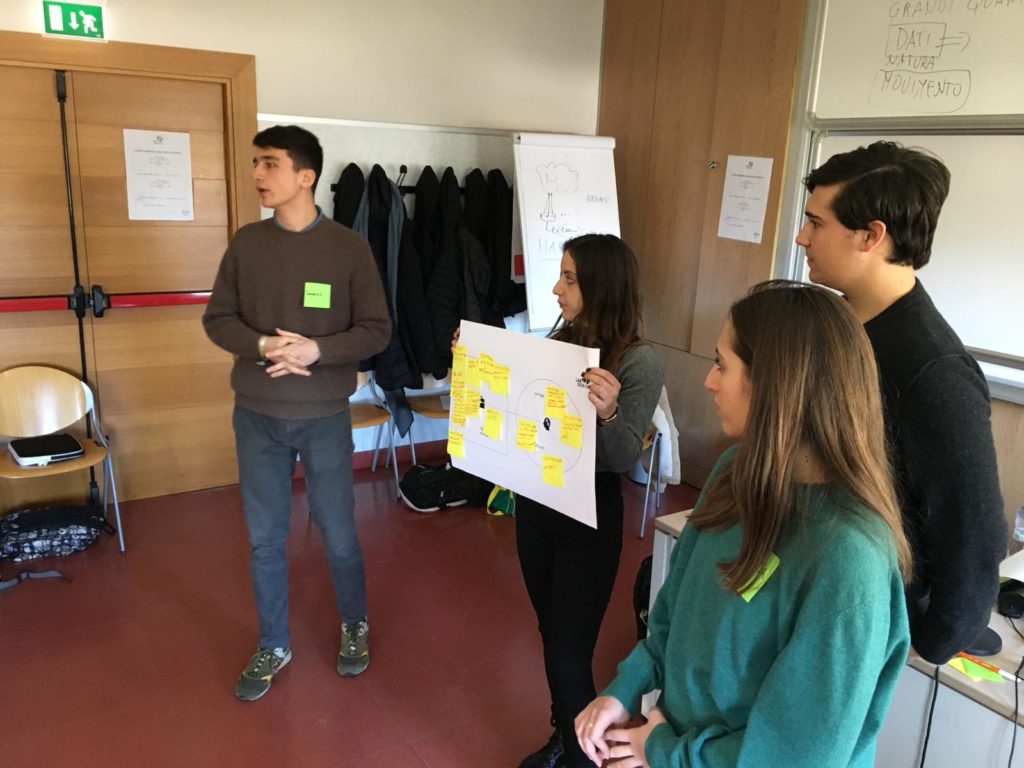
Co-working session “Idea Generation lab”, February 23 2019.
The first module of the Urban Clinic of LabGov EDU continued with the first co-working session, the “Idea Generation Lab”, that took place on Saturday February 23rd, 2019.
In the idea generation lab, the LabGov team facilitated the emersion of a shared project idea leveraging on the body of knowledge generated during the Opening day of the Urban Clinic, on the intersection between agricolture and technology as a tool to improve welfare in cities. The idea generation lab began with an inspirational speech by Raffaele Ciriani, President of the Italian Association of Apicultures and Barbara Invernizzi, landscape architect and expert in the facilitation of community gardens in complex urban environments. Barbara Invernizzi will accompany the LabGovers throughout a laboratory of self-construction of prototype a mobile beds garden (beginning on March 9).
The inspirational session was conducted by Raffaele Cirone, President of the Italian Federation of the Beekeepers. He has created two urban apiaries, in the center of Rome. One on the Rooftop of Confagricoltura building and the other in the a police station. The bees monitor the quality of the air and the urban environment. Such an interesting idea!
After the inspirational session, the facilitation session began and the team asked the LabGovers to identify keywords main issues that emerged from the opening day of the Urban Clinic. The keywords and main issues were then clusterized in macro-themes, on which the project will be build upon.
In the second part of the co-working session, the LabGov team introduced to the students the social value proposition canvas. The LabGovers were then split in four groups that worked on the social value proposition canvas separately. Then, in the plenary session, each group shared their work and the team synthesized the groups’ work and filled in a unified canvas. The project idea was therefore defined starting from the shared elements included in the groups’ work.
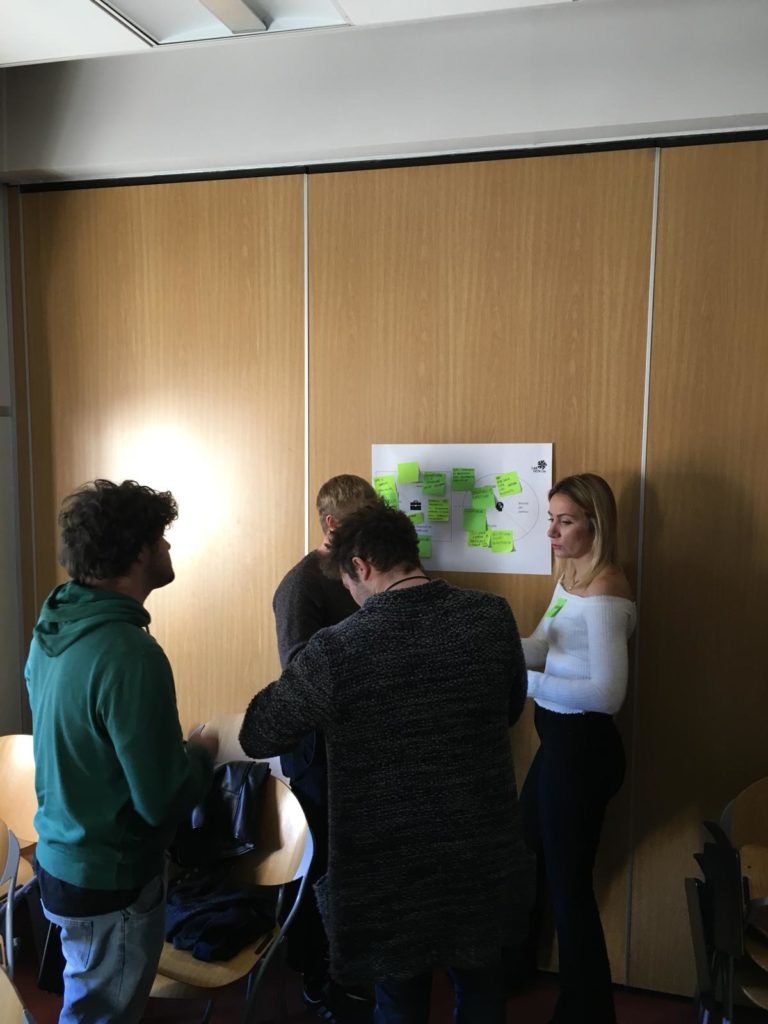
The LabGovers were ultimately divided in four groups, that will work on gathering the data and carrying out key tasks necessary to refine the project idea generated during the session and move towards the next co-working session: group 1) desk research 2) logistics and material for mobile garden tutorial 3) interviews on community garden (conducting interviews with representatives of community gardens in the city 4) guerrilla research (survey to LUISS students to validate the initial project idea with a first sample of respondents).