
by Adriana Marasco | Feb 24, 2016 | The Urban Media Lab
What is Hortus Urbis?
Hortus Urbis is an experimental project on public space and biodiversity managed by the Zappata Romana ; it was born in 2012 in Rome , in a green area unused in the setting of the Appia Antica Park , to shared space and is educational vegetable garden with plants that were used in ancient Rome.
Which are the goals of the project?
The purpose of the project are related on the natural aspects and the cultural ones. The objective is to increase the sensitivity of children, youth and adults on the issues of biodiversity; acquire information and think about the cultural and cultural differences between past and present; lead in children, young people and adults respect for nature by understanding and knowledge.
How Hortus Urbis wants to find funding ?
The Hortus Urbis has decided to participate in the announcement of the Aviva Community Fund, becouse it is actually maintained through citizens voluntary activities and with the support of local associations, without government grants.
From 4 years of project starting the number of adult guests and children requires the adaptation of the spaces with the construction of furniture and equipment to improve the reception and the performance of activities.
The Aviva Community Fund provides to a phase of web voting for the projects selected and then a screening of the most voted by a jury. They have accepted the project and it i began the phase of open votation that will end on the next 8 March . It ’s important to reach many votes as possible.
Lab Gov helps Hortus Urbis by voting but everyone can give an help just by easly steps : a registration with password and email and then by voting on the link https://community-fund-italia.aviva.com/voting/progetto/vista/14.
How Hortus Urbis would like to use the founding ?
The funding will be used for the construction:
• a protected area to allow the activities during the days of bad weather;
• a table of work , to ensure the performance of workshops for children in the most appropriate way;
• furnishings for the hospitality of the companions of the children participating in the workshops;
• a shelter of garden tools;
• educational games for children.
——————————————————————
Hortus Urbis è un progetto sperimentale sullo spazio pubblico nel parco dell’Appia Antica gestito dall’associazione Zappata Romana nato nel 2012 a Roma.
L’Hortus Urbis ha deciso di partecipare al bando di Aviva Community Found , essendo mantenuto attraverso le attività di volontariato di cittadini e con il supporto di associazioni locali, senza contributi pubblici.
A 4 anni dall’avvio del progetto il numero di ospiti adulti e bambini richiede l’adeguamento degli spazi con la realizzazione di arredi e attrezzature per migliorare l’accoglienza e lo svolgimento delle attività.
Per sostenere il progetto, come Lab Gov ha fatto ; è in atto una votazione su internet al link https://community-fund-italia.aviva.com/voting/progetto/vista/14. attraverso il quale chiunque può votare attraverso poche semplici mosse.

by Adriana Marasco | Feb 15, 2016 | The Urban Media Lab

How would Italy be without its creativity and what does it matter in Italy creativity?
Carlo Verdone said that it would be a great drought. The creative and cultural sector in Italy involves almost 1 million people, and is worth 2.9% of GDP. Dario Franceschini stresses the importance of thinking about the future , about came back to making Italy the country of arts and beauty. Gianni Letta defines the culture and creativity of Italy as a daughter of the other, they may grow you need to invest in a coordinated education and in school. The task of the institutions and schools, says Walter Veltroni is to help new ways to emerge. The private sector is to experiment. The artists to be creative. Filippo Sugar said that :”creative Italy is the heart and brain of the economic body of our country.” Ferruccio De Bortoli reminds us that many of us may mistakenly think that culture is a cost ,while it is a great investment, each of us must support this thought and becoming ambassador, proud of italian culture and Italian creativity. In a stronger way Monica Maggioni by a old saying “if you think the cost culture try with ignorance.”
the creative industry in Italy is undervalued. The three pillars are the future of Italy “creativity, culture, community,” underlines Maurizio Costa, and in this the role of Italian cities is to be spread factories culture says Stefano Boeri.
What is Italia creativa?
Italia Creativa is the first study that presents the Industry of Culture and Italian Creativity through a global vision: quantitative and qualitative, of the situation and perspective. The goal is to focus, the attention of the public, on this crucial sector, in which our leadership is undisputed but not sufficiently valued or recognized.
Creativity and culture are part of the highest expressions of the heritage of a people, constituting at the same time the wealth of a society. Italy, in particular, enjoys a creative and cultural prestigious past, unique in the world. Suffice it to say that our country has the largest number of sites declared World Heritage by UNESCO.
Creativity and culture have, however, also an important social and economic value, both in terms of turnover, is employment.
The study is born from the intuition that this world, as a whole, is one of the key drivers of growth present and future of the country. We want to highlight the need to support this industry, so that its role may become even more central to our economic system.
Our greatest desire is to be able to work together. We would like that all sectors and all the people of Industry of Culture and Italian Creativity could benefit from the project of Italian cuisine. To this end we have been involved the main associations of the sector, without whose membership of a study of this size and of this relief would have been impossible. We hope to be able to take a first step, together, towards the construction of the “Creative Italy” brand.
Italian photographer Creative Industry of Culture and Italian Creativity very important figures, both from the economic value perspective (almost 47 billion euro in 2014) and from the number of employees (nearly one million in the same year).
These considerable numbers translate into a leading role in the national economic landscape. The comparison with other macro-productive sectors raises the creative industry in a leading position.
The significance could rise further, at least judging from the value generated share of the total national GDP. Better results are possible: takes courage, awareness, additional efforts and especially collegiality.
most of us don’t know that the Industry of Culture and Creativity in Italy has generated, in 2014, a total economic value of 46.8 billion euro. 86% derived from activities directly related to the creative industry, such as design, production and distribution of works and cultural and creative services. The remaining 14% are made up of indirect revenues, is related to collateral activities or subsidiaries.
In 2014, the Industry of Culture and Creativity gave employment to almost one million people, of which 85% in direct economic activities industry. With about 850,000 jobs, direct employment in the Industry of Culture and Creativity represent 3.8% of total employment in Italy.
The Industry of Culture and Creativity is confirmed then not only a human capital-intensive sector, but also among the first in Italy for number of total employees, surpassing sectors such as food production, the luxury, the automotive industry , the chemical industry and more.
which are the ambitions of Italia Creativa for the future?
At European level, the creative industry is worth between 3.1% and 3.5% of GDP. To give a “readable size” to the ambitions of Italia Creativa , it may be interesting to compare with one of the countries most culturally close to us: France.
Compared to the French, the Industry of Culture and Italian Creativity weighs on GDP around 0.9 percentage points lower. If we succeed in Italy, teaming and protecting the sector, for the supply chain to express the same share of GDP that characterizes France, it would be 15 billion additional euro. The creative industry will thus increase from 40 billion to 55 billion euro and would generate more than 300,000 new jobs, for a total of nearly 1.2 million jobs.
The Industry of Culture and Creativity is part of a national context which, as is known, is characterized by a prolonged period of economic crisis. In recent years the competitiveness of the Italian system of settlements showed that they are naturally discharged on the overall profitability of the national operators and, therefore, also on the creative industry.
It is evident, therefore, as Italia Creativa, by virtue of the weight of the sector in GDP, should aim, for herself and for the country, to meet the challenge of the Italian competitiveness in the world. It speaks of a diverse supply chain, not only at high rate of “creative innovation” but also a high rate of human capital and strongly oriented to the exploitation of the new generations. In fact, the more open they are usually the younger generation, to new ideas and new models. They are the ones who “speak, think and consume digital.”
That of digital is another challenge that must be won. Industry players will need to rethink their business models, open to intra and inter-sectoral collaboration, exceed our own particularities and aim to make the team.
It is with these challenges in mind that for the first edition of the study, Italia Creativa 2015, it was decided to thoroughly address two issues considered particularly important by all parties involved, through cross-cutting insights compared to the eleven areas:
• The culture of the engine of development for the country: an opportunity for young
• The remuneration of creativity on digital channels
The two investigations, which precede the treatments related to the eleven areas of Industry of Culture and Creativity, aim to propose issues for analysis and reflection on topics to today much debated, in an attempt to launch concrete messages to institutional operators and the economic operators of our country.
The study is intended primarily as an opportunity to offer to the operators of all the sectors that deal with creativity and culture to confront, to converge on common themes, to define perimeters and comparability metrics, in order to increase almost naturally, knowing another better, the ability to work as a team and the ability to move in a coordinated manner in addressing the challenges posed by the overall economic environment and the evolutionary dynamics of the industry.
Today more than ever you need a concentrated effort in identifying the most practical and effective ways of exploiting and, I would say more, monetization of a truly significant industrial heritage for our country, perhaps the only one that can guarantee, in its manifestations direct and indirect (such as,
limited to cultural tourism), competitive advantages and differentiators obvious, large and long-lasting than in other countries.
To conclude we cite Michelangelo Pistoletto who says that “ this boot should give a kick to his culture.”
——————————————————————————————————-
Creatività e cultura sono la ricchezza di una società, l’espressione di un popolo.
L’Italia, in particolare, vanta un passato creativo e culturale prestigioso, unico al mondo. Italia Creativa nasce per evidenziare la necessità di sostenere e valorizzare l’Industria della Cultura e della Creatività nel nostro Paese, che rappresenta oggi un valore economico e sociale importante, sia in termini di volume d’affari che di occupazione.
Lo studio di Italia Creativa vuole essere innanzi tutto un’occasione da offrire agli operatori di tutti i comparti che si occupano di creatività e cultura per confrontarsi, per convergere su temi comuni, per definire perimetri e metriche di comparabilità, al fine di incrementare quasi in modo naturale, conoscendosi meglio reciprocamente, la capacità di fare squadra e la capacità di muoversi in maniera coordinata nell’affrontare le sfide poste dall’attuale contesto economico complessivo e dalla dinamica evolutiva dell’industria stessa.
Mai come oggi è necessario uno sforzo di concentrazione nell’identificare le più concrete ed efficaci modalità di valorizzazione, di monetizzazione di un patrimonio industriale veramente ingente per l’Italia, forse l’unico a poter garantire, nelle sue manifestazioni dirette ed indirette, vantaggi competitivi ed elementi di differenziazione evidenti, ampi e duraturi rispetto agli altri Paesi.

by Adriana Marasco | Feb 1, 2016 | The Urban Media Lab

On February 4 and 5 City Makers from across 60 cities in the Netherlands and Europe will exchange know-how and experience, during a two day conference in preparation of the City Makers Summit where LabGov will participate . The networks of Nieuw Nederland- Steden in Transitie and New Europe – Cities in Transition will further develop and work on the input for the City Makers Agenda, to inspire the EU Urban Agenda. Co-creating the City Makers Agenda towards the New Europe City Makers Summit.
The goal of the meeting is to face up the problem of the city and take up initiatives , ideas , project that could improve the livability of their cities.
The City Makers will deal about how redevelop neglected brownfields; start community enterprises to create jobs in the neighbourhood, rethink food production through urban farming, address increasing vacancy of shops and industrial heritage or promote a more sustainable use of existing resources alltogether. Our cities face many contemporary challenges, but thanks to initiatives such as City Market it is possible to aim to innovative solutions for the cities. City Makers will turn every problem into a resource for their cities.
On February 4 and 5 they will co-create the City Makers Agenda that will provide insight in how make sure that the best practices flourish and accelerate, how can City Makers combine their societal impact with sustainable business models, which could be the aspect of new roles of governament and which rules could be simply adjusted to support the works of City Makers .
There will be 12 Expert sessions on :
(1 session about : Coperative Area Devolpment into which will discuss about the role of the public developer and what is needed from the local government , responsible for the civic space and the quality of its entire city .
(2 session about: Alternative Finance into which City Makers will talk about new ways of city making that are calling for alternative financial channels and instruments.
(3 session about: Co-creation citizens and the government into which City Makers will focus on this changing role between the government and citizens and especially on the co-creation between their.
(4 session about: Online Platforms into which City Makers with some good examples of online platforms will explore the power of online world.
(5 session about Redesigning Democracy into which City Makers will redesign democracy in the city making process
(6 session about: Social Entrepreneurship into which City Makers will explore how idealism can be combined with a sustainable business model, and the necessity of a European legal form for social enterprises in order to encorporate a social mission in their organizational structure.
(7 session about: Value Creation into which City Makers will discuss about how are exactly created value by City Makers how is the economical , social and ecological value measured and how it can be ensured that the value is captured by the parties who created it.
(8 session about: Open Data into which City Makers will talk about how can open data improve efficiency and effectiveness of government services and help create innovative (bottom-up) solutions to the urban challenges of our time?
(9 session about: Budgetmonitoring
(10 session about: Circular Economy into which City Makers will redesing the future in a way in which production leads to limited waste and pollution and in which building systems are restorative and regenerative.
(11 session about :Community Building into which City Makers will share stories of communities from the Netherlands and Europe.
(12 session about:Community Rights.
———————————————————————————————————————–
Il 4 e 5 febbraio si incontreranno ad Amesteram i City Makers (creatori di città ), provenienti da tutta Olanda e Europa , per scambiarsi idee e esperienze ; daranno vita ad una conferenza in preparazione del City Makers Summit alla quale LabGov sarà presente. L’obiettivo dell’incontro è quello di affrontare il problema della città ; prendere iniziative, idee, progetti che potrebbero migliorarne la vivibilità. I creatori della città si occuperanno di come riqualificare aree dismesse e trascurate; di come avviare le imprese della comunità per creare posti di lavoro nel quartiere ; di come ripensare la produzione alimentare attraverso l’agricoltura urbana e di come promuovere insieme un uso più sostenibile delle risorse delle città.
by Adriana Marasco | Jan 25, 2016 | The Urban Media Lab

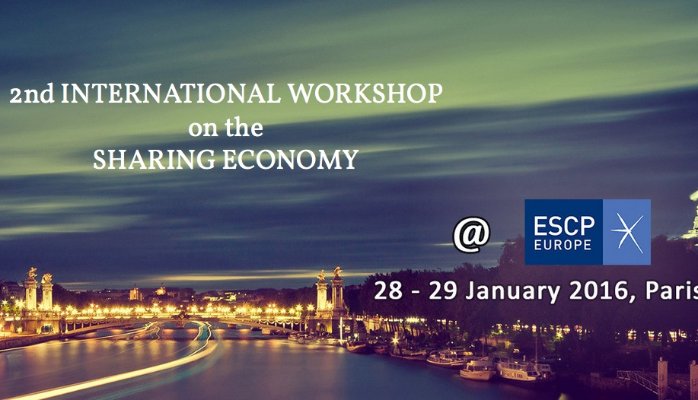
The second edition of international workshop on the sharing economy will have a meeting the next 28th and 29th January in Paris. The main topic will be How the sharing economy influence individual behavior, companies and public regulation.
Nowdays it’s common to talk about collaborative economy , with its uses and benefits ,however, despite the rise of the “sharing economy”, no consensus about its definition yet exists. Botsman (2013) defines this sector as “an economic model based on sharing, swapping, trading, or renting products and services, enabling access over ownership.”
It thus pertains to a broad set of industries, including collaborative finance (crowdfunding), collaborative production (3D printing, FabLabs, DIY, etc.) collaborative education (e.g. open education and open knowledge) and finally collaborative consumption. Throughout this workshop, they will aim to explore the impact of the sharing economy on various dimensions: Individual behaviors,Industry, competition and public regulation.
Among Italians participate in the event Davide Arcidiacono (Catholic University of the Sacred Heart), Ivana Pais (Catholic University of the Sacred Heart) and Marta Mainieri (Collaboriamo!) who will present the collaborative platforms of italy .
Speakers also Filippo Sallet (University Sapienza) and Venere Stefania Sanna (Sapienza University) who will discuss digital reputation, while Emanuela Mora (Catholic University of the Sacred Heart) will focus on the combination of intimacy-friendliness in the economy collaborative. Francesca Oven (University of Bergamo) with Roberta Garibaldi (University of Bergamo), however, analyze the reasons that characterize the category of tourists in the era of the sharing economy.
Airbnb, Kickstarter, Uber, Fab Labs, The Food Assembly, etc.: the rise of these collaborative initiatives no doubt constitutes one of the most striking revolutions of the present day. it’s time to better understand what are the motivations that drive us to share, how is turning the sharing economy, and how we are turning by sharing economy ,about emerging business models and how they evolve collaborative platforms. That’s what 2nd international workshop on the sharing economy is going to do in Paris .
——————————————————————————-
In che modo l’ economia della condivisione influenza i comportamenti individuali, le aziende e la regolamentazione pubblica? Questa è la domanda a cui cercherà di dare risposta la seconda edizione dell’International Workshop on the Sharing Economy durate l’incontro che si terrà a Parigi i prossimi 28 e 29 gennaio. Un incontro accademico , che vedrà l’intervento di vari professori italiani testimoni del fenomeno della sharing economy italiana e delle nuove piattaforme collaborative che sul territorio si stanno sviluppando. Si discuterà di quali sono le motivazioni che ci spingono a condividere, di come si sta (e ci sta) trasformando la sharing economy, dei modelli emergenti di business e di come si evolvono le piattaforme collaborative.

