
by Alessandra Feola | Aug 19, 2014 | The Urban Media Lab
 In Mantova the participants of the Lab will work for two days on the start up of cultural enterprises with Daniele Di Gennaro.
The “Entrepreneurs for the commons” co-design laboratory – promoted by the “Cooperative and Civic Economy Enterprises Group” established within the Chamber of Commerce of Mantova and realized in collaboration with Labsus – Laboratory for the subsidiariarity – will restart its work, on the first and the second of September in Mantova at the Politecnico di Milano – Polo territoriale di Mantova on Via Scarsellini, 2.
The first meeting after the summer holidays will be held by the expert in cultural enterprises Daniele Di Gennaro, publisher of Minimun Fax and producer of Minimun Fax Media.
On the first day, there will be a workshop from 2 p.m. to 6 p.m. entitled “The cultural enterprise: structure, functions and strategies” devoted to the analysis of the contemporary artistic production in order to understand the mechanism of sharing of cultural production. Moreover there will be a focus on the strategies of communication on the market for the cultural enterprises.
On the second day, from 9 a.m. to 5 p.m. the participants will be involved in a co-working session and they will be able to test their ideas and projects. Thanks to the role of facilitators of Labgovers through the guidance of Di Gennaro, the participants will make three experimentations: an assessment of the feasibility of their ideas; the strategic planning and the design of cultural enterprises start-up.
Download the bill here: Locandina_Mantova_1_2_settembre

by Alessandra Feola | Jul 23, 2014 | The Urban Media Lab
 In Mantova on the 24th and 25th of July for the fourth leg of the “Entrepreneurs for the commons” Laboratory.
The importance of the social media within the communication sphere, in particular in the fields of involvement, persuasion and influence, is difficult to estimate, but is undeniable. We are in the era of “prosuming” i.e. the exact correspondence of production and consumption. For this reason it is necessary to rethink how to communicate.
In Mantova the “Entrepreneurs for the commons” Laboratory – promoted by the “Cooperative and Civic Economy Enterprises Group” established within the Chamber of Commerce of Mantova and realized in collaboration with Labsus – Laboratory for the subsidiariarity – has reached its fourth leg. The project aims to cultivate, develop, empower some of the best ideas emerged from the call for ideas “Culture as a commons” launched by the Province of Mantova, Cariplo Foundation and the Chamber of Commerce of Mantova.
The next 24th and 25th of July the expert in social media and political communication Dino Amenduni of Proforma, will held the two day activities of the group supported by the facilitators of LabGov. The meeting, hosted by Santagnese10, a creative co-working space provided by the Municipality of Mantova, is entitled “How to communicate a collaborative enterpirse for the commons on social media”.
In the first day will be held a workshop, from 2 p.m. to 7 p.m., with a theoretical part and a more practical one, in which the participants of the Laboratory will receive all the tools and methodology for creating a communication campaign. The second day, from 9 a.m to 4 p.m., the group will be involved in a co-working session. The objective will be to write a ready-to-use communication plan and to test the ideas emerged within the Mantova ideas camp from a communication perspective.

by Alessandra Feola | Jul 1, 2014 | The Urban Media Lab
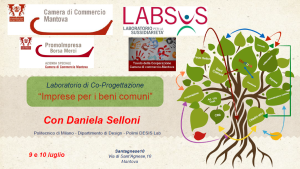 In Mantova, the 9th and 10th of July, for the second leg of the co-design “Entrepreneurs for the commons” Laboratory
To activate collaboration, co-design and co-production involving the final user is a constant challenge in the field of services design. Something is changing. An increasing number of cases of co-production and co-design are spreading throughout our cities.
This will be the subject, on the 9th and 10th of July, of the co-design “Entrepreneurs for the commons” Laboratory promoted by the “Cooperative and Civic Economy Enterprises Group” established within the Chamber of Commerce of Mantova and realized in collaboration with Labsus – Laboratory for the subsidiariarity. The two day activities will be hosted by the co-working space “Santagnese10”. The Lab aims to promote collaboration and cooperation among civil society, entrepreneurs and public institutions for the care and regenerations of cultural common in the city of Mantova.
After the opening meeting that was held in Mantova on the 19th and 20th of June with the participation of professors Gregorio Arena and Christian Iaione, for this second meeting the Lab will be animated by the designer and researcher Daniela Selloni of the Politecnico of Milan, creator of the project “Creative Citizens”
On Wensday, July 9th from 2 p.m. to 5 p.m. there will be a workshop for the introduction to the subject and the presentation of three interesting projects: Nutrire Milano, Cittadini Creativi, Coltivando.
On Thursday, July 10th from 9 a.m. to 17 p.m. the member of the Laboratory will be directly involved into a co-working session for designing and testing their ideas through three tools: Interaction Storyboard, Co-desig e Prototyping.
by Alessandra Feola | Jun 16, 2014 | The Urban Media Lab

By Paola Brizi
Gregorio Arena and Christian Iaione presentations about collaborative economy and shared administration at 2014 Forum PA
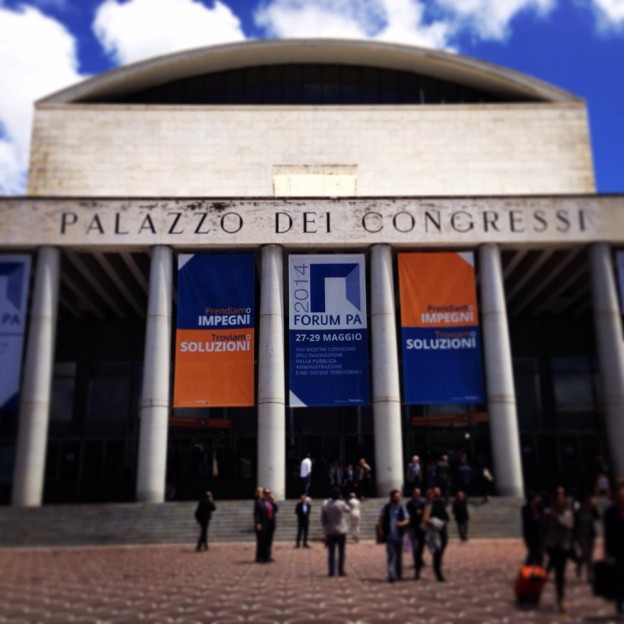
The XXV edition of the 2014 Forum PA took place from the 27th to the 29th of May. It is the main conference for the innovation and modernization of the Italian public sector, this year titled “Let’s take commitments, let’s find solutions” which was attended by Professors Gregorio Arena and Christian Iaione to present the Regulation on the collaboration among citizens and administration for the care and regeneration of urban commons and to discuss about collaborative economy.
Among the topics of discussion in the 2014 edition of the Public Administration Forum, which was held at the Palazzo dei Congressi in Rome, the principles of transparency, participation and collaboration have taken on great importance, aimed at building new relationships between government and society.
The Forum has involved politics, businesses, governments and all the innovator actors in public administration and, in two separate conference sessions, Professors Gregorio Arena and Christian Iaione illustrated the work carried out by Labsus to foster the collaboration between institutions and citizens, in particular through the drafting of the Regulation on the collaboration among citizens and administration for the care and regeneration of urban commons, recently approved by the two Municipalities of Bologna and Siena.
Arena: “From the open government to the partner state”
According to professor Gregorio Arena the administrations reflect the needs and the values of the society they serve, so that their reform will have to be in tune with the major underlying trends of the society, at that particular moment in history.
Today, the main theme around which we have to build a new model of society is that of “sharing”, – adds the professor – a concept that requires a shift from “I” to “Together”. In fact, if we accept the idea that we are living in what is defined a “sharing society”, i.e. a society in which the use is more important than the ownership, this theme could become one of the inspiring souls of the administration reform which is so much discussed in this period in Italy, putting it in line with the society itself.
“In Italy this is feasible thanks to three elements”: the constitutional provision of Article 118, according to which the public authorities shall promote the autonomous initiatives of citizens carrying out general interest activities, which necessarily leads to the sharing; the organizational model defined “shared administration” by Arena himself in an essay of 1997 and which goes beyond a mere participation in decision-making but which means instead the sharing of general interest functions with the administration; finally, the third element is the paradox of a society like ours where there are those who want to actively take care of the commons, but cannot do it because they are not allowed to.
“For this reason Labsus – Laboratory for Subsidiary worked for two years within the City of Bologna aimed at writing a Regulation, setting in three districts of Bologna but with a look over the horizon, thinking about a tool that would have served all eight thousand Italian municipalities”.
The heart of the Regulation is the Covenant of Cooperation between the Municipality and the citizens to share the responsibility for the caring of the urban commons. “This is a fundamental concept, because we have lived for generations on the idea of the delegation, the idea that someone else will take care of our problems. We must instead recover a sense of collective responsibility, not in the negative sense of the term, but in the Latin sense: respondere, referred to those who give answers”.
Iaione: “Twist and Share, Public administration at the turning point of collaborative economy”
Many public policy and administration scholars are questioning the new phenomenon of the Public Administration seen as enabler, and on how there can be innovation without excluding the institutions.
According to Christian Iaione the explosion of collaborative paradigm corresponds to a new role of the public administration: “We are in the third institutional revolution so, after the Leviathan state of the nineteenth century and the Welfare state of the twentieth century, now is the time for a state that no longer deals with every issue, but of a relational and enabler state”.
Within this social innovative phenomenon, not dictated by the economic crisis, the public administration should take on the necessary role of enabler by fostering strong partnerships with its citizens who hold competencies, resources and knowledge, thus discovering the value of collaboration and initiating new institutional paradigms to convey these energies toward civic objectives of general interest.
The Regulations for the care and regeneration of urban commons, drafted by Labsus in collaboration with the Municipality of Bologna, is just a tool to facilitate the deployment of these new techniques that allow the diffusion of positive impacts on the community.
The Article 2 contains a definition of the urban commons seen as “non-abstract but almost operational category, because they are both public and private goods of which the citizens together with the institutions decide to share the responsibility of care and renewal, through processes of participatory democracy, precisely because these are functional assets for the individual and collective welfare”.
“The Regulation is a manual for the collaboration between the outside and the inside of the government”, thanks to which the administration becomes an interlocutor between all the collaborative economy actors. It represents a platform used to enable the citizens motivation for the caring and regeneration of urban common tangible and intangible goods, together with the government and giving answers to the main community problems.
It is also a platform of economic policy: it implies in fact the idea of a collaborative business model that creates value through the collaboration of different actors, whether individuals, associations or companies.
“This regulatory infrastructure is lacking, however, of two fundamental elements: the communication and training”, i.e. the construction of platforms for communication but also appropriate digital media and educational workshops for young people to involve them in the maintenance of the civic commons.
Since 2010 Labsus has launched a project involving two high schools in Rome, and it is now promoting it to other schools thanks to “Rock Your School“, the School of civic maintenance of commons. The leading idea is to create a shared city hall, in which the students are educated and trained for this cultural change through active schools and co-design laboratories, to make businesses, schools, universities and institutions collaborate, and to allow this cultural paradigm shift becoming a living reality.


 The initiative “Italia Ti Voglio Bene” presents on Monday the 9th of September in Rome a public debate for the discussion of new proposals for the development of Italy through social capital.