by Alessandra Feola | Jun 1, 2014 | The Urban Media Lab
 In Mantova new ideas for the development of cultural heritage.
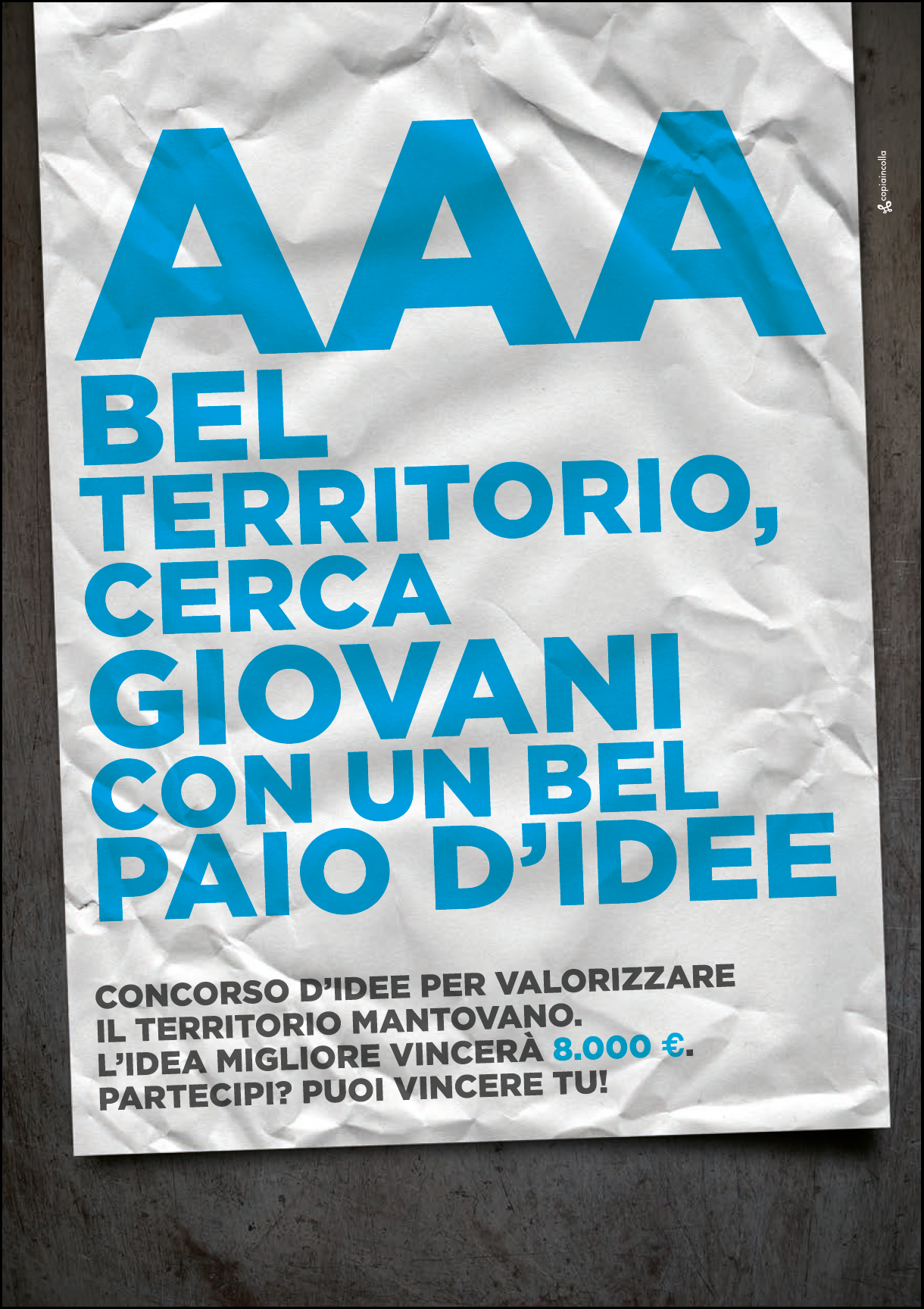
The examining committee of the Competition of ideas “Culture as a commons – Shared promotion of the development and cultural-touristic identity of the Mantua’s territory” announced the list of the winning ideas. This competition of ideas for the development of projects and the shared care of culture in the Mantova’s territory has been held by the Province of Mantova and For.Ma., an educational institution, with the support of the Chamber of Commerce of Mantova and Labsus – Laboratory of subsidiarity, that wanted to experiment a new model of care, regeneration and valorization of cultural heritage and activities, based on the model of the shared administration.
The first place was awarded to “Project of smart human street – Have you salt?” that obtained 92 points by the committee and will receive 8.000 euro for prize. The second place, with 90 points, is of the project “(O)URS 2.0 Our Urban Regeneration Square 2.0” that will obtain a prize of 6.000 euro. The third place “ArteAgricoltura”, will be awarded with a prize of 4.000 euro. Worth of mention other four ideas that won a little contribution of 500 euro. The public presentation of these ideas will be the next 6th June at 5 p.m. at Palazzo della Cervetta, in Piazza Mantegna, Mantova.
The competition is part of a more ambitious project that aims to involve citizens, also organized in groups and associations, in the care of the cultural commons of the Mantova’s territory since the ideation and design. In the last years has emerged the idea that the right of every single people to enjoy the cultural heritage must be completed through its involvement in the entire process of management, from the planning to the conservation. This idea is also endorsed by the Convention of Faro of the Council of Europe, that is the most recent legal instrument in the international scenario among the cultural Convention. The Convention calls the member states and their population to sustain and promote policy of governance for the management and conservation of cultural heritage, material and immaterial and promote the adoption of policy that take into account the participation of citizens and communities.

by Alessandra Feola | May 18, 2014 | EducationLabs, Luiss LabGov 2013-2014
LuissLab
MEETING MINUTES 9TH MAY 2014
Katia Ballacchino, professor and anthropologist held the meeting about the theme of Intangible Cultural Heritage and Community. Specifically, an attempt was made to discuss ‘an anthropological analysis of the recent conventions starting from ethnographic case studies – a research methodology that provides technological activity by the individual’. This analysis passes through eight years of study. These years proved to be crucial for our country, for they started from a milestone decision of UNESCO of 2003, which recognized intangible goods as proper Cultural Heritage
What is an Intangible Good? It covers a whole range of practices, traditions, folklore, customs, which a community perceives it as a belonging. Moreover, it does not remain static over time, but it changes and becomes dynamic as the community itself changes. Some examples are the Festa dei Gigli di Nola, Santa Rosa in Viterbo, Candelieri Sardi and Carresi del Basso in Molise. First experiment of a participated national inventory has been when the Ministry for Cultural Heritage asked to think about the UNESCO candidacy as an indirect form to catalogue Intangible goods in their new consideration as proper assets. The idea arose from the debate on the food culture in the vicinity of Lake Bolsena
What is the advantage of gaining recognition from UNESCO? It is basically a matter of intangible value. It brings a series of advantages ranging from commercial to political. Just think of how easily a promotion can be built on it, or how strong a political campaign can be starting from this success. As already said participation is today fundamental. Pompei, UNESCO World Heritage since ever, is paradigmatic. In the last years it has been registered a loss of interest from the community.
Ballacchino tell about the case of Festa dei Gigli of Nola in Campania. During the fest eight obelisks (heigt 25 meters and weight 25 quintals) are built and destroyed each year by the community on a self-financed base. They represents the guilds of crafts and an homage to the saint Paulinus of Nola. Today’s obelisks are the result of an evolution of this tradition. St. Paulinus of Nola returns to the city on a boat to save Nola and its citizens. Nola has no sea , but historically extended to Torre Annunziata. Malformations of the shoulder due to the weight of the Gigli (Callus of San Paulinus). Such a disturbing image increases the idea of belonging to the community. The physical sacrifice to carry each Giglio is an honor for every man. In the Campania region a processes of dissemination of the festival occurred. In many others community (Barra, Brusciano, Casavatore, Crispano, Cimitile, Mariglianella, just to name a few, some similar festivals took place every year). The paradox concerns the creation of a conflict between the neighboring towns, rather than a collaboration between areas with similar traditions. Which festival is ‘original’? Is there something as an ‘original festival’?
According to art. 2 of the Agreement of Faro, a convention for the protection of cultural rights, cultural heritage is defined as a group of resources inherited from the past that some people identify, regardless of who owns the property, as a reflection and expression of their values, beliefs, knowledge and traditions. It evolves as time goes by. It includes all aspects of the environment derived from the interaction over time between people and places. A community asset is made up of people who attach value to aspects specific of their cultural heritage which they wish, within the framework of public action, sustain and transmit to future generations.
Other two examples have been given:
The Sicilian Puppets: Since being recognized by UNESCO as world heritage, the families of puppeteers paradoxically had more problems in terms of the traditional technique. After the production of the roof, thousands of young people have started to create “puppets”, although not perfect from in terms of production. This overproduction ended up in creating conflict, competition and lowering the overall quality of the festival.
The Carreri del Basso in Molise: Feast of just few minutes. It encompasses oxen and horses tied together to pull a wagon. Animal rights activists, for some time now, have denounced the violent attitude towards the animals. Horses are told to be doped for the festival, and the bleeding that can happen during the event, is just another alarm bell from this perspective. On the other hand, managers who run the stables are generally very careful towards their animals, and these are treated well all year long. This attitude is a reflection of a spirit of participation and respect towards animals.

by Alessandra Feola | May 16, 2014 | Luiss LabGov 2013-2014

MEETING MINUTES 5th MAY 2014
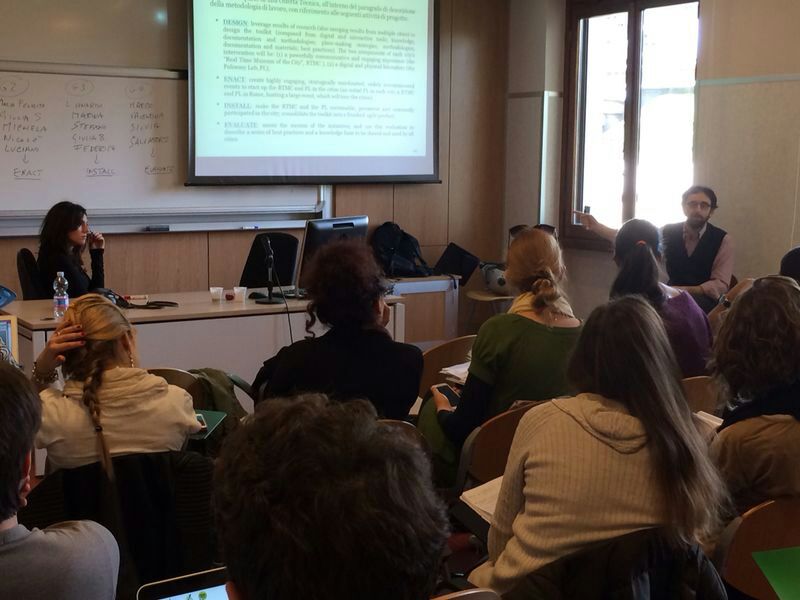
The Labgovers met the writer and director Giulia Morello of Officinegm. The event has evolved into two main directions: the first explanation on “videomaking” and the second exercise on field.
Videomaking Techniques
In the first part of the meeting Giulia Morello has presented a series of more or less well-known “videomaking” techniques, which are essential for the realization of any type of video. This point have to be emphasize, because the same group of creative people can deal with different targets or concepts (commercials, music videos, movies, etc..), To every type of video corresponds a type of language which can be declined in several ways. In its fundamental aspects, however, it would seem that any video is characterized by:
- TYPE: related to the topic that we are going to tell, and to whom we want to tell, and through which channel (for example, if we choose the web channel, it must be characterized by brevity)
- LINEUP
- SCREENPLAY (it is a mechanism of thoughts that follow each other in a video)
- STORYBOARDS: during the evolution of the script we have to think about what we want to see and feel what is needed to be created, without ever losing sight of times in the story.
If we decode those just listed as features of any video format, the ones listed below, instead, are areas within which it is called upon to choose between alternatives:
- PREPARATION: If we make an outdoor video we have to provide all the possible audio / lighting problems, and prepare a plan B in case it rain for example. Moreover it’s important to test all the tools before recording and make a list of the tools;
- LIGHTING: affects the quality of the final result (better to shoot with a lot of light rather than with a little, because we can always lower), the ideal conditions to record are early morning or late afternoon ( better when the sun is near the horizon) ;
- AUDIO: usually underestimated, is the most difficult thing to fix in the post production;
- SHOTS: they are the basic language of cinema (portion of space took by the camera);
- FIELDS AND PLANS: two families of the frame (field, medium field, long field, very long field; individual plan, first plan, very first plan, half-figure, American plan, entire figure);
- REFERENCE POINTS OF SHOTS – normal, from below, from above;
- THE CAMERA MOVEMENTS: panoramic (vertical, horizontal, circular. It contextualizes the character compared to his action);
- ZOOM AND TRAILER (mechanics-trailer – the camera is moved on a track); steady camera
- EDITING: often underestimated. When we took a lot of scenes, it is always preferable to record the bests footage (that will certainly se) to avoid wasting memories;
- ESSENTIAL ROLES: director, sound engineer, operators, actors, editors, photography director.
Part Two: Exercise
During the second part of the meeting, the director Morello asked to the LabGov group to divide into four subgroups. Then prepare a plan for the construction of a spot that explains the activities of the Laboratory, and to promote the same to the students for the future 2015 initiative.

by Alessandra Feola | May 16, 2014 | Luiss LabGov 2013-2014
 MEETING MINUTES 23rd APRIL 2014
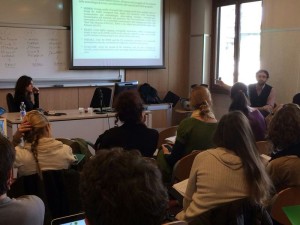
LabGov hosted Federica Fotino, coordinator of Planning and Valorisation of the State Property. The meeting was divided into two main parts: the first one was a general introduction to project management and to those instruments and methods to realize it; the second one was a real workshop to put into practice the new-acquired knowledge.
In the first part of the meeting Fotino explained what is a project, defining it as “a temporary endeavour undertaken to create a unique product, service or result”. The activity of Project Management consists in having the nautical charts (knowing the social, juridical and economic environment in which we come to act), defining the route (defining the objectives), organizing the galley (defining competences, roles, in-depth analysis, activities).In every kind of Project Management, it is fundamental to respect the relation between time and resources, in particular human resources. It is necessary to work bearing in mind the significant difference between objectives and goals; the first ones are different for each part of the project, whereas the second ones are long term intentions. It has been explained what are the methods through which create the Activities/Resources matrix in order to individuate the budget for the project. After the introduction Fotino organized the class in groups for the practical exercise consisting in writing a piece of a project following the instruction received during the meeting.
by Alessandra Feola | Apr 21, 2014 | The Urban Media Lab
 On Monday 28th April, 2014 twenty students of Gaetano De Sanctis High School, in collaboration with Labsus – Laboratory for the subsidiarity and Retake Roma will present the new edition of Rock Your School – School of civic care of the commons. The event hosted in the Aula Magna of De Sanctis High School in via Cassia, 931 will be at 12:00.
The project aims to bring to the young generation an experience of shared care of a common good such as the school. The actors involved are the students and the teachers, that lived the school in everyday life, but also Public administration and the civil society of the neighborhood that acknowledge great importance to the school and its role in society.
This project designed and launched by Labsus in 2010 seeks to engage students in taking care of the commons and in training for the respect of environment. Students will receive at the end of the project a certificate in Active Citizenship.
Rock your School consists of two parts, on the one hand a theoretical part in which students (and all participants) are invited to reflect about the principles of active citizenship, on the other hand a practical part in which through experimentation on field there will be possible to appreciate concretely how the civic care of the commons create added value in the community. Students in fact will be directly involved in the care of their school thanks to the partnership with the XV Municipality of Rome.
The presentation will be the occasion for the students to tell their experience of these months of training, started in November 2013, and to make some reflections about what they have learnt. Moreover on the same day will be presented the three projects of civic care of the commons elaborated during this period and that will be implemented during the month of May 2014.
The program will be as follows:
h 12.00
Geetings of Head-teacher Maria Laura Morisani
Presentation of “Rock your School”
Speakers:
Gregorio Arena President of Labsus – Laboratory for the subsidiarity
Paola Carra Retake Roma;
Danilo Rocca President of De Sanctis High School Council
h 12.30 Presentation of three projects elaborated and to be realized by the students
h 13.00 Conclusion
Speakers:
Daniele Torquati President of XV Municipality of Rome,
Alessandro Cozza Vice-President in charge of Culture, Sport, School, Transparency and Participation of XV Municipality of Rome
Elisa Paris in charge of Suburbs, Public Works, Urban Transformation, Transport and Mobility of XV Municipality of Rome
Michela Ottavi in charge of Social Policies, Social Support and Subsidiarity, Health and Equal opportunities of XV Municipality of Rome
h 13.30 Luch provided by De Sanctis High School.

 In Mantova new ideas for the development of cultural heritage.


