
by Chiara De Angelis | Nov 3, 2017 | The Urban Media Lab

From November 11th to 12th, Gaverina Terme is going to host the second edition of Cooperative in Cammino – “La cooperazione per i beni comuni”, a moment of analysis and elaboration of proposals for a new model of connection between public and private, a place where different experiences of cooperation meet and share their knowledge on those new experimental models of organization.
Cooperative in cammino comes up from the need of defining more open and participated models of cooperation, that provide the involvement of citizens in the management of goods and services of common interest, and that experiment new forms of dialogue between those actors and public administration.
The meeting is organized by Cooperativa Sociale L’Innesto (which we already talked about in this article on the crowdfunding campaign they launched for the acquisition of La Casa del Pescatore), a cooperative born in 1999 and since then pursuing the common interest of the local community to the social integration of citizens through the execution of productive activities, in the respect of the environment, territory, culture and local knowledge, finalized to the job placement for disadvantaged categories.
Saturday, November 11th, Cooperative in Cammino will host the convention “Give back commons to collectivity” (“Restituire i beni comuni alla collettività“), that is going to be introduced by Lodovico Patelli, President of the Cooperative, and Christian Iaione, LabGov’s co-founder.
Sunday, November 12th, the round table “Experimenting the management of public goods and services” (“Sperimentare la gestione di beni e servizi pubblici“) will take place.
The full program of the event is available here: http://www.innesto.org/wp-content/uploads/2016/07/coopincammino2ante_def.pdf
Dall’11 al 12 novembre Gaverina Terme ospiterà la seconda edizione di Cooperative in cammino – “La cooperazione per i beni comuni”, organizzata dalla Cooperativa Sociale L’Innesto.
Il programma dell’evento è disponibile qui: http://www.innesto.org/wp-content/uploads/2016/07/coopincammino2ante_def.pdf

by Chiara De Angelis | Oct 26, 2017 | Luiss LabGov 2017-2018
Friday, October 6th, LabGov EDU held the first 2017-2018 meeting, which main aim was to present the year’s team to the labgovers and to inspire them with its mission and objectives.
The meeting was introduced by Chiara de Angelis, LabGov EDU’s coordinator, who explained to the class the past projects and future objectives. The best way was to tell the experience of those who have already participated to the course such as Elena De Nictolis, currently Labgov EDU’s scientific coordinator, who suggested to enjoy this experience, Alessandro Antonelli and Paola Todisco, LabGov EDU’s tutors, who talked about their experience and how engaging it was.
Soon with the students we decided to move outside, in the community garden, to show that LabGov is a research-action project and that they will be involved a lot in practical activities.

The session in the community garden begun with the presentation of the new labgovers, who talked about their passions and expectations, skills and attitudes.
When the students finished to introduce themselves, Chiara de Angelis explained the rules of the course, that contemplates 50 hours “in class” (workshop and co-working sessions), and 50 hours of on field activities (community gardening and teamwork). About the community gardening, LabGov’s expert Alessandra Noce illustrated her experience. She has devoted particular attention to her experience in the district of Centocelle and the Co-Roma project. In Centocelle the association “the happy island” (“L’isole felice“) was born, and she explained ahow through it she has been able to give a turn to the district.
Then, some “ex labgovers” from last year’s course were invited to “join the circle” and to tell their recent experience with LabGov, why and how they liked it and in which way they decided to collaborate with the team even after they finished the course.
The meeting was concluded by Prof. Iaione, expert of urban politics and LabGov’s co-founder. He explained how Labgov is a place where everyone is able to express freely and to experiment own limits collaborating with other people.
by Chiara De Angelis | Oct 23, 2017 | The Urban Media Lab

On October 24th and 25th, Milan is going to host ICityLab 2017 “Towards a sustainable city”, the annual FPA meeting focused on cities, sponsored by the Municipality of Milan.
The opening of the meeting will be dedicated to the presentation of ICity Rate, the first FPA annual report that draws a ranking of Italian Smart Cities in relation twith the objectives of sustainable development proposed by the ONU 2030 Agenda.The report will help us to understand where are we in relation to those objectives: the results of the research will be presented during the first meeting, held in the innovative spaces of BASE Milano, on Tuesday, October 24th from 10 AM.
Gianni Dominici, FPA General Director, explains that Milan has benn chosen because it is actually the city that is working more than the others in the logic of an “urban lab“, focusing on all the actors of the city.
The program provides 40 sessions in two days: conventions, labs and working tables where local entities, public administrations, innovative entreprises, local actors, the third sector and representatives of the active citizenship will participate actively. The themes of the events will focus on policies and platforms for civic participation and civic crowdfunding, tools for urban regeneration and re-use of public spazes, digital innovation for the city, the new borders of 4.0 manifacture, big data and IOT, participatory budgenting and so on.
LabGov’s co-founder Christian Iaione is going to attend the meeting, and in particular:
– the convention dedicated to “Regenerating the cities: a national perspective“. The focus is going to be on the national and international measures taken by the Italian government and the EU to answer the local needs of a participated solution to the re-use of spaces. The meeting will be held on Wednesday, 25th from 9.30 AM to 11.30 AM, in Sala 2;
– the convention on “Innovative and circular Procurements“, fundamental elements when speaking about innovation processes and urban Living Labs. The meeting will be held on Wednesday, 25th from 11.45 AM to 13.45 AM, in Sala 1
The full program of the event is available on the official website: http://icitylab2017.eventifpa.it/
Milano ospiterà il 24 e 25 ottobre ICityLab 2017, “Verso una città sostenibile”, l’appuntamento nazionale sulle città organizzato da FPA, quest’anno con il patrocinio del Comune di Milano.
Il programma dell’evento è disponibile a questo link: http://icitylab2017.eventifpa.it/

by Chiara De Angelis | Oct 13, 2017 | The Urban Media Lab

In February 2017 the report “Value in the Commons Economy – Developments in Open and Contributory Value Accounting” has been co-published by P2P Foundation and Heinrich Böll Foundation.
The authors, Michael Bauwens and Vasilis Niaros, address several question in the report, like “is anything good coming up from the crisis”, or “is a new system able to grow from within an old one”: they focus on a main thesis, describing the “value crisis” that is affecting our current world as a sign of a silent transformation in our “value system”.
Starting from the analysis of real case studies, the authors try to explore how the new value regimes emerging from pioneering communities can represent a shift towards post-capitalist practices. In the “commons’ transition” approach, that would mean that commons themselves could represent a new economy emerging within the old system.
The report offers an overview on how the new commons-based approaches are attempting to deal with some significant questions regarding the evolution of value, such as:
- What is value in our “digitalized” and “networked” societies where knowledge commons are playing a fundamental role?
- What should value be in a world marked by ecological and resource constraints?
- In a world of social and cultural diversity, can a new value system incorporate all the values that are not recognized by capitalism?
Three main case studies are therefore analyzed, namely: Enspiral, an entrepreneurial coalition of mostly mission-driven entities that calls itself an ‘open cooperative’ because of its commitment to both the production of commons, and an orientation towards the common good, Sensorica, an open collaborative network committed to the design and deployment of sensors and sense-making systems, utilizing open source software and hardware solutions, and Backfeed, a system based on the use of the blockchain ledger, which imagines itself as a full infrastructure for decentralized production, which comes with sophisticated capabilities to develop incentives and express them through crypto-currencies..
Bauwens’ and Niaros’ analysis also shows some different perspectives and approaches regarding what determines values. All the analyzed approaches, however, agree on the fact that we are going through a “value crisis”, characterized by an increasing capacity to create commmon value through commons-based peer production and other practices from the collaborative economy.
The main question that the authors address, in this sense, is not what is value nowadays, but what if value is becoming a driver for change. The possible consequences are mainly two: a complete shift of paradigm, where a translation of capitalism’s features in new terms is necessary, and a scenery of coexistence of the different realities, with the doubt of an effective possibility of preservation of the characteristics of each one.
And what is the role of commons in this shift of paradigm?
In this scenery, Bauwens’ and Niaros’ approach really matches with LabGov’s co-founders’ (prof Sheila Foster and Prof Christian Iaione) one, who in “The City as a Commons” affirm that “What we are interested in is the potential for the commons to provide a framework and set of tools to open up the possibility of more inclusive and equitable forms of “city-making”. The commons has the potential to highlight the question of how cities govern or manage resources to which city inhabitants can lay claim to as common goods, without privatizing them or exercising monopolistic public regulatory control over them.”
LabGov is in fact currently carrying out a research on the CoCities approach, investigating what are the variables that conduct a city in the process of a commons transition. The output of the research will be soon available on www.commoning.city
The full report is available here: http://commonstransition.org/value-commons-economy/
A febbraio 2017 è stato pubblicato il report Value in the Commons Economy – Developments in Open and Contributory Value Accounting, che analizza il concetto di valore e quale sia la sua prospettiva e il ruolo dei beni comuni nel cambio di paradigma che la crisi sta generando
by Chiara De Angelis | Oct 12, 2017 | Luiss LabGov 2017-2018
Save the date!
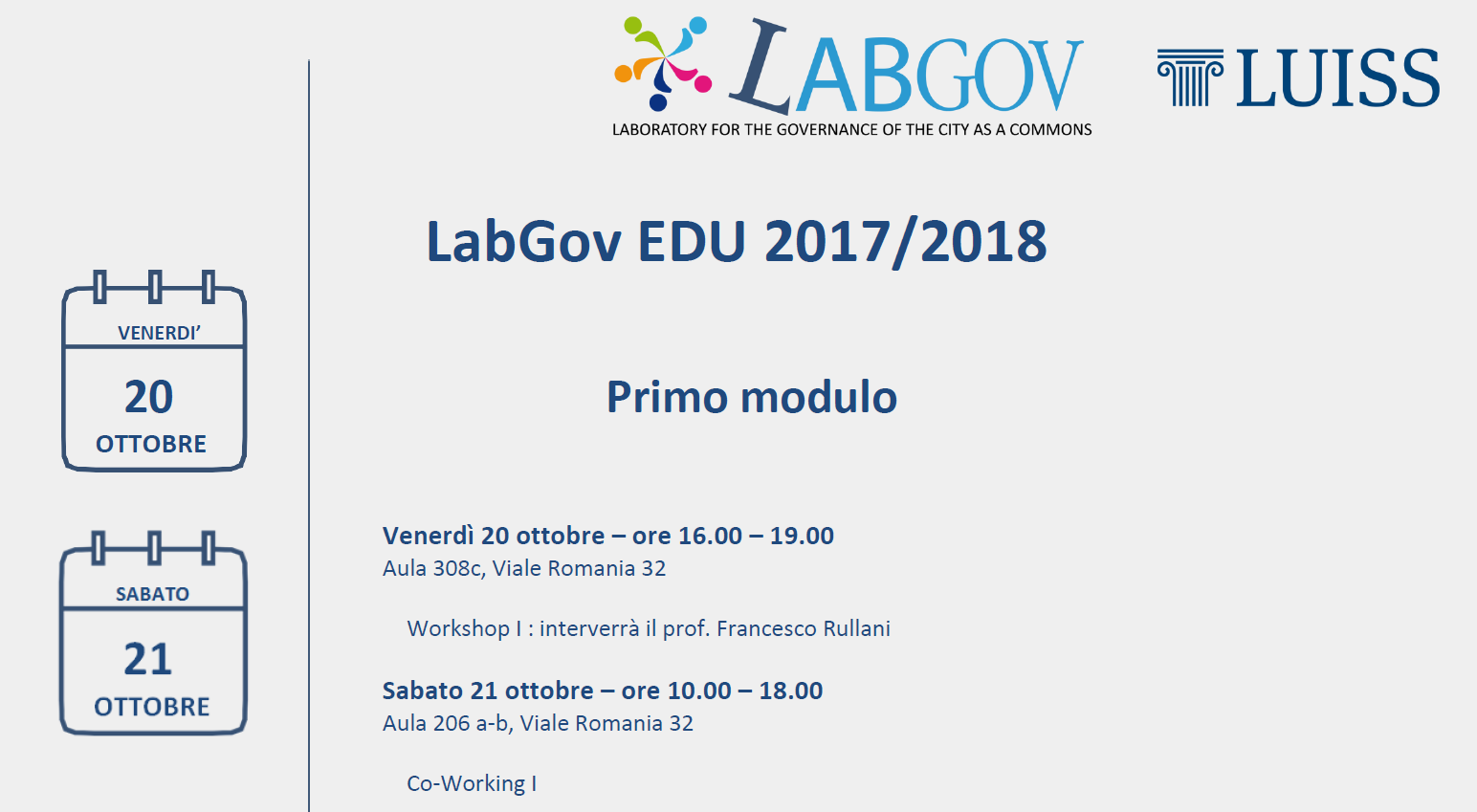
Venerdì 20 e sabato 21 ottobre primo modulo di LabGov EDU 2017/2018!
Venerdì, dalle 16. 00 alle 18.00 in aula 308/c avremo ospite il prof. Francesco Rullani, esperto di implicazioni organizzative, strategiche e manageriali dell’adozione di modelli di produzione di conoscenza aperti, che presenterà un intervento su Social Innovation e Social Entrepreneurship come nuovi strumenti per affrontare nuovi sfide.
Durante l’ultima ora del venerdì i labgovers verranno formati per il co-working del sabato.
Sabato la giornata sarà interamente dedicata al primo co-working dell’anno: divisi in gruppi, i labgovers tramite tecniche di co-design inizieranno a progettare sul tema del Social Business.

L’appuntamento successivo di LabGov EDU al 17-18 novembre!


