
by Stefano Speranza | Apr 11, 2015 | The Urban Media Lab
In the majority of the articles published in this blog, a recurring keyword is social innovation. The paradigm is not only well-known among the experts of the sector, but that is also spreading fast in the whole civil society.
Actually, after the economic crisis out-broken in 2007, most of the people are starting to approach to economy at-large, they are starting to be more interested in the methods of doing business and in the ways of learning and teachings. Basically they are logging at everyday life in different ways from the past.
Basically, social innovation is an approach. A new approach through which collective energies are released thanks to grassroots involvement.
An even more exhaustive definition of social innovation can be found in this very useful dictionary, based on the above mentioned concept, in which it is quoted the founder of The Hub – Rome, who states that “social innovation has to be made, not to be defined”.
However, making social innovation implies to let this kind of approach enter into the learning institutions.
That is why, with this short article, we are pleased to support and spread among our readers the first Master’s program in social innovation, social business, social start-up and innovative design in Italy.
The Master’s program will start in June and it is offered by ASVI Social Change, with Simone Cicero – OuiShare connector Italy – as director.
The educational plan will be “blended”, that is to say a mixture of e-learning, webinars, frontal lesson in Rome, Milan and London, and workshops.
More than five hundreds different orgnisations will offer their teachers and stage opportunities. Among them we find Libera, Agire, FairTrade, Save the Children, Emergency, Greenpeace, Amnesty International, Amref, Unicef, ActionAid, Peter Pan, Aidos, Telethon.
As it is possible to read in the website of the Master’s program, it is important to underline the fact that the world is deeply changing, and that the third sector —especially when it comes to the non-profit— is strongly increasing.
The Master’s program will build professional figures that will follow three profiles. A designer and strategic advisor for the social innovation, a social business’s and start-up’s manager, a consultant for social enterprises and for the organisational re-design.
So, the outgoing participants from the Master will find an employment and will bring an added value in the third sector, in the private businesses, and in the Public Administration.
The participants will be people and professionals between the age of 23 and 55 exercising the role of managers and supervisors looking for turn over a new leaf, managers of innovative processes, workers and experts in human resources, graduates.
To participate, if you have a dream and if you are motivated to take a significant professional choice, you can take a look to the syllabus and apply for an interview here. fluent english and good organisational skills are required.
For further infos, please follow this link.

by Stefano Speranza | Apr 3, 2015 | The Urban Media Lab
 As we all know, all over the world, and in Italy too, things are changing. The daily way in which we spend our money, the way we organize travels, the way we move. That is basically the arising of a new economic approach.
The first thing to do is to map all of our “friends” and to support each other when we do something good for our communities, so to create a network of social innovators and supporters of sharing economy.
Few weeks ago, a participant of the Sharing School organized in Matera (of whose LabGov was an official partner) in January, emailed us in order to let us know a very nice initiative we are proud to support.
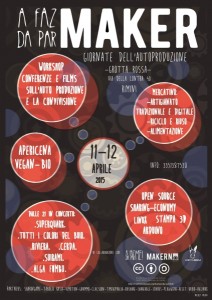
It is the weekend (on April the 11th and the 12th) called “A faz da par maker”, which will take place in the community center GrottaRossa in Rimini. The expression a faz da par maker is a funny union of the typical expression of Romagna (a faz da par me in that region literally means “go it alone”) with the word Makers.
The two-days event grows out of two different realities.
The first one, DIY Rimini, which will cover a more traditional side of the event, that has at his core themes like agriculture and nutrition. And the second one, MakeRN, more linked to the sharing economy and to the digital craftsmanship.
Both the realities are obviously interconnected and they are driven by the passion for the self-production. Consequently, everybody will be given the chance to exhibit projects and experiences through expository booths, talks, conferences, workshops, laboratories, projections and various amusements.
On Saturday the 11th, the opening day, from 2 pm it will start the 9th edition of the DIYFest, during which it will be possible to participate in free workshops dedicated to yoga, cooking, craftsmanship and reuse activities. Meanwhile it will be possible to have a walk through expository booths and a little market with local producers and craftsman.
At night, after the projection of a movie dedicated to the punk scene of the city of Rome during the 90’s, some local independent bands will play Italian punk/hardcore music.
Finally, Sunday will be the concluding day, which will host the third edition of the “From Market to Makers” faire. There will be a lot of makers’ expository booths with their technological projects such as 3D printers and little robots.
From 3 pm on, there will be a series of speeches and talks on sharing economy, presentations of local and national collaborative economy innovative services, which touch important themes like sustainable mobility, tourism, housing, and economic exchanges alternative to money.
For the whole day, interesting workshops on 3D printing, Arduino, CoderDojo, Linux and Wearable will took place, both for children and adults.
Starting from 9 pm the event will be closed with the “Salotttino”, where it will be possible to freely debate and exchange ideas and opinions on sharing economy. Remember, the only rallying cry will be #sharing!
Both on Saturday and on Sunday, a bio-vegan dinner will be waited on by Tabula Rasa.
The event will be live broadcast by ResetRadio, the first European radio exclusively broadcasting CreativeCommons/Copyleft music.
At the entry, you will be asked a little subsidy (3€ for a single day, 5€ both the days) to contribute to the expenses and to support the future activities.
The event is supported by international partners like Shareable, OuiShare and 3DHubs.
The full and detailed program is available here, see you soon in Rimini!

by Stefano Speranza | Mar 29, 2015 | The Urban Media Lab
 What we are going to write about today is a bit out of our standards, but it is a news worth spreading.
We are going to talk about a crowdfunding campaign for a documentary, a very particular one which is based on a true story set in Rome.
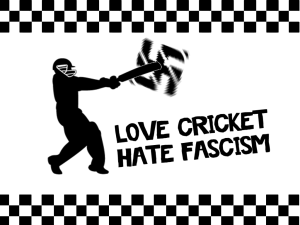
I will start by saying that “IT’S NOT CRICKET!”, and you have to read this exclamation in the sense given by McGraw-Hill Dictionary, namely “it is not acceptable!”
What is it that is not acceptable, or better, that is no more acceptable?
A very thorny answer must be given to this question. It regards immigration and immigrants, racism and social inclusion, and consequently it is about militant and productive antifascism, and forms of protest which are so unique as to bring a movie director to decide to film a documentary about this story.
Let’s try to explain all these issues form the beginning.
This is a real story about Piazza Vittorio Cricket Club, a glorious cricket team that no longer exists, and about the attempt of re-establish it.
Here in Italy we are getting to know cricket thanks to the immigration streams that permit us to understand that soccer, together with few other mainstream sports, is not the only activity practiced during the weekend!
Actually, cricket is the second most practiced sport in the world and it is the most important sport in very populated countries such as India, Pakistan or Bangladesh. Here we have the first precious gift given to us by the immigration flows, that is the mixture of customs and habits of different cultures, the realization of a Melting Pot (that became popular thanks to Israel Zangwill’s play, first staged in 1908!).
Edoardo Gallo was the coach of Piazza Vittorio Cricket Club and, during an interview released in 2011 for the newspaper La Repubblica, he explained how the team was born and what are the principles behind the project. He affirmed that “the team was founded in 2006 and, at the very beginning, we have worked on the territory, trying to involve all the citizens from Piazza Vittorio neighborhood. Then we extended the possibility of participation to every young folks beyond Piazza Vittorio and we started organizing cricket games.”
Then he fully explained why they chose cricket among dozens of possible sports: “cricket itself has distinguishing features which foster respect for the opponent and for those who are different from us and far away from our culture. Our aim was to bring together these guys of different nationalities, and to realize a racial and culture integration through the cricket”.
The other coach, Federico Mento, thanks the UISP of the city of Rome and his project “Lo sport per tutti – Sport for everybody”, through which it was possible to use sport as a tool for the social inclusion of foreign communities in the Italian social fabric.
How does this beautiful story go on? In 2013 the project has stopped because, as we can read on the crowdfunding platform webpage, “the young men have now turned eighteen. Some of them play on pick up teams or in the streets, while others have stopped playing. The experience of the Piazza Vittorio Cricket Club today is just a memory, but it has been an important cultural training. At the end of this cultural experiment, all the boys sadly refused to integrate with the Italian culture and society. Almost all of them went back to their original communities, Bengali with Bengali, Sri Lankan with Sri Lankan etc. I would like to investigate the experience of everyone involved and try to understand why this project failed”.
So, the admirable aim of Jacopo de Bertoldi is to raise 15,000$ in order to film a documentary about this great story, and to make the audience look between the lines and think about diversity, inclusion, and issues of latest political relevance, such as the growth of neo-racist political parties in the European Union (as Matteo Salvini’s italian Northern League proves). And to make everyone scream: “IT’S NOT CRICKET!”
For the ones who have read the 2008 novel “Netherlands” by Joseph O’Neill, a parallel could easily be made.
Actually the main character in the book can be compared to all the people who want to give voice to the Piazza Vittorio Cricket Club social experiment. At some point in the novel, Chuck says: “All people, Americans, whoever, are at their most civilized when they’re playing cricket, and what’s the first thing that happens when Pakistan and India make peace? They play a cricket match. Cricket is instructive, Hans. It has a moral angle…. I say, we want to have something in common with Hindus and Muslims? Chuck Ramkissoon is going to make it happen. With the New York Cricket Club, we could start a whole new chapter in U.S. history. Why not?”
We do want to stop political and social criticisms against such important and innovative experiments. Not with arrogance or violence, but by making people meditate on the issue of diversity.
In my opinion, touching the issue of diversity could only implement the awareness of being citizens of the world and, most of all, social relations can be tighten up thanks to initiatives like this.
This is a clear example of an intangible, cultural Commons, that must protected and enhanced.
These guys deserve more attention and full support; here you are the link to donate.
Please, share!
Pictures for this article have been taken here, and here. Please, follow the links for further infos.
Pubblichiamo l’articolo per supportare la lodevole iniziativa del regista Jacopo de Bertoldi, il quale sta raccogliendo fondi per realizzare un docu-film sulla storia del Piazza Vittorio Cricket Club, una squadra romana di cricket nata nel 2006 e le cui avventure sono sfortunatamente terminate nel 2013.
Lo scopo della creazione della squadra, supportata dalla sezione romana dello UISP, era quello di favorire la coesione e l’inclusione sociale, tenendo bene a mente alcuni temi fondamentali come l’antirazzismo e l’antifascismo come argine ai movimenti politico-sociali in espansione in tutta l’Unione Europea.

by Stefano Speranza | Mar 17, 2015 | The Urban Media Lab
 A very nice and recommendable initiative about urban regeneration in Italy is the project “Bari per Bene”, adopted by the municipality of Bari.
It was a particular San Valentine’s day this year in Bari, because during that day the project has started. An “act of love” dedicated to the whole town. An act proposed by the administration to the citizens, who will be involved in an experimental process that has started from the “Madonnella” neighbourhood.
The main goal of the project, as it is stated on the official web page of the project, is to make the city more beautiful to enjoy, having guaranteed cleanliness and decency.
The local administration won’t be alone. Actually, in this process will be involved not only the citizens, but also the districts, and all the branches of the local administration, together with the local police.
“Bari per Bene” starts from Madonnella neighborhood for two main reasons.
First of all, because it is one of the most popular districts and secondly, because it is well defined and this could lead to a plausible test of the efficacy of the experimentation. Later on, the project will cross all the neighborhoods following the same procedures, thanks to the help and the warnings of the citizens (thanks to the establishment of a toll-free number and the creation of an application for smartphone).
What is worth to underline is the structure of the project, which is organized in three phases and follows a clear and well-structured timeline chart.
In particular, the first month (February 14th – March 16th) has been dedicated to monitoring and to raise-the-awareness activities on field, through the active collaboration among citizens and the neighbourhood’s administration.
The second phase, that will last until April 15th, will include important activities such as collecting and managing the feedback through the analysis of the data collected from the monitoring activities. Then, the programme of the experimentation will be updated.
Lastly, in April, a press conference will be hold, during which this part of the project will be closed and will be presented the next district to which “Bari per Bene” will move.
On January 31st, the Mayor Antonio Decaro wrote on his facebook profile:
“Dear friend citizens, our city is mainly made of respectable people. But often we see events characterized by incivility that contribute to make Bari uglier, dirtier and less healthy. We, as administration, can do more in order to guarantee cleaning, decency and livableness. But without you, this is a lost battle.
With the project “Bari per Bene”, I propose you an agreement in which we, the Administration, undertake to enforce the public services for cleanliness. At the same time, I ask you to cooperate with us following the rules and reporting who does not.
Public spaces belong to everyone, and to protect them from negligence and neglect is a duty. Actually, it is a challenge that will bring together all the people who love our city, Bari.”
E’ stato avviato lo scorso 14 Febbraio il progetto “Bari per Bene”, con il quale il Comune del capoluogo pugliese sta coinvolgendo i cittadini nella cura degli spazi comuni in una lotta contro il degrado e l’incuranza degli stessi.
Oggi il progetto sta attraversando la seconda fase nel quartiere Madonnella. Dal 15 Aprile in poi scopriremo i successivi quartieri nei quali il progetto continuerà a coinvolgere i residenti, i quali verranno sempre affiancati dall’amministrazione locale, dalla Polizia Municipale e dall’AMIU.

by Stefano Speranza | Mar 2, 2015 | The Urban Media Lab
LabGov goes global. After the interview to one of LabGov strategist, Christian Iaione, by Michel Bauwens, founder of the Foundation for Peer to Peer Alternatives, on the City as a Commons project, that has been published few weeks ago on the Shareable website (and available here), another great expert of Commons, David Bollier dedicated an article to LabGov and its projects on his famous blog about the commons.
We have already talked about Bollier, his works and his efforts as an activists on our blog. In particular, we have written on the crowdfunding campaing launched less than an year ago for the likely attempt of translating in Italian his “Think like a Commoner”, and on his publication more in depth, here.
Bollier defined pioneering the work done in Italy on the paradigm of the City as Commons. In his article Bollier highlighted the important role of LabGov in the reconceptualization of the catalytic role that universities can play and the idea behind LabGov projects that we are in front of a epochal transition in which is emerging a new social class – active citizens, social innovators, makers, creatives, sharing and collaborative economy practitioners, service designers, co-working and co-production experts, and urban designers. This new social class needs commons-related policies as ways to tap into the talents and enthusiasm. In fact conventional governance structures cannot effectively elicit or organize the energies of these people.
Bollier devotes particular attention also to two important LabGov projects: CO-Mantova and the “Regulation on collaboration between citizens and the city for the care and regeneration of urban commons“.
Moreover, Bollier endorsed Iaione’s idea of public-commons partnerships to build a “sharing city” or a “commons-oriented city”. As perfectly synthesized by Bollier, LabGov approach consists in this: “Instead of relying on the familiar public/private partnerships that often siphon public resources into private pockets, a city can instead pursue “public/commons partnerships” that bring people together into close, convivial and flexible collaborations. The working default is “finding a solution” rather than beggar-thy-neighbor adversarialism or fierce political warfare”.
This is just an excerpt of the full article that is possible (and worth) reading at this link:
http://bollier.org/blog/labgov-pioneers-paradigm-city-commons
Dopo essere stato intervistato da Michel Bauwens, l’idea del prof. Iaione di “Governance dei beni comuni” viene ripresa da un altro grande attivista dei Commons, David Bollier.
In passato, su questo blog, si è già parlato di Bollier.
Con questo articolo rimandiamo a bollier.org, blog sul quale è stato pubblicato l’articolo che illustra i successi e le sfide future del Laboratorio per la Governance dei beni comuni.
The picture for this article has been taken here.
