
by Stefano Speranza | Feb 16, 2015 | The Urban Media Lab
After the economic crisis out-broken in 2007 and the consequent period of time defined by recession, all of us are aware that in this situation, one of the most important thing in which to believe in, is to do with what we have got. For this reason, the creativity in using material stuffs, the fact of using something instead of putting it, the replacement of simple owning with shared use (as the sharing economy demonstrates), become every day more important.
Well, we should name all of this mix as “Resilience”. That, for what we are interested in, is to say the capacity, for a society, to anticipate disruptions, to adapt to events and to create lasting value.
And what about the city of Rome?
The project “Roma Resiliente”, that the Municipality of Rome act in the framework of the programme “100 Resilient Cities” promoted by the Rockefeller Foundation, is getting going.
Actually, the Foundation decided to allocate one-hundred million dollars – in occasion of its hundredth birthday – to one hundred cities selected among more than four hundred cities.
Rome was selected as first, together with thirty-two more cities in the world, by eight judges among which the former U.S. President, Mr. Bill Clinton.
The working plan, proposed by Giovanni Caudo (Municipality of Rome’s council member for the Urban Transformation) has persuaded the examination board, and has been awarded with one million dollars to be allocated to the City.
The main goal of the proposal is to create an improved resilience, that is to say the capability in resisting to disasters caused by people or simply natural events, and to raise again stronger than before. This is possible thanks to the building of a widespread “culture of resilience” among citizens, associations and enterprises, and the advent of an evaluated institutional capability.
Thanks to the partnership with the Rockefeller Foundation, the local administration will launch a partecipatory process for the creation of a resilience plan for the Municipality of Rome.
Among the priorities identified in the working plan emerge the so called resilience challenges that are, for the city of Rome, earthquakes, flooding, pollution or environmental degradation, rising of the sea level and the consequent coastal erosion.
But, overlooking for a moment natural diseases, “Rome is struggling to reverse decades of poorly regulated development and address its informal housing neighbourhoods, inadequate infrastructure provision, and urban sprawl. This activity has made Rome highly vulnerable to flooding and other disruptions, which threaten to undermine social cohesion and prosperity in this city of immense cultural and economic significance. Rome’s city limits include large expanses of still viable rural land and natural reserves, and its forward looking planners are focused on transforming these assets in order to maintain and protect its environment and build long-term resilience to shocks and stresses”, as the officialwebsite of the 100 Resilient Cities reports.
Last but not least, Roma Resiliente is going to deal with themes such as nutrition and green common areas.
Actually, on January, 20th at the Piccola Protomoteca of the Capitol Hill of Rome was held a meeting dedicated to “Agricolture and food for resilient cities”. During this meeting were analysed and illustrated the best practices and the good purposes about a new kind of food policies, which should consist of the best quality of the nutrition as a tool for improving public health , the sustainability of the production and distribution chains of food, the stress on the role of urban agriculture.
Undoubtedly, such policies are one of the fundamental paths that will make our cities more resilient and, the cooperation of the multiple social actors is needed.
Institutions alone cannot go far away. The community garden that we, as LUISS-LabGov, are taking care of, is a clear example. Together with the dozens of shared gardens in the whole city of Rome, our community garden represent a nice resilient partnership among citizens, students and academy.
For further infos, please visit the following websites:
http://www.100resilientcities.org/
http://www.urbanistica.comune.roma.it/roma-resiliente.html
http://www.luiss.edu/news/2014/11/25/shared-garden-becomes-greenhouse-social-innovation
E’ stato lanciato il progetto “Roma Resiliente”, che la città di Roma intende realizzare nell’ambito del programma “100 Resilient Cities” promosso dalla Rockefeller Foundation.
Difatti, la prestigiosa fondazione americana ha deciso, in occasione del proprio centesimo compleanno, di donare cento milioni di dollari a cento città nel mondo, selezionate fra oltre quattrocento.
Grazie alla partnership con la Rockefeller Foundation, l’amministrazione romana avvierà un processo partecipativo per la creazione di un piano di resilienza per Roma Capitale.
Tra le priorità identificate nel piano di lavoro emergono le sfide di resilienza che, per la città di Roma, riguardano anche l’alimentazione e l’agricoltura.
In questo scenario, il community garden dell’Università LUISS “Guido Carli” rappresenta un esempio positivo.

by Stefano Speranza | Dec 12, 2014 | The Urban Media Lab
 2015 is going to begin, and in some cities all over the world, it is possible to live in and to believe in a new concept of “city”, where the concept of “community” plays a great role.
These new cities which I am referring to are the so-called smart cities. And they are changing the way in which we intend the usual urban life.
If we focus on Italy we can see few likely attempts of transforming some municipalities into smart cities.
The city of Milan, which among the other things, will host Expo2015 – the Universal Exposition that will merge the most prominent people who mainly studies social innovation, or works on it, and themes related to it – is making efforts in order to change and become a smart city.
Soon after the politicians have understood what Milan should become, the main tool that is useful to let the civil society enter in this new paradigm is the Internet. And the city of Milan is doing it well.
Actually, a very clear and direct website is online and it answers to lots of questions that may rise.
First of all, what are we talking about? What are the goals of a new kind of city? And, before that, what is, concretely, a smart city?
Milano Smart City is a fact promoted both by the Municipality of Milan and its Chamber of Commerce, whose core aim is to include the main actors in the development of the city, into the realization of the “Milano Smart City” strategy.
On an international level, the Municipality of Milan is already an active member of the biggest European and worldwide networks that work on smart cities.
On the local level, the Municipality and the Chamber of Commerce are building stable partnerships between different realities, in research, social innovation, business and finance.
Secondly, how it is possible to give life to a smart (in the literal sense of the word), green and inclusive city? Simply through a continuous dialogue on and exchange of practises with the communities that are involved in the process.
Actually, Milan can compete on a national or European level, in order to become a benchmark of innovation and sustainability only thanks to collaboration processes between the public sector and the private entities.
Therefore, a way of consultation has been launched and it has networked institutions, private entities, Universities and various associations through the creation of six thematic working group, that are named Smart Economy, Smart Living, Smart Environment, Smart Mobility, Smart People and Smart Governance.
Moreover, what I was referring to, before in the article, is the process carried on from April 2013 that has had as result the drafting of a document that contains guidelines for Milan Smart City. It was a very useful period of time during which the Administration, along with the citizens, has outlined the seven guidelines, that are:
-
global city, national and European Lab;
-
Lab for sustainable urban mobility;
-
Lab for environmental and energy policies;
-
Lab for social inclusion and diversity;
-
Lab of well-being in the city;
-
Lab for decluttering and simplifying Public Administration;
-
incubator for business models.
The document can be downloaded at this link, both in Italian and in English.
Finally, MilanoSmartCity’s motto is of importance to me and it is emblematic: “a smart city not only cultivates its technological component, but must combine economic development with social inclusion, innovation with education, research with participation”.
To be updated, for further infos or to gain knowledge of other projects on Italian smart cities, please follow this link.

by Stefano Speranza | Nov 23, 2014 | The Urban Media Lab
 On November, 19th the students attending the course “Communication theory” held by Professor Sorice at the department of Political Science of LUISS Guido Carli, had the possibility to meet Professor Giovanni Moro and to talk with him about “Active Citizenship and Quality of Democracy”.
Giovanni Moro was born in Rome in 1958. He is a political and organization sociologist who conducts research and consultations on citizenship and on related issues, such as civic activism in public policy, new forms of Governance and corporate responsibility.
He teaches Political Sociology at the Faculty of Education at the Roma Tre University, and he has been president of FONDACA since its foundation in 2001. He has written extensively on these themes and in 2001 he established his network of European politics, the Active Citizenship Network.
The lecture of Professor Moro started with a foreword about his book, which stresses the quality of democracy and how active citizenship has to deal with it. “My research works deal with anomalies – affirmed Professor Moro – as the philosopher Thomas Kuhn pointed out during the 60’s”.
As we should know, a paradigm changes when anomalies emerge and create new standards. Professor Moro studies and analyses anomalies in the democratic citizenship paradigm and states that “the activism is one of these anomalies”.
After having recalled to the audience the differences between point of view and standpoint, Moro explained what there is inside the democratic citizenship paradigm, namely working together for a common goal, to guarantee quality of life standards and to have these standards recognised by everyone and, finally, to build an institutional system which protects all these issues. “This paradigm takes into account the principles of equality, membership and participation, but it does not work anymore” stated Professor Moro.
This paradigm does not work anymore for various reasons, such as the existence of lots of social groups and, consequently, new democratic citizenship paradigms in the plural sense emerge, which include people continuously moving, ideas always changing and a modification in the mass culture. “All of these traits represent anomalies and contribute to the evolution of the democratic citizenship paradigm” affirmed Professor Moro closing his opening remarks.
Then, he continued his enriching lecture following some clear paths.
The first one cleared the audience’s mind about the concept of active citizenship. “Active citizenship is a practice of citizenship that consists of a variety of organizational forms and collective actions designed to implement rights, treating commons and/or support people in conditions of weakness through the exercise of powers and responsibilities in policy making”. This was the general definition given by Professor Moro who soon explained how this kind of citizenship is divided into different forms of organization with different action fields, that however have to play three or more roles, such as the protection of rights that are proclaimed in laws or patrimony of the common consciousness which are constantly in danger, the care of the Commons and the empowerment of and support to people in difficulty.
The organizations which I am referring to operate through advocacy and through providing services. “I have to say that citizens have very strong powers. I mean the power of influence on the course of things and on the behaviour of other subjects” Professor Moro stated referring to all that innate power that the organizations hold, such as the power of producing knowledge (e.g. knowledge on illegal dumps), symbolic power to make consciences change (e.g. on themes regarding women’s rights), effective power (e.g. to remove architectural barriers for handicapped people) and power of legitimization.
Secondly, Professor Moro explained how these organizations work, and provided the audience with some results of the effective existence of these organizations. “It would be a catastrophe if these organizations were unable to operate as civic organizations all over the world” was the sharable statement made by Professor Moro. Indeed, some of the results collected by these organizations concern enacting laws, activating resources, changing the mass culture and introducing new ways of administration and management of public services.
Getting back to the first remarks, Professor Moro explained why these organizations represent a civic anomaly. They are an anomaly both compared to the Standard View of the participation, both as opposed to the before mentioned democratic citizenship paradigm. Actually, on the one hand we can see how these anomalies exist autonomously from the formal political system, act in policies not in politics, and do not involve the whole electoral constituency. On the other hand, as opposed to the democratic citizenship paradigm, they change the concepts of belonging, participation and rights, seeing the citizens not only as beneficiary but as promoters of rights not acknowledged yet.
Lastly, Professor Moro focused more in depth on the topic of the seminar, that was active citizenship and quality of democracy. “It is an interesting issue because it permits to understand how much a country is democratic and under which aspects it must be empowered or is considered at an excellent point” he affirmed. To do this, Professor Moro has analysed what Professor Leonardo Morlino theorized in 2013 about the three dimensions and the various standards of democratic quality, and he added very useful specifications regarding other standards and specifications, which can be then converted into indicators.
After having answered to some questions from the audience, Professor Sorice made a closing remark and thanked Professor Moro, the students and the Labgovers who attended the seminar .

by Stefano Speranza | Nov 12, 2014 | Luiss LabGov 2014-2015, The Urban Media Lab
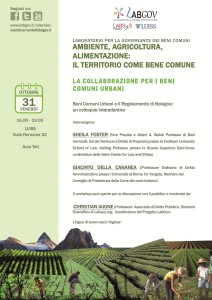 On October, 31st Professor Christian Iaione – LabGov’s coordinator – along with the LabGov’s tutors and the new Labgovers, had the possibility to have an inter-atlantic dialogue with two internationally prominent scholars about the collaboration for the Urban Commons.
Actually, the audience listened to the speeches and then debated with Professor Sheila Foster – Vice Dean and Albert A. Walsh Professor of Real Estate, Land use and Property law at Fordham University School of Law, Visiting Professor at Scuola Superiore Sant’Anna, co-director of the Stein Center for Law and Ethics and Professor Giacinto della Cananea – Full professor of Administrative Law at University of Rome Tor Vergata and member of the Presidential Council of the Italian Supreme Audit Institution.
The topic of the workshop was the Urban Commons, particularly focusing on the Bologna regulation on public collaboration and its comparison with some international practical examples. Professor Iaione opened the workshop, saying what LabGov is and how it works. He soon gave the floor to Professor Sheila Foster.
Professor Foster gave us a theoretical framework and seemed excited and pleased of being there. “I have studied and looked to the Bologna regulation with great passion, and I do believe that LabGov is my field” she soon affirmed. Her enriching speech moved towards three directions.
Firstly she gave to the audience a general idea of the commons especially in the urban context, then she moved to some ideas about how the government/management of the commons comes up and finally she went in depth by underlining how the Bologna regulation approaches these questions.
It was an enriching speech because of its clarity and linearity, through which she explained that we must consider the Commons as opposed to an asset or a mere good, so as a shared and open thing. Shared by everyone and open in the sense that it provides open access to the people who should be involved and obviously not excluded.
“Of course the natural world contains Commons but exist other types such as cultural, digital and Urban Commons” Professor Foster explained, but “many collectively shared Urban Commons shares the same dilemma that Hardin wrote about in his essay regarding the tragedy of the Commons”, she continued and “The debate that Elinor Ostrom launched, goes in two directions: privatization and shared government control with the people”. Since Professor Foster and Labgov operate in the this last context, it was interesting reflecting together about the need of a public regulation even because an unregulated context does not exist.
Moreover, “contemporary Commons’ dilemmas arise not in open spaces but in highly regulated spaces” Professor Foster explained. This is Foster’s point of view, that is shareable by everyone who realize that in urban areas we have all seen open spaces where public authority have rules and we all see tragedies, such as degradation but even crimes. “This regulatory slippage in the urban contexts creates the tragedy or the Commons dilemma”, Foster affirmed.
So, how do we deal with these dilemmas? Some scholars proposed a public way, others a simple privatization of the Commons but what is the core idea, for a Commoner, is the collective management of the Commons.
After having provided the audience with same cases, such as what happened in New York’s Central Park and the Guardian Angels, and some examples concerning the commercial sector, Foster told the audience that these are the cases in which groups of users cooperate to allocate resources even if they could be temped by individualism or personal use. And she wrote extensively about these situations. “What is interesting is not the cooperation or the collaboration, but the collective action in the pure sense” she pointed out. And soon after, she made the audience meditate on the question concerning the Government, if it supports and helps citizens in doing actions for the general interest. A Government that facilitates the creation of partnerships or agreements is praiseworthy.
And by analysing this point it was easy to move to the Bologna regulation, on which Professor Foster made some comments and suggestions. These regarded the definition of Urban Commons, that in the regulation is similar to the one of public goods and should be revised, by getting it tighter. But Sheila Foster said that the regulation does a very good job in bringing together citizens for public goals.
The second part of the workshop had as lecturer Professor Giacinto della Cananea, and we saw the Bologna regulation on public collaboration in the administrative and constitutional Italian context, considering the legal categories that the regulation touches and challenges. “We are having a huge public debate in Italy about the commons, but a little bit misleading”, Professor Iaione stated and gave the floor to the lecturer.
Starting with a distinction between ownership and management and underlining that the concept of ownership is fully explained and contained in the Italian Civil Code, Professor della Cananea reminded the audience that only the national Government can legislate on matters regarding topics expressed in the Civil Code. But this is not true in the United States, for example, where different civil codes coexist.
After having pointed out this issue, della Cananea stated that there is “a confusing debate about ownership and use of common goods” and for this reason the question of the Bologna regulation on public collaboration is of importance to him.
And he followed a clear outline in order to illustrate his arguments, after having clarified that the translation into English of the regulation could not mean the same of the Italian one, as Professor Foster said before him.
In particular, Professor della Cananea stated that the Bologna regulation is a tool of public policy, it is precious because a similar document is still missing in Italy, and it is unique because it is not a political document, it is an ideological one.
He pointed out some issues regarding the question of the ethical principles in the regulation, the question placed by the art. 33 of the regulation regarding conciliations in case of eventual disputes, problems in the definitions of the concepts of urban commons and active citizens, liability and inertia.
Moreover, Professor della Cananea went in depth in the analysis of the practises of the local governments, especially at the regional level.
Italy is differentiated from north to south and, following the ideas of Robert Putnam, he affirmed that the different performances of the local public institutions are mainly, not only, caused by the different city traditions. And this brilliant examination led him to ask a basic but fundamental question: “is this a very helpful tool or a dangerous tool? Not all the Italian areas are like Bologna and we obviously know something about criminal organizations. As a lawyer I must raise this question”.
For sure, it was a passionate and punctual dissertation made by Professor della Cananea that left the students with a lot of food for thought.
Finally, Professor Iaione spoke. He thanked both the scholars very much for their very precious contributions and emphasized on the meaning of the art. 35 of the regulation: “Art. 35 is the mission impossible of Labgov’s intents, this regulation was an experiment and that is why we are here today, to discuss and improve our capabilities” was the closing remark which was followed by a passionate debate with the students from the audience.

by Stefano Speranza | Sep 15, 2014 | The Urban Media Lab
 Few months ago I have written about a likely attempt of translating David Bollier’s “Think Like a Commoner” into italian.
David Bollier is an American author, blogger, policy strategist and international activist who has written extensively about the Commons. In 2002 he has co-founded Public Knowledge, whose mission is to preserve the openness of the Internet and the public’s access to knowledge. In 2003 he has founded onthecommons.org website and has edited it until 2010, when he co-founded the Commons Strategies Group, whose primary purpose is to “help, consolidate and extend the many existing commons initiatives around the world”. In 2012 he has won the Berlin Prize in Public Policy for his work on the commons and nowadays he blogs at bollier.org.
Well, after having read its book I strongly encourage a translation, not only in italian but in many languages as possible, in order to fully let the message arrive to everyone.
Actually, Think like a Commoner represents, as the cover of the book states, a short but intensive and incisive introduction to the life of the Commons. It is an immediate and quick reading, in my opinion indispensable for all the economists, political scientists, jurists and all the people of the civil community who are tired of this kind of economy, the way in which the world is going on.
Bollier’s message is direct and shareable by anyone who is involved in trying to modify not only yhe rules, the legislations, but also the social relationships among the people of the civil society: “the language of the commons is so useful – states Bollier – It helps us to confront the pathological tendency of markets to force people, communities and nature to become fictional commodities in the market system”.
I am pretty sure that, for the ones who have read Think like a commoner, this will not be the last reading by Bollier or by other scholars, activists, academics who have written extensively on the matter of the Commons.
Eleven chapters, some tables at the end and lots of suggested further readings on the theme. The guide, I would love to talk to you about a guide, not a book, starts with a story, like a romance.
Bollier is flying somewhere in the world and her seatmate on the plane ask him “what do you do?”. The answer would leave everyone stucked. Actually Bollier replies that he studies the Commons and he works as an activist to try to protect them.
But in the ten following chapters, he reassures the readers, as he has reassured her seatmate on that plane. Through practical examples he illustrates what the Commons are, their history, their challenges, their issues and their connections with the market state, and most of all how would be possible a “peaceful” coexistence of the Commons in a world dominated by the rules of the capitalism, so in the market-based state.
Bollier points out that in the time of crisis in which we are living, is no more possible to hang the head and to continue to be dominated by that “old” rules. His mission, and the mission of who believes in a change, is to rediscover the Commons, that is why he fully examines in depth the issue of the enclosures. Both historically and critically, from the point of view of the enclosures of the Commons itself, the enclosures of public spaces and infrastructures and of knowledge and cultures.
He also analyzes the “tragedy myth of the commons”, stating that it represents a tyrrany and it is very interesting how the private property is nowadays an empire.
Here, I do not want to go in depth in the features of every chapter because I hope to have left curiosity in you but, if you share just one of the ideas I have mentioned above, just start to Think like a Commoner!
