by Chiara Fratalia | Jun 29, 2016 | Commons Press
“The tragedy of urban roads: Saving cities from choking, calling on citizens to combat climate change” is an article wrote by LabGov coordinator, prof. Christian Iaione, and published on the Fordham Urban Law Journal in 2009.
This article argues that the best response to the tragedy of road congestion has to rely on market-based regulatory techniques and public policies aimed at controlling the demand-side of transportation congestion. Among market-based regulatory techniques, economists seem to favor price-based instruments over quantity-based instruments. This article argues instead that quantity instruments, such as tradable permits of road usage and real estate development, can better internalize all the externalities that road congestion produces. This article also advances the idea that quantity instruments are more successful tools in addressing urban congestion for four reasons: (1) they respond better to equity concerns; (2) they are therefore more politically viable; (3) they are more likely to be well designated; and (4) they are able to represent a catch-all strategy for externalities produced by congestion.
Part II of this Article illustrates that the costs that congestion imposes on society or, to use the preferred language of economists, the negative externalities that road congestion produces. Part III sheds light on the underlying causes of urban congestion. Part IV enumerates regulatory tools that are available to address the negative externalities of urban congestion and proposes a comparative analysis of the different strategies that have been implemented to address this problem throughout the world. Part V outlines possible policy options that should complement the regulatory framework. Finally, the last section concludes by stressing the need for further differentiation and experimentation in order to shape a new understanding in the use and management of the “commons” and advocates for a bottom-up regulatory strategy to address climate change and global warming, a strategy centered upon the regulation of individual behavior at the urban level.
If you are interested in this subject, please explore the full article here.

by Francesca Spigarolo | May 21, 2016 | The Urban Media Lab

The image of the satisfied self-employed, able to set up his small business and to ensure in this way his financial security, is dramatically far from representing reality. As temporary and casual work, freelance work and various other atypical forms of work continue to increase in Europe, the drawbacks of self-employment, often definable as “precarious work”, begin to be of general concern.
The data are clear: as stated in the Labour market and Labour force survey (LFS) statistics, in 2014 self-employed persons accounted for 16.4 % of total EU employment, with proportions varying from more than 20% in Italy, Portugal and Greece to 10% or below in Denmark, Luxemburg and Estonia . A particular case is offered by the UK, where self employment appears to be growing at a higher rate than in other European countries, leading to the expectation that in 2018 more people will be in self employment than in public sector jobs.
But working outside the traditional employment structure means moving “in a grey zone, where freelancers work, perhaps more than full-time, but they do not qualify for workers’ protections” explains Joel Dullroy, author of “Independents Unite! Inside the Freelancers’ Rights” movement. As shown in the Not Alone Report, self employed workers do not enjoy the same degree of protection granted to other workers under European Regulations, with entitlements to sickness and holiday pay. Furthermore, they bear the extra costs of office space, equipments, insurance, pension saving and much more. To this we often have to add the psychological costs, as self-employed often experience loneliness when working alone for extended time.
The EU is aware of the need to work on the adaptation of the traditional social security systems to suit self-employed workers, as it appears from the report “On social protection for all, including the self-employed workers” of the Committee on Employment and Social Affairs, in which member states and the Commission are called to work towards the introduction of “adequate social protection framework provisions for the self-employed, based on reciprocity and the principle of non-discrimination”.
While at the European level a changement in the regulations begins to be envisaged, much has already been done at local level, as more and more freelances decide to join forces and build cooperatives, sharing costs and services and rediscovering solidarity.
A classical example, analyzed in the Not Alone Report (and brought to the public attention by a recent article published on The Guardian), is the Swindon Music Co-operative, which was born from the effort of 20 music teachers who chose to collectively market their services and share the burdens of administration, rather than continuing to struggle day by day to find new jobs on their own. From their successful example many others followed, and cooperatives of interpreters, musicians, graphic designers and any other profession began to develop, each one adapting to a specific context and developing the most suited features.
As the co-operative model becomes popular in the UK, it is worth giving a look to the numerous examples coming from different countries, where experimentation in this field has been going on for a longer time. In the USA the Freelancers Union has managed to attract over 280,000 members without giving up on its mutual nature, while in France a recent legislation recognizes the role of numerous cooperatives and allows their member to access benefits of conventional employees. The Self-employed Women Association was set up in India and acts as a cooperative, providing its 1.7 million members with micro-insurances while fighting for members rights in the mean time.
The co-operatives are not to be seen as a substitute to the traditional trade unions for the self employed, but instead can become a fundamental complement to the services already offered within the trade union framework, and contribute to the creation of a valid response to the transformational changes taking place in the workforce. Judging from the Report’s findings, a beneficial distribution of roles between the two would leave to the trade union the task of securing employment protection, decent labor standards and collective bargain rights, while it would count on mutual organizations for the provision of a complementary set of services, from workplace to forms of financial support.
A good starting point for the assessment of self-employed needs and rights could be the Charter of Freelance Rights, developed by the European Federation of Journalists, which could be extended to other categories of workers and could constitute the basis for the development of a self-employed workers’ charter.
Our analysis has shown that solidarity economy strategies are unequivocally on the rise but, as Pat Conaty (co-author of the Not Alone Report) rightly points out, they are still fragmented. Therefore trade union and co-operative movements need to unite their effort in the definition of a response to the workforce transformations and, by starting the process, they might trigger a snowball effect which will result in more solidarity solutions.
________________________________________
In Europa il lavoro autonomo, il lavoro temporaneo, il freelance e altre forme di lavoro atipico sono in continuo aumento, e preoccupano gli svantaggi che derivano da questa tipologia di impiego, spesso definita anche come “lavoro precario”. Come emerge dal report “Not Alone – Trade union and co-operative solutions for self-employed workers” i lavoratori autonomi si trovano in una zona grigia: non rientrando nelle categorie di lavoratori tradizionali essi non hanno accesso allo stesso livello di protezione garantito ai primi, e devono affrontare molti costi aggiuntivi.
Gli esempi di gruppi di lavoratori autonomi che costituiscono cooperative in modo da condividere spese e servizi diventano sempre più numerosi, e ci dimostrano come ancora una volta solidarietà e condivisione possano essere la risposta giusta.

by Diletta Di Marco | Apr 25, 2016 | The Urban Media Lab
Wednesday, April 27, 2016 from 17:00 PM, the event “Per una nuova cultura della città: la periferia come bene comune”organized by Giovani per Roma Association will be held at Sala Quaroni , placed in via Ciro il Grande in Rome EUR. Professor Christian Iaione from LabGov will partecipate to discuss the role of urban common as the engine for the regeneration of the suburbs. The main theme of the conference is urban innovation: how current urban dimensions could represent challenges fostering original future models of governance? In fact, the idea that lies behind this new critical way to organize the city is to build together a robust yet innovative system and to rethink the spaces and services putting at the centre stage the role of the citizenship. Other crucial issues will be addressed: the respect for the environment, the enhancement of the territory and the quality of life.
The event will be opened by Andrea Santoro, President of Municipio Roma IX. The conference will be attended by the following experts: Massimo Alvisi from Alvisikirimoto+Partners, Francesco Marsico from Caritas Italia, Davide Lottieri as President of Campus Bio-Medico Spa, Maurizio Gubbiotti as Special Commissioner for RomaNatura, Roberto Setola as Founder of the Italian Association for experts in Critical Infrastructures, Nicola Ferrigni for LinkLab and Francesco Limone as Director of ELIS Corporate School.
Here the full program of the event.
To participate please send a message to: INFO@GIOVANIXROMA.ORG.

——————————————————————————————————————
Il 27 Aprile 2016 ore 17:00 LabGov prenderà parte grazie all’intervento del Professor Christian Iaione all’incontro “PER UNA NUOVA CULTURA DELLA CITTÀ: LA PERIFERIA COME BENE COMUNE”. L’evento avrà luogo presso la Sala Quaroni – Via Ciro il Grande, 16 – Sede EUR- Roma. Il tema principale dell’incontro sarà come le attuali dimensioni urbane pongono nuove sfide al futuro della città ed ai modelli di governo.A seguito del convegno verrà istituito un gruppo di lavoro multidisciplinare per la stesura di un documento programmatico per lo sviluppo e la valorizzazione del ruolo delle periferie nel contesto urbano e sociale di Roma Capitale. Per prendere parte al convegno scrivere a INFO@GIOVANIXROMA.ORG

by Diletta Di Marco | Feb 8, 2016 | The Urban Media Lab
An Ecomuseum is a dynamic way in which communities preserve, interpret, and manage their heritage for a sustainable development. An Ecomuseum is based on a community agreement. Introduced by the French museologist Hugues de Varine in 1971, the word ecomuseum has often been misused and the definition of an ecomuseum is still a controversial matter for contemporary museology.Many museologists sought to define the distinctive features of ecomuseums, listing their characteristics.Following a complexity approach, in recent definitions, ecomuseums are more properly defined by what they do rather than by what they are.[1]
The ecomuseum phenomenon has grown dramatically over the years, with no one ecomuseum model but rather an entire philosophy that has been adapted and molded for use in a variety of situations. As many more ecomuseums are established across the world the idea has been growing and the changes in the approach towards the philosophy are reflected in the reactions of the communities involved. In recent time particular significance is the rise in ecomuseology in India, China, Taiwan, Japan, Thailand, Vietnam and Cambodia, with significant increase in Italy, Poland, the Czech Republic and Turkey.Ecomuseums are an important medium through which a community can take control of its heritage and enable new approaches to make meaning out of conserving its local distinctiveness.
The Urban Ecomuseum Casilino “Ad duas Lauros” is located inside the Centocelle park, on via Casilina. In this urban reality, in the east of Rome and within G.R.A., there are various types of landscapes:
- The archaeological landscape that goes from the Mausoleo di Sant’Elena to the Catacombe di SS. Marcellino e Pietro, from Villa Imperiale di Centocelle inside the Parco Archeologico, to Villa Gordiani, through the Acquedotto Alessandrino and the Terme di Largo Irpinia.
- The landscape of spirituality ,this heritage is in fact part of the historic path of the Via Francigena that crossed Europe to reach the main cultural centers of Christianity
- The agricultural landscape of the Roman countryside with houses, towers, fields and pastoral areas.
- The natural landscape created by the presence of green areas
The Ecomuseum is an intangible infrastructure that brings together these landscapes, bridging them through extraordinary walking and cycling paths, which link together realities anciently connected by these modern views, in order to attract tourists to that area from all over the world.
For decades, urban planning in Rome does not take into account the needs of residents, but only those of profit and speculation, the Ecomuseum is now a new model of “development”. A new way to see the city.It promotes urban planning that incorporates the particularities with territorial wealth to use them to the fullest way, an urbanism that has as its main topic of community health. An easy and effective city, a citizen-friendly neighborhood where livabilityis the central theme.

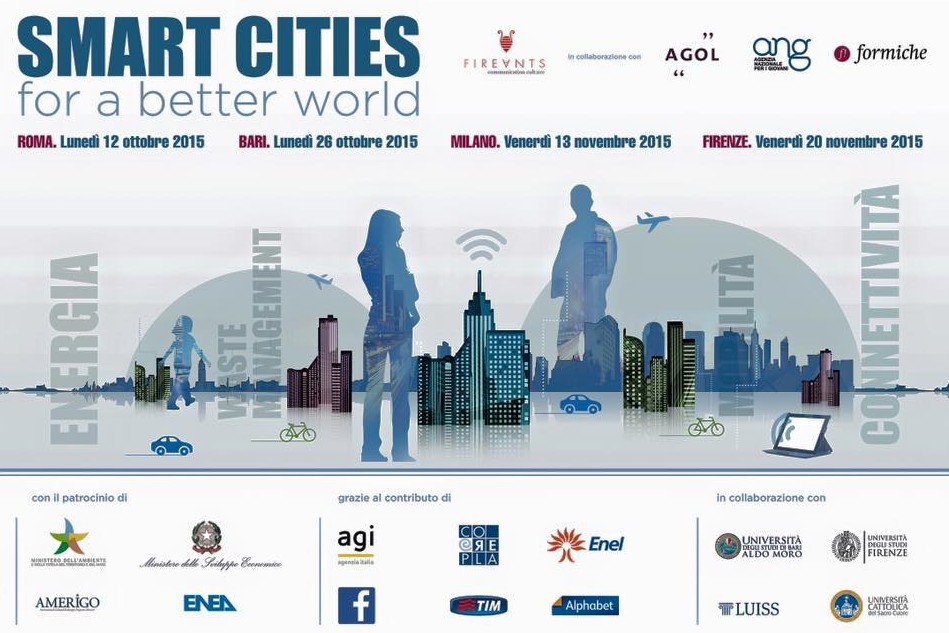
by Diletta Di Marco | Oct 10, 2015 | The Urban Media Lab
On October 12, LUISS University will host the first “Smart Cities Roadshow“,
organized by Formiche and Agol, in collaboration with the National Agency for
Youths, as well as several universities, institutions and firms.
These partners will work together to help young students to become the next
generation of leaders; they will teach students to be smarter and more
intelligent citizens of the community.

These are challenges that we can only overcome together through collective awareness
and strong participation. The day will begin at 9:30 am, and Professor Christian Iaione
will be one of the distinguished guests, along with Giampiero Gallo (Economic Advisor
to the Prime Minister Matteo Renzi and a professor at the University of Florence),
Simona Vicari (State Secretary at the Ministry of Economic Development with
responsibility for Smart City and President of the Task Force of the Ministry on
Smart Cities), Andrea Costa (project manager of EXPO 2015 Telecom Italia),
Laura Bononcini (Head of Public Policy at Facebook Italy) and many others.
In the afternoon the group will engage in stimulating co-design activities, where
students can consult with experts in the field. The round-tables will be organized
with policy makers, enterprises and experts to discuss a possible national policy
on the development of smart collaborative cities.
These activities will be featured by experts of the various branches: Ilaria Potito
(Head of Working Capital Operations at Telecom Italian), Mauro Annunziato
(Smart City and Coordinator of Eco enterprise ENEA) and Ugo Barbara (Head
New Media editors AGI).The event will end at 17:30.
We look forward to your participation!
If you want to participate register at this link.


