
by Federica Maranesi | Jul 16, 2015 | The Urban Media Lab
Did you know that every 30 minutes you complain about problems, your problem solving neurones are passing away? That sounds incredible, but still dramatically true. The worst comes thinking that is not just one person, or two, or four people to have this kind of attitude. It is a sort of epidemic disease that brings people, and consequently the society, to complain when a crisis comes up. Why? Because complaining is just easier.
We could say, as many already know, that word “crisis” has a double meaning, especially for the oriental cultures tradition. It means at same time “risk” and “opportunity”. Indeed, as history teaches us, when a situation arrives at its caos point and consequently to its saturation point, something has to change. At this moment, creativity and resilience take the stage. Nevertheless, without going deep in linguistic research, it is already illustrative itself the fact that when you complain, instead of having a problem solving predisposition, makes part of you literally dying.
The crisis is part of our lives. Our grandparents had to face the war, our parents had to deal with the cold war and the flared trousers (and this explain many things). Anyway, our task is to deal with the crises whether you like it or not. The financial crises, the political crises, the economic crises, the security crises, the social one, the food security one, the communitarian, the job market, youth employment, the citizen participation, the public administration ones. So the next question I have is: do you want part of yourselves to die? Do we want to die? I can hazard a guess that the answer is no.
Therefore, now it is maybe the right moment for us to take confidence with the word “resilience”. Yes, because it seems that we have got used to the term “crisis”, even with its Asiatic meaning, but not the one, which explain how to get the opportunity. Resilience is the ability of a system to adapt to change. If we want to be more specific, just to better understand, we could say that:
- In computer science, resilience is the ability of a system to adapt to the conditions of use and resist wear in order to guarantee the availability of the services provided.
- In ecology, resilience is the ability of a living material to repair itself after a damage, or that of a community or an ecosystem to return to its initial state after being subjected to a disturbance, which amended that state.
- Inpsychology, resiliencyis the abilityto respondpositivelyto thetraumatic eventsofhis lifepositivelyrearrangethe face of difficulties.
If it sounds good, it is better to know that from July 27th to August 1st, at Macomer, a little city in Sardinia (Italy) there will be the Festival of Resilience 2015. A group aged 20 to 30 years, all over Italy and the world, students and workers, realists and dreamers, has created the Propositivo project, which promotes the Festival. They have the intent to highlight the many examples of virtuous practices present on the territory, which share a vision of reality with a positive, innovative, sustainable and resilient attitude. The Festival will be focused on Sardinia territory. This trip will affect specifically the territory of Marghine-Planargia. This year the Festival aims to put together a team of experts at national level that can dialogue with the territory of central Sardinia and its protagonists, looking for new ideas to recover the local economy, rural tourism, participation and open government, in a resilient way. They want to start launching their project “Brainsurfing”: a week of traveling brainstorming to find the best proposal, which will be spread through the Festival and turned into concrete projects through the direct involvement of citizens.
The festival will provide:
- The realization of BrainSurfing: a meeting between brainstorming and couchsurfing, involving local professionals under 35 to talk about the territory to national experts. During the week of traveling meetings between Macomer and Bosa, they will discover the critical issues and new projects for the Marghine and Sardinia;
- A presentation to the population of the results obtained through the Brainsurfing;
- Workshops through the sharing of outcomes on how to implement the projects arised;
- The involvement of local producers and innovators on Sardinian issues and the pread of their initiatives;
- The creation of two days of cultural activities, theatrical, literary, musical and multimedia events.
6 days to get involved in what is our, in what is about us. 6 days to remember that we do have a brain and neurons that are actually made to create ideas, to make thing going better. If complaining is an epidemic disease, it is also true that resilience is a cure as much contagious as the crises is. Having a resilient attitude is not easy, for sure, but it is powerful. The kind of things that scares usually complains, which makes afraid that everything could really change. However, the very important thing to think about is: what will happen, if nothing changes?

by Leonardo Rossi | Jun 22, 2015 | The Urban Media Lab
An Italian Foundation (CON IL SUD) wants to revalue some buildings (14 to be exact) according to projects made by the local communities, enterprises and institutions. CON IL SUD granted 4 million euros in order to enact such propositions aimed to allow the community to enjoy such common goods in a sustainable way.
This is the third edition of this call that previously managed to enforce 21 projects with a cost of 8 millions euros.
The Foundation asked to the cities of the south of Italy to propose some buildings and places eligible to this end, and 14 out of the 22 proposed were choose. 5 of those are in Sicily, 7 in Puglia and 2 in Campania.
The legal property of this good will be given by the owner (the region) to the organization that won the call for that building for at least 10 years, in advance of knowing what the use will be, and the requests made for the financing of the renewing of a public good cannot exceed 500.000€.
On their website is it still possible to see the full list of the public goods that are part of the call and everyone can present an idea or a project, even when the call will be over on 14th of July 2015.
This experiment aims to make clear that every community wants to cooperate and to put their efforts together in order to achieve a better lifestyle and a better world for everyone to enjoy.
La Fondazione CON IL SUD alla sua terza edizione per la riqualifica dei beni comuni; terza edizione con I fiocchi
La Fondazione CON IL SUD vuole, con la terza edizione di questo bando, rivalutare 14 beni comuni presenti in Sicilia, Puglia e Campania, grazie ad un fondo di 4 milioni di euro.
Grazie a questo bando i progetti scelti saranno sovvenzionati fino ad un massimo di 500.000€ per le spese di ristrutturazione e i vincitori avranno la proprietà del bene assegnato per almeno 10 anni.
Sul sito internet è possibile consultare la lista completa dei beni comuni scelti e, anche dopo la chiusura del bando che si terrà il 14 luglio 2015 sarà possibile proporre idee e progetti.

by Leonardo Rossi | May 15, 2015 | EducationLabs
What happens when a region is scourged by a natural disaster, like an earthquake? There is the time grief, of course, and the time of reconstruction, involving an extremely delicate phase: the healing of the victims’ souls.
That was the motivation that pushed the Ministry of the Tourism and Cultural Activities to fund an initiative, the “Beni Comuni Project”, that gathered the ETR Foundation, ATER and eleven Provinces (Campogalliano, Carpi, Cavezzo, Cento, Concordia sulla Secchia, Finale Emilia, Mirandola, Novi di Modena, San Felice sul Panaro, San Possidonio, Soliera). Their goal was to recover and reunite the spirits of the communities threatened by the 2012 earthquake by an active participation in the organization of public events with the main goal to foster the sharing sense.
This idea is much needed in a time where society tends to be more and more egoistic, full of technological barriers that allows people to communicate easily with one another, but at the same time tends to label those who cannot afford such connections as “social pariah”. Stimulate the spark of active cooperation and sharing may ignite again an essential characteristic of the human soul that is slowly dying as the society evolves.
The Project reunites 24 partners: from schools to theatres and music schools: through the organization of public events, shows, concerts and readings, this group wishes to foster the reconstruction of the populations that survived the earthquake, thanks to arts and artistic expression. In the words of a member of the Project: “a way to allow the community to restore the spaces destroyed by the earthquake and start again with a stronger sharing spirit”.
This approach is really valuable, also because allows the people’s mind to wander off such grief and crisis and their souls to understand that nothing is over and everything can be solved, as long as there is a common goal and a common support. Act as one, survive as a whole.
—————-
Cosa accade a una comunità quando essa viene distrutta da un cataclisma naturale, come un terremoto? Ovviamente c’è il tempo del dolore, e dopo la ricostruzione inizia una fase delicatissima: la rigenerazione degli spiriti dei cittadini.
A tale proposito è stato finanziato dal Ministero dei Beni e delle Attività Culturali e del Turismo e promosso dal Comune di Carpi in collaborazione con ERT Fondazione e ATER il “Progetto Beni Comuni”.
Esso coinvolge undici Comuni (Campogalliano, Carpi, Cavezzo, Cento, Concordia sulla Secchia, Finale Emilia, Mirandola, Novi di Modena, San Felice sul Panaro, San Possidonio, Soliera) del cratere sismico con l’obiettivo di rinsaldare e ricostruire le identità delle comunità minacciate dal terremoto del 2012 attraverso la partecipazione attiva alla costruzione di eventi artistici che abbiano come orizzonte primario il senso della condivisione e dello stare in comune.
L’idea alla base del Progetto è encomiabile, e potrebbe essere spiegata in vari modi, ma il modo migliore è utilizzare le parole di un esponente del Progetto: “Il progetto Beni Comuni ha un valore intrinseco e speciale. Non è solo un programma destinato alla fruizione, ma un laboratorio di produzione culturale che coinvolge professionisti dello spettacolo ma anche e soprattutto i cittadini. Uno spazio artistico composto da tanti luoghi […]. Un modo concreto per le comunità di rimpadronirsi degli spazi violentati dal sisma e ripartire, con uno spirito di socialità condivisa”.
Questa idea è necessaria anche per un altro motivo: essa consente di far vagare la mente delle vittime del sisma lontano dal dolore e dalla sofferenza, e far capire che nulla è perduto e tutto è superabile, se si collabora e ci si aiuta nella comunità: Agisci come uno, sopravvivi come gruppo.
by Marina Bassi | Apr 16, 2015 | EducationLabs, Luiss LabGov 2014-2015
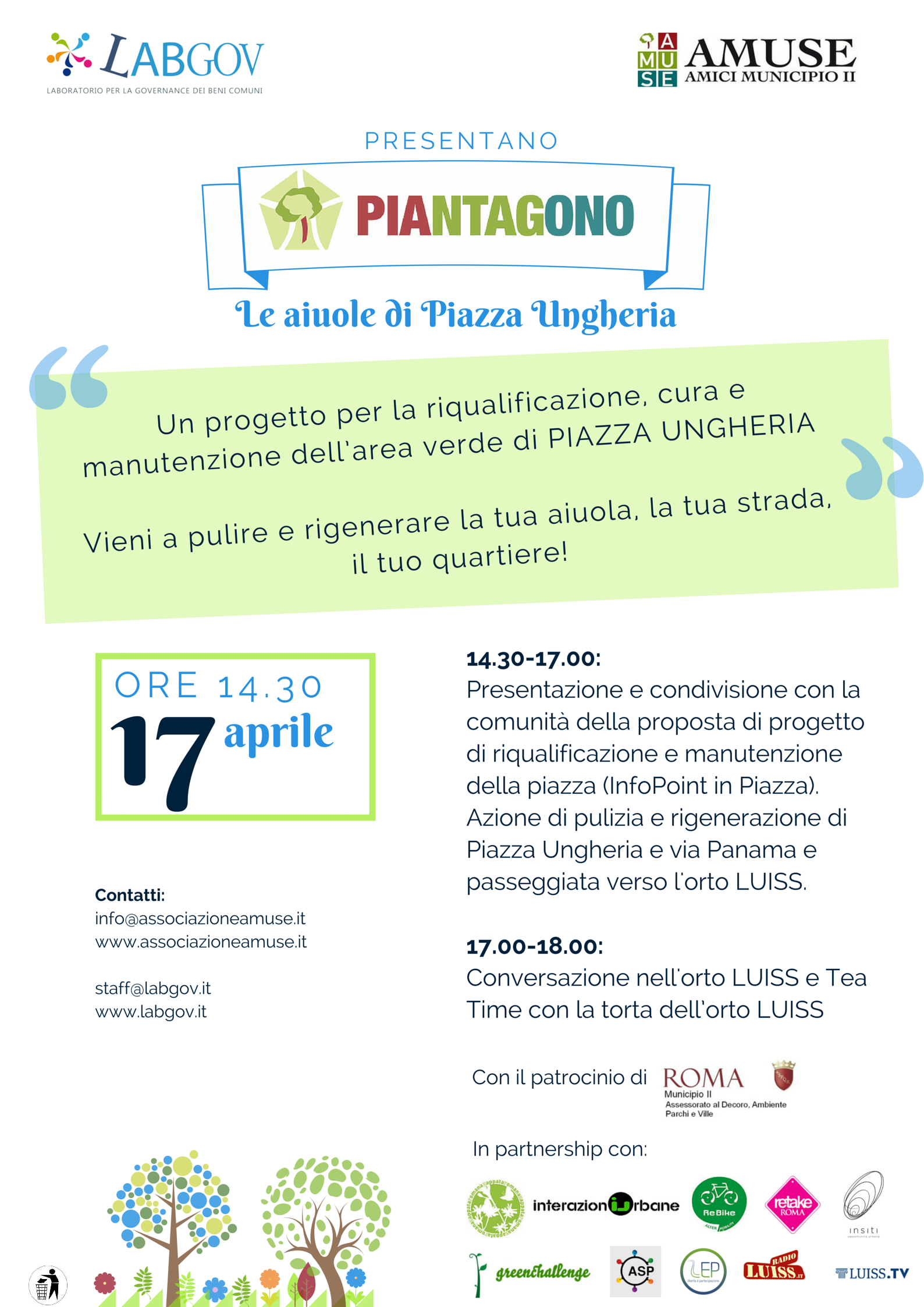
Next Friday, April the 17th, LabGov – LABoratory for the GOVernance of commons and AMUSE – Amici Municipio Secondo will collaborate to regenerate the central flowerbed of Piazza Ungheria, Rome.
The goal of the project is to raise awareness of sustainable development, the care and regeneration of urban green spaces and governance of the commons. The specific objective of the project is the rehabilitation, care and maintenance of the flowerbed of Piazza Ungheria and the creation of a network of collaboration among active citizens in urban green spaces.
Among all partners that will enjoy the event, there will be Zappata Romana; Interazioni urbane; Rebike ALTERmobility; Radio Luiss; Greenchallenge; Luiss TV; Luiss LEP; Retake Roma.
The event – that will begin at 2.30 PM in Piazza Ungheria, Rome – will be divided in two parts:
2.30 PM – 5.00 PM: regenerating action
5.00 PM – 6.00 PM: Tea Time in LUISS Community Garden
For more details, please refer to the flyers below:


by Edoardo De Stefani | Apr 10, 2015 | The Urban Media Lab
Thinking about cities, we cannot avoid thinking about pitfalls in public services or drawbacks of its uncured spaces. Also, we cannot avoid speaking about financial constraints, economic crisis and socio-cultural deficiencies.
Though, looking at the positive side, there are people, administrators, professionals, enterprises, academics or simply citizens that actively nudge for urban regeneration.
Eventually, this is also the idea of the municipality of Alessandria, which drafted and signed a Memorandum of Understanding (Protocollo d’Intesa) with the two universities that are present on the territory, the University of Piemonte Orientale “Amedeo Avogadro” and the Politecnico of Torino, with the objective of creating social innovation within the framework of the program “Noi Cittadini”.
The underlying idea is that of rethinking the city and its territory, but most of all the space and the role of citizens.
It is not a secret that public administrators cannot solve alone the enigma of social innovation, simply because designing a project is not only about money or calculus; there are several tangible and intangible resources which are needed for the success, and these include ideas, sentiments, energies, competencies and time.
For this reason it is very important to include all stakeholders in the “regeneration” project, both in the preliminary design phase and in the implementation stage.
The view of the Public Administration as a sort of financier must be abandoned, because again, projects are about discerning necessities and the particular socio-cultural microsystem, but also about finding a line of understanding between different stakeholders, namely a collaborative attitude. Having the opportunity to work collaboratively at a round table with the university and the public administration represents an opening to reverse the paradigm of the old and inefficient public plans.
Nonetheless, what it is important to acknowledge is that including different actors in the show does not mean having a divestiture of responsibilities, but simply a more legitimized process of democratic representation.
LabGov is well acquainted with the dynamics of collaboration between public administration, society and enterprises. It is all within the core of our quintuple helix approach, as represented by the LabGov logo. For this reason, the “Noi Cittadini” initiative represents a good opportunity to reflect on different collaborative opportunities, with regard to new partners and interlocutors.
_ _ _ _ _ _ _ _ _ _ _ _ _ _ _ _ _ _ _ _ _ _ _ _ _ _ _ _ _ _
Sulla scia dei recenti successi di esperimenti di amministrazione condivisa, tra cui il Regolamento di Bologna sulla cura e rigenerazione dei beni comuni, diverse iniziative stanno poco alla volta prendendo piede sul territorio nazionale. Da un alto, l’avvicinamento a pratiche di collaborazione rappresenta una necessità finanziaria e di legittimazione politica, mentre dall’altro esprime la volontà di godere appieno del diritto di essere cittadini.
Per far sì che progetti interessanti e innovativi trovino poi concreta realizzazione, è necessario costruire un tavolo di progettazione condiviso al quale possano sedere congiuntamente università, cittadini, imprese e pubblica amministrazione.
Parlare di rigenerazione delle città, significa ripensare il ruolo dei vari attori che vivono un determinato territorio, ma soprattutto trovare quelle risorse utili a sostenere un progetto di lunga durata.
L’innovazione sociale e la sua sostenibilità richiedono uno sforzo condiviso, ed è proprio per questo motivo che il Comune di Alessandria, in collaborazione con l’università degli Studi del Piemonte Orientale “Amedeo Avogadro e del Politecnico di Torino, ha siglato un protocollo d’intesa per “fare sistema”.
L’elaborazione di politiche innovative passa attraverso la costruzione di un asse portante tra forze territoriali, economiche, professionali e sociali.
In tal senso, l’operazione “Noi Cittadini” rientra nel quadro di innovazione sostenibile che il comune intende perseguire.


