
by Leonardo Rossi | Mar 25, 2015 | The Urban Media Lab

On November 18-20 2014 there was the 4th edition of the “Smart City Expo World Congress” (SCEWC), and it took place in Barcelona.
The topics covered during this event were: Smart Society, Technology, Governance, Energy, Mobility and Sustainable City.
It was an event full of discussions, projects and a lot of great ideas were discussed around such topics; the “Smart Society” theme was focused on the fostering of creativity, innovation, economic development and collaboration inside the boundaries of the cities, bringing the population to the center of decision-making in order to make urban and social development more democratic. Cities must be reinvented and transformed so that they become more sustainable, and improve quality of life and economic performance. This should be a shared vision and the way forward for citizens, public and private organizations and multi-stakeholders.
This topic is growing in importance in modern society, and recently there was also an European call, “Horizon 2020”, that was focused on the attempt to bring the population closer to the European mechanisms, in order to foster the collaboration between citizens and governments, and create a network of Smart Cities all around Europe.
All the topics that formed the “core” of this were deeply covered, and all seemed to express a common will to shift the modern view and use of energy, technologies and governance towards a collaborative approach, were the citizens cooperate with the governments in order to produce and support a lifestyle focused on the sustainability of energy, lifestyle, governance and technologies.
As a matter of fact, consumers are in a demanding shift, asking for a new energy model, environmentally and economically sustainable, making better use of local scale and renewable resources, while having a global focus and a strong partnership between governments and companies. The marketplace for wind or solar energy is shifting and reaching the mainstream. Every industry is regulatory and subsidy dependent. Clean energy in short will be able to deliver to local stable energy and subsidies will decline over time, as many of the renewables are able to be paid by themselves. This technological revolution is an opportunity of real change in how cities are operated and therefore a possible way forward for economic and social development.
This congress was a great example of how the modern societies’ demands managed to influence the economic and political spheres, and the fact that more and more multinational companies like IBM, Philips, Nissan, BNP Paribas, Microsoft, Oracle and Cisco became more concerned about such topics and aware of the possible available solutions is indeed a beacon of light into the grim darkness of the “non-collaborative future”.
The 5th edition of the SCEWC will take place on the 17-19 of November 2015, and given the growing success and importance of such event, it is possible to hope for some real projects to be proposed regarding the topics of sustainability.
Smart City Expo World Congress: Le Multinazionali accendono il faro della speranza.
Nella quarta edizione della SCEWC si sono discusse tematiche fondamentali quali energia, tecnologie, Smart Cities, governance e sostenibilità.
Dalle conferenze e dai workshop è emerso che la società sta cambiando e che desidera sempre più spostarsi verso una società più attenta e proiettata alla sostenibilità e alla governance comune.
Il ciclo di conferenze ha dimostrato come la società moderna riesce ad influenzare la sfera politica ed economica; il fatto che numerose multinazionali del calibro di IBM, Philips, Nissan, BNP Paribas, Microsoft, Oracle e Cisco abbiano preso parte a questo evento dimostrandosi sensibili alle tematiche sopracitate ci rende più fiduciosi riguardo al futuro.
La prossima edizione del SCEWC si terrà dal 17 al 19 Novembre del 2015 e si potrebbe azzardare la speranza di vedere una serie di progetti concreti prendere forma.

by Edoardo De Stefani | Mar 19, 2015 | The Urban Media Lab
The neoliberal world-system has entered a multiple crisis, while the stalemate of the growth function is hampering the socio-economic progress. Energy provision, climate stability, food production and distribution, public service provision, land access and political stability are consequentially threatened by a system that is no more sustainable and self-reliant.
Moreover, the congestion and the rivalry upon the use and exploitation of resources leave no room for development, at least if the current structural paradigm is not questioned.
Seemingly, the current society is at the margin of disruption and far obviously, existing institutional structures are not functioning properly.
To put it differently, a wave of disruption is sweeping in from various marginal corners, in particular from the contours of cities that are slowly becoming the cemetery of social cohesiveness.
Though, the problem is much easier to identify than expected: a non-participatory attitude of citizens in the public life dislocates the foundations of civil society.
Nonetheless the problem is different: why citizens are not feeling included in the decision-making processes or in the public life?
Once again the answer is simple, if we accept that normal bureaucratic procedures and institutional ecosystems are not citizen-friendly.
The focal question then, is about redesigning existing structures in a functional way and in a sense that they could become appealing and welcoming.
Arguably the claim is not complex: if the functioning of the society were based on cooperation, solidarity, democracy, equality and responsibility, there would be enough reason to claim ownership over public spaces. And if people eventually get the chance to enjoy the public space, simply because they feel attached to it, energies and input would naturally flow into the social machinery.
Thus, the emergence of the idea of the Commons is instrumental to the paradigm shift. It is not merely about a smooth transition, but widely, it is the product of an exploding social enrichment.
The transition to a world of the commons corresponds to the establishment of a new social contract, which can defend and promote the opportunity for people to participate at the making of public life.
In a sense, opening the system to a path of systemic collaboration can stimulate a pioneering form of social co-working between the principal political, economic and social agents.
However, it is clear enough that a common-based economy cannot flourish without appropriate institutions, especially those that should play a sustaining role in the direct creation of value by civil society (see the concept elaborated by Michel Bauwens of the Partner State ).
It is for this reason that shareable cities have always represented an ideal chimera, till today.
Quoting an article by Jonathan Dawson appeared recently on The Guardian, it is from the marginal corners of our society that a new wave of disruptive innovation is coming.
Shifting from a passive form of electoral democracy to a generative democracy of radical engagement is what is currently happening in Italy, and it is real.
The city of Bologna and the “Regulation on public collaboration” (see also the article on Bologna Regulation on Public collaboration) carry a new vision of the sharing city, or commons-oriented one. Professor Christian Iaione, LabGov Coordinator, is one of the pioneers of such institutional innovation.
As he argues, what we need is a nudging class, in order to drive and convince society and institutions that sharing is the new frontier of social innovation.
The five actors of collaborative governance, as subscribed in the Quintuple Helix approach (expressed in LabGov logo), represent the emergence of an innovative platform of open cities.
Professor Iaione took seriously the idea that citizens have energy, imagination and responsibility, but mainly, that people can become themselves innovators, service designers, co-workers and experts.
And for those who think that Commons are just a naïve and ingenuous pretence, they may be interested in the dozen of other Italian cities that are emulating the Bologna initiative.
As LabGov, we are making governance at grassroots level because people need a new vision, new energies and powerful social relations to come out from a bottom-up perspective.
The economy of the commons cannot simply be understood as a ready to go policy, but I feel that wherever there would be enough imagination and confidence, we can really work on the role of collaboration.
Our commitment is just the first step for bringing a new social narrative, but there is only one way to challenge the typical narrow thinking, and that is about being agents of collaboration.
Therefore also LabGov owes a debt of gratitude to all those experts, professionals, citizens, students, and courageous pioneers that are collaborating for making this change real. See more at:
http://blog.p2pfoundation.net/the-city-as-commons-michel-bauwens-interviews-professor-christian-iaione/2015/02/24
http://commonstransition.org/the-city-as-commons-with-professor-christian-iaione/
http://www.shareable.net/blog/interviewed-professor-christian-iaione-on-the-city-as-commons
http://bollier.org/blog/labgov-pioneers-paradigm-city-commons
http://www.theguardian.com/sustainable-business/2015/mar/12/disruption-challenge-neoliberalism-commons-political-system
_ _ _ _ _ _ _ _ _ _ _ _ _ _ _ _ _ _ _ _ _ _ _ _ _ _ _ _ _ _ _ _ _
Il fallimento dell’attuale configurazione istituzionale, nonché il susseguirsi di crisi economiche, politiche e socio-culturali, hanno lentamente spostato l’asse della società verso una fase di stallo apparentemente irreversibile.
Inoltre, l’incapacità delle amministrazioni pubbliche di fornire servizi adeguati e il contemporaneo disinteresse del cittadino alla vita pubblica, hanno ulteriormente peggiorato la situazione di crisi odierna.
Tuttavia, la soluzione alla crisi appare più semplice se inquadrata nell’ottica di un drastico cambiamento di paradigma istituzionale.
La città come bene comune diviene allora la nuova narrativa che può vincere il dominio dell’egemonia neoliberale.
E le shareable cities, finora ritenute un illusorio esercizio di stile, cominciano a smuovere le fondamenta degli assetti istituzionali tradizionali.
La città di Bologna rappresenta in questo senso un’innovazione, grazie anche al contributo delle idee e delle energie di visionari pionieri della democrazia intesa come inclusione radicale del cittadino, tra cui il Professor Christian Iaione Coordinatore di LabGov.
Il Professor Iaione ha realmente saputo catalizzare le idee e le energie per costruire un sistema istituzionale di governance collaborativa.
Grazie anche a LabGov, nuovi agenti della collaborazione stanno gettando le basi per costruire e coltivare l’innovazione sociale e nuove forme di governance collaborativa.
Una nuova visione della società civile, basata su un virtuoso scambio collaborativo tra stato, cittadino, imprese e università è già in proiezione.
Per questo motivo, LabGov onora il suo debito di gratitudine verso tutti quegli esperti, professionisti, studenti, università, cittadini ed incoscienti pionieri che stanno contribuendo a rendere reale questo cambiamento.
Appare evidente come il movimento dei Commons non possa più essere considerato un fattore di nicchia; rendiamolo globale.
http://blog.p2pfoundation.net/the-city-as-commons-michel-bauwens-interviews-professor-christian-iaione/2015/02/24
http://commonstransition.org/the-city-as-commons-with-professor-christian-iaione/
http://www.shareable.net/blog/interviewed-professor-christian-iaione-on-the-city-as-commons
http://bollier.org/blog/labgov-pioneers-paradigm-city-commons
http://www.theguardian.com/sustainable-business/2015/mar/12/disruption-challenge-neoliberalism-commons-political-system

by Marina Bassi | Feb 7, 2015 | The Urban Media Lab
The City of Bologna launched a participative process for the definition of the guidelines on school meals services. For the first time all the aspects concerning the school meals program, such as quality of meals, priority on investments, monitoring system and customer needs, will be defined through a participatory process. In fact, the opinions and comments expressed by citizens during the online consultation will be integrated in the Guidelines for the development of the school canteen service.
The City School Meals Commission, established in 2013 thanks to the alliance between families, the City, the Health Local Service and SE.Ri.BO (the mixed-capital local school meals food service company), drafted a document titled “Guidelines for the development of the school meals service”. The document announces that “school age is the time when the child sets up and consolidates the eating habits. It is in this stage of life that collaboration between institutions, family and school can contribute to the development of a healthy eating style which continues and persists into adulthood. Proper nutrition combined with regular physical activity can prevent excess weight and reduce the risk of developing adult chronic diseases”.
Therefore, there is full awareness that the Municipality of Bologna has an important role in the determination of quality food and educating the younger generation and their families to proper nutrition, preventing the risks of chronic diseases. Now, the process is open to all citizens who can express their ideas and introduce any additions to the document.
To participate:
- Join the community “Comunità” of Rete Civica > Access to “Comunità”
- Express your preferences in each section of the document.
Particularly, it is possible to send contributions about six main topics:
- Quality of alimentation
- Staff employed
- Investments
- Environmental Sustainability
- Customer services
- Monitoring and evaluation
For more information: openscuola@comune.bologna.it
Link to consultation: Linee di indirizzo per lo sviluppo del servizio di refezione scolastica
_______________________________________________________________
Servizio di mensa scolastica: è online la consultazione per definire le linee guida
Il Comune di Bologna ha avviato un percorso partecipato per la definizione delle linee guida del servizio di refezione nelle scuole bolognesi.
Grazie al lavoro realizzato dalla Commissione Mensa Cittadina (CMC), istituita dal Comune a marzo 2013, che riunisce formalmente Comune, genitori, AUSL, SE.Ri.BO (società mista attualmente incaricata del servizio), per la prima volta vengono definite alcune specifiche indicazioni sul servizio di refezione dei prossimi anni, in particolare sulla qualità dei pasti, sugli investimenti necessari, sul sistema di monitoraggio e controllo e sulla partecipazione degli utenti
La Commissione Mensa, composta da Comune, genitori e Se.Ri.Bo, ha realizzato il documento “Linee d’indirizzo per lo sviluppo del servizio di refezione scolastica“, articolato in 6 punti, in base al quale verrà poi elaborato il capitolato di gara per la selezione del nuovo gestore del servizio. Il documento specifica che “L’età scolare rappresenta il periodo in cui s’impostano e si consolidano le abitudini alimentari del bambino ed è proprio in questa fase della vita che una migliore collaborazione tra istituzioni, famiglia e scuola può contribuire allo sviluppo di uno stile alimentare salutare, che si protragga e permanga anche nell’età adulta. Attraverso una corretta alimentazione associata a un’attività fisica regolare si può prevenire il sovrappeso e ridurre il rischio di sviluppare in età adulta malattie cronico-degenerative (malattie cardiovascolari, diabete, ipertensione, ecc…). Vi è la piena consapevolezza, quindi, che il Comune di Bologna quando eroga il servizio di ristorazione ha un ruolo importante nella determinazione di un’alimentazione di qualità e nell’educare le giovani generazioni e le loro famiglie a una corretta alimentazione, volta a prevenire l’insorgenza di malattie croniche.
Ora il processo è aperto a tutti i cittadini, che potranno esprimere le proprie idee ed introdurre eventuali integrazioni al documento.
Come fare per partecipare?
Per esprimere le proprie osservazioni è sufficiente:
- iscriversi alla sezione “Comunità” della Rete Civica
- esprimere la propria preferenza sotto ad ogni singola sezione del documento (tramite “VOTA” o “FAI UNA PROPOSTA”).
In particolare, è possibile inviare i contributi in merito ai 6 argomenti principali:
- qualità dell’alimentazione (derrate alimentari, qualità nutrizionale, sicurezza alimentare, gradibilità)
- personale impiegato
- investimenti
- sostenibilità ambientale
- rapporto con l’utenza e gli stakeholder del servizio
- controlli (misurazioni)
Tutti i contributi e le domande che arriveranno saranno analizzati dal Settore Istruzione e, in base alla pertinenza degli stessi, eventualmente recepiti nelle “Linee di indirizzo”.
La consultazione è a questo link > Linee di indirizzo

by Marina Bassi | Feb 2, 2015 | The Urban Media Lab
Did you ever imagine a space, a street, an abandoned area, a neighborhood or a city center where boarded-up shops have changed the face of a city? Are you an administrator, an association or a group of citizens who want to take steps to strengthen their communities? Join the Pop_Up Lab Call for ideas 2015!
By networking creativity, POP UP Lab triggers an innovative process to consider the future of the contemporary city in an informal, open and engaging way. By doing so, it creates a favorable environment that make the leap from experimentation to policy. POP UP Lab is a laboratory for testing new practices that challenge emptying of the old town and its symbol: the boarded-up shops.
In Tuscany, municipalities are revitalizing the city starting from unused spaces and networks of relationships that local communities are able to express. Through the re-opening of the temporary vacant commercial funds (for social, cultural and artistic reasons), POP UP Lab enhances collaboration between owners, governments and citizens.
To do that, it implements a social and cultural experiment: to give a new life to the city by inviting those who have an interesting idea concerning a temporarily use of one of the many closed-end funds to the historical center. The initiative harnesses the creativity of all social resources: the City and private spaces. Through a call for ideas, citizens fielding ideas and translate into reality.
 Also LabGov contibuted with the experimentation. On 14th November 2014 Cristian Pardossi, president of Pop Up partecipated ate the LUISS LabGov seminar devoted to Urban social regeneration. On 6th December 2014 Prof. Christian Iaione, LabGov Coordinator, held a workshop in Empoli devoted to the governance of urban commons.
Join the competition at: http://www.popuplab.it/partecipa-a-pop-up-lab/
The Pop_Up Lab five steps:
1 – In municipalities involved, vacant funds are identified in a defined area of the city center, and they are made available to the participants during the event.
2 – A call for ideas is opened to individuals and formal or informal groups, offering an idea or a project to animate the funds over three days.
3 – An evaluation committee selects the projects submitted and it assigns them to the available space.
4 – The winners of the call could use for free the funds to realize over the course of three days the ideas presented and to organize social, cultural and commercial activities (amateur and / or business).
5 – During the next three days, cultural activities, debate and contact are held among the winners of the call and other parties participating
———————————————————–
Pop_Up Lab – Call for ideas 2015
Conosci uno spazio a cui vorresti dare nuova vita, una via, un’area dismessa, un quartiere o un centro storico dove le saracinesche abbassate hanno cambiato il volto della città? Sei un amministratore, un’associazione o un gruppo di cittadini che vuole attivarsi per rafforzare la propria comunità? Partecipa alla Pop_Up Lab Call for ideas 2015! In Toscana i Comuni sperimentano processi per rivitalizzare le città partendo dagli spazi inutilizzati e dalle reti di relazioni che le comunità locali sanno esprimere (See more at: http://nova.ilsole24ore.com/progetti/la-governance-collaborativa-rianima-il-centro-storico#sthash.Q5oTFeHP.dpuf). Attraverso la riapertura temporanea dei fondi commerciali sfitti per iniziative sociali, artistiche e culturali, POP UP Lab valorizza la collaborazione tra proprietari, Amministrazioni e cittadini.
Mettendo in rete la creatività, POP UP lab innesca un processo innovativo per riflettere sul futuro della città contemporanea in modo informale, aperto e coinvolgente e, così facendo, costruisce un ambiente propizio a compiere il salto dalla sperimentazione alla policy.
POP UP Lab è un laboratorio di sperimentazione di nuove pratiche che lancia una sfida allo svuotamento del centro storico e alla sua immagine simbolo: la saracinesca abbassata. Per farlo mette in atto un esperimento sociale e culturale: dare una nuova vita alla città invitando chi ha un’idea interessante a utilizzare temporaneamente uno dei tanti fondi chiusi al centro storico. L’iniziativa sfrutta la creatività di tutte le risorse sociali: il Comune e i privati mettono a disposizione gli spazi. Tramite una call for ideas, i cittadini mettono in campo le idee e le traducono in realtà.
Per partecipare: http://www.popuplab.it/partecipa-a-pop-up-lab/
POP UP lab in cinque passi
- Nei Comuni coinvolti, vengono individuati fondi sfitti in un’area delimitata del centro cittadino, e messi a disposizione dei partecipanti durante i giorni dell’evento.
- Viene lanciata una call for ideas aperta a singoli e gruppi formali o informali, che propongono un’idea o un progetto per animare i fondi nel corso di tre giorni.
- Una commissione di valutazione seleziona i progetti presentati e li assegna agli spazi disponibili.
- I vincitori del bando utilizzano gratuitamente i fondi a loro destinati per realizzare nel corso dei tre giorni le idee presentate e organizzare attività sociali, culturali e commerciali (di tipo amatoriale e/o imprenditoriale).
- Nel corso dei tre giorni si svolgono attività culturali, di dibattito e di incontro tra i vincitori della call, il pubblico e altri soggetti che partecipano all’iniziativa (See more at: http://www.popuplab.it/wp-content/uploads/2015/01/Popuplab_call_for_ideas_2015.pdf).
by Edoardo De Stefani | Jan 28, 2015 | The Urban Media Lab

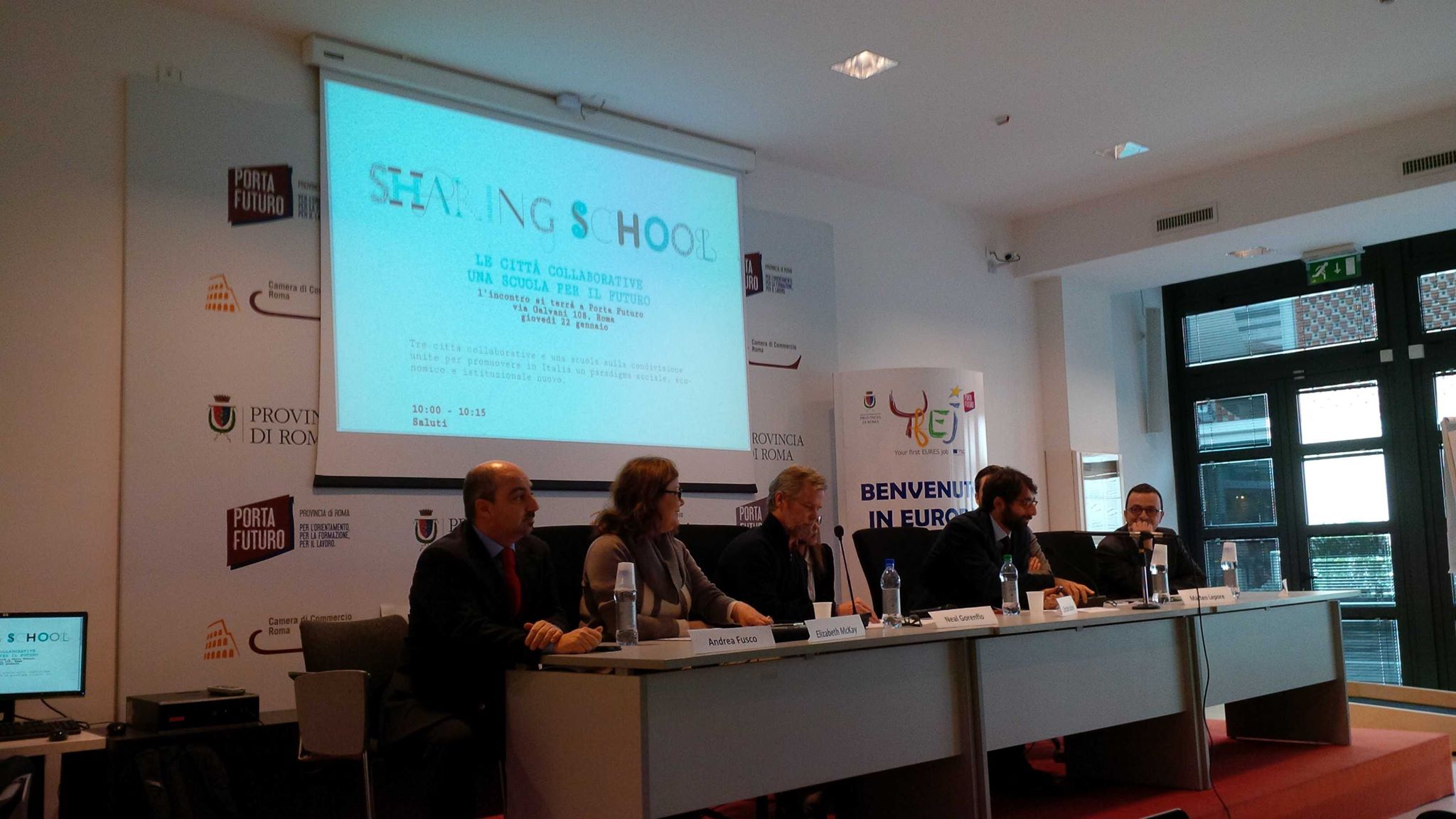
The sharing economy is growing faster than ever and becoming a hot policy issue these days. Casa Netural, Collaboriamo, RENA and LabGov have for this reason decided to launch the “Sharing School”. Thanks to the collaboration between these organizations and with the support of Ouishare, Avanzi and Societing, the School has been able to host highly qualified professionals and experienced innovators. The guest star of the event has been Neal Gorenflo from Shareable, an American leading organization in the field of sharing economy and collaborative practices.
The event held in Rome at Porta Futuro, had the main objective of dealing with the mainstream tendency of sharing economy and to understand if such trend can become the leading paradigm of the new economy. Andrea Fusco, Director of Department III – Services for placement and quality of life of the Province of Rome, the future Metropolitan City, was very happy to host the Sharing School initiative.
Minister Counselor for Public Affairs of the US Embassy in Italy Elizabeth McKay, reminded how the sharing economy has already changed things; it is no longer a new phenomenon and thanks to technological interactions and social media, we are exploring a potential that can disrupt traditional forces. Customers become service providers themselves, acting as catalysts for phasing into the system resources and goods that are normally not exploited.
We were used to think about sharing economy as some “nerd stuffs”, while nowadays there is a sort of “media bulimia” that affect the topic of sharing economy – says Francesco Russo, President of RENA. It is undeniable that we are assisting to a growing tendency of the concept of collaboration, as we simply trust strangers. However, the problem is that we shall distinguish what sharing is really about, and that is the aim of the Sharing School. There is a paradigmatic change of society and in the next future, 40% of the online staffing will be served through services provided by the sharing economy. Then, the approach of the initiative is not only about telling the story of a new economic trend.
As Neal Gorenflo recognizes, we are all here to learn how to gather people and create a common homogeneous vision about the sharing economy. But here we encounter obstacles, since we need to dissolve the gap between trans-formational economy and trans-action sharing, which basically maintains social hierarchies. Neal Gorenflo talked about making a choice between the red pill and blue pill like in The Matrix movie. The blue pill is a story about the re-adaptation of the old capitalist paradigm to the new economic trends, where Uber and AirBnB are the concrete examples of how initiatives of such strand of the sharing economy can still create monopolies. On the other hand, the red pill is the one that inspired our research. It is about the resurgent collaborative experimentation and it is what can wake up reality. We need to open cities, to make them available for use and to activate citizens by creating an economy “by and for” the people. We need to invest on transformational sharing much rather than transactional sharing.
However, as Matteo Lepore – Commissioner to Economy, Development of the City, Tourism, International Relations and Digital Agenda of the City of Bologna – underlined, if we talk about social order and sharing economy, we are inevitably bound to themes such as politics, democracy and participation. In fact, even taking the red pill has the risk of initiating a debate between citizens and the political representation. It is all about a systemic change, otherwise there would be no way back from the loss of collaboration between citizens and institutions. Step by step, we are loosing the sense of citizenship, by projecting a vision of citizens as the residual assets of society. Fortunately, the City of Bologna was able to initiate a process of human capital reactivation, thanks to the implementation of the “Bologna Regulation on public collaboration for urban commons” that seeks to transform the Public Administration in an enabling factor. The City of Bologna is thus a starting point for understanding how collaborative practices can rehabilitate citizens and regenerate urban networks, for instance with the instrument of the “pact of collaboration“. The underlying idea is that important results can only be achieved through effective practices of co-working, which involve citizens and professionals through a platform of mutual exchange of skills and knowledge.
Starting from the community to build competences and deliver effective results on the territory is also the strategy of the City of Milan , says Renato Galliano, Director of Smart City Service in Milan. We have to recognize that it exists a network of collaborative urban cities, which is itself a new form of infrastructure. This is the confirmation that collaborative economy is not only about isolated and scattered projects of mobility sharing, start-ups and civic crowdfunding. The social innovation entails a renaissance of the cities in a wider context, whereas citizens are the locomotives of change and public administrations are the habilitating infrastructure.
As Christian Iaione, Coordinator of LabGov, reminded we have to reinforce the processes of active citizenship and active entrepreneurship, to foster a steady dialogue between the five actors of collaborative governance and to create an “Italian way” to sharing. Indeed, the real sharing is centered on the restitution of value to the community. This is a good opportunity also for the City of Rome. Daniela Patti – from the staff of the Comminisioner to the Urban Transformation in Rome – affirmed that we need to create a network of collaborative cities, to develop instruments to regenerate abandoned urban spaces and to consolidate practices for exploiting the latent potential of the great cultural heritage.
Alex Giordano (Societing and Rural Hub) warned against the dysfunctions that an incorrect practice of sharing economy can create. In this sense, we should not only focus on the quantitative approach and upon capitalist mechanisms. It is in fact essential to reason on communities and social impact. If we have a look at territorial distributions, it is possible to notice how people are divided by interests and have lost the sense and ethic of community building. Fortunately there are breeding grounds of innovation that create value, even if their outreach is limited by disabling institutional leaderships. The problem is that those who have the courage to produce social innovation are constantly marginalized, as Simone Cicero of Ouishare, noticed. Even Enrico Parisio, of Coworking Millepiani says that we need to express such new exigency, as a pedagogic stimulus for social innovation. When we started talking about sharing economy, nobody believed it could be real, reminds Ivan Fadini of Impact Hub Roma. For this reason we are strongly committed today on avoiding the reiteration of traditional economic capitalism.
The commoners will be the heroes of social innovation.
Stay united!
– – – – – – – – – – – – – – – – – – – – – – –
Presentata a Roma la prima edizione della Sharing School.
Si è tenuto il 22 gennaio 2015 l’evento di presentazione della Sharing School di Matera, la prima scuola sulla sharing economy e sulla condivisione per promuovere in Italia un nuovo paradigma sociale, economico e istituzionale. L’incontro, ospitato da Porta Futuro e reso possibile grazie alla collaborazione tra Casa Netural, RENA, Collaboriamo e LabGov, con il supporto di Avanzi, OuiShare e Societing, ha visto la partecipazione, grazie al supporto dell’Ambasciata americana in Italia, di Neal Gorenflo co-fondatore di Shareable.
L’evento, incentrato su temi dell’ economia collaborativa e innovazione sociale, ha rappresentato un importante punto d’incontro tra ospiti internazionali, attori istituzionali, accademici e società civile. Se si vuole sviluppare un nuovo concetto di economia, è necessario rivedere gli orizzonti sociali e promuovere spazi innovativi di collaborazione. E’ in un contesto di inclusione sociale e di promozione della cittadinanza attiva che la sharing economy deve prendere piede perché, come ricorda Neal Gorenflo, le persone devono rappresentare lo snodo per un’economia collaborativa.
Dobbiamo cominciare a comprendere come l’implementazione di un modello di governance condivisa non ruba potere alle amministrazioni, semmai ne rinvigorisce la struttura e la riempie di nuovi contenuti. Per questo il prof. Christian Iaione, coordinatore di LabGov, invita a pensare all’economia come un bene comune che possa essere curato e messo a punto con interventi di animazione da parte di tutti quei soggetti coinvolti nell’ambito della sharing economy, inclusi i cittadini.


