
by Chiara De Angelis | Mar 31, 2017 | The Urban Media Lab
The City of Turin is currently hosting the fifth edition of the Biennale Democrazia, a cultural event promoted by the City of Turin and by the Fondazione per la Cultura Torino, with the aim of spreading a culture of democracy that is able to result in democratic practices. The 2017 edition is fully dedicated to the concept of emergency, to the uses and abuses of this term, and to all the things that this word hides and shows.

The theme of this fifth edition is articulated in five thematic routes:
- State of necessity
- Society of uncertainty
- New beginnings
- Focus_Questions to Europe
- Focus_The city that changes
LabGov, with its co-founder prof. Christian Iaione, will attend the Biennale Democrazia on Saturday, April 1st, during the panel “Storie di beni comuni” (“Stories of Commons”), coordinated by Alessandra Quarta and attended by Gianluca Cantisani and Roberto Covolo as well. The panel is organized in collaboration with the “Servizio Arredo Urbano, Rigenerazione urbana e Integrazione della Città di Torino” within the framework of the CO-CITY project.
The three speakers are going to investigate the new models of urban welfare and of community co-production. Some of the most significative experiences in Italy are going to be analyzed, in order to show how with the co-management of commons, innovative government tools and paths can be activated.
The program of the Biennale Democrazia is available here: http://biennaledemocrazia.it/programma-bd-2017/
Dal 29 marzo al 2 aprile la città di Torino ospita la Biennale Democrazia, giunta alla sua quinta edizione e quest’anno dedicata al tema dell’emergenza, agli usi e agli abusi di questo termine così usato negli ultimi anni, e a tutto ciò che la parola nasconde e manifesta.
Il prof. Iaione, co-fondatore di LabGov, parteciperà insieme a Gianluca Cantisani e Roberto Covolo, il primo aprile alle ore 11.00 al panel “Storie di beni comuni”, moderato da Alessandra Quarta e organizzato in collaborazione con il Servizio Arredo Urbano, Rigenerazione urbana e Integrazione della Città di Torino, nell’ambito del progetto CO-CITY. Durante il panel verranno investigati nuovi modelli di welfare urnano e di co-produzione di comunità. Saranno analizzate alcune delle esperienze più significative in Italia, per dimostrare come con la co-gestione dei beni comuni possano essere attivati strumenti e percorsi di governo innovativi.
Il programma completo della Biennale Democrazia è disponibile qui: http://biennaledemocrazia.it/programma-bd-2017/
by Francesca Spigarolo | Mar 23, 2017 | The Urban Media Lab
There is one kind of economy which is good: it is the economy which supports the quality of life of the whole community, creates the abundance of possibilities and opportunities needed to satisfy our needs without hurting others, embraces responsibility and nourishes solidarity. It is the economy which uses and shares the resources fairly, which respects the sustainability of the system.
It is about this kind of economy that the participants in the “4th Conference on Good Economy” will talk about during the conference that will take place in Zagreb from Thursday the 23rd to Saturday the 25th of March 2017. The conference, organized by The Green Network of Activist Groups and by Dobra Ekonomija will be a great occasion for speakers coming from all over the world to meet and exchange knowledge and experience on good economy models. From Delhi to Berlin, from Paris to Barcelona, Sarajevo, Wien, Lincoln or Rome, different practices have been developing: we observe the emergence of “collaborative economy” practices, “open factories”, ecological social enterprises, participatory and democratic governance experiences, collective ownership, and much more.

Professor Christian Iaione, LabGov co-founder, has been invited to the conference to speak about the idea of the “City as a commons” (discussed in this paper) and about the possibility to develop a urban co-governance framework. It will also be an occasion to present the experimentations conducted by LabGov in different Italian cities and in the international arena.
The “City as a Commons” and LabGov experience with urban co-governance in the city of Bologna will also be presented by Professor Christian Iaione during the “Good City for All” seminar, which will take place from the 24th to the 26th of March in the area of the Plitvice lakes. During the event the participants will address important questions, such as how we can coordinate and strengthen civil society’s strategies to tackle urban issues and influence the political agenda positively, within the framework of a European debate on the transformative power of urban politics in a two-fold event.

———————————————————————–
Nei prossimi giorni il Professor Christian Iaione, co-fondatore di LabGov, sarà in Croazia per parlare dell’idea di “The City as a commons” e delle sperimentazioni sviluppate da LabGov a Bologna e in diverse città italiane e straniere con lo scopo di sviluppare nuove forme di co-governance urbana.

by Ornella Martinello | Jul 22, 2016 | The Urban Media Lab
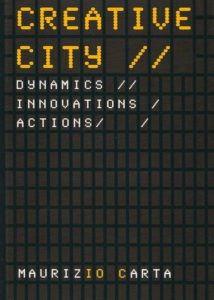 Maurizio Carta, Architect, PhD in Urban and Regional Planning, Full Professor of urban and regional planning at the Department of Architecture at the University of Palermo and advisor for a number of public national and international bodies, is the author of “Creative City – Dynamics, Innovations and Actions“. In his work, Carta tries to condensate his studies on urban regenation based on culture, innovation and creativity. The result is a review of the most innovative processes of urban regeneration undertaken across Europe, an “atlas of urban, landscape and architectural projects”.
Evocative and inspiring is the quote by Irish playwright George Bernard Shaw which the author decided to open the book with:
“Some men see thing as they are and say, ‘Why?’. I dream of thing that never were and say, ‘Why not?'”
Admittedly, the book is the outcome of a “trip” across current best and most innovative urban practices and a hopeful insight into the future of territorial bounds, communities and cities. The wide set of maps, data and figures that complement the analysis not only helps to better figure out how cities are evolving nowadays in Europe; they also give a strong evidence of the fact that the future will undeniably lie in a kind of city that is creative, culture-oriented and sustainable. In Carta’s words:
“The city of the future will be a city of culture, a city generating new culture: the creative cities of the twenty-first century will be capable of competing on the international scenario by optimizing and promoting their own individual cultural identities, attracting a class of creative and generating new sustainable futures.”
The author concisely depicts the world of the future. But he also gives us the instruments we need to build it, or, as he defines them, the “four keywords” which the “creative city manifesto” is based on and which should guild city-makers:
– VISION, the city of the future is forward-looking;
– MISSION, the city of the future is responsible towards its citizens and their needs;
– OUTPUT, the city of the future is productive and effective;
– FUTURE, the city of the future is culturally and environmentally sustainable, able to enhance its citizens’ wellbeing without compromising future generations’ one.
As a matter of fact, these concepts recur repeatedly throughout all the three parts which the book is divided, namely:
I – Creative cities: an Action-Oriented Manifesto;
II – Towards a new polycentric competitiveness;
III – The fluid city – experiments in 13 cities around Europe.
What markedly emerges from the review of those 13 citites (Amsterdam, Barcelona, Bilbao, Bordeaux, Genova, Hamburg, Lyon, Lisboa, Marseille, Newcastle, Palermo, Rotterdam, and Valencia) is a call to act now in order to make our future richer. As Carta puts it, “the twenty-first century is without doubt set to be the ‘age of cities'”. The present and future lie in the local dimension. That is where territorial specificities are respected and promoted and where new forms of political participation can be experimented.
In order to make our cities “desirable places to inhabit”, we cannot but recognize the crucial role governance plays in determining the quality of the outcomes of urban regeneration and how working on ownership, inclusiveness, participatory practices and cooperation leads to a better and long-lasting enhancement of the local dimension, re-building a sense of citizenship through culture and knowledge.
—
Il famoso drammaturgo irlandese George Bernard Shaw scrisse: “Vedi cose che esistono e ti chiedi “perché”? Ma io sogno cose non ancora esistite e chiedo “perché no”?”.
Attraverso una rassegna dei progetti più creativi ed innovativi messi in atto in 13 città europee, l’architetto italiano esperto di rigenerazione urbana Maurizio Carta traccia i contorni della città del futuro: visionaria, produttiva, sostenibile, creativa.

by Adriana Marasco | May 24, 2016 | The Urban Media Lab
The
City Makers Summit will be held from
May 27 to May 30,2016. LabGov, with the presence of
Professor Christian Iaione, is getting ready for four days full of innovative inspiration, unlocking know-how and setting agendas, and reflections on the (Im)pact of the city of Amsterdam on the development of the New Urban Agenda.
Professor Iaione will lead two session. The first, more general in character, will consist in a philosophical dialogue on the values and ambitions of the New Europe and on the idea of a Europe managed by People. The second one instead will be one part of the New Democracy series. It will be focused on governance and on the concept of the co-city, with reference to the experience of the Co-Bologna project, and the partecipants will be encouraged to start their own projects and become part of a learning network in Amsterdam.
The City Makers Summit pools knowledge from City Makers from all over Europe and presents innovative ways of creating more livable, thriving, resilient and inclusive cities. City Expeditions all over the Netherlands’ territory will showcase emerging initiatives focusing on urban farming, social design, the redevelopment of industrial heritage, co-housing, the makers movement, social entrepreneurship, inclusion of refugees, the development of collaborative areas, community enterprises, the circular economy, and so on.
Best practices and models of collaboration with multiple stakeholders will be explored and feed into the City Makers Agenda. While the EU member states are adopting the EU Urban Agenda thought the Pact of Amsterdam, City Makers will pay their contribution, share inspiration and know-how, present their input and work towards further co-creation. Do not miss this incredible experience!
———————————————————————————————————–
Il City Makers Summit si terrà ad Amsterdam dal 27 a 30 Maggio. LabGov, grazie al prezioso contributo del Professor Iaione, è pronto a partecipare a questi quattro giorni pieni di ispirazione per la costruzione di nuovo originale know-how e d’approfondimento dell'(Im)Patto che la città di Amsterdam sta avendo sull’agenda Europea. Non perdetevi questa incredibile esperienza!


