by Francesca Spigarolo | May 8, 2017 | The Urban Media Lab
On Wednesday the 10th of May the Turning Tables initiative, promoted by the network of international Laboratories UrbanLab+[1], comes to Calabria for a collective laboratory aiming at stimulating a dialogue on the functioning of cities and on the wellbeing of their inhabitants. The event is organized by the Urbanism Department of the Calabria region and by the UdLab of the Diatic Department of the University of Calabria, and will represent a great occasion to engage in a dialogue within the hearth of the local administration.
The laboratory, which aims at supporting the local development processes taking place in the region, takes as a starting point the occasion offered by the signature of the River Amato Contract and activates an innovative process which will see local actors as absolute protagonists. During the laboratory the participants, guided by experts from UdLab and LabGov and by members of the Region, will engage in a mapping activity which will help locating the relevant local actors and understanding the territory with all its everyday aspects, its needs and its desires.
During the event, after the opening by Francesco Rossi (Councillor for Territorial Planning and Urbanism of the Region) and the official greetings, Paola Cannavò from UdLab and Christian Iaione from LabGov, will introduce the concept of Collaboratorio and will guide the mapping process.
Here is the program of the event:

[1] The UrbanLab+ network, born in the context of the Venice Biennale, includes between its members: UdLab, Università della Calabria (Italia), laba, EPFL (Switzerland) KRVIA Mumbai (India); School of Architecture, Chinese University of Hong Kong (China); Urban Lab, University College London (UK); CUBES, Wits University Johannesburg (South Africa); U- Lab, TU Berlin – (Germany); OCUC, Pontificia Universidad Catolica de Chile (Chile).
—————————————————–
Mercoledì 10 maggio, presso la Cittadella Regionale della Calabria, si terrà un laboratorio collaborativo organizzato nel contesto dell’iniziativa Turning Tables promossa da UrbanLab+. L’evento, organizzato dall’Assessorato alla Pianificazione Territoriale e Urbanistica e l’UdLab del Dipartimento Diatic dell’Università della Calabria, mira a stimolare il dialogo ed il confronto sul funzionamento della città (e del territorio) e sul benessere dei suoi abitanti.
Il Professor Christian Iaione, co-fondatore di LabGov, sarà presente all’incontro per presentare, assieme a Paola Cannavò di UdLab, il Collaboratorio, e per coordinare le attività di mappatura a cui prenderanno parte i partecipanti al laboratorio.
by Francesca Spigarolo | Apr 22, 2017 | The Urban Media Lab
All over the world, cities are facing multiple and ever-changing challenges, ranging from growing economic inequalities, widespread gentrification and increasing segregation to issues of environmental degradation and scarcity of resources. In the most extreme cases, such challenges are at the origin of a phenomenon defined by the sociologist and economist Saskia Sassen as political, social and economic expulsions.
In such a climate of widespread insecurity, the number of cities that are becoming aware of the limits implied in the traditional top-down decision making processes, seen with suspicion and detachment by many city inhabitants, is continuously growing, alongside with the numerous voices calling for the necessity of a new governance paradigm. Such paradigm should aim at strengthening citizens’ participation in decision-making, in order to allow for the creation of public policies and institutions able to answer to the needs expressed by the community, to increase the legitimacy of political choices and to foster inclusion.
One path that is being object of experimentation in different cities and that holds the potential to bring about a substantive transformation in urban life is based on the idea that participation and collaboration could be built around the urban commons, resulting in benefits for the whole community. Such path will eventually lead to the creation of Collaborative Cities (CO-Cities), as envisaged by Professor Christian Iaione and Sheila Foster in their work The City as a Commons, where the two scholars advance the idea that not only common resources, but the city itself should be governed as a commons.
Cities from all over the world appear to be heading in this direction, by focusing on the development of different forms of collaborative governance, designed according to the peculiar characteristics of the context and resulting for this reason in a wide variety of experimentations. While throughout the past years we have been closely following the path that led to the creation of the Bologna Regulation on collaboration for the urban commons and to the activation of the CO-Bologna process, it is fundamental to bring our attention to the similar phenomena that are taking place all over the country, where different strategies and approaches are being adopted in order to design public policies for the urban commons.
This is what we will try to do through our CO-Cities series, which will look into the variety of strategies adopted by other Italian cities like Turin, Naples, Reggio Emilia, Milan, Messina, Rome, etc.) in order to improve their inhabitants’ lives by enabling the governance of the urban commons.
Stay tuned for more stories!

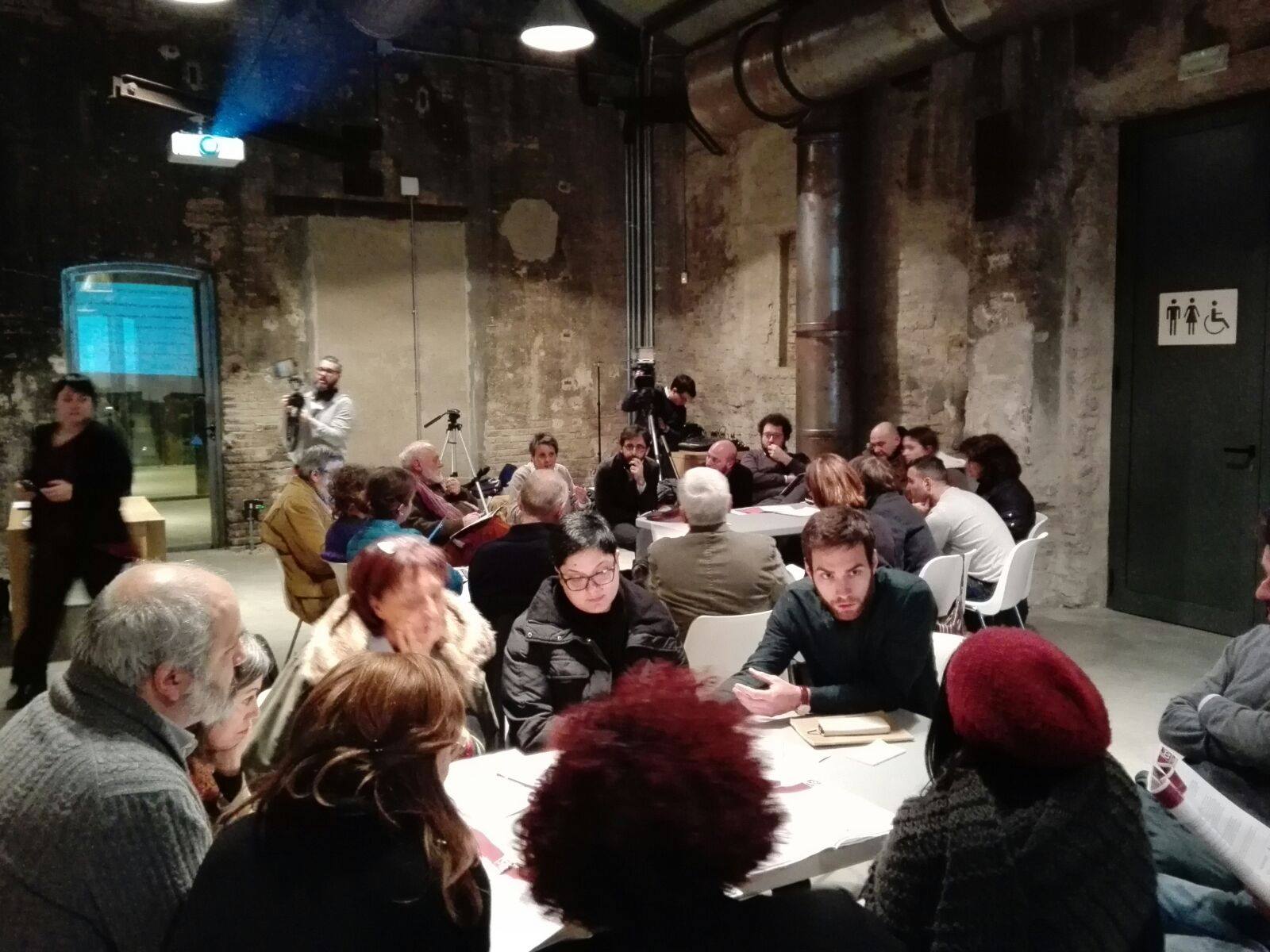
The participatory process #CollaboratorioRE in Reggio Emila
———————————–
Da Bologna a Napoli, da Torino a Palermo, passando per Milano, Reggio Emilia, Messina e per tante altre città italiane, osserviamo la nascita di risposte innovative alle problematiche che caratterizzano l’ambiente urbano. Molte di queste risposte ci mostrano come i beni comuni e la collaborazione possano essere alla base di un nuovo paradigma di governance urbana.
Attraverso la serie CO-Cities racconteremo storie di cambiamento provenienti da tutta Italia. Non perderti i prossimi articoli!

by Chiara De Angelis | Mar 31, 2017 | The Urban Media Lab
The City of Turin is currently hosting the fifth edition of the Biennale Democrazia, a cultural event promoted by the City of Turin and by the Fondazione per la Cultura Torino, with the aim of spreading a culture of democracy that is able to result in democratic practices. The 2017 edition is fully dedicated to the concept of emergency, to the uses and abuses of this term, and to all the things that this word hides and shows.

The theme of this fifth edition is articulated in five thematic routes:
- State of necessity
- Society of uncertainty
- New beginnings
- Focus_Questions to Europe
- Focus_The city that changes
LabGov, with its co-founder prof. Christian Iaione, will attend the Biennale Democrazia on Saturday, April 1st, during the panel “Storie di beni comuni” (“Stories of Commons”), coordinated by Alessandra Quarta and attended by Gianluca Cantisani and Roberto Covolo as well. The panel is organized in collaboration with the “Servizio Arredo Urbano, Rigenerazione urbana e Integrazione della Città di Torino” within the framework of the CO-CITY project.
The three speakers are going to investigate the new models of urban welfare and of community co-production. Some of the most significative experiences in Italy are going to be analyzed, in order to show how with the co-management of commons, innovative government tools and paths can be activated.
The program of the Biennale Democrazia is available here: http://biennaledemocrazia.it/programma-bd-2017/
Dal 29 marzo al 2 aprile la città di Torino ospita la Biennale Democrazia, giunta alla sua quinta edizione e quest’anno dedicata al tema dell’emergenza, agli usi e agli abusi di questo termine così usato negli ultimi anni, e a tutto ciò che la parola nasconde e manifesta.
Il prof. Iaione, co-fondatore di LabGov, parteciperà insieme a Gianluca Cantisani e Roberto Covolo, il primo aprile alle ore 11.00 al panel “Storie di beni comuni”, moderato da Alessandra Quarta e organizzato in collaborazione con il Servizio Arredo Urbano, Rigenerazione urbana e Integrazione della Città di Torino, nell’ambito del progetto CO-CITY. Durante il panel verranno investigati nuovi modelli di welfare urnano e di co-produzione di comunità. Saranno analizzate alcune delle esperienze più significative in Italia, per dimostrare come con la co-gestione dei beni comuni possano essere attivati strumenti e percorsi di governo innovativi.
Il programma completo della Biennale Democrazia è disponibile qui: http://biennaledemocrazia.it/programma-bd-2017/
by Maria Elena Santagati | Mar 29, 2017 | The Urban Media Lab
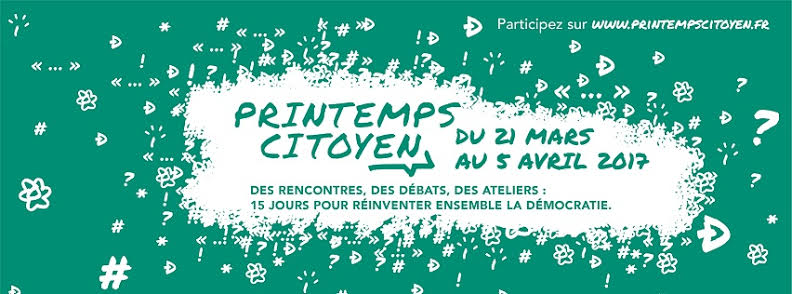
From March 21 to April 5 France hosts the first edition of Printemps citoyen, a collaborative initiative gathering 1000 events like meetings, debates and workshops organized on the initiative of citizens and associations. Hosted in 500 informal locations like cafeterias, schools, co-working and association spaces, the events will be an opportunity to debate on different topics proposed by citizens, from culture to economics, from health to history, thus strengthening citizens participation.

The aim is in fact giving a voice and making space to citizens, “populariser la démocratie participative au-delà de celles et ceux qui prennent déjà la parole ou exercent déjà des responsabilités et de dresser une cartographie des préoccupations et des propositions des citoyens”.
Initiated by the cooperative start-up Kawaa and the collective “Le labo du faire ensemble”, a think-tank promoted by different institutions operating for young target, Unis-Cité AFEV, Coexister, Passeport Avenir, Singa and the International Collaborative Foundation, with the financial support of the corporate foundation of Macif group, the initiative represents a unique opportunity for citizens to raise problems and debate proposals, that will be collected and presented in a final dissemination meeting on April 20.
Many partners joined the project, some of them belonging to Démocratie ouverte, an independent citizens collective whose aim is to accelerate democratic transition by promoting transparency and citizens participation with dedicated programs.
Partners provide also digital tools, like the collaborative platform proposed and offered by Kawaa, and some animation formats containing instructions and details to organize and conduct effective meetings/workshops, also according to different contexts and targets. Open Forum, World Café, SenseDrink, Le Café envie d’agir are just few examples of the available formats. A documentary film showing best practices of democratic innovation from around the world is also available on the website. Citizens could choose a topic and a format, search for the available locations, register their event or simply attend the various meetings organized throughout the national territory. Secularity, creativity, political elections, ecological issues, tax avoidance, migration, citizens engagement are some of the topics under debate.
The complete program is available here.
—————————————————————–
Si tiene in Francia, dal 21 marzo al 5 aprile, la prima edizione di “Printemps citoyen”, iniziativa collaborativa che promuove in tutto il territorio nazionale 1000 incontri, atelier e dibattiti organizzati dai cittadini per i cittadini, con l’obiettivo di stimolarne una partecipazione attiva nella società.

by Francesca Spigarolo | Mar 9, 2017 | The Urban Media Lab
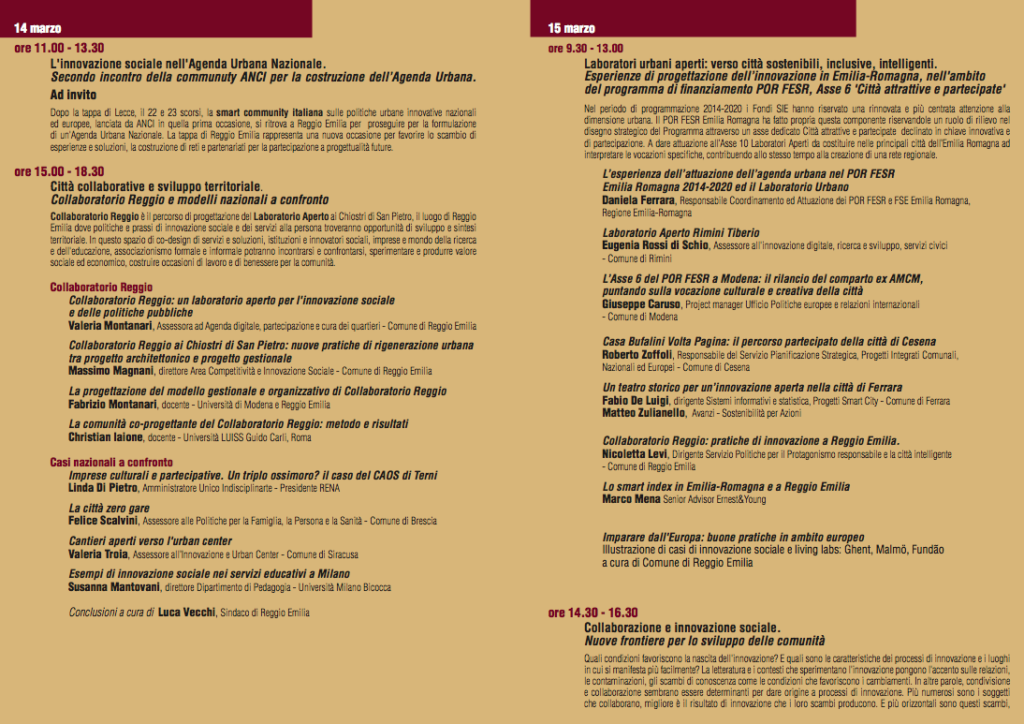
On Tuesday the 15th and Wednesday the 16th of March 2017, the city of Reggio Emilia will host the 2-days conference “Social innovation, commons, collaboration models. Cities and local communities development”.
The event will bring together experts, policy makers, social innovators and citizens, and will be a valuable occasion to reflect on the transformations that contemporary cities are undergoing and on the challenges they are facing. Furthermore, it will be a moment to discover and analyze the numerous practices and experimentations which are being developed by Italian cities, which are trying to provide an answer to the complex and overlapping issues experienced in the urban environment. Cities are being transformed thanks to social, economic and cultural initiatives, which are activated by a variety of urban actors, from institutions to private actors, universities and members of the civil society (associations and citizens). These actors are collaborating and finding new ways to work together in different sectors of urban policies, creating in this way a community of urban innovators.
During the conference, taking as a starting point the experiences of Collaboratorio Reggio and QUA (Quartiere bene comune), activated by the Administration of Reggio Emilia, different topics connected to social innovation, collaboration and urban development will be discussed.

The conference will begin on the 14th of March at 11am with a discussion about the role of social innovation in the national Urban Agenda, which is being promoted by ANCI.
In the afternoon of the same day the discussion will turn to analyze the topic of “collaborative cities and local development” and the experience of Collaboratorio Reggio (a co-design path through which the identity and functions of a new urban actor, the Open Laboratory, were collectively imagined – more information on the path are available here) will be compared and connected to experiences developed all over the country.
The Collaboratorio Reggio path will be illustrated and analyzed thanks to the contribution of Valeria Montanari (Council Member for Digital Agenda, Participation and Care of the Neighborhoods), Massimo Magnani (Director of the Competitiveness and Social Innovation Area), Fabrizio Montanari ( Professor at the University of Modena and Reggio Emilia) and Christian Iaione (LabGov coordinator and Public Law Professor at UNI Marconi and LUISS Guido Carli University in Rome). Other experiences developed in different parts of the country will also be presented: from the case of CAOS in Terni, to that of “La città zero gare” in Brescia, from the development of the Urban Center of Siracusa to the social innovation experimentations activated in the field of education in Milan.
The morning of the second day will be dedicated to the topic of Open Urban Laboratories, which are being financed by the POR FESR Emilia Romagna with the aim of fostering innovation and participation as key components of a transformation process aiming at the creation of sustainable, smart and inclusive cities.
Afterwards, through a roundtable which will see the participation of, among the others, both Christian Iaione and Sheila Foster (LabGov co-founders), it will be possible to analyze the fundamental role of collaboration and social innovation in cities and community development, and in the improvement of citizens’ life.
The complete program of the event is available at the end of this article (in Italian).
———————————————————————————
Martedì 14 e mercoledì 15 marzo 2017, presso il Centro Internazionale Loris Malaguzzi di Reggio Emilia si terrà il convegno “Innovazione sociale, beni comuni, modelli di collaborazione. La città e lo sviluppo delle comunità locali”.
Le pressioni che i sistemi urbani subiscono in ragione dei processi di mutamento demografico, climatico, economico impongono alle città di dare risposta a sfide vecchie e nuove. Le città italiane non si sono fatte trovare impreparate, e hanno messo in campo una pluralità di pratiche e sperimentazioni all’insegna della collaborazione e riguardanti i diversi settori delle politiche urbane, attivando così una community dell’innovazione urbana.
Al protagonismo delle istituzioni si è accompagnato un crescente protagonismo delle comunità nella tutela dei beni comuni urbani. Le città sempre più si vanno trasformando grazie a iniziative sociali, economiche, culturali che nascono e sopravvivono tramite l’attivazione di nuove reti e relazioni. A partire dai progetti Collaboratorio Reggio e QUA – Quartiere bene comune, realizzati dal Comune di Reggio Emilia, parleremo con esperti della sfida dell’Agenda Urbana legata ai temi dell’innovazione.
Ecco il programma dell’evento, disponibile anche qui.