
by Chiara De Angelis | Sep 26, 2016 | Storytelling 2016-2017
The fifth edition of LUISS LabGov Educational Lab (workshops, co-design sessions and fieldwork) will re-start on September 30th, 2016! The meeting will be held in Viale Romania, 32 – 00198 Rome at 4.00 PM.

EDU_LabGov 2016-2017 will explore the principles, techniques, instruments and practices of the roman commons’ management. Rome, in particular its periferic areas, is going to be the focus of this experience, which will begin from LUISS community garden, intended as a gym for collaboration, cooperation and auto-organization. Students will learn to build and develop concrete projects of social innovation, sharing economy and collaborative urban development for the city of Rome, in particular in the urban experimentation fields of the CO-Roma project (www.co-roma.it)
More info about the Laboratory here: http://www.luiss.it/studenti/soft-skills-and-training-opportunities/soft-skills-con-cfu/corsi-di-laurea-triennale-e-ma-1
The calendar of activities is available here: http://www.luiss.it/sites/www.luiss.it/files/LabGov_1.pdf
La quinta edizione di LUISS LabGov (workshops, sessioni di co-design e fieldwork) ripartirà il 30 settembre 2016 alle ore 16.00 in Viale Romania, 32 – Roma!
Il nuovo LABoratorio per la GOVernance dei beni comuni riprenderà le sue attività concentrandosi sulla Città Eterna, Roma, e in particolare nei cantieri di sperimentazione urbana del progetto CO-Roma (www.co-roma.it). Anche in questo caso, le 5 anime dellagovernance collaborativa (social innovation, istituzioni, Università , imprese e società civile) collaboreranno per RIcostruire Roma, rendendola più vivibile e sostenibile.
Informazioni dettagliate sulla struttura del Laboratorio a questo link: http://www.luiss.it/studenti/soft-skills-and-training-opportunities/soft-skills-con-cfu/corsi-di-laurea-triennale-e-ma-1
Il calendario delle attività è disponibile qui: http://www.luiss.it/sites/www.luiss.it/files/LabGov_1.pdf

by Francesca Spigarolo | Jul 26, 2016 | The Urban Media Lab
There will be no sustainable development without action by local authorities. Habitat III needs to discuss a new U.N. council or other body representing cities and regions.
“This story originally appeared in Citiscope [available here] and was republished via the Habitat III Journalism Project.”

Pavlo Vitanovsky/Shutterstock, taken from @citiscope
The United Nations’ behaviour toward local authorities and non-state stakeholders is ambivalent. The body’s view on the importance of NGOs is highlighted in numerous U. N. resolutions and declarations, but when it comes to decision-making and other commitments, member states recall theU. N. Charter’s principle of “sovereign equality of all its Members” — and continue to focus on relations between national governments.
For at least some member states, there remains a palpable fear: Giving stakeholders a stronger voice will result in a loss of control over the global agenda and its implementation. Unfortunately, time and again this has prevented ambitious visions from transforming into a result-oriented enabling environment.
Most recently, this was repeated ahead of last year’s agreement on the Sustainable Development Goals (SDGs), the framework that will guide global anti-poverty and sustainability efforts over the coming decade and a half. Now, it’s being repeated again in the current process toward Habitat III, the major urbanization summit taking place in October.
Although local authorities in all U.N. member states are part of the governmental system, the United Nations categorizes them as one of the official groups of non-state actors — stakeholder bodies formally known as “major groups”. Thus, even if cities build collective associations — such as United Cities and Local Governments (UCLG), Metropolis or ICLEI (Local Governments for Sustainability) — these are not considered international governmental groups but rather international NGOs.
[See: Cities clamour for a seat at the table of the U. N. countries club]
The United Nations and its member states do argue that many problems of SDG implementation can be best solved at the national level, thus urging the international level not to interfere with national policies for urban development. But many of the SDG targets still need to be “localized”, to allow for their local-level implementation.
Indeed, several of these goals — to end poverty and hunger, on good health and quality education, or on sustainable and resilient cities — depend on local action and progress. Others depend at least partly on local action, including those around gender equality, sustainable energy, decent work and resilient infrastructure
[See: The only sustainable city is one co-created by all of us]
Mayors and the local civil society need to know what is expected from them and what will be provided to their city as enabling environment. Many are hoping that the Habitat III process can provide exactly that clarity.
Way forward
Unfortunately, the United Nations has continued to hesitate in clearly expressing that the governance and management of implementation will require the strong exchange of information and intensive cooperation between all relevant actors, including local authorities. Instead it has simply entrusted the responsibility of monitoring implementation to member states themselves, through a body called the High Level Political Forum (HLPF), which has been engaging in its first review over the past few weeks.
We need a better understanding of how decisions that will affect cities are made at the international level. In collaboration with academia and others, local authorities need to analyze how international economic, environmental, social and other trends affect their urban development. Such research also will need to look at the impact of limiting local authorities’ cooperation with international bodies to occasional encounters at international conferences and field visits by international representatives. How can the voice of local authorities be strengthened, and how could this bolster international deliberations and related decision-making?
[See: Global mayors pledge collective action on inequality, sustainability]
The Post-2015 Development Agenda does not see the 17 SDGs as 17 separate “silos” but rather as a web of goals. As such, it requires integrated governance and management at all levels of that web. How can this be achieved? There is no master plan, and since the SDGs are unprecedented, the experience of the past is of limited value.
First, mayors and local stakeholders are used to multiple challenges, but whenever possible they tend to try to reduce this complexity by making priorities and addressing these one at a time. But this doesn’t work in case of the SDGs, where the U. N. has provided a set of 17 universal goals with 169 targets — suggesting that all of them are priorities. Thus far, hardly any guidance has been given to local authorities on how to deal with this complexity. HabitatIII will need to change this.
Second, we need a better understanding of the institutional environments and individual capacities best suited to cope with the challenges and opportunities posed by the SDGs. Once mayors, local authorities and citizens understand the transformative character of this framework, they will work to identify to what extent their institutions, resources and procedures may or may not be suited to cope with the unprecedented challenge of the SDGs. Yes, many of them will need better institutions, finances and human resources, but they also have to improve and professionalize their own ways of working.
[See: The SDGs don’t adequately spell out cities’ role in implementation]
With respect to local actors, there are numerous open questions. The current and required level of commitment by local representatives to the implementation of the SDGs is unclear. We also don’t know what exactly is needed to mobilize local authorities and to unlock the full potential of cities in order to achieve these goals.
The Habitat III process is indeed starting to look into these issues, including through the deliberations that will result in a 20-year global strategy around urbanization, the New Urban Agenda — key negotiations on which are taking place this week in Indonesia. Yet while the draft agenda, which was first released in early May (two revisions are available here), begins to point to these questions, the action-oriented responses it is offering are currently insufficient.
A local leaders’ body?
In 2013, political theorist Benjamin Barber famously suggested that mayors should “rule the world” — and that they should do so through a parliament of local authorities. According to this proposal, such a parliament would consist of 300 mayors who would be allowed to serve just a single term. The parliament would meet around three times per year, each time in a different city. Its objective would be voluntary action and, accordingly, compliance too would be voluntary.
Yet this idea ignores the reality of public offices and the work of large international bodies. A council with a rotating membership, no permanent seat and voluntary implementation seems unrealistic. It more closely resembles a parliamentary assembly with a consultative role than a parliament as a legislative body.
[See: Cities on the world stage: Players or spectators?]
Members of a parliament need to get to know each other and the procedures and politics of the institution before they can become effective in developing initiatives and vote. In addition, they need resources including qualified staff to support the drafting of proposals. Finally, the formal establishment of a new U. N. body would require a modification of the U. N. Charter, and for the time being this is unrealistic.
Nonetheless, the establishment of a U. N. council or other body representing cities and regions should be further discussed. In the long run, the establishment of an entity channelling the voice of sub-national authorities (and perhaps other major groups) could allow for the strengthening of multi-level communication and cooperation. It may also lead to stronger commitments from and accountability of local actors.
Considering the large number of cities in the world, there would be numerous challenges related to the legitimacy, organization and financing of such a body. If governance networks were to contribute to public policy and service innovation, they would need to be governed with this purpose in mind; in this respect, organizations such as the United Nations would need to develop further.
[See: Cities must be part of defining the New Urban Agenda]
Electronic means of communication offer new opportunities for global dialogue and coordination, but they also pose challenges. At least to date, they seem to be limited in their capacity to substitute for face-to-face meetings.
Finally, strengthening the role of local authorities and other stakeholders also depends on the way these groups organize and present themselves. Mayors and other non-state actors will need to improve the coordination and representativeness of their global activities.
City voice
A year after the launch of the Post-2015 Development Agenda, the Habitat III conference is, in principle, an excellent opportunity to continue analysis, dialogue and negotiations on a stronger role for local actors. The United Nations will have to do its part and engage all stakeholders; in turn, local authorities will need to contribute by coordinating and expressing their collective voice.
“An entity channelling the voice of sub-national authorities could allow for the strengthening of multi-level communication and cooperation. It may also lead to stronger commitments from and accountability of local actors.”
[See: Cities turn to implementing the Sustainable Development Goals]
Thinking beyond the Habitat III conference, the New Urban Agenda still could include provisions that would help create a better framework for SDG implementation at the local level and a stronger role of local authorities. Here are a few recommendations:
- Following the U. N.’s 1992 “Earth Summit”, more than 5,000 local initiatives helped to implement the that summit’s outcome strategy. Their success may have been mixed, but their rich experience in exploring local cooperation for sustainability should now be used to stimulate new forms of local engagement for implementing the SDGs.
- The U. N. will monitor SDG implementation with specific indicators for each goal, but to monitor how these goals interrelate, sector-specific monitoring is inadequate. Thus, it will be of utmost importance for the United Nations and its member states to communicate and cooperate closely with actors at the local level. For this purpose, the U. N. should establish a permanent dialogue with local stakeholders at the international level (for instance, their representation at the HLPF) and national level (for instance, dialogues linked to U. N. country programmes).
- Member states should establish national urban policies and coordinate urban planning with regional and national territorial planning.
[See: Cities respond: Testing the urban SDG indicators]
At the same time, cities should not wait for others to motivate them. Even without Habitat IIIand the New Urban Agenda, they will need to intensify cooperation with each other and to raise their voice in intergovernmental processes related to sustainable and urban development. As U. N. Secretary General Ban Ki-moon stated in 2012, “The road to sustainability runs through our cities and towns.” Now, it’s up to cities to decide whether they want this to happen with or without their active engagement. khjk
————————————————————————————————————————
È impossibile immaginare di raggiungere uno sviluppo urbano sostenibile che non coinvolga una forte azione delle autorità locali. La maggior parte degli obiettivi che le Nazioni Unite hanno selezionato come “Obbiettivi per uno Sviluppo Sostenibile” (SDG) – tra cui il porre fine alla povertà e alla fame, migliorare la sanità e la qualità dell’educazione, ridurre le ineguaglianze, costruire città resilienti – dipendono in buona parte dall’azione a livello locale. È per questa ragione che l’atteggiamento ambivalente da parte delle Nazioni Unite nei confronti delle autorità locali deve essere rivisto: è necessario coinvolgere tutti gli attori nei processi decisionali anziché limitarsi a un confronto tra Stati Membri, preoccupati per una possibile riduzione nella loro sovranità.
Il processo di Habitat III potrebbe rivelarsi la giusta occasione per modificare questo paradigma attraverso il coinvolgimento di sindaci e della società civile locale nel disegnare il percorso verso uno sviluppo urbano più sostenibile.
Questo articolo è stato originariamente pubblicato da Citiscope [testo completo disponibile qui in lingua inglese] ed è riprodotto qui nel quadro del progetto Habitat III Journalism Project.

by Ornella Martinello | Jul 22, 2016 | The Urban Media Lab
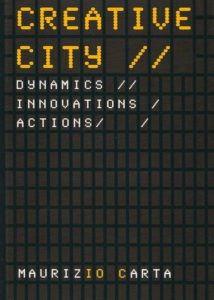 Maurizio Carta, Architect, PhD in Urban and Regional Planning, Full Professor of urban and regional planning at the Department of Architecture at the University of Palermo and advisor for a number of public national and international bodies, is the author of “Creative City – Dynamics, Innovations and Actions“. In his work, Carta tries to condensate his studies on urban regenation based on culture, innovation and creativity. The result is a review of the most innovative processes of urban regeneration undertaken across Europe, an “atlas of urban, landscape and architectural projects”.
Evocative and inspiring is the quote by Irish playwright George Bernard Shaw which the author decided to open the book with:
“Some men see thing as they are and say, ‘Why?’. I dream of thing that never were and say, ‘Why not?'”
Admittedly, the book is the outcome of a “trip” across current best and most innovative urban practices and a hopeful insight into the future of territorial bounds, communities and cities. The wide set of maps, data and figures that complement the analysis not only helps to better figure out how cities are evolving nowadays in Europe; they also give a strong evidence of the fact that the future will undeniably lie in a kind of city that is creative, culture-oriented and sustainable. In Carta’s words:
“The city of the future will be a city of culture, a city generating new culture: the creative cities of the twenty-first century will be capable of competing on the international scenario by optimizing and promoting their own individual cultural identities, attracting a class of creative and generating new sustainable futures.”
The author concisely depicts the world of the future. But he also gives us the instruments we need to build it, or, as he defines them, the “four keywords” which the “creative city manifesto” is based on and which should guild city-makers:
– VISION, the city of the future is forward-looking;
– MISSION, the city of the future is responsible towards its citizens and their needs;
– OUTPUT, the city of the future is productive and effective;
– FUTURE, the city of the future is culturally and environmentally sustainable, able to enhance its citizens’ wellbeing without compromising future generations’ one.
As a matter of fact, these concepts recur repeatedly throughout all the three parts which the book is divided, namely:
I – Creative cities: an Action-Oriented Manifesto;
II – Towards a new polycentric competitiveness;
III – The fluid city – experiments in 13 cities around Europe.
What markedly emerges from the review of those 13 citites (Amsterdam, Barcelona, Bilbao, Bordeaux, Genova, Hamburg, Lyon, Lisboa, Marseille, Newcastle, Palermo, Rotterdam, and Valencia) is a call to act now in order to make our future richer. As Carta puts it, “the twenty-first century is without doubt set to be the ‘age of cities'”. The present and future lie in the local dimension. That is where territorial specificities are respected and promoted and where new forms of political participation can be experimented.
In order to make our cities “desirable places to inhabit”, we cannot but recognize the crucial role governance plays in determining the quality of the outcomes of urban regeneration and how working on ownership, inclusiveness, participatory practices and cooperation leads to a better and long-lasting enhancement of the local dimension, re-building a sense of citizenship through culture and knowledge.
—
Il famoso drammaturgo irlandese George Bernard Shaw scrisse: “Vedi cose che esistono e ti chiedi “perché”? Ma io sogno cose non ancora esistite e chiedo “perché no”?”.
Attraverso una rassegna dei progetti più creativi ed innovativi messi in atto in 13 città europee, l’architetto italiano esperto di rigenerazione urbana Maurizio Carta traccia i contorni della città del futuro: visionaria, produttiva, sostenibile, creativa.

by Ieva Punyte | Jul 18, 2016 | The Urban Media Lab
On the 15th of July, Unipolis Foundation in collaboration with Fitzcarraldo Foundation and Make a Cube association organised a second mentoring workshop for the 15 finalists (the description of finalists see below, or at: http://culturability.org/notizie/finalisti-bando-culturability/) who have been selected from the “Culturability” call – an Italian national call to support innovative projects in cultural and creative fields to promote urban regeneration processes (see more about Culturability at: http://culturability.org/).

The third day of the workshop series was complemented by Urban Law professor at Fordham University Sheila Foster and LabGov coordinator, prof. Christian Iaione’s presentation as well as an interactive discussion with the audience. Scholars focused on bringing the attention of the 15 progressive cultural innovators to the idea of urban commons and, more specifically, addressing the collaborative governance of commons as the main target in the urban regeneration processes of today.
Coming from the school of thought on commons, Sheila Foster began with questions of what exactly an urban common is and what does it mean to the society and the city as a whole. “Urban commons are what city inhabitants share daily, in fact, these commons are of a deeply democratic nature, because they have an open access meaning that the usage of them is non-excludable”. From a property law perspective it is very important to distinguish urban commons from what is conventionally understood as common pool resources within the field of environmental law. Such distinction is necessary, because these commons differ in terms of their nature, characteristics and value that they create to the society, and hence this affects the character of their governance. “Urban commons are city spaces, such as squares, parks, abandoned or non-utilised buildings, streets, vacant lots, even cultural institutions, for instance, museums, and other urban open-access units – spaces of a truly common good nature”- addressed S. Foster. “These spaces are unique because they generate value, that is precisely of a social and cultural origin and a wide range of city actors have a stake or an interest in these urban commons. Thus, by preserving commons together, we can contribute to an inclusive and sustainable well-being co-creation by and for city inhabitants”.

On the other hand, scholar stressed that commons are not a simple concept in law or theory. “Commons are neither private nor public, it is something in between. Therefore, the question of governance of the commons is condemned to be a challenge from both practitioners and scholars’ viewpoints”. Having addressed the “Tragedy of Commons” (see H. Garrets), S. Foster emphasised that urban commons are not something that should be governed either by private or public, because these commons are not necessarily in threat of over-consumption or degradation like natural commons, as some scholars suggest. The opposite – open-access urban spaces, which increase multi-stakeholder usage, even enhance shared social, economic and environmental value and contribute to the so-called “Comedy of Commons” (see C. Rose). “The issue is that today every urban common is overly regulated, today nothing is an open access and non-excludable anymore and having mentioned the value of urban commons the re-opening and collaboratively governing urban commons is a highly valuable process for all stakeholders. The opening urban commons – contributes to the stimulation of a social value to the community. To add, the value of opening up the commons is directly linked to the production of culture, of housing. Commons are not about tragedy, rather about solidarity and shared value” – stressed S. Foster.
Christian Iaione took over the debate stressing that today there is a growing need to rethink economy, institutions and focus on the energy that the community possesses. “The community should recognise the value of commons. It is not the tangible commons that matter, it is the collaborative governance of commons and the value to the community that it produces”- said C. Iaione. Professor focusing on governance of commons stated that between the state and the market there is a room for experimentation and this is the space of commons that connect different stakeholders. So far, what the overly regulated cityscape has produced is scarcity and collaboration, or collective action, as stressed by E. Ostrom, yet in an urban context, is the way to introduce new approaches to governance and eliminate the problem of scarcity. Despite the fact that “[w]orking on commons requires constant experimentation, what we have accomplished thus far is writing the Regulation which is a strong step towards the recognition of urban commons at the city level and the introduction of collaborative urban governance”.

Lastly, by sharing experiences from the Parco Centocelle project in Rome and the project on #CollaboraToscana, C. Iaione emphasized that the governance of commons is an arrangement between 5 different actors (or “quintuple helix” model, see more about this in “City as a Commons“), where (1) the unorganized public (e.g. social innovators, active citizens, urban regenerators, urban innovators, etc.), (2) public authorities, (3) businesses, (4) civil society organisations, and (5) knowledge institutions (e.g. schools, universities, cultural institutions, etc.) work together to establish public-private-community partnerships and contribute to the preservation of the cultural heritage and the co-creation of the social as well as economic value.
Laboratory for Collaborative Governance of Urban Commons appreciates the energy and the ideas that 15 finalists of the Culturability Call possess. These finalists are promising examples of urban regeneration processes and therefore are strongly supported by LabGov.
The information about the finalists:
An initiative which regards culture in proposing a hybrid agricultural production system which creates a lively ecosystem. This, while restoring the role of not only agricultural production, but also of culture, contributes to the creation of welfare and strong community. This is a biological and social farmhouse of innovation and agriculture to improve the integration and employment, aggregation of space and the production of cultural places. It creates a sustainable local supply chain between farmers as well as it is a museum contributing to the regeneration of an area.
A non-profit organisation, founded by people who share a dream: to return the Cascina Sant’Ambrogio – an important place of agriculture and economy. This place regarded as poor and outdated due to the transformation of society is just an error of perspective. The Cascina is place rich in culture, memory and practices that need to be rethought by integrating them with the needs of present times. Citizens must not just be consumers and voters, but producers and active citizens able to concretely transform a portion of reality. This path does not come from nothing, but by a gradual emergence of the collective application that, with more and more insistently, asks sustainable and alternative lifestyles, as well as adequate opportunities.
- Caserma Archeologica + Art Sweet Art – San Sepolcro (Arezzo) | artsweetart.net
This is a platform of artists to display their works in private homes to visitants. A homeowner can choose an artist via the website artsweetart.it from those who have joined up to the initiative. After assessing the home, the artist decides what type of art work to display in the new location. The art has to fulfil both the customers’ needs (the house as a location, the artwork’s theme, etc.) as well as those of the artist (who is invited to carry out a piece of art which fully respects their artistic expression). The initial drafting phase is followed by the artist creating their work. The artist is hosted in the customers’ private home, an unprecedented experience which influences the creative process. During the artists’ stay, the organisers-together with the hosts’ family- promote the art in construction and facilitate workshops in schools, local cultural guides, gatherings with friends, etc.
The projects seeks to reform the system of support the cultural industry in Italy. It highlights the critical issues and illustrates the best solutions.
The project promotes different cultural tradition lines belonging to all Italian regions. Through musical concerts, plays, lectures and seminars, many of the popular culture heritages met within the framework of demonstrations made in Pisa, which due to its characteristics naturally prepares to host a dialogue between diverse communities and different cultures.
The project that seeks to create a network of people and spaces, such as, the abandoned buildings and underused of sites, with the objective of denunciation of situations of abandonment and then revaluation of the buildings by putting the spotlight on forgotten places, abandoned or fallen into disuse, showing its potential for reuse, it will foster a new collective interest in these spaces. This is a project that wants to revolutionise the way of seeing and understanding the assets disposed of a city, turning it into a resource.
This is a residence project that was born in a former industrial factory, able to provide hospitality for the whole year to travellers and tourists, and simultaneously transform into a school on urban regeneration: a “training of the mind” in the heart of central Italy, where two cities, Terni and Rieti meet. The idea is to experiment with new solutions and re-design territorial integration policy.
- LAB+: Piazza Gasparotto Urban Living Lab – Padova | copiu.it/lab
The project that focus on workers with different skills to meet, share ideas and expertise in urban regeneration practices. Gasparotto Square in a space of co-design living between citizens, private organisations and public institutions. To achieve this objective, the project makes the system a series of micro-actions of re-appropriation of public space: the urban expansion, construction of a weekly market of organic producers, involvement of local residents through the social theatre and community, realisation of works public art, use of storytelling and the creation of micro-community events.
- Mana Grika – Hub Culturale della Grecìa Salentina – Calimera (Lecce) | managrika.it
It is a Cultural Hub of the territory that will be made available to local communities to create initiatives with a strong cultural and social impact spaces. The main objectives are the territorial promotion and enhancement of the local culture through affiliated initiatives for social activation of communities and by creating a synergistic network among all organisations working in the area.
- MUFANT, MuseoLab del Fantastico e della Fantascienza di Torino – Torino | mufant.it
This is a project by a team of professionals and industry experts, academics, journalists and researchers who are aspired to imagine a world, in which people are aware that this is just one of the possible worlds. This is being accomplished by the multiple permanent or temporary exhibitions, performances, conferences, events, and such, in the MusueoLAB.
Piazza dei Colori is one of Co-Bologna “construction sites”, and the aim is to turn it into a collaborative district that could later include different realities from Croce dei Biacco and all the migrants that live there.
The project aims to put an end to the progressive abandonment and degradation of one of the most prestigious and representative testimonies of the assets of the industrial archaeology resulting from the old age epic mining of Sardinia, which UNESCO declared a universal value in 1997 . With the completion of the project they intend to preserve and make available the public buildings of great architectural value at the Sella Well located in the mining complex-Monteponi on the outskirts of the city of Iglesias. The work of protection and restoration of the industrial archaeological heritage will accompany the exhibition. The abundance and beauty of the available space will also allow to set up an area for conference activities with its audiovisual and multimedia equipment. With the completion of the project, as well as regeneration of the museum space, the site will be returned to the local community.
Station Chiaravalle project focuses on the regeneration of the unused gym of neighbourhood school and creation of a hybrid space in order to host a community hub: operational production based on cultural content, artistic home and an urban laboratory. Additionally, it reinterprets the disused railway line along the Vettabbia channel as space in transformation. Lastly, it activates a participatory observation with the local community and generates landscape projects and custody of places and common open spaces for the enjoyment of the area as a landscape for immersive experiences.
The project which has an aim to enter into the social and productive fabric of Rome and spread to further cities. It focuses to put in place cultural practices and job opportunities that would promote inclusion and integration of those individuals who are in need for help and solidarity. It is a job creation, but also the artistic expression, which can also become a source of income, are the ways in which we intend to intervene in the social and cultural fabric of Rome.
This is a non-profit organization active in the field of contemporary art and culture both at a local and international level. It produces and organises art exhibitions, theatre shows, publications, audio-visual works, training and residency programs with the aim to encourage artistic mobility and the promotion of artists on an international scale. It intends to invent original devices in order to promote projects and enable processes that mobilise unconventional strategies and plans of intervention in the artistic and cultural system. The members of the core working group are artists who chose not to limit their activities and their identities to “the creation of artworks”, but to work actively – and independently – for the activation of shared processes and the redefinition of the role of the artist in society. The project starts from an idea of hospitality and sharing to create a symbolic place where experience and the individual journey are set aside to make way for the development of a collective strategy. The network of people intertwined constitutes a network able to relate with institutions, questioning established practices and models, with the aim of generating concrete outcomes/results in the community.
LabGov congratulates all finalists and looks forward to new collaborations!
Secondary sources:
- Garrett, Hardin, (1968) The Tragedy of the Commons
- Iaione, Christian. (2016) “The CO-City: Sharing, Collaborating, Cooperating, and Commoning in the City.” American Journal of Economics and Sociology, 2: 415-55.
- Ostrom, E. (1990) “Governing The Commons: The Evolution of Institutions for Collective Action”, Journal of Natural Resources Policy Research, Volume 6, Issue 4, 235-252
- Rose, C. (1986) The Comedy of the Commons: Custom, Commerce and Inherently Public Property, 53

by Cristiano Gatti | Jul 18, 2016 | The Urban Media Lab
 This article talks about Y Combinator‘s Basic Income Project, an attempt to understand if and how basic income works in the US. The idea is to give a basic income (an amount of money that is sufficient to meet basic needs) to a group of people in the US for a period of time and try to answer a few key issues: if there are links between basic income and people’s happiness, well-being, financial health and how people spend their time.
The Research Director of Basic Income Project is Elizabeth Rhodes: she recently completed a PhD in Social Work and Political Science at the University of Michigan where she studied health and education provision in slum communities in Nairobi.
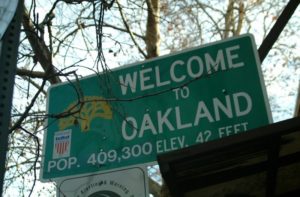
Anyway, before running a large long-term study, the researchers decided to start with a short-term pilot in Oakland. In order to be prepared for the longer-term study, it is therefore necessary to understand the methods i.e. how to pay people, how to collect data, how to randomly choose a sample, etc.
According to Y Combinator’s vision, Oakland is a great city to do this because it is a place with social and economic diversity and there are both targeted wealth and widespread inequality. Oakland is also very close to where they live: it is an advantage because researchers are closer to the treated. Researchers also think that local resources and relationships will help them in terms of effectiveness of the study. In addition, in the past, Oakland was the field of other famous scientific investigations: in 1973 Aaron Wildavsky and Jeffrey L. Pressman wrote the book Implementation about an unsatisfactory implementation process of a federal policy in Oakland.
Coming back to the study, they have decided that the income is unconditional: according to the researchers, basic income promotes freedom, so they want to see how people treated will experience that freedom. They are free to use basic income how they want: it is permitted to be a volunteer, to be an unemployed, to work, to move to another country or anything.
It is obvious that, if the pilot goes well, they follow up with the larger study, if it doesn’t go properly, the researchers will consider different action plans.
According to YC’s researchers, in the future technological improvements should generate an abundance of resources and the cost of living should fall considerably. Although basic income seems fiscally challenging today, in a future without a steady job, it could become necessary. The researchers hope a minimum level of economic security that will give people the liberty to pursue their own aims such as improve their education, create a better job, plan the future without anxiety and fear of the future. The question is. “When you have a little more freedom and you have more security, what opportunities does that create?”
This study will be very important because we have some examples of something close to a basic income in other countries, but it interesting to see how it would work in the US.
—
Il primo studio sul reddito minimo negli USA sarà portato avanti da Y Combinator e Elizabeth Rhodes nella città di Oakland. Nelle intenzioni dei promotori, questo studio pilota dovrà essere l’inizio di un lavoro di ricerca più ampio e più diffuso nel paese. L’importanza di questo progetto risiede nel fatto che ci sono già esempi di reddito minimo in altri paesi ma questa è la prima volta che si cerca di capire se e come questo possa funzionare negli USA.


