
by Diletta Di Marco | Feb 8, 2016 | The Urban Media Lab
An Ecomuseum is a dynamic way in which communities preserve, interpret, and manage their heritage for a sustainable development. An Ecomuseum is based on a community agreement. Introduced by the French museologist Hugues de Varine in 1971, the word ecomuseum has often been misused and the definition of an ecomuseum is still a controversial matter for contemporary museology.Many museologists sought to define the distinctive features of ecomuseums, listing their characteristics.Following a complexity approach, in recent definitions, ecomuseums are more properly defined by what they do rather than by what they are.[1]
The ecomuseum phenomenon has grown dramatically over the years, with no one ecomuseum model but rather an entire philosophy that has been adapted and molded for use in a variety of situations. As many more ecomuseums are established across the world the idea has been growing and the changes in the approach towards the philosophy are reflected in the reactions of the communities involved. In recent time particular significance is the rise in ecomuseology in India, China, Taiwan, Japan, Thailand, Vietnam and Cambodia, with significant increase in Italy, Poland, the Czech Republic and Turkey.Ecomuseums are an important medium through which a community can take control of its heritage and enable new approaches to make meaning out of conserving its local distinctiveness.
The Urban Ecomuseum Casilino “Ad duas Lauros” is located inside the Centocelle park, on via Casilina. In this urban reality, in the east of Rome and within G.R.A., there are various types of landscapes:
- The archaeological landscape that goes from the Mausoleo di Sant’Elena to the Catacombe di SS. Marcellino e Pietro, from Villa Imperiale di Centocelle inside the Parco Archeologico, to Villa Gordiani, through the Acquedotto Alessandrino and the Terme di Largo Irpinia.
- The landscape of spirituality ,this heritage is in fact part of the historic path of the Via Francigena that crossed Europe to reach the main cultural centers of Christianity
- The agricultural landscape of the Roman countryside with houses, towers, fields and pastoral areas.
- The natural landscape created by the presence of green areas
The Ecomuseum is an intangible infrastructure that brings together these landscapes, bridging them through extraordinary walking and cycling paths, which link together realities anciently connected by these modern views, in order to attract tourists to that area from all over the world.
For decades, urban planning in Rome does not take into account the needs of residents, but only those of profit and speculation, the Ecomuseum is now a new model of “development”. A new way to see the city.It promotes urban planning that incorporates the particularities with territorial wealth to use them to the fullest way, an urbanism that has as its main topic of community health. An easy and effective city, a citizen-friendly neighborhood where livabilityis the central theme.

by Diletta Di Marco | Oct 10, 2015 | The Urban Media Lab
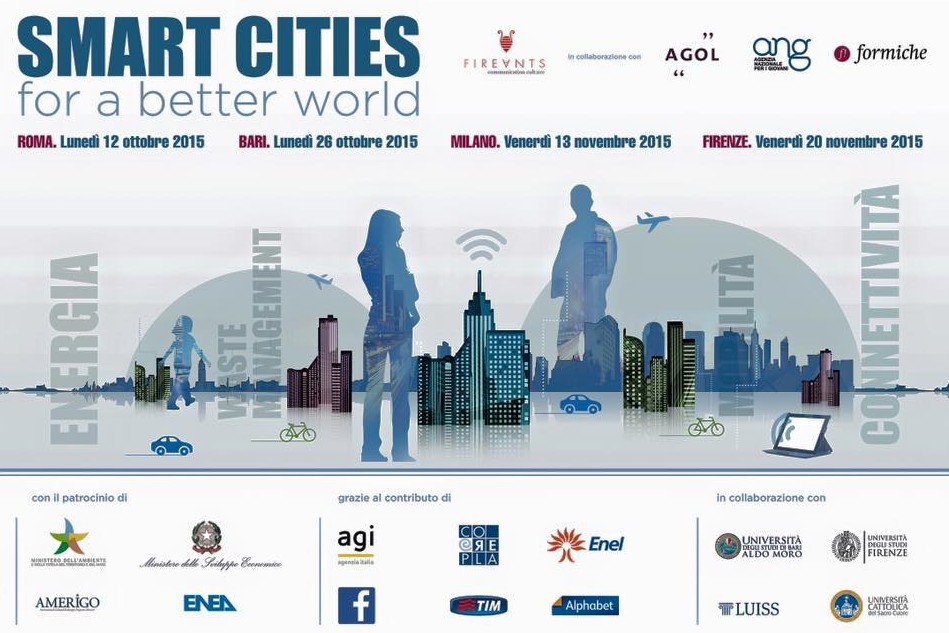
On October 12, LUISS University will host the first “Smart Cities Roadshow“,
organized by Formiche and Agol, in collaboration with the National Agency for
Youths, as well as several universities, institutions and firms.
These partners will work together to help young students to become the next
generation of leaders; they will teach students to be smarter and more
intelligent citizens of the community.

These are challenges that we can only overcome together through collective awareness
and strong participation. The day will begin at 9:30 am, and Professor Christian Iaione
will be one of the distinguished guests, along with Giampiero Gallo (Economic Advisor
to the Prime Minister Matteo Renzi and a professor at the University of Florence),
Simona Vicari (State Secretary at the Ministry of Economic Development with
responsibility for Smart City and President of the Task Force of the Ministry on
Smart Cities), Andrea Costa (project manager of EXPO 2015 Telecom Italia),
Laura Bononcini (Head of Public Policy at Facebook Italy) and many others.
In the afternoon the group will engage in stimulating co-design activities, where
students can consult with experts in the field. The round-tables will be organized
with policy makers, enterprises and experts to discuss a possible national policy
on the development of smart collaborative cities.
These activities will be featured by experts of the various branches: Ilaria Potito
(Head of Working Capital Operations at Telecom Italian), Mauro Annunziato
(Smart City and Coordinator of Eco enterprise ENEA) and Ugo Barbara (Head
New Media editors AGI).The event will end at 17:30.
We look forward to your participation!
If you want to participate register at this link.
by Marina Bassi | Oct 6, 2015 | The Urban Media Lab
THE 2015 EDITION OF THE EVENT Il Salone della CSR e dell’innovazione sociale WILL TAKE PLACE FROM TODAY – THE 6th TO THE 7th OF OCTOBER.
The event, organized in collaboration with Bocconi University, Unioncamere, and Alleanza Cooperative Italiane, will be held in Milan, in via Roentgen 1 (University of Bocconi). Professor Iaione, coordinator of LabGov, will attend the Exhibition and participate in a panel about Collective impact: collective intelligence as a tool for development.
The Fair has been confirmed as the most important event in Italy centered around corporate responsibility and social innovation. It is not only a meeting place for organizations’ leaders but also a time to bring together an attentive audience, that is interested in understanding the future of sustainability.Passion is the engine that leads companies to choose sustainability. It helps young people move towards training programs that focus on the values of Corporate Social Responsibility, and pushes the consumer to reward organizations more accountable. Inspiration is an important factor because there can be no innovation or change without attention to values, and no cross-pollination between different worlds and spheres without excellent examples to refer to.
Three words characterize the edition 2015: sciences, openness, and sharing.
Sciences because, as always, the quality of content and the debate will be high and the Exhibition will combine theory and practice.
Opening because the trade fair helps to spread the principles and values of CSR and to involve people who are not yet engaged with these issues.
Sharing because, in a rapidly changing society, it is increasingly necessary to network in all senses.
Here is the program of the event: Program – Salone CSR
______________________________
IL SALONE DELLA CSR E DELLA INNOVAZIONE SOCIALE
Il 6 e il 7 ottobre avrà luogo a Milano, in via Roentgen 1 – Università Bocconi – la nuova Edizione del Salone della CSR e della Innovazione Sociale. All’evento, organizzato in collaborazione con l’Università Commerciale Luigi Bocconi, Unioncamere e Alleanza Cooperative Italiane, parteciperà il Professor Fernando Christian Iaione, coordinatore di LabGov , nel Panel Collective impact: intelligenza collettiva al servizio del cambiamento.

by Leonardo Rossi | Jun 22, 2015 | The Urban Media Lab
An Italian Foundation (CON IL SUD) wants to revalue some buildings (14 to be exact) according to projects made by the local communities, enterprises and institutions. CON IL SUD granted 4 million euros in order to enact such propositions aimed to allow the community to enjoy such common goods in a sustainable way.
This is the third edition of this call that previously managed to enforce 21 projects with a cost of 8 millions euros.
The Foundation asked to the cities of the south of Italy to propose some buildings and places eligible to this end, and 14 out of the 22 proposed were choose. 5 of those are in Sicily, 7 in Puglia and 2 in Campania.
The legal property of this good will be given by the owner (the region) to the organization that won the call for that building for at least 10 years, in advance of knowing what the use will be, and the requests made for the financing of the renewing of a public good cannot exceed 500.000€.
On their website is it still possible to see the full list of the public goods that are part of the call and everyone can present an idea or a project, even when the call will be over on 14th of July 2015.
This experiment aims to make clear that every community wants to cooperate and to put their efforts together in order to achieve a better lifestyle and a better world for everyone to enjoy.
La Fondazione CON IL SUD alla sua terza edizione per la riqualifica dei beni comuni; terza edizione con I fiocchi
La Fondazione CON IL SUD vuole, con la terza edizione di questo bando, rivalutare 14 beni comuni presenti in Sicilia, Puglia e Campania, grazie ad un fondo di 4 milioni di euro.
Grazie a questo bando i progetti scelti saranno sovvenzionati fino ad un massimo di 500.000€ per le spese di ristrutturazione e i vincitori avranno la proprietà del bene assegnato per almeno 10 anni.
Sul sito internet è possibile consultare la lista completa dei beni comuni scelti e, anche dopo la chiusura del bando che si terrà il 14 luglio 2015 sarà possibile proporre idee e progetti.

by Edoardo De Stefani | May 18, 2015 | The Urban Media Lab
According to a recent report issued by the European Commission, social enterprises have become nowadays a constitutive element of the strategy set up by European Institutions for promoting inclusive growth. Following the last recognition of social enterprises as something that can combine economic activity with social mission, they reflect the necessity to align business and investment programs to more ethical and social principles. The feature of “social enterprise” has indeed become associated to development and growth, revealing a latent necessity to address the growing instability and inefficiency of typical business models.
The idea of social enterprises is that they can provide innovative responses to the current economic, social and environmental challenges by developing social inclusion, social services, territorial cohesion and so forth.
Nonetheless, if social economy and social innovation are recognized to be at the heart of Europe’s concern, there is no such clarity in identifying which actors are supposed to “operate” within the novel ecosystem. By the way, the process of identification reveals another controversial problem, which is the one of defining what a social enterprise is.
For this reason, the European Commission launched a Mapping Study in April 2013 as a follow-up to Action 5 of the Social Business Initiative (SBI) to help fill this gap in knowledge. In particular, the objective is to converge toward a common operational definition of social enterprises. The relevance of the action is related to the dynamic evolution of such enterprises and to the fact that political arenas are constantly dominated by discourses on social innovation.
Finally, the study highlights another important aspect related to the process of mapping social enterprises: the family of those enterprises is incredibly diverse, encompassing a range of legal and organizational forms and it remains mainly unsupported in overcoming main barriers to development (poor visibility and recognition of the sector, the constraints of current legal and regulatory frameworks, limited financial resources, difficult access to markets)
So, acknowledging the role of such enterprises in tackling societal challenges, we should also understand how much is important to provide a supportive environment. In so doing, the preliminary step should consist in enabling supportive policy framework, by reinforcing for example the interconnections between stakeholders, or creating virtuous partnerships with diverse societal actors. Again, it would be nonsense talking about innovation without any regard to social stakeholders.
Recently Iris Network, the Italian network of Institutes for the research on the social enterpreises, published an interesting and comprehensive Report on the situation of the social enterprises in Italy.
The future is about collaboration.
Further info at:
http://ec.europa.eu/internal_market/social_business/docs/COM2011_682_en.pdf
http://ec.europa.eu/social/BlobServlet?docId=12988&langId=en
_ _ _ _ _ _ _ _ _ _ _ _ _ _ _ _ _ _ _ _ _
Il tema di imprese sociali in Europa rappresenta la nuova frontiera in termini di sviluppo economico e di crescita sostenibile. Legare tradizionali sistemi di business a dinamiche etiche e sociali riproduce i tratti di una strategia Europea sempre più mirata a investire sull’ inclusione sociale e sul valore economico aggiunto che se ne può trarre. Tuttavia, non sempre appare semplice definire quali siano le caratteristiche di queste imprese sociali, né tantomeno appare immediato costruire una mappatura per identificare i poli d’innovazione sociale.
Per questi motivi, la Commissione Europea affronta il tema delle imprese sociali e delle barriere allo sviluppo, identificando tra i maggiori limiti la mancanza di un sistema di policy per il supporto, nonché la difficoltà di accedere ai mercati ed ai finanziamenti.
Pertanto, nel ricercare una soluzione alle barriere strutturali che incontrano le imprese sociali nel promuovere il loro sviluppo, è evidente quanto la collaborazione tra i diversi attori sociali rappresenti in realtà la prima fonte di progresso.
Interessante anche il Report pubblicato recentemente da Iris Network sull’impresa sociale in Italia.
Image credit to: www.cnm.org


