
by Leonardo Rossi | May 15, 2015 | EducationLabs
What happens when a region is scourged by a natural disaster, like an earthquake? There is the time grief, of course, and the time of reconstruction, involving an extremely delicate phase: the healing of the victims’ souls.
That was the motivation that pushed the Ministry of the Tourism and Cultural Activities to fund an initiative, the “Beni Comuni Project”, that gathered the ETR Foundation, ATER and eleven Provinces (Campogalliano, Carpi, Cavezzo, Cento, Concordia sulla Secchia, Finale Emilia, Mirandola, Novi di Modena, San Felice sul Panaro, San Possidonio, Soliera). Their goal was to recover and reunite the spirits of the communities threatened by the 2012 earthquake by an active participation in the organization of public events with the main goal to foster the sharing sense.
This idea is much needed in a time where society tends to be more and more egoistic, full of technological barriers that allows people to communicate easily with one another, but at the same time tends to label those who cannot afford such connections as “social pariah”. Stimulate the spark of active cooperation and sharing may ignite again an essential characteristic of the human soul that is slowly dying as the society evolves.
The Project reunites 24 partners: from schools to theatres and music schools: through the organization of public events, shows, concerts and readings, this group wishes to foster the reconstruction of the populations that survived the earthquake, thanks to arts and artistic expression. In the words of a member of the Project: “a way to allow the community to restore the spaces destroyed by the earthquake and start again with a stronger sharing spirit”.
This approach is really valuable, also because allows the people’s mind to wander off such grief and crisis and their souls to understand that nothing is over and everything can be solved, as long as there is a common goal and a common support. Act as one, survive as a whole.
—————-
Cosa accade a una comunità quando essa viene distrutta da un cataclisma naturale, come un terremoto? Ovviamente c’è il tempo del dolore, e dopo la ricostruzione inizia una fase delicatissima: la rigenerazione degli spiriti dei cittadini.
A tale proposito è stato finanziato dal Ministero dei Beni e delle Attività Culturali e del Turismo e promosso dal Comune di Carpi in collaborazione con ERT Fondazione e ATER il “Progetto Beni Comuni”.
Esso coinvolge undici Comuni (Campogalliano, Carpi, Cavezzo, Cento, Concordia sulla Secchia, Finale Emilia, Mirandola, Novi di Modena, San Felice sul Panaro, San Possidonio, Soliera) del cratere sismico con l’obiettivo di rinsaldare e ricostruire le identità delle comunità minacciate dal terremoto del 2012 attraverso la partecipazione attiva alla costruzione di eventi artistici che abbiano come orizzonte primario il senso della condivisione e dello stare in comune.
L’idea alla base del Progetto è encomiabile, e potrebbe essere spiegata in vari modi, ma il modo migliore è utilizzare le parole di un esponente del Progetto: “Il progetto Beni Comuni ha un valore intrinseco e speciale. Non è solo un programma destinato alla fruizione, ma un laboratorio di produzione culturale che coinvolge professionisti dello spettacolo ma anche e soprattutto i cittadini. Uno spazio artistico composto da tanti luoghi […]. Un modo concreto per le comunità di rimpadronirsi degli spazi violentati dal sisma e ripartire, con uno spirito di socialità condivisa”.
Questa idea è necessaria anche per un altro motivo: essa consente di far vagare la mente delle vittime del sisma lontano dal dolore e dalla sofferenza, e far capire che nulla è perduto e tutto è superabile, se si collabora e ci si aiuta nella comunità: Agisci come uno, sopravvivi come gruppo.

by Stefano Speranza | May 4, 2015 | The Urban Media Lab
 On May the 6th, LUISS will host the second edition of the CSR and Social Innovation Exhibition in Rome, named “Passion and Inspiration: get ready for the future”.
It is the most important event in Italy dedicated to the development of the Corporate Social Responsibility, towards more and more innovative and sustainable scenarios.
This edition will promote a CSR dedicated to the needs of the territory, and some of the most important best practices regarding environmental and social innovation will be presented and analysed by companies, local authorities, social businesses and cooperatives.
Anima, Koinetica, LUISS and Next propose a program full of debates and meetings in which students and their ideas will be the leading actors.
In the afternoon, from 2.30 p.m. until 4 p.m., a seminar entitled “Territory, Sharing and Innovation: collaborative projects are increasing” will take place.
According to the program of the exhibition, professor Christian Iaione, LabGov’s coordinator, Fabrizio Torella from Ferrovie dello Stato, Alessandro Radicchi from ONDS, and Maurizio Gubbiotti from Legambiente, after having talked about the project “Help Center” in the train stations and the various examples about public-private-civic partnerships which LabGov is carrying on in Italy, will also examine the co-design and the participation projects for the environmental sustainability of the territory. Certainly, the participant will have the opportunity to understand what has been made during this academic year at the LUISS Community Garden.
Rossella Sobrero, Koinetica’s president, will moderate the debate.
To obtain further informations and to consult the full and detailed program, please visit the following links:
http://www.nexteconomia.org/le-attivita/salone-csroma/csroma15
http://www.csreinnovazionesociale.it/
http://www.luiss.it/evento/2015/05/06/il-salone-della-csr-e-dellinnovazione-sociale-passione-e-ispirazione-prepararsi-al
Mercoledì 6 maggio la LUISS ospiterà la seconda edizione romana del Salone della CSR e dell’innovazione sociale, “Passione e ispirazione, prepararsi al futuro”.
L’edizione 2015 promuoverà una responsabilità sociale attenta alle esigenze e ai bisogni del territorio; verranno presentate alcune delle più importanti buone pratiche sul tema dell’innovazione ambientale e sociale.
Il programma (visionabile a questo link) prevede un seminario intitolato “Territorio, Condivisione, Innovazione: crescono i progetti collaborativi” cui parteciparanno, oltre al professor Christian Iaione – coordinatore di LabGov – anche Fabrizio Torella, Responsabile attività sociali Ferrovie dello Stato Italiane, Alessandro Radicchi di ONDS, Osservatorio Nazionale sul Disagio e la Solidarietà nelle Stazioni Italiane e Maurizio Gubbiotti, Coordinatore Segreteria Nazionale, Responsabile Dipartimento Internazionale di Legambiente. Coordinerà il dibattito Rossella Sobrero, presidente di Koinetica.
L’appuntamento è fissato in aula 203, dalle 14.30 alle 16.

by Stefano Speranza | Apr 11, 2015 | The Urban Media Lab
In the majority of the articles published in this blog, a recurring keyword is social innovation. The paradigm is not only well-known among the experts of the sector, but that is also spreading fast in the whole civil society.
Actually, after the economic crisis out-broken in 2007, most of the people are starting to approach to economy at-large, they are starting to be more interested in the methods of doing business and in the ways of learning and teachings. Basically they are logging at everyday life in different ways from the past.
Basically, social innovation is an approach. A new approach through which collective energies are released thanks to grassroots involvement.
An even more exhaustive definition of social innovation can be found in this very useful dictionary, based on the above mentioned concept, in which it is quoted the founder of The Hub – Rome, who states that “social innovation has to be made, not to be defined”.
However, making social innovation implies to let this kind of approach enter into the learning institutions.
That is why, with this short article, we are pleased to support and spread among our readers the first Master’s program in social innovation, social business, social start-up and innovative design in Italy.
The Master’s program will start in June and it is offered by ASVI Social Change, with Simone Cicero – OuiShare connector Italy – as director.
The educational plan will be “blended”, that is to say a mixture of e-learning, webinars, frontal lesson in Rome, Milan and London, and workshops.
More than five hundreds different orgnisations will offer their teachers and stage opportunities. Among them we find Libera, Agire, FairTrade, Save the Children, Emergency, Greenpeace, Amnesty International, Amref, Unicef, ActionAid, Peter Pan, Aidos, Telethon.
As it is possible to read in the website of the Master’s program, it is important to underline the fact that the world is deeply changing, and that the third sector —especially when it comes to the non-profit— is strongly increasing.
The Master’s program will build professional figures that will follow three profiles. A designer and strategic advisor for the social innovation, a social business’s and start-up’s manager, a consultant for social enterprises and for the organisational re-design.
So, the outgoing participants from the Master will find an employment and will bring an added value in the third sector, in the private businesses, and in the Public Administration.
The participants will be people and professionals between the age of 23 and 55 exercising the role of managers and supervisors looking for turn over a new leaf, managers of innovative processes, workers and experts in human resources, graduates.
To participate, if you have a dream and if you are motivated to take a significant professional choice, you can take a look to the syllabus and apply for an interview here. fluent english and good organisational skills are required.
For further infos, please follow this link.

by Stefano Speranza | Apr 3, 2015 | The Urban Media Lab
 As we all know, all over the world, and in Italy too, things are changing. The daily way in which we spend our money, the way we organize travels, the way we move. That is basically the arising of a new economic approach.
The first thing to do is to map all of our “friends” and to support each other when we do something good for our communities, so to create a network of social innovators and supporters of sharing economy.
Few weeks ago, a participant of the Sharing School organized in Matera (of whose LabGov was an official partner) in January, emailed us in order to let us know a very nice initiative we are proud to support.
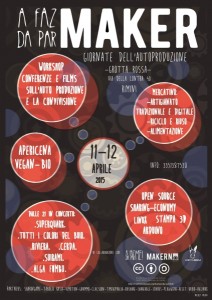
It is the weekend (on April the 11th and the 12th) called “A faz da par maker”, which will take place in the community center GrottaRossa in Rimini. The expression a faz da par maker is a funny union of the typical expression of Romagna (a faz da par me in that region literally means “go it alone”) with the word Makers.
The two-days event grows out of two different realities.
The first one, DIY Rimini, which will cover a more traditional side of the event, that has at his core themes like agriculture and nutrition. And the second one, MakeRN, more linked to the sharing economy and to the digital craftsmanship.
Both the realities are obviously interconnected and they are driven by the passion for the self-production. Consequently, everybody will be given the chance to exhibit projects and experiences through expository booths, talks, conferences, workshops, laboratories, projections and various amusements.
On Saturday the 11th, the opening day, from 2 pm it will start the 9th edition of the DIYFest, during which it will be possible to participate in free workshops dedicated to yoga, cooking, craftsmanship and reuse activities. Meanwhile it will be possible to have a walk through expository booths and a little market with local producers and craftsman.
At night, after the projection of a movie dedicated to the punk scene of the city of Rome during the 90’s, some local independent bands will play Italian punk/hardcore music.
Finally, Sunday will be the concluding day, which will host the third edition of the “From Market to Makers” faire. There will be a lot of makers’ expository booths with their technological projects such as 3D printers and little robots.
From 3 pm on, there will be a series of speeches and talks on sharing economy, presentations of local and national collaborative economy innovative services, which touch important themes like sustainable mobility, tourism, housing, and economic exchanges alternative to money.
For the whole day, interesting workshops on 3D printing, Arduino, CoderDojo, Linux and Wearable will took place, both for children and adults.
Starting from 9 pm the event will be closed with the “Salotttino”, where it will be possible to freely debate and exchange ideas and opinions on sharing economy. Remember, the only rallying cry will be #sharing!
Both on Saturday and on Sunday, a bio-vegan dinner will be waited on by Tabula Rasa.
The event will be live broadcast by ResetRadio, the first European radio exclusively broadcasting CreativeCommons/Copyleft music.
At the entry, you will be asked a little subsidy (3€ for a single day, 5€ both the days) to contribute to the expenses and to support the future activities.
The event is supported by international partners like Shareable, OuiShare and 3DHubs.
The full and detailed program is available here, see you soon in Rimini!

by Edoardo De Stefani | Mar 26, 2015 | The Urban Media Lab
The stagnation of the economic growth and industrial development could induce us to believe that the time of fabrics has come to an end. Conversely, the emergence of the mounting trend of the so-called “start-up” phenomenon is modernizing the way of doing business. Moreover, the scenario comprehends a different category, namely the one of the FAbLabs.
Although it is difficult to classify strictu sensu the different typologies of Labs, there are common qualities that can be traced for all. Indeed, it is not difficult to accept as a common denominator that those LABs represent a melting pot for the fabrication of social energy. To put it alternatively, citizens, machines, methods and ideas altogether create a tangible output for the surrounding community within this co-working spaces.
In this sense, the added value is represented by the contribution of multiple stakeholders, especially citizens, which eventually inject novel inputs in the mechanisms.
So for example, the idea of the FAbLabs entails the possibility to create a physical and digital hub whereas people can work together exchanging ideas, projects, competencies and experimenting innovation as consequence of autonomous initiatives.
In a sense, the path opened by the culture of co-working LABs is a good premise for designing and developing new practices for social inclusion and community growth.
Nonetheless, bringing the concept of social innovation to the market has also the effect of redefining the roles and the objectives of enterprises, municipalities and even universities. In fact, it is not uncommon that even universities try to install ideas and incubate projects in order to produce high quality series of tangible and intangible products.
This is for instance the case of affiliation with European Universities, as in the case of VUB in Bruxelles (see more here).
FabLabs are indeed a sort of Fabric of Labour, as well as a space for cultural innovation, knowledge production and eventually a place for nurturing social cohesiveness.
But more surprisingly these spaces, even if limited in number, are slowing popping-out as a good alternative to fit the needs of a socio-economic renovation.
In Italy for example, there are at least 43 relevant spaces for running this kind of social innovation, as showed in the map here.
Besides, supporting institutions and policies can set a milestone in terms of social innovation, for example through the recognition of the co-working method as a referential practice of governance.
However, in relation to FabLabs, there are still lot of dynamics and themes that have to be further investigated and those are briefly the following:
1) Fundraising and accession criteria
2) Added value of the social enterprise
3) Governance method and redefinition of public spaces
4) Pact of collaboration with the public administration
5) Census of actors and activities
6) Real estate speculation
7) Political project – civic targeting- social dialogue
That said, there are also good instances of social planning, as the one envisioned in 2014 by the Lazio Region within the “Lazio Creativo Planning”.
But other examples can be easily found, for instance in our previous article here.
_ _ _ _ _ _ _ _ _ _ _ _ _ _ _ _ _ _ _ _ _ _ _ _ _ _ _ _ _ _ _ _ _ _
La recente evoluzione del fenomeno dei FabLab, si ricollega alla necessità di rilanciare le economie di produzione , tenendo in considerazione allo stesso tempo il valore delle dinamiche socio-culturali.
Laddove le fabbriche non sono più in grado di sostenere la crescita economica e le start-up non sono ancora sufficientemente radicate sul territorio, la categoria del FabLab si inserisce allo stesso tempo come strumento di innovazione sociale e di sviluppo industriale.
Il concetto di base è quello di creare spazi di collaborazione, ove il comune cittadino – e non solo – possano sperimentare tecniche, metodi, idee e pratiche di produzione di qualità.
L’idea principale del FAbLab, cosi come delle sue varianti, è quella di creare un hub fisico e digitale che possa produrre output tangibili per la comunità circostante.
In Italia per esempio esiste già un rigoglioso ambiente per sperimentare l’ innovazione sociale, supportato spesso da politiche di pianificazione ed inclusione sociale, tra cui il piano Lazio Creativo.
