
by Leonardo Rossi | Mar 25, 2015 | The Urban Media Lab

On November 18-20 2014 there was the 4th edition of the “Smart City Expo World Congress” (SCEWC), and it took place in Barcelona.
The topics covered during this event were: Smart Society, Technology, Governance, Energy, Mobility and Sustainable City.
It was an event full of discussions, projects and a lot of great ideas were discussed around such topics; the “Smart Society” theme was focused on the fostering of creativity, innovation, economic development and collaboration inside the boundaries of the cities, bringing the population to the center of decision-making in order to make urban and social development more democratic. Cities must be reinvented and transformed so that they become more sustainable, and improve quality of life and economic performance. This should be a shared vision and the way forward for citizens, public and private organizations and multi-stakeholders.
This topic is growing in importance in modern society, and recently there was also an European call, “Horizon 2020”, that was focused on the attempt to bring the population closer to the European mechanisms, in order to foster the collaboration between citizens and governments, and create a network of Smart Cities all around Europe.
All the topics that formed the “core” of this were deeply covered, and all seemed to express a common will to shift the modern view and use of energy, technologies and governance towards a collaborative approach, were the citizens cooperate with the governments in order to produce and support a lifestyle focused on the sustainability of energy, lifestyle, governance and technologies.
As a matter of fact, consumers are in a demanding shift, asking for a new energy model, environmentally and economically sustainable, making better use of local scale and renewable resources, while having a global focus and a strong partnership between governments and companies. The marketplace for wind or solar energy is shifting and reaching the mainstream. Every industry is regulatory and subsidy dependent. Clean energy in short will be able to deliver to local stable energy and subsidies will decline over time, as many of the renewables are able to be paid by themselves. This technological revolution is an opportunity of real change in how cities are operated and therefore a possible way forward for economic and social development.
This congress was a great example of how the modern societies’ demands managed to influence the economic and political spheres, and the fact that more and more multinational companies like IBM, Philips, Nissan, BNP Paribas, Microsoft, Oracle and Cisco became more concerned about such topics and aware of the possible available solutions is indeed a beacon of light into the grim darkness of the “non-collaborative future”.
The 5th edition of the SCEWC will take place on the 17-19 of November 2015, and given the growing success and importance of such event, it is possible to hope for some real projects to be proposed regarding the topics of sustainability.
Smart City Expo World Congress: Le Multinazionali accendono il faro della speranza.
Nella quarta edizione della SCEWC si sono discusse tematiche fondamentali quali energia, tecnologie, Smart Cities, governance e sostenibilità.
Dalle conferenze e dai workshop è emerso che la società sta cambiando e che desidera sempre più spostarsi verso una società più attenta e proiettata alla sostenibilità e alla governance comune.
Il ciclo di conferenze ha dimostrato come la società moderna riesce ad influenzare la sfera politica ed economica; il fatto che numerose multinazionali del calibro di IBM, Philips, Nissan, BNP Paribas, Microsoft, Oracle e Cisco abbiano preso parte a questo evento dimostrandosi sensibili alle tematiche sopracitate ci rende più fiduciosi riguardo al futuro.
La prossima edizione del SCEWC si terrà dal 17 al 19 Novembre del 2015 e si potrebbe azzardare la speranza di vedere una serie di progetti concreti prendere forma.
by Chiara Falduto | Mar 13, 2015 | The Urban Media Lab
In today’s society topics such as environmental and territorial issues are increasingly gaining importance. The impact that pollution has on the Planet we are living in is of central importance in many debates. Often, though, speeches are not enough to sensitize the population on such a delicate subject.
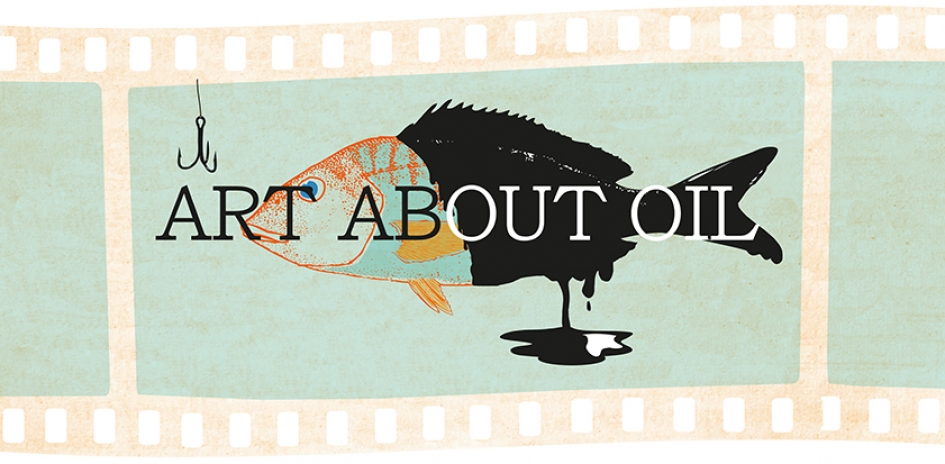
In this context, a new project has risen: ArtAbout. ArtAbout is an Open and Integrated Project Platform that aims at denouncing all the environmental issues surrounding us through the use of art. Indeed, since the very beginning of mankind, art has been a great tool for reaching towards men’s hearts by representing from a critical point of view uncomfortable matters.
The first theme that ArtAbout wants to deal with is the pollution caused by petrol, which represents a great problem especially in the Italian region Basilicata. Through the competition ArtAboutOIL, artists and publishers from all over the world are called to propose a project for a film work on site aimed at sensitizing the people about the oil issue.
Allelammie, Casa Netural, IAC – Centre of Integrated Art and SassieMurgia are the sponsors of ArtAbout: four Lucan agents that work in the field of social innovation and creativity. Launching the project ArtAboutOIL they want to restate their commitment to innovation and improvement of territorial and cultural issues by transmitting a message about the importance of safeguarding the wonderful Lucan territory before it gets seriously damaged by pollution.
As written in the grant, the sponsors have not received any kind of external founding for the project. This is why ArtAboutOIL not only calls artists to participate, but is also looking for investors that are willing to “donate” some money that will help to provide basic tools that will help to realize the project and will also help to found the winner’s prize: a 10 day stay in Basilicata, during which he or she will be able to realize the video-project proposed. Investing even a little amount of resources in ArtAboutOil will surely be a great symbolic act that will have an even greater impact especially in the local territory. In fact, it is important to understand that only through small actions we can hope to mobilize greater mechanisms of solidarity and union.
The kind of art that ArtAbout wants to enhance is a “partecipative art”, which means that people will not only be asked to observe the wonderful creations that the artists will produce but will also have to look at them critically, and will have to appeal their sense of civic duty to improve their community afterwards. We could also talk about a “360degrees-art” which wants to tell in an innovative way the reality of energetic production and its related issues. A reality which now more than ever is of great importance and of which we all need to become aware of.
_______________________________________________________________________
ArtAbout è una Piattaforma Progettuale Aperta e Integrata lanciata da quattro realtà Lucane che operano dell’ambito dell’innovazione sociale. In ArtAbout l’arte diventa il principale strumento per comunicare e diffondere messaggi relativi l’importanza della salvaguardia del territorio, dell’ambiente e delle culture locali.
Con il progetto ArtAboutOIL, ArtAbout vuole concentrarsi sul tema del petrolio in Basilicata; argomento molto importante che copre non solo tematiche relative all’inquinamento dell’ambiente ma anche alla questione delle politiche energetiche. In questo contesto artisti e produttori sono chiamati a partecipare ad ArtAboutOIL, creando un video focalizzato su questo problema.
ArtAbout non riceve nessun finanziamento esterno ed è per questo che fa appello anche a possibili investitori che desiderino contribuire economicamente alla realizzazione di questo progetto.
Con ArtAbout si parla di arte partecipata, dove ogni individuo è chiamato a rielaborare in maniera critica i messaggi trasmessi dagli artisti ed impegnarsi per migliorare la realtà che lo circonda.
by Edoardo De Stefani | Feb 10, 2015 | The Urban Media Lab
NexT SNIA Viscosa is an open call for attracting ideas, talents and competences for the regeneration of an ex-industrial area in the City of Rieti.
The underlying idea is not about selecting the best project or about competition among ideas, rather the working method of collaboration and co-design becomes an objective itself.
All local and international stakeholders are called to work in a transversal and interdisciplinary manner on the themes of social innovation and urban requalification.
The participative structure of the call makes possible to include all those local stakeholders that are interested in building a new narrative of the territory.
The project of regeneration becomes a transparent experiment of social co-designing and it gives the possibility to be part of the think-tank together with professionals and changemakers.
The project promoters are the Municipality of Rieti, Rena, Monte dei Paschi di Siena and Snark for the technical support.
To participate, please visit > link
Further info at > Link
_ _ _ _ _ _ _ _ _ _ _ _ _ _ _ _ _ _ _ _ _ _ _
Presentato il bando internazionale NexT Snia Viscosa: un’opportunità di rilancio per Rieti
Giovedì 29 gennaio, presso il cinema Moderno, l’associazione RENA, il Comune di Rieti e Banca Monte dei Paschi di Siena hanno lanciato il bando internazionale “NexT Snia Viscosa”, sulla base di un importante progetto di riqualificazione di un ex area industriale del territorio laziale.
L’idea del bando è quella di raccogliere la sfida di una rigenerazione urbana di aree produttive dismesse, attraverso l’utilizzo di strumenti di innovazione sociale e tecniche di co-progettazione. L’idea principale è quella di mettere insieme un gruppo di professionisti ed innovatori sociali, nonché di persone che abbiano competenze di analisi, progettazione e di racconto dell’area.
Individuare una direzione progettuale richiede infatti un approccio trasversale che coinvolga allo stesso tempo cittadini e operatori del territorio, in modo da comprendere quali siano le reali motivazioni ed esigenze del cambiamento.
Il bando mira quindi a raccogliere idee per la riqualificazione dell’ex Snia Viscosa e ad attirare manifestazioni di interesse, da parte di tutti quei soggetti interessati, siano essi attori locali, nazionali o internazionali impegnati su tematiche di progettazione ed innovazione sociale.
Il percorso prevede una fase di ricerca, ascolto ed osservazione -sulla base di un approccio di comunicazione e partecipazione trasparente alla città e agli stakeholders coinvolti- ed infine un vero e proprio processo di co-progettazione e formulazione progettuale.
Per rispondere alla call, si rimanda al link seguente : link
Ulteriori informazioni su: link
by Edoardo De Stefani | Jan 28, 2015 | The Urban Media Lab

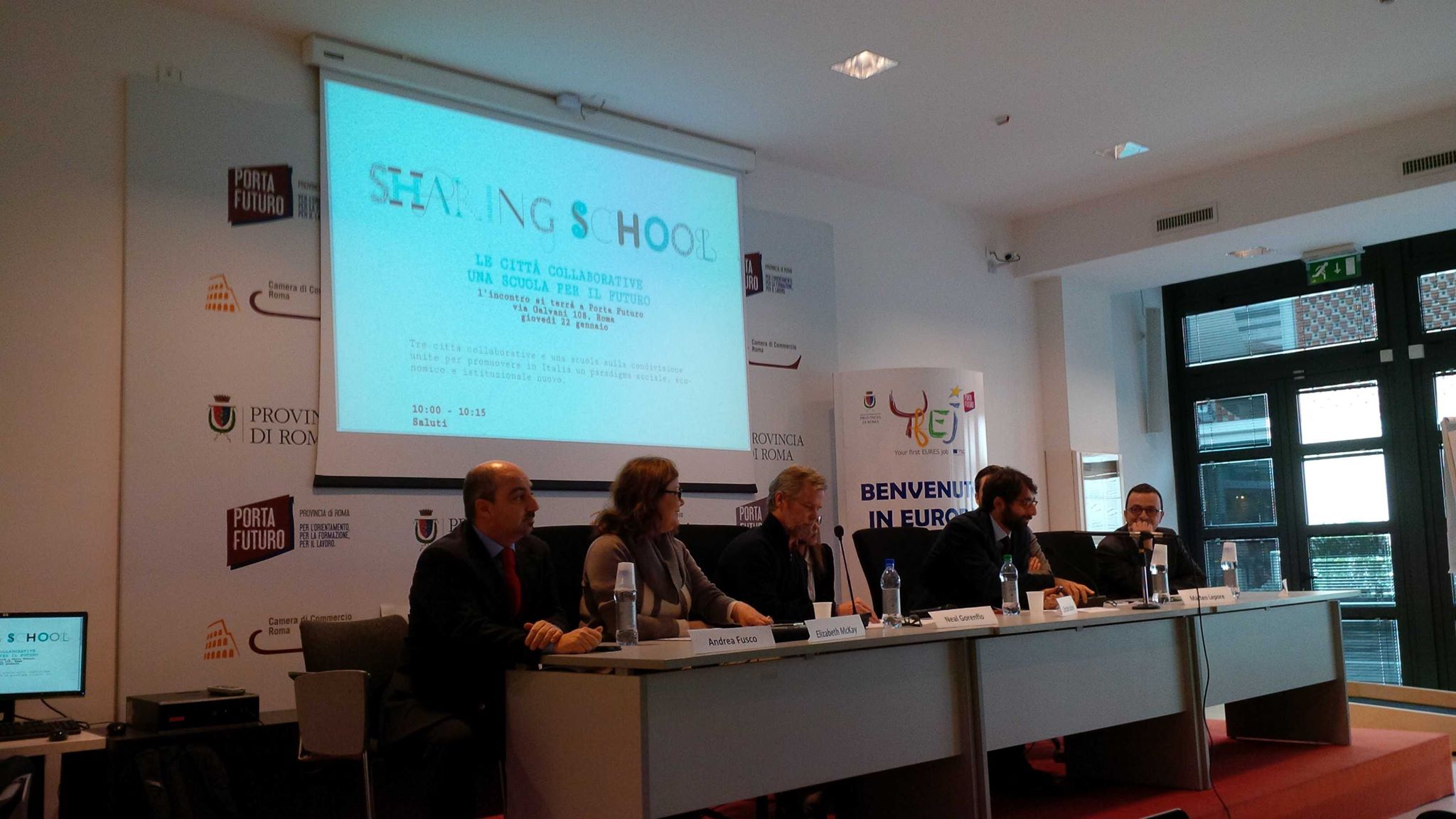
The sharing economy is growing faster than ever and becoming a hot policy issue these days. Casa Netural, Collaboriamo, RENA and LabGov have for this reason decided to launch the “Sharing School”. Thanks to the collaboration between these organizations and with the support of Ouishare, Avanzi and Societing, the School has been able to host highly qualified professionals and experienced innovators. The guest star of the event has been Neal Gorenflo from Shareable, an American leading organization in the field of sharing economy and collaborative practices.
The event held in Rome at Porta Futuro, had the main objective of dealing with the mainstream tendency of sharing economy and to understand if such trend can become the leading paradigm of the new economy. Andrea Fusco, Director of Department III – Services for placement and quality of life of the Province of Rome, the future Metropolitan City, was very happy to host the Sharing School initiative.
Minister Counselor for Public Affairs of the US Embassy in Italy Elizabeth McKay, reminded how the sharing economy has already changed things; it is no longer a new phenomenon and thanks to technological interactions and social media, we are exploring a potential that can disrupt traditional forces. Customers become service providers themselves, acting as catalysts for phasing into the system resources and goods that are normally not exploited.
We were used to think about sharing economy as some “nerd stuffs”, while nowadays there is a sort of “media bulimia” that affect the topic of sharing economy – says Francesco Russo, President of RENA. It is undeniable that we are assisting to a growing tendency of the concept of collaboration, as we simply trust strangers. However, the problem is that we shall distinguish what sharing is really about, and that is the aim of the Sharing School. There is a paradigmatic change of society and in the next future, 40% of the online staffing will be served through services provided by the sharing economy. Then, the approach of the initiative is not only about telling the story of a new economic trend.
As Neal Gorenflo recognizes, we are all here to learn how to gather people and create a common homogeneous vision about the sharing economy. But here we encounter obstacles, since we need to dissolve the gap between trans-formational economy and trans-action sharing, which basically maintains social hierarchies. Neal Gorenflo talked about making a choice between the red pill and blue pill like in The Matrix movie. The blue pill is a story about the re-adaptation of the old capitalist paradigm to the new economic trends, where Uber and AirBnB are the concrete examples of how initiatives of such strand of the sharing economy can still create monopolies. On the other hand, the red pill is the one that inspired our research. It is about the resurgent collaborative experimentation and it is what can wake up reality. We need to open cities, to make them available for use and to activate citizens by creating an economy “by and for” the people. We need to invest on transformational sharing much rather than transactional sharing.
However, as Matteo Lepore – Commissioner to Economy, Development of the City, Tourism, International Relations and Digital Agenda of the City of Bologna – underlined, if we talk about social order and sharing economy, we are inevitably bound to themes such as politics, democracy and participation. In fact, even taking the red pill has the risk of initiating a debate between citizens and the political representation. It is all about a systemic change, otherwise there would be no way back from the loss of collaboration between citizens and institutions. Step by step, we are loosing the sense of citizenship, by projecting a vision of citizens as the residual assets of society. Fortunately, the City of Bologna was able to initiate a process of human capital reactivation, thanks to the implementation of the “Bologna Regulation on public collaboration for urban commons” that seeks to transform the Public Administration in an enabling factor. The City of Bologna is thus a starting point for understanding how collaborative practices can rehabilitate citizens and regenerate urban networks, for instance with the instrument of the “pact of collaboration“. The underlying idea is that important results can only be achieved through effective practices of co-working, which involve citizens and professionals through a platform of mutual exchange of skills and knowledge.
Starting from the community to build competences and deliver effective results on the territory is also the strategy of the City of Milan , says Renato Galliano, Director of Smart City Service in Milan. We have to recognize that it exists a network of collaborative urban cities, which is itself a new form of infrastructure. This is the confirmation that collaborative economy is not only about isolated and scattered projects of mobility sharing, start-ups and civic crowdfunding. The social innovation entails a renaissance of the cities in a wider context, whereas citizens are the locomotives of change and public administrations are the habilitating infrastructure.
As Christian Iaione, Coordinator of LabGov, reminded we have to reinforce the processes of active citizenship and active entrepreneurship, to foster a steady dialogue between the five actors of collaborative governance and to create an “Italian way” to sharing. Indeed, the real sharing is centered on the restitution of value to the community. This is a good opportunity also for the City of Rome. Daniela Patti – from the staff of the Comminisioner to the Urban Transformation in Rome – affirmed that we need to create a network of collaborative cities, to develop instruments to regenerate abandoned urban spaces and to consolidate practices for exploiting the latent potential of the great cultural heritage.
Alex Giordano (Societing and Rural Hub) warned against the dysfunctions that an incorrect practice of sharing economy can create. In this sense, we should not only focus on the quantitative approach and upon capitalist mechanisms. It is in fact essential to reason on communities and social impact. If we have a look at territorial distributions, it is possible to notice how people are divided by interests and have lost the sense and ethic of community building. Fortunately there are breeding grounds of innovation that create value, even if their outreach is limited by disabling institutional leaderships. The problem is that those who have the courage to produce social innovation are constantly marginalized, as Simone Cicero of Ouishare, noticed. Even Enrico Parisio, of Coworking Millepiani says that we need to express such new exigency, as a pedagogic stimulus for social innovation. When we started talking about sharing economy, nobody believed it could be real, reminds Ivan Fadini of Impact Hub Roma. For this reason we are strongly committed today on avoiding the reiteration of traditional economic capitalism.
The commoners will be the heroes of social innovation.
Stay united!
– – – – – – – – – – – – – – – – – – – – – – –
Presentata a Roma la prima edizione della Sharing School.
Si è tenuto il 22 gennaio 2015 l’evento di presentazione della Sharing School di Matera, la prima scuola sulla sharing economy e sulla condivisione per promuovere in Italia un nuovo paradigma sociale, economico e istituzionale. L’incontro, ospitato da Porta Futuro e reso possibile grazie alla collaborazione tra Casa Netural, RENA, Collaboriamo e LabGov, con il supporto di Avanzi, OuiShare e Societing, ha visto la partecipazione, grazie al supporto dell’Ambasciata americana in Italia, di Neal Gorenflo co-fondatore di Shareable.
L’evento, incentrato su temi dell’ economia collaborativa e innovazione sociale, ha rappresentato un importante punto d’incontro tra ospiti internazionali, attori istituzionali, accademici e società civile. Se si vuole sviluppare un nuovo concetto di economia, è necessario rivedere gli orizzonti sociali e promuovere spazi innovativi di collaborazione. E’ in un contesto di inclusione sociale e di promozione della cittadinanza attiva che la sharing economy deve prendere piede perché, come ricorda Neal Gorenflo, le persone devono rappresentare lo snodo per un’economia collaborativa.
Dobbiamo cominciare a comprendere come l’implementazione di un modello di governance condivisa non ruba potere alle amministrazioni, semmai ne rinvigorisce la struttura e la riempie di nuovi contenuti. Per questo il prof. Christian Iaione, coordinatore di LabGov, invita a pensare all’economia come un bene comune che possa essere curato e messo a punto con interventi di animazione da parte di tutti quei soggetti coinvolti nell’ambito della sharing economy, inclusi i cittadini.

by Marco Quaglia | Jan 7, 2015 | The Urban Media Lab
How to measure social innovation? How to assess the impact of new models on our society? These are just some of the main questions that will be addressed in a 3-days workshop that will be held in Salerno (January 16-18).
Organized by Societing and Socialseed, Labgov will be among the partners of this event. The aim of the workshop is in line with the necessity to change drastically our approach to social innovation. Today’s world cannot rely anymore on old paradigm based on profit and competitiveness; in fact the complexity of our society deserves something more. The only way to value new practices is to develop a new analytical toolbox for social innovation.
To be accountable, we need to measure the added value that enterprises can generate by adopting a social innovation-oriented model; the challenge is thus the one of acknowledging the value of the practices of social innovation and to understand, through an interactive process, all the instruments of design thinking and their possible application.
Through the use of new tools derived from Design Thinking and Theory of Change, the workshop will be a valuable experience of co-working.
Finally it will be given the possibility to interact with professional facilitators and brilliant personalities that will offer their contribution in the co-working session.
Program and inscription at : Societing


