by Edoardo De Stefani | Feb 10, 2015 | The Urban Media Lab
NexT SNIA Viscosa is an open call for attracting ideas, talents and competences for the regeneration of an ex-industrial area in the City of Rieti.
The underlying idea is not about selecting the best project or about competition among ideas, rather the working method of collaboration and co-design becomes an objective itself.
All local and international stakeholders are called to work in a transversal and interdisciplinary manner on the themes of social innovation and urban requalification.
The participative structure of the call makes possible to include all those local stakeholders that are interested in building a new narrative of the territory.
The project of regeneration becomes a transparent experiment of social co-designing and it gives the possibility to be part of the think-tank together with professionals and changemakers.
The project promoters are the Municipality of Rieti, Rena, Monte dei Paschi di Siena and Snark for the technical support.
To participate, please visit > link
Further info at > Link
_ _ _ _ _ _ _ _ _ _ _ _ _ _ _ _ _ _ _ _ _ _ _
Presentato il bando internazionale NexT Snia Viscosa: un’opportunità di rilancio per Rieti
Giovedì 29 gennaio, presso il cinema Moderno, l’associazione RENA, il Comune di Rieti e Banca Monte dei Paschi di Siena hanno lanciato il bando internazionale “NexT Snia Viscosa”, sulla base di un importante progetto di riqualificazione di un ex area industriale del territorio laziale.
L’idea del bando è quella di raccogliere la sfida di una rigenerazione urbana di aree produttive dismesse, attraverso l’utilizzo di strumenti di innovazione sociale e tecniche di co-progettazione. L’idea principale è quella di mettere insieme un gruppo di professionisti ed innovatori sociali, nonché di persone che abbiano competenze di analisi, progettazione e di racconto dell’area.
Individuare una direzione progettuale richiede infatti un approccio trasversale che coinvolga allo stesso tempo cittadini e operatori del territorio, in modo da comprendere quali siano le reali motivazioni ed esigenze del cambiamento.
Il bando mira quindi a raccogliere idee per la riqualificazione dell’ex Snia Viscosa e ad attirare manifestazioni di interesse, da parte di tutti quei soggetti interessati, siano essi attori locali, nazionali o internazionali impegnati su tematiche di progettazione ed innovazione sociale.
Il percorso prevede una fase di ricerca, ascolto ed osservazione -sulla base di un approccio di comunicazione e partecipazione trasparente alla città e agli stakeholders coinvolti- ed infine un vero e proprio processo di co-progettazione e formulazione progettuale.
Per rispondere alla call, si rimanda al link seguente : link
Ulteriori informazioni su: link
by Stefano Speranza | Jun 13, 2014 | The Urban Media Lab
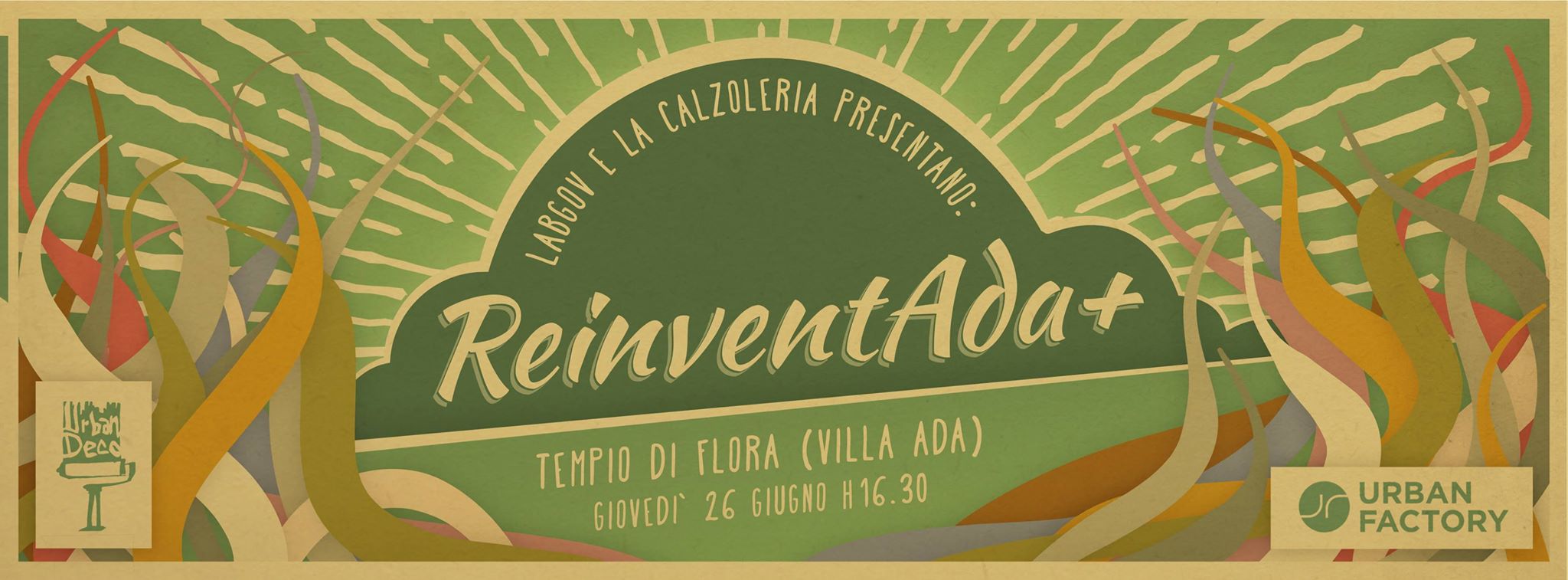
 The next June 26th, 2014 at the Temple of Flora in Rome will be held ReinventAda+, an opportunity of shared regeneration organized by LabGov in the wake of the highly successful ReinventAda, held in October 2013 together with La Calzoleria, club of social and cultural promotion.
LabGov considers as handbook and benchmark the Regulation adopted by the Municipality of Bologna on the “Cooperation among citizens and administration for the care and the regeneration of urban commons” and the urban commons at issue is the Temple of Flora which is in the wonderful park of Villa Ada, in Rome.
The Labgovers will symbolically repossess the Temple on June 26th, for a second edition of shared regeneration that, this time, will also see the presence of artists to animate the event.
In fact, during the first edition of ReinventAda, held on October the 25th, 2013, the Labgovers have cleaned up and restored the Temple and its surrounding area that, despite the restoration works made over the years, were in a state of degradation and abandonment.
During that memorable day it was shown that thanks to the cooperation of the local Administration (the Councillors of the City of Rome Flavia Barca and Estella Marino were actually attending the event) the people willing to roll up their sleeves can easily do it and take care of those urban commons which the Administration often loses sight of.
After eight months, however, the writers (the ones who only soil, not the artists), the waste and the dry leaves are back together with the abandonment, so the Temple of Flora is back to seem an old ruin left alone. But the Labgovers do not accept this situation and they have decided to persist and continue to work actively on the territory.
Thus, on June the 26th will be held ReinventAda+, the second edition of the first ReinventAda event that this time will not only consider the cleaning of the Temple but also moments of entertainment, called “Intimismi”, with music, reading and an exhibition of live painting made by Urban Decoarations. LabGov intends to contribute to the construction of a steering committee that aggregates the various associations, institutional entities, as well as civic and business subjects interested in achieving cultural and amusement activities to enhance the Temple of Flora and restore its former function of meeting place and cultural exchange. For this reason will be presented a Pact of Collaboration to ensure that the Temple of Flora will soon become a meeting and interest place for the local community.
Here the programme of ReinventAda+:
h 2:00 pm – Start of the activities
- Setting up and Regeneration of the Temple of Flora
h 4:30 pm – Arrivals of guests
h 5:00 pm – “A proposal for the shared Governance of Villa Ada”
- Opening greeting from LabGov
- Presentation of the Pact of Collaboration
- Presentation of the Handbook for the Placemaking
- Reading by Professor Sebastiano Maffettone
h 5.00 pm Live painting by Lorenzo Properzi of Urban Decorations
h 5:30 pm – Cultural entertainment “Intimismi”
- Music provided by La Calzoleria with:
- Marcello e il mio amico Tommaso
- Luca Bertelli
h 7: 30pm – End of the activities
For LabGov Group
Stefano Speranza
by Giulia Spinaci | May 22, 2014 | The Urban Media Lab
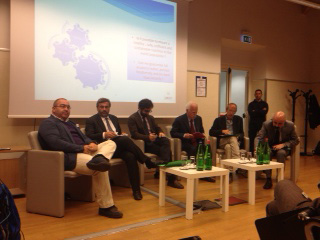
 On May 19th 2014, LabGov – Laboratory for the Governance of the commons organized the event “Coltiviamoci” at LUISS Guido Carli University in Rome. In organizing such a meeting, LabGov had the aim to present both the results achieved in the 2013/2014 academic year and the focus of the laboratory for the 2014/2015 session, namely the governance of the environmental commons. However, the event was also an occasion for a panel discussion, as LabGov had the pleasure to host prestigious speakers: Giovanni Lo Storto, LUISS Guido Carli CEO; Carmelo Troccoli, the National Secretary of Coldiretti Giovani Impresa; Luca D’Eusebio from the association Zappata Romana; Albino Ruberti, Managing Director and President of Zètema Progetto Cultura s.r.l. and coordinator of the working group Lazio Expo 2015. Professor Christian Iaione and Professor Gregorio Arena (Labsus) participated at the conference as LabGov founders and promoters.
Four neo-LabGovers, Marina Bassi, Edoardo De Stefani, Federica Maranesi and Leonardo Rossi made an introductive speech and presented the video that has been realized by the LabGovers in collaboration with Doctor Morello and Doctor Sbordoni from Officine GM. The video perfectly expressed the spirit of LabGov: youth, participation, training, and social innovation. Then, they spoke about the goals achieved during this academic year, which are impressive: ReinventAda, ReinventAda + and Human Ecosystem.
ReinventAda consisted in the regeneration of the Flora’s temple in Villa Ada’s park, which took place in October 2013. In that occasion, the LabGovers wanted to create a new form of governance of the commons and for this reason, they decided to practically take care of this site, by giving it new life through a restoration activity, under the supervision of the “Sovrintendenza Capitolina”. It is still an ongoing project and in fact, on June 26th 2014, LabGov will launch the second edition of the event: ReinventAda +. This year, LabGov will be the promoter of a memorandum of understanding open to all those associations willing to take care of Villa Ada, thanks to the model provided by the Bologna’ regulation about the collaboration between citizens and public administration for the cure and regeneration of the urban commons. The translation in English of the latter has been another goal achieved by LabGov 2014 and it will be an important documentation source for all foreigners who have already demonstrated a genuine interest in the LabGov project.
Nevertheless, the most important project that LabGov had the honour to carry out during the last semester has been “Human Ecosystems”. The latter is a new technology that qualitatively and quantitatively measures all information that human beings produce in the main social media and gives us back the real time geography of our relations, ideas and conversations in the form of an ever-changing map. In strict collaboration with the creators of this device, Salvatore Iaconesi and Oriana Persico, and with Roma Capitale, the LabGovers wrote a European project in response to a Horizon 2020 call for proposal.
All participants to the conference positively welcomed these results and after this brief introduction, the conversation with the host speakers began. The conversation revolved around the themes of Expo 2015, which perfectly coincide with those on which LabGov is based. In particular, since LabGov focus of the 2014/2015 academic year will be the environmental commons, the LabGovers asked the host speakers to meditate on possible solutions to the problem of a healthy, secure and sustainable global sustenance and on LabGov proposal of the vegetable garden sharing.
Giovanni Lo Storto, LUISS Guido Carli CEO, expressed his enthusiasm for the goals LabGov achieved during the last academic year. He was fundamental in LabGov creation and without his support, such a great success would not have been even possible. He underlined that the natural resources are finite and that we should welcome this situation as an opportunity for the best energies of the society to create new forms of governance for the commons. Even if he could no longer participate to the conference for institutional reasons, he finally praised the choice of the word “Coltiviamoci” which implies a collective commitment towards a common goal.
Carmelo Troccoli, the National Secretary of Coldiretti Giovani Impresa, picked up the baton and continued the discussion. He praised LUISS Guido Carli University for its commitment towards such important and living matters. He gave a picture of the Italian agriculture, showing how it is one of the most competitive in the world. In fact, even though the country has never invested in new technologies or in the GMOs, it has experimented different innovations, which mainly derive from the capacity to be creative. In Italy, a new development method was born, centred on the concept of diversity and for this reason, the successful idea of “smart territories” was launched.
Luca D’Eusebio, instead, told the experience of an informal association: Zappata Romana. Unconsciously, more than 40 voluntary associations of citizens over time have decided to take care of abandoned gardens and have promoted their regeneration. In this context, Zappata Romana created an on-line map of all these experiences and for the first time, the involved associations could communicate with each other. In addition, Zappata Romana gathered all the success stories in a single Handbook, which has been published on the internet. Nevertheless, Luca D’Eusebio admitted that none of these experiences collaborated with the public administration and consequently, some of them followed a regulation process, which in the case of the XI Municipality of Rome has brought the approval of a Municipal regulation for the governance of the vegetable garden sharing.
Finally, Albino Ruberti, Managing Director and President of Zètema Progetto Cultura s.r.l. and coordinator of the working group Lazio Expo 2015, intervened in the debate. He argued that the experience of the Lazio Region in Expo 2015 has superseded the classic hierarchical method in favour of a universal representation of all trade associations of the territory, with the aim of highlighting the excellence it has reached. Since the Lazio Region will enjoy a prominent position for the whole duration of Expo 2015, the latter represents the perfect opportunity to create long-term paths and to promote sustainability, cultural and tourism valorisation, the international dimension of local enterprises and new start-ups. Moreover, the institutions chose 8 macro-themes that constitute the fundamental prerequisites in order to select the experiences that will presented: the relationship between food and tourism; water; the city-country cleavage; sustainable nutrition; the relationship between genius and innovation; food products; the productive chain of the gastronomic itineraries; centrality of the city of Rome.
In the end, Professor Gregorio Arena (Labsus) and Professor Christian Iaione made the final remarks. In particular, the former informed the audience that the same day, the Bologna’s regulation has been finally approved by a large majority and suggested a reflection on the concept of “sharing”, on which a society should lay its foundations, together with the values of autonomy, trust, responsibility, reputation and transparency. Both professors hope for a radical change of the governance and while thanking all speakers for their participation, they distributed the certificate of attendance to all neo-LabGovers.
“Coltiviamoci” has been an interesting and amazing opportunity to share values and success stories and to lay the foundations of the 2014/2015 LabGov edition. Join LabGov II edition and you will do the most formative experience ever!

by Lucia Mosca | Mar 8, 2014 | Luiss LabGov 2013-2014
 MEETING MINUTES, FEBRUARY 28th 2014
The second meeting of the new cycle of seminars of LabGov was held at LUISS – Guido Carli, Viale Romania, 32. The agenda focused on the presentation of the “Regulation on collaboration between citizens and the Administration for the care and regeneration of urban commons”, presented on February 22nd in Bologna. Prof. Gregorio Arena, President of Labsus – Laboratory for subsidiarity, explained how the Regulation is actually the first case in Italy to incorporate concretely the principle of horizontal subsidiarity, as advocated by Art. 118 of the Italian Constitution.
An initial focus has gone immediately to the question: why a regulation rather than a law? As it is explained, there might be in the near future some sort of regional laws governing such matters; however the risk of the so-called institutional bricolage has to be avoided – which often leads to the limitation of the autonomous initiative, rather than to its promotion. Historically, moreover, the need for intermediate organizations has always been registered in each social system – let’s just think of the Corporations in the Middle Ages, or to the encyclical Quadragesimo Anno issued by Pope Pius XI (1931) which called for the administrative decentralization and for the fragmentation of the services provided by the Public sector.
The discussion then moved on the choice between local administrations and the state administration for what concerns the protection of citizens’ activities: after an exchange of views on this issue, it has come to the conclusion that it is the case for the local government to ensure and support these activities in the first place. It is not only the internal debate at the meeting that suggests us this type of approach to the topic: the jurist Sabino Cassese, at the end of the 80s, noted that the 70% of the total amount of resources used for the functioning of the Italian system is monopolized by the services provided by municipalities; in addition to that, the reform of Title V of the Italian Constitution in 2001 represents a further example of this thesis.
The Municipality of Bologna was taken as an example of the fact that Italy is an incubator of priceless public goods and of cities of rare beauty. Today we live in a time of (re-)discovery of such assets. The arcades of Bologna are a good example: they have all the necessary features to be defined by UNESCO as world heritage, as long as someone decides to take care of their maintenance. To date, only 60 owners in the area were successfully mobilized in this way. Why? Due to lack of information and training. In this respect, Donato Di Memmo, currently Head of Administrative Simplification, Institutional Affairs, Decentralization and Metropolitan Cities in the municipality of Bologna, in the June of last year, ‘put down’ a first but articulated Memorandum of Understanding between citizens and the Administration.
What do we mean by the term ‘administration’? An evergreen distinction (Giannini, 1961): Administration as activity and Administration as organization. When we speak of Administration as an organization, we mean a redundant system – in the sense that it has influence – on the functions and activities of the very same Administration; if the administrative organization is hierarchical, the activities of popular initiative will suffer, because they are perceived as secondary. Instead, Art. 98 par. 1 of the Italian Constitution: ‘Public employees are at the exclusive service of the Nation.’ establish a different concept of Administration. It is possible to highlight three major observations: 1) the meaning of public employees listed above assume a paternalistic meaning – which sees citizens as ‘passive’ subjects in providing care and protection; 2) service is here understood as in the civil servant case of Anglo-Saxon derivation, according to which the public employee can not and must not be in a higher position with respect to the citizens; 3) in the final analysis, the term Nation – and not Republic, as is the case of many other articles of the Italian Constitution – has to be intended not as an aggregation of institutions, but as a defined territory to preserve and defend. Once concluded the debate which covered differences and relations between citizens and the Administration according to the Italian Constitution, as well as in the everyday life, we moved to investigate the Regulation on collaboration between citizens and the Administration for the care and regeneration of urban commons’ specifically, by giving some definitions.
– URBAN COMMONS – are those which, if enriched, enrich all, if impoverished, impoverish all: it is the case of goods that are, tangible, intangible and digital that citizens and the Administration, through participatory and deliberative procedures, acknowledge to be functional to the well-being of individuals and of the collectivity. Pursuant to Art. 118 last paragraph of the Italian Constitution, the citizens share the responsibility with the administration (defined as responsiveness – ability to respond) of the regeneration of these goods in order to improve the collective use;
– MEASURES OF CARE: interventions aimed at the protection, preservation and maintenance of the urban commons to ensure and improve their usability and quality – an element that is reactive and proactive in protecting the urban commons;
– MEASURES OF REGENERATION: interventions aimed at the recovery, transformation and innovation of the commons, as a part of social, economic, technological and environmental processes, broad and integrated, which have an impact on improving the quality of life in the city.
CHAPTER I – GENERAL PROVISIONS contains a series of precise and accurate ‘rules’ to which the regulation is harmonized – namely the Constitution, general rules, municipal statute and local rules – and emphasizes the ultimate purpose of the interaction between citizens and Administration: collaboration. Something that can be easily derived, following three principles of the text: freedom, responsibility, and solidarity.


