
by Diletta Di Marco | Oct 27, 2015 | Luiss LabGov 2015-2016
Last weekend, on 16 and 17 October LabGov held the first co-working session for 2015-2016. On Friday afternoon, the new LabGovers came together to discuss and to co-design a new idea for Rome together. Students were inspired by foremost experts in the field of regeneration and care of the commons. Each expert, with his or her own particular approach, could make an important contribution to the discussion.
The afternoon began with the intervention of the famous architect Massimo Alvisi, promoter of the project CO-Battipaglia and G124. The intervention has shown, through its key points for urban regeneration and using as example the cities of Turin, Catania and Rome, how collaborative relationships between the city and its inhabitants can stimulate active citizenship in the care for the commons. Massimo Alvisi told of the importance of working in a multidisciplinary environment and acting with determination in the territory. Because public buildings are a common good, participation is a key issue, especially for citizens. His method for participation was simple, with small interventions that have created wealth and stimulated energy. The focus is how citizens who are reclaiming their places in the city should not transform the territories but synthesize impactful solutions for the things that have gone wrong. Massimo Alvisi also demonstrated how a city can be developed through simple ideas in the service of its people to really meet the needs of a city. It can care of all its participants, where every small stimulus is a big step towards a path of cooperation. It is precisely in the areas most abandoned and suffering, that the presence of basic services can activate citizenship. That is where you have the key role of urban regeneration and the creation of a barrier-free city.
The second intervention involved Professor Sheila Foster, Professor of Law and Faculty Co-Director, Fordham Urban Law Center. She told the student how being an an activist and at the same time an expert could impact on things at different levels. She worked with environmental groups in New Jersey, Philadelphia, and New York and she reported to the students with energy her experiences. At LabGov, she discussed how the city can benefit from new forms of collaboration and participation through a new administrative approach. The creation of links is the basis of trust in a smart city.She focused on there the difference between “planning vs. doing” things, in order to help the administrations with experts to re-design and plan the commons.According Sheila Foster, collaboration is already a practice but we should push that to the next level, especially here in Rome.
The afternoon dedicated to building a new Rome, also had the pleasure of hosting a prominent communication expert. Michele D’Alena currently works at the Press and Communications Office of the City of Bologna, for which he also coordinated the process of the Digital Agenda and the project of the new civic network. Michele trasmetted to LAbgov students the basic know-how to enable them to change the administration with a buttom-up process, for Michele, that means first of all change the connection between citizens and the communication and transparency of their legislators and public policers. The proper communication, the marketing and the co-design of the processes shoulb be aimed at creating an active citizenship and an open-government.
The last guest was Flavia Barca, former commissioner of the culture of Rome, who gave us a very personal contribution on how, in Rome, to overcome the crisis, we must recognize the importance of cultural heritage. The impact that cultural heritage can have on economic, cultural and social, is the cornerstone of a new way of doing politics. This idea of culture for us is new, and we must rethink and revive the historical memory. Re-inhabiting the ruins, the past must be reconsidered and switched to instrument. The 1st part of the session was also attended by Lavinia Pastore, Paola Cannavò, Enrico Parisio for Mille Piani and Sara Seganti for Human Foundation.

The second part of the session was held on Saturday morning, from 10 am to 5 pm. Students spent their first hour in the garden with expert Zappata Romana. Strategists organized lectures with students in which they explained the three stages of analysis, mapping and testing. During the first co-working session, LabGovers they split into groups to co-create and start the process. The sustainability group led by Professor Luigi Corvo and Lavinia Pastore had the goal of making feasible the economic-financial, social and environmental ideas of the design group.
During this first session, it was considered necessary to dwell on the economic-financial profile, specifically analyzing the cost items and revenue to be leveraged to make the project sustainable. In particular to do so, after highlighting the various categories of stakeholders potentially affected, we focused on tools for fundraising, to the increase revenue of the project, and crowdsourcing, to reduce their costs. The former included mainly spontaneous donations, especially necessary to start a communication campaign that can reach large groups of people, and corporate investments, both civil and institutional. The latter are needed to lower start-up costs of the project.Special thanks also goes to the point of view reported by Sara Seganti for Human Foundation, thanks to her our students understand the importance of a proper evaluation for investments, and more than anything else the impact that these have on the whole society.
The design team, with the help of Eloisa Susanna, Serene Baldari and Paola Cannavò, worked on areas in which to intervene, reviewing areas and imagining solutions to get in touch with the people. One of the objectives that arose in this group was identifying the potential and the critical places. Another key thing that this group set out to do was to analyze existing structures, in particular those that are already based on collaborative structures such as co-working spaces and fablabs. A short-term objective essential for the group is mapping the area by taking a cue from existing best practices.
The third group worked on the difference between assets and assets not mappable mappable with Guglielmo Apolloni, especially, on how to experience an active search for these on the territory. The Communication’s role more sensitive in the process of starting the project, work on their balance is based on the purpose of receiving more visibility and transparency as possible.
The meeting gave the students a chance to take to the field, having acquired the know-how. The next goal is to go and visit the site to review its territory and its needs. Students have identified the managers of several sites to develop with them a relationship of partnership and trust. On November 13, the group will launch the second module of LabGov 2016 where all the students will report their experiences in comparison with the “collaboration-yards” studied.


by Federica Maranesi | Jun 25, 2015 | The Urban Media Lab
How many times did happen to you to be in a little station of a little town, with almost nobody around, in the Italian countryside in the middle of nowhere? It seems quite an unlikely scenario, in some fancy movie where the protagonists have just five euros, a backpack and one cigarette left, trying to get home. Unfortunately, this could potentially be the destiny reserved to everyone, who finds him/herself in one of the 1700 abandoned little stations in Italy.
The country of the small towns, always hold up as far away from technological advances, seems now to have too many technological tools within medium and little train stations. Just for briefly recap what happened: the automation of the controls and their “out station” activation in a single center has imposed a different allocation of human resources. This is a typical case of how the development and upgrading of technology can undermine and revolutionize the organization of pre-existing work. The main output of the so-called C.T.C. (Centralized Traffic Control system) on the management of human resources, was precisely to replace personnel who served in circulation stations.
Thanks to the technological innovation, medium and little stations are free from duties purely related to the railway, which became obsolete. They are now concentrated in few locations and carried out by a few men, with the help of computers. However, the new management carried out by more technological assets, indeed, does not mean that the stations have to remain without rail services, or that the lines have to be deleted, or that the railway stations have to be closed. These stations have still their traditional value of usage for the community: daily trains continue to arrive and departure again, the passengers continue to get on and off the trains, and to attend in the waiting halls, or to use the shelters.
This poses new management problems of the vast real estate assets that the Ferrovie dello Stato (the Italian State Railway Agency) have to deal with. As already said the unstaffed stations are 1700 considering all the national territory.
On the one hand, the giant costs of maintaining small stations all around Italy emerges, with all that this implies for the State. One the other hand, the traditional value of each station has to be considered with its functions for the community that everyday lives the station.
When the resources are lacking but at list, some assets are available, there come in place energies and ideas. More than ever, the Kennedy’s way to say: “don’t ask what your country can do for you, but what you can do for your country”, seems to be the right path to follow.
This is the reason of the agreement signed by the Ferrovie dello Stato and CSVnet – National Coordination Centers for Voluntary Services (March 14th 2013) – for developing innovative measures of social support of the whole country. An action that is part of a Memorandum of UnderstandingsUs with some major associations (CSVnet, Italian Association for Responsible Tourism, Legambiente and Legacoopsociali) and through which the Ferrovie dello Stato intends to make an innovative system of management of unused real estate assets at National and European level.
The idea is to give the disused spaces to the ones who would take care of them, in particular to volunteers’ associations, which have the right attitude and the need to have spaces where to operate with their social and communitarian projects. The agreement indeed, is about making these spaces available for meetings and promotion of volunteering. That is not all. The formula used to revitalize these areas is that of the contracts in free loan with a duration of 5 to 9 years: municipalities, local authorities and non-profit associations can use the stations to accommodate social activities, institutions, associations, and to initiate projects. This new way of management has a positive impact on the territory and the quality of the stations themselves. Thanks to the sale of loan, the community is enriched with service facilities and this guarantees at the same time positive effects in terms of quality and decor of the stations.
Some examples of the implementation of this project date back to September 2014 and are continuously taking place. Lazzaro di Motta San Giovanni (Rc), location assigned to the Association “InHoltre“, will host a center with educational and recreational workshops for children with disabilities. At Condofuri (Rc), the Association “Europa Unita” will organize daily activities of land conservation. At Maddaloni (Ce), assigned to the CSV of Caserta, it will be promoted voluntary activities on the territory. At the station of Pineto (Te), assigned to “non-profit Pros Pineto“, it will implement the social and health service transport, assistance and delivery of drugs at home in the province of Teramo. At Eboli (Sa), for example, inside the building of the former cargo warehouse it was opened a rehearsal room for local bands.
These are just few of the stories that are bringing back to life the Italian railway stations. What is important to understand it is that in a situation of decline there might be an opportunity. Opportunities, as we saw, do not have costs. Instead, they have a variety of unexplored way of collaboration.

by Leonardo Rossi | Jun 23, 2015 | The Urban Media Lab
 Fondazione CON IL SUD, an Italian Foundation operating in the south of Italy, has just launched a call for proposals entitled “Bando storico-artistico – il bene torna comune”. With this initiative the Foundation wants to regenerate 14 assets according to projects made by the local communities, enterprises and institutions. CON IL SUD granted 4 million euros in order to enact such propositions aimed to allow the community to enjoy such common goods in a sustainable way. This is the third edition of this call that previously managed to enforce 21 projects with a cost of 8 million euros.
The Foundation asked to the cities of the south of Italy to propose some buildings and places eligible to this end, and 14 out of the 22o proposed were chosen. Five of those are in Sicily, seven in Puglia and two in Campania. The legal availability of these assets will be granted by the owner to the organization that would win the call for that asset for at least 10 years. The requests made for the financing of the renewing of a commons regeneration cannot exceed € 500.000. On their website is it still possible to see the full list of the urban commons that are part of the call and everyone can present an idea or a project, even when the call will be over on 14th of July 2015. This experiment aims to make clear that every community wants to cooperate and to put their efforts together in order to achieve a better lifestyle and a better world for everyone to enjoy.
**************
La Fondazione CON IL SUD alla sua terza edizione per la riqualifica dei beni comuni; terza edizione con I fiocchi
La Fondazione CON IL SUD vuole, lancia la terza edizione del Bando storico artistico – Il bene torna comune Con questa iniziativa la Fondazione intende rivalutare 14 beni comuni presenti in Sicilia, Puglia e Campania, grazie ad un fondo di 4 milioni di euro. Grazie a questo bando i progetti scelti saranno sovvenzionati fino ad un massimo di 500.000 euro per le spese di ristrutturazione e i vincitori avranno la proprietà del bene assegnato per almeno 10 anni. Sul sito internet è possibile consultare la lista completa dei beni comuni scelti e, anche dopo la chiusura del bando il 14 luglio 2015, sarà possibile proporre idee e progetti.
by Marina Bassi | Apr 16, 2015 | EducationLabs, Luiss LabGov 2014-2015
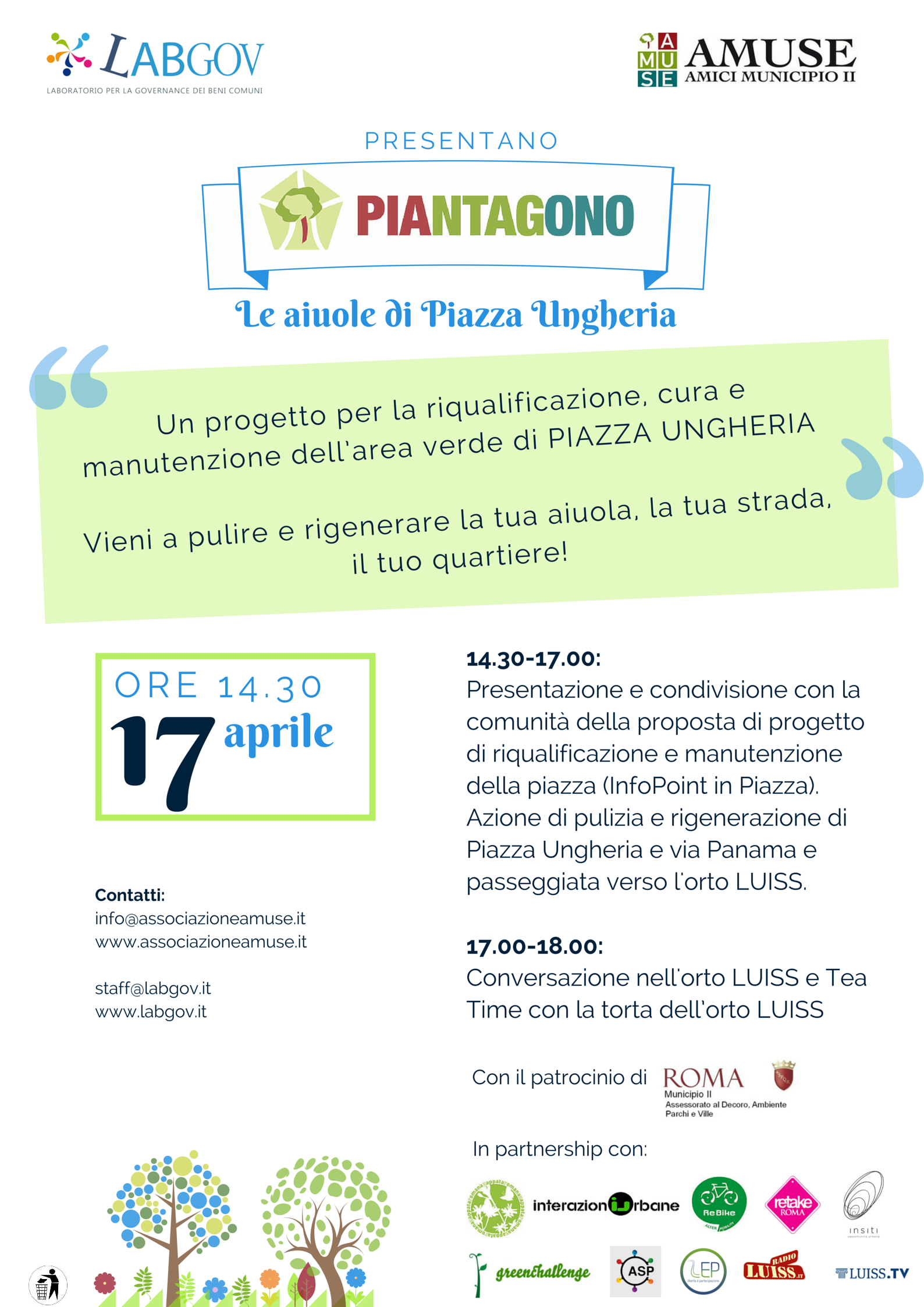
Next Friday, April the 17th, LabGov – LABoratory for the GOVernance of commons and AMUSE – Amici Municipio Secondo will collaborate to regenerate the central flowerbed of Piazza Ungheria, Rome.
The goal of the project is to raise awareness of sustainable development, the care and regeneration of urban green spaces and governance of the commons. The specific objective of the project is the rehabilitation, care and maintenance of the flowerbed of Piazza Ungheria and the creation of a network of collaboration among active citizens in urban green spaces.
Among all partners that will enjoy the event, there will be Zappata Romana; Interazioni urbane; Rebike ALTERmobility; Radio Luiss; Greenchallenge; Luiss TV; Luiss LEP; Retake Roma.
The event – that will begin at 2.30 PM in Piazza Ungheria, Rome – will be divided in two parts:
2.30 PM – 5.00 PM: regenerating action
5.00 PM – 6.00 PM: Tea Time in LUISS Community Garden
For more details, please refer to the flyers below:


by Edoardo De Stefani | Feb 14, 2015 | The Urban Media Lab
 On the 18th of February there will be an interesting meeting at the Casa della Città in Rome, entitled “Il mercato al centro” (The market at the centre) and organized within the activities of the TUTUR project. The meeting aims at searching and questioning what will be the role of the market in the urban regeneration of the neighborhood. It will be present local and Dutch experts, such as Francesca Miazzo, Pinar Balat and Paul Alexander de Graaf. LabGov is partner of the project and it will partecipate at the meeting for contributing at the debate on urban regeneration bringing the experience of Bologna, Mantova and Rome. Prof. Christian Iaione, Coordinator of LabGov will partecipate in the roundtable together experts and local public officers.
TUTUR – Temporary use as a tool for urban regeneration – is a planning tool developed to bring together a wide number of stakeholders for advancing projects of urban regeneration. In particular, the potential uses of existing resources and infrastructures are developed with a specific regard to the revitalization of neighborhoods. As happened for the temporary use requalification of the area placed under the “Viaduct of the Presidents” in Rome, TUTUR aims at facilitating and promoting the reactivation of unused public assets.
In line with this philosophy, the project of Viale Adriatico Market was born with the objective of reanimating the urban network, from the perspective of environmental quality and services to citizens.
The Urban Transformation Assesorate of the City of Rome is the Leading Partner of the project, given the great importance of urban regeneration for the future development strategy of the city. For this reason, on 2 February 2015 there were presented several projects for the regeneration of the “Viale Adriatico Market”, developed by the students of the UARK Rome centre and with the support of TUTUR.
There are in fact a wide range of public owned spaces that need to be placed in a renovated planning scheme, in order to serve the demands and opportunities of that specific physical capital.
Thanks to the support of the residents of the area and of experts and professionals like those from LabGov and Farmingthecity, it was possible to open a panel discussion for identifying the best ideas for the Viale Adriatico Market.
The input received will serve as a basis to operationalize the intervention on the market that will take place on 20-22 March 2015.
For further info visit the link
Forthcoming event at:link
_________________________________
Il 2 Febbraio sono stati presentati a Roma i progetti per il rilancio del mercato di Viale Adriatico sviluppati dagli studenti americani del UARK Rome centre con il gruppo di supporto locale del progetto TUTUR, alla presenza di esperti locali ed internazionali di rigenerazione urbana, tra i quali LabGov e Farmingthecity.
Grazie al supporto delle idee sviluppate dallo UARK Roma Centre, TUTUR mira a ricostruire l’esperienza del “mercato al centro” con l’obiettivo di implementare una strategia di rigenerazione di spazi pubblici mal utilizzati o sottosviluppati. E’ importante riuscire a ricostituire un utilizzo comunitario di beni pubblici, data la crescente necessità di confrontarsi con le sfide di rivitalizzazione dei quartieri.
Gli input ricevuti durante l’incontro sono altresì preziosi per confrontarsi nuovamente sul progetto di rinnovamento.
Per seguire i prossimi eventi o per ulteriori informazioni => link


