by Francesca Spigarolo | Mar 30, 2017 | The Urban Media Lab
On Friday the 31st of March 2017, the city of Turin will host an event to launch the project Co-City, developed by ANCI, the City of Turin, Turin University, FirstLife and Rete delle case di Quartiere.
The Co-City project, developed within the framework of the European program Urban Innovative Action (UIA), aims at experimenting innovative solutions to regenerate abandoned spaces or/and structures and to fight urban poverty in the most problematic areas of the city. The city will favor the creation of collaboration pacts between different urban actors, and it will stimulate a dialogue at the city level but also at national and European level with universities, innovators, private actors, institutions and members of the civil society.
The launch of the project will be an occasion to present the actions that will be developed in the city, and also to discuss the state of the art of the commons at national and international level. Numerous actors engaged in the field of urban regeneration and innovation will take part to the debate, enriching the discussion with examples coming from Athens (SynAthina), Amsterdam (Pakhuis De Zwjiger), Barcelona (project UIA), Lisbon (BipZip) Milan, Reggio Emilia and Bologna.
The event will begin at 10am, with the institutional greetings from the deputy major Guido Montanari and from the Turin University Dean Gianmaria Ajani, followed by the presentation and discussion of the experiences and studies of several experts. Then, the Co-City project itself will be presented, and afterwards some cities will share their own experience regarding the governance of urban commons. The speech of Marco Giusta, Assessor to the coordination of policies for multiculturalism and integration of the new citizens of Turin, will conclude the event. Afterwards the participants will be invited to take part in an Aperitivo, an occasion to continue the conversation in a more informal setting.
The event will certainly be an interesting occasion to discuss about urban commons and about their strategic role in shaping the future of our cities. More information on Co-City launch event are available here.
—————————————————————
Nella giornata di venerdì 31 Marzo, nella città di Torino presso l’ex Incet, si terrà l’evento di lancio del progetto Co-City, vincitore insieme ad altre 18 città del bando Urban Innovative Action (UIA).
Il progetto prevede l’utilizzo di patti di collaborazione come strumenti di rigenerazione urbana e lotta contro la povertà nelle aree più degradate della città.
Maggiori informazioni sull’evento sono disponibili a questo link.

by Francesca Spigarolo | Mar 9, 2017 | The Urban Media Lab
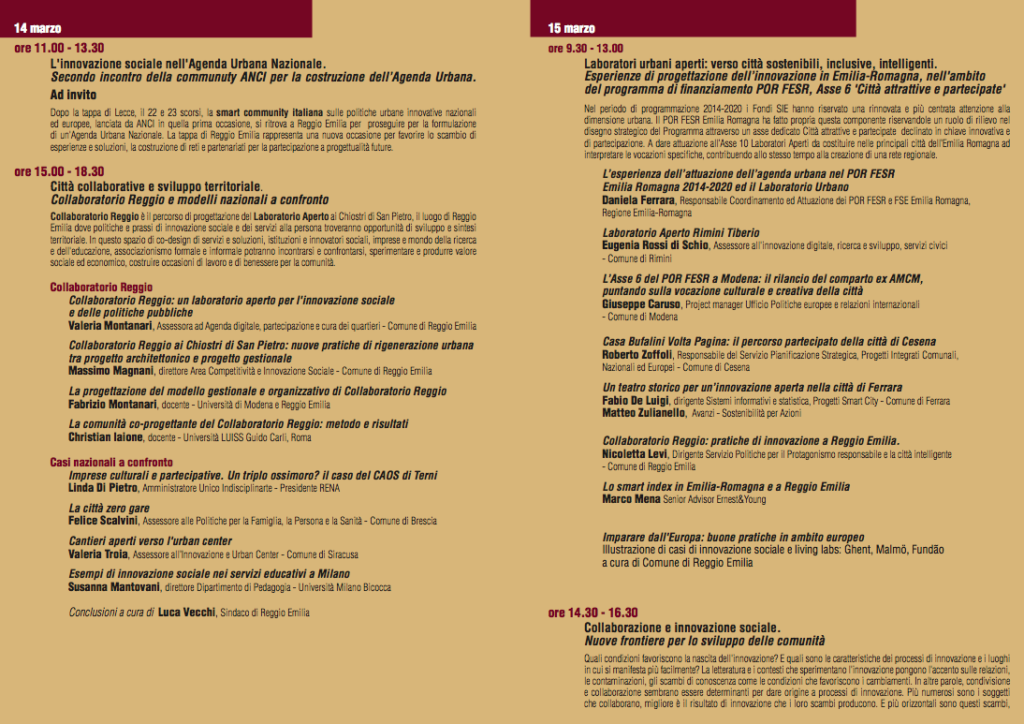
On Tuesday the 15th and Wednesday the 16th of March 2017, the city of Reggio Emilia will host the 2-days conference “Social innovation, commons, collaboration models. Cities and local communities development”.
The event will bring together experts, policy makers, social innovators and citizens, and will be a valuable occasion to reflect on the transformations that contemporary cities are undergoing and on the challenges they are facing. Furthermore, it will be a moment to discover and analyze the numerous practices and experimentations which are being developed by Italian cities, which are trying to provide an answer to the complex and overlapping issues experienced in the urban environment. Cities are being transformed thanks to social, economic and cultural initiatives, which are activated by a variety of urban actors, from institutions to private actors, universities and members of the civil society (associations and citizens). These actors are collaborating and finding new ways to work together in different sectors of urban policies, creating in this way a community of urban innovators.
During the conference, taking as a starting point the experiences of Collaboratorio Reggio and QUA (Quartiere bene comune), activated by the Administration of Reggio Emilia, different topics connected to social innovation, collaboration and urban development will be discussed.

The conference will begin on the 14th of March at 11am with a discussion about the role of social innovation in the national Urban Agenda, which is being promoted by ANCI.
In the afternoon of the same day the discussion will turn to analyze the topic of “collaborative cities and local development” and the experience of Collaboratorio Reggio (a co-design path through which the identity and functions of a new urban actor, the Open Laboratory, were collectively imagined – more information on the path are available here) will be compared and connected to experiences developed all over the country.
The Collaboratorio Reggio path will be illustrated and analyzed thanks to the contribution of Valeria Montanari (Council Member for Digital Agenda, Participation and Care of the Neighborhoods), Massimo Magnani (Director of the Competitiveness and Social Innovation Area), Fabrizio Montanari ( Professor at the University of Modena and Reggio Emilia) and Christian Iaione (LabGov coordinator and Public Law Professor at UNI Marconi and LUISS Guido Carli University in Rome). Other experiences developed in different parts of the country will also be presented: from the case of CAOS in Terni, to that of “La città zero gare” in Brescia, from the development of the Urban Center of Siracusa to the social innovation experimentations activated in the field of education in Milan.
The morning of the second day will be dedicated to the topic of Open Urban Laboratories, which are being financed by the POR FESR Emilia Romagna with the aim of fostering innovation and participation as key components of a transformation process aiming at the creation of sustainable, smart and inclusive cities.
Afterwards, through a roundtable which will see the participation of, among the others, both Christian Iaione and Sheila Foster (LabGov co-founders), it will be possible to analyze the fundamental role of collaboration and social innovation in cities and community development, and in the improvement of citizens’ life.
The complete program of the event is available at the end of this article (in Italian).
———————————————————————————
Martedì 14 e mercoledì 15 marzo 2017, presso il Centro Internazionale Loris Malaguzzi di Reggio Emilia si terrà il convegno “Innovazione sociale, beni comuni, modelli di collaborazione. La città e lo sviluppo delle comunità locali”.
Le pressioni che i sistemi urbani subiscono in ragione dei processi di mutamento demografico, climatico, economico impongono alle città di dare risposta a sfide vecchie e nuove. Le città italiane non si sono fatte trovare impreparate, e hanno messo in campo una pluralità di pratiche e sperimentazioni all’insegna della collaborazione e riguardanti i diversi settori delle politiche urbane, attivando così una community dell’innovazione urbana.
Al protagonismo delle istituzioni si è accompagnato un crescente protagonismo delle comunità nella tutela dei beni comuni urbani. Le città sempre più si vanno trasformando grazie a iniziative sociali, economiche, culturali che nascono e sopravvivono tramite l’attivazione di nuove reti e relazioni. A partire dai progetti Collaboratorio Reggio e QUA – Quartiere bene comune, realizzati dal Comune di Reggio Emilia, parleremo con esperti della sfida dell’Agenda Urbana legata ai temi dell’innovazione.
Ecco il programma dell’evento, disponibile anche qui.

by Francesca Spigarolo | Feb 17, 2017 | The Urban Media Lab
Verge NYC – Invisibility, a 2.5-day design event organized by students at Parsons School of Design, will take place from the 22nd to the 24th of February 2017.

This year the event will focus on the theme of invisibility, with the idea of highlighting “Invisibility as an opportunity for new strategies to impact our societies” and using “design and trans-disciplinary collaboration as acts of seeing, revealing, and creating new perceptions which investigate invisibility”.
Through panel discussions and conversations the theme of invisibility and of restoring visibility to the unseen will be observed in relation to different issues, ranging from urban regeneration to migration, from inequalities and inclusion to civic engagement, with the aim of confronting complex and transdisciplinary questions such as: “How might we continue to reveal intangible aspects of society and human behaviors? How can we restore visibility to the unseen, unheard communities disenfranchised/displaced by power and politics? In the face of unprecedented social issues emerging from the ongoing refugee crisis how do we highlight contradictions of different inclusion strategies? What aspects are better left invisible?”.
LabGov’s co-founders, Sheila Foster (Fordham University) and Christian Iaione (Luiss University and UniMarconi) will be present at the event, which will bring together leading thinkers, field experts and change-makers with the aim of investigating the invisibility theme. In particular, on Thursday the 23rd from 12.15 to 1.15PM Professor Foster will moderate a panel discussion on “The in/visibility of the urban commons”, which will see the participation of Professor Iaione together with Paola Canavò (Associate Professor of Urban Design at University of Calabria) and Francesco Rossi (Deputy Governor for Urban Planning, Housing, Transport, Calabria Region).
Furthermore, Professor Foster and Iaione will take part in the two-days conversation on “Invisibility in urban commons – envisioning and reclaiming spaces” that will take place in the afternoon of the 23rd and 24th. The conversation, which will be leaded by Cynthia Warner & Lissa Fedrizzi from the University Transdisciplinary Lab, will also involve Eduardo Staszowski, Director at Parsons DESIS Lab. The conversation will stimulate a reflection on the possibility of adopting the “urban commons” framework as a way to create “new social arrangements that enable sharing of (not always visible) spaces, resources, and information among urban denizens, to meet their needs”. The potential of the urban commons and the possible obstacles to their growth will be analyzed through the lenses of un/reclaiming spaces, dynamic and inclusive governance, and alternative economies. Furthermore, the “urban commons” framework will be considered as a possible arrangement to apply in the specific urban case study of the 14th Street in Manhattan, which will be closed to private transit during upcoming repairs to the subway line, offering the opportunity to imagine totally new uses, relationships, and interactions for the street landscape.
The program of the event is available on the website (where it is possible to find the panels and conversations complete list).


by Benedetta Gillio | Jan 11, 2017 | EducationLabs, Luiss LabGov 2016-2017, Storytelling 2016-2017
On Friday 11th November 2016, labgovers met Professor Paola Santoro during the third session of co-working. The session started with the report concerning the on-the-spot- investigations made by the students on the 8th and 10th of November at the archaeological park of Centocelle and its surroundings. Their impressions and considerations were different, but the students agreed on the fact that there is a clear feeling of uneasiness and resignation regarding the Park and its neighbourhood. Following this report made by the students, Paola Santoro taught them how to use the Value Proposition Canvas, a tool extremely useful in the field of facilitation of common goods. The tasks for the students were the following: targeting the needs, the fears, the wants and the substitutes connected to the park, and placing them inside the model. Despite the difficulties found in the choice of the best category to fit each concept, the results have been quite similar across the different groups. The session concluded focusing on the activities of the following day, which would have been devoted to find solutions for the many problems of the area.
The morning debate, guided by Eloisa Susanna, started with the presentation of the Co-Roma platform and the analysis of the related questionnaire, lately used by the participants. After this analysis it was time to map some commons and the participants, after identifying the Tevere’s graffiti, are split in six groups and start the mapping, which makes them able to identify 18 more commons, to be analyzed and approved later. The last half an hour is then used to talk about what labgovers have seen and found during the on-the-spot investigations.
The mobility group is the first to start, stating that the car sharing services are not available in Centocelle, that is in a state of abandonment, that an orientating system is missing and that the accessibility to the park is problematic for disabled people; the services group puts the accent on the dissatisfaction of the people, wondering if that could be blamed for the lack of investments.
The afternoon debate is guided by Paola Santoro who introduced the concept of ‘Minimum Viable Product’, and the mobility group confirms the points listed above (accessibility from all neighbourhoods, accessibility for disabled people, orientating system to cross the park, grant public transports’ efficiency, map the park, park in safe spots, widen car sharing services) ranked by importance, from the more to the less important, and the same procedure is applied to the fears felt by the park’s users (being victim of an assault or theft, to be lost, stray animals, darkness) and to the services to be realized, and the wants( services inside the park, parking lots, underpass, directions, knowledge of the park). The remarks of the mobility group are taken as an example by the other groups in the analysis of the classification of needs, fears and wants.
The meeting closes with the exposition of the work made during the day, and each group is able to provide some solutions aimed at resolving the problems of the park.
The first to talk is the services group, which identify three main concepts: the organization of turns for the monitoring, communication and diffusion of information, organization of cultural events. After them, the group resources stress, as a first solution, the importance of the presence of benches inside the park. They also suggest to increment the accessibility of the park and its surveillance. The group mobility focuses on the accessibility to the park: their solutions are mainly the creation of entrances and structures suitable also for disabled people. Finally, the criticity group stress the importance of developing a sense of belonging to the park for the citizens.
Venerdì 11 Novembre 2016, i giovani labgovers hanno partecipato alla terza sessione di co-working sotto la guida della professoressa Paola Santoro. La sessione è iniziata con il resoconto degli studenti sui sopralluoghi effettuati presso il Parco archeologico di Centocelle e i suoi dintorni effettuati in data 8 e 10 novembre. Gli studenti, avendo potuto osservare la situazione e parlare con gli abitanti della zona, hanno potuto percepire un generale clima di disagio e rassegnazione nei confronti del parco stesso. A seguito del resoconto, Paola Santoro ha illustrato ai ragazzi come utilizzare il Value Proposition Canvas, uno strumento molto utile per la facilitazione dei beni comuni. Il compito successivo, infatti, è stato individuare i bisogni, le paure, i desideri e i substitutes connessi al parco, e posizionarli all’interno del modello fornito. Nonostante le difficoltà incontrate nell’individuare la categoria migliore in cui inserire le numerose idee, i risultati emersi si sono rivelati abbastanza simili in tutti i gruppi presenti. L’incontro si è concluso anticipando che il giorno seguente gli studenti si sarebbero concentrati sulle soluzioni ai problemi individuati.
La giornata del 12 Novembre 2016 ha avuto come ordine del giorno la mappatura digitale.
La discussione della mattina, guidata da Eloisa Susanna, è iniziata con la presentazione della piattaforma Co-Roma e con l’analisi del questionario ad essa allegato, che è stato poi utilizzato dai ragazzi. Dopo questa analisi si è passati alla mappatura di alcuni beni comuni ed i ragazzi, dopo aver identificato i graffiti sul Tevere, sono stati divisi in sei gruppi ed hanno iniziato la mappatura vera e propria, grazie alla quale sono stati inseriti altri 18 beni comuni, in seguito analizzati e approvati. L’ultima mezz’ora è stata quindi utilizzata per restituire quanto visto e riscontrato durante i sopralluoghi.
Ad iniziare è stato il gruppo mobilità che ha riscontrato che i servizi di car sharing non arrivano fino a Centocelle, che la mobilità è lenta e difficoltosa e che manca un sistema per orientarsi e che l’accessibilità al parco è difficoltosa per le persone diversamente abili; in seguito, il gruppo servizi ha evidenziato come il punto più interessante sia l’insoddisfazione dei cittadini e si domanda se non sia questa la causa della mancanza di investimenti.
La discussione del pomeriggio è stata guidata invece da Paola Santoro che ha introdotto il concetto di Minimum Viable Product ed il gruppo mobilità ha ribadito i punti sopra elencati (accedere da tutti i quartieri, accessi per disabili, attraversare il parco, garantire efficienza mezzi pubblici, mappare parco, parcheggiare in sicurezza, estendere i servizi di car sharing)  che sono stati classificati in base alla loro importanza, dal più al meno importante, così come le paure provate dagli utenti del parco (subire aggressioni e furti, perdersi, animali randagi, buio) e i servizi che si vorrebbero offrire, wants, (servizi nel parco, parcheggi per tutti i mezzi (in/out), sottopassaggio, indicazioni agli utenti, tunnel, conoscere il parco).
Gli altri ragazzi, divisi nei quattro gruppi, hanno analizzato la classificazione dei bisogni, delle paure e dei wants.
La sessione si è conclusa con la restituzione del lavoro fatto durante il giorno, tramite il quale ogni gruppo è giunto all’identificazione di soluzioni destinate a migliorare il parco e la sua fruibilità da parte degli utenti.
Il primo a parlare è stato il gruppo servizi che ha individuato tre concetti fondamentali: organizzazione di turni per il monitoraggio sistematico/diffusione azioni di volontariato, comunicazione e diffusione delle informazioni, organizzazione di eventi culturali. In seguito è stato il turno del gruppo risorse, il quale ha sottolineato come prima soluzione la necessità di panchine all’interno del parco. Altre soluzioni proposte sono l’incremento del numero di accessi al parco e la vigilanza al suo interno.
Il gruppo mobilità si è concentrato sulla questione dell’accessibilità al parco, tramite l’abbattimento di barriere architettoniche e il coinvolgimento degli abitanti della zona al fine di aumentare l’affluenza e diminuire il tasso di criminalità. Infine, il gruppo criticità si è focalizzato sul piano psicologico, proponendo soluzioni mirate allo sviluppo di un senso di appartenenza nei residenti del Municipio V.
Written by Flavia Parisini

by Ieva Punyte | Jul 1, 2016 | The Urban Media Lab
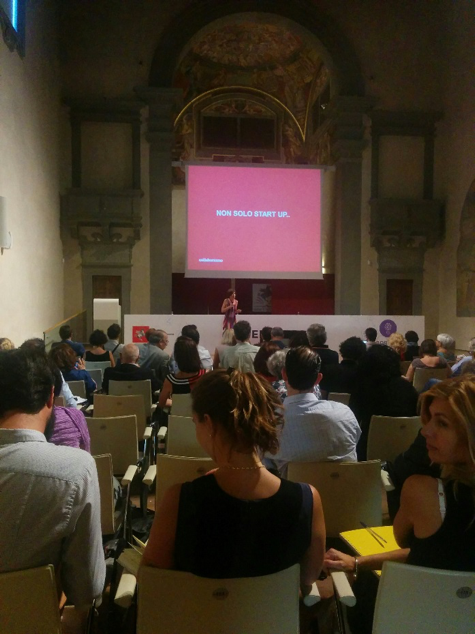
On June 29th 2016 academics, practitioners and active citizens gathered at the Auditorium of Saint Apollonia in via San Gallo 25 in Florence for the opening of #CollaboraToscana, the public policy co-design process led by Tuscany Region, supervised by LabGov and managed by SocioLab.
#CollaboraToscana projected to focus on collaboration and sharing economy aiming to co-create a map of regional public policies – a synergy and a proposal for targets, actions and measures which would be co-designed and deployed at different levels to maximize opportunities and minimize risks for the sharing economy and collaborative development of the region. Therefore, the objective of the conference and workshop series was to introduce diverse, yet interconnected approaches and tools for regional collaborative practices. By emphasizing on sustainability, inclusion and the themes of presentations varied from start-ups to infrastructure, territorial regeneration and security, and from participatory governance to digital innovation and communication – all being closely tied to collaboration and sharing economy.
The event was opened by the Deputy President of the Toscana Region Vittorio Bugli who after a warm welcome acknowledged the promising #CollaboraToscana initiative. V. Bugli stressed that in regards to the sharing economy, sustainability and collaborative management of the region the recognition of civic participation is crucial. The Deputy President thus emphasized that it is important to address migration while focusing on collaboration. “In Tuscany we are very attentive to the reception of migrants fleeing from their countries”- said Bugli. “But we have to think of a greater integration, these people can be an important vantage rather than obstacle in terms of collaboration”- after the conference stressed V. Bugli.
 The first keynote Marta Mainieri (Collaboriamo.org), focused on collaboration in terms of innovation and start-ups. M. Mainieri stressed that the new economy model – a collaborative economy – is important first of all because its volumes are rapidly growing. “Gross revenue in the EU from collaborative platform and providers was estimated to be 28 billion in 2015. Growth in recent years has been spectacular with revenues almost doubling from 2014 to 2015”- presented M. Mainieri. Yet, despite of the growing amount of the sharing economy practices, M. Mainieri emphasized the need to recognize the real value of collaboration, which is based on collective knowing, connection, co-planning and communication and therefore is projected to contribute to the construction of open, more inclusive systems that are based on trust and reciprocity, rather than exclusion.
 The second speaker, Massimo Alvisi (Alvisi-Kirimoto, Renzo Piano G124) focused on city requalification and regeneration. By illustrating his presentation with the experiences from Viadotto dei Presidenti in Rome, Via Fossata in Torino, and Librino in Catania, M. Alvisi emphasized that in terms of urban regeneration, collaboration has a great potential to contribute to social wellbeing, security as well as revitalization of deteriorated urban areas (more information related projects: http://renzopianog124.com).
 This was followed by the engaging Annibale D’Elia’s presentation. While addressing collaboration A. D’Elia, a consultant for innovation policies, touched upon topics of inclusion and citizens’ engagement. He stressed that collaboration in terms of governance is mainly about the unleashing the energy of the people, who should be enabled and facilitated in order to actively participate and collaborate. Furthermore, the last speaker Michele D’Alena, an expert in e-government processes and social innovation, supported Annibale’s comments by adding that digital means – the information communication technologies (ICT), are essential for sharing economy, collaboration as well as active citizens’ engagement.
The presentations were followed by Silvia Givone who represents Sociolab and works with #CollaboraToscana project. After thanking to all presenters S. Givone introduced the road map and the critical phases of #CollaboraToscana (more about #CollaboraToscana: http://open.toscana.it/).

The first part of the conference was followed by the debate between Antonella Galdi, the vice secretary of the National League of Italian Cities, Stefano Bartolini, a professor of political economy at the University Siena, Ernesto Belisario, an expert in law of technology and innovation in public administrations, and Marta Leonori, representing the department of Civil Service.
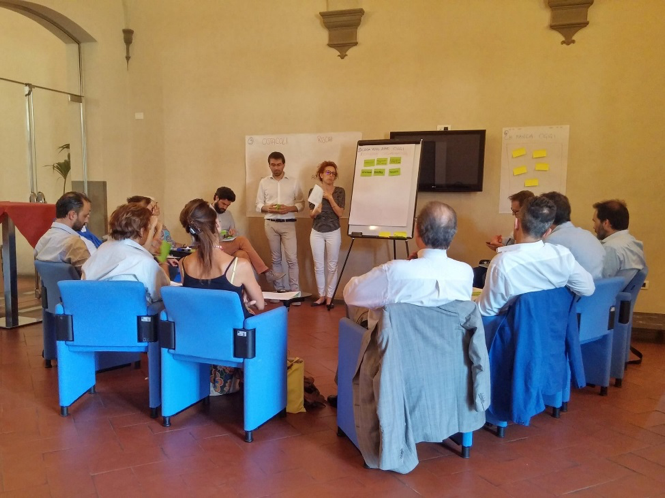
Lastly, the conference was finalized by the series of workshops on co-planning to co-create concepts of collaboration and sharing economy by mapping (meaning, opportunities and problems) activities. Participants were divided into 4 groups (representing public and private sectors, knowledge institutions, civic social organizations) and were asked to further reflect on prevalent issues (infrastructure, services, goods and governance) and to design possible tools for a regional policies on the economy of sharing and collaboration.


The event was moderated by Christian Iaione, LabGov co-director, who outlined the prevailing currents of collaboration and sharing economy and supported the presentations as well as panel debates by insightful comments.