
by Chiara De Angelis | Feb 21, 2018 | The Urban Media Lab
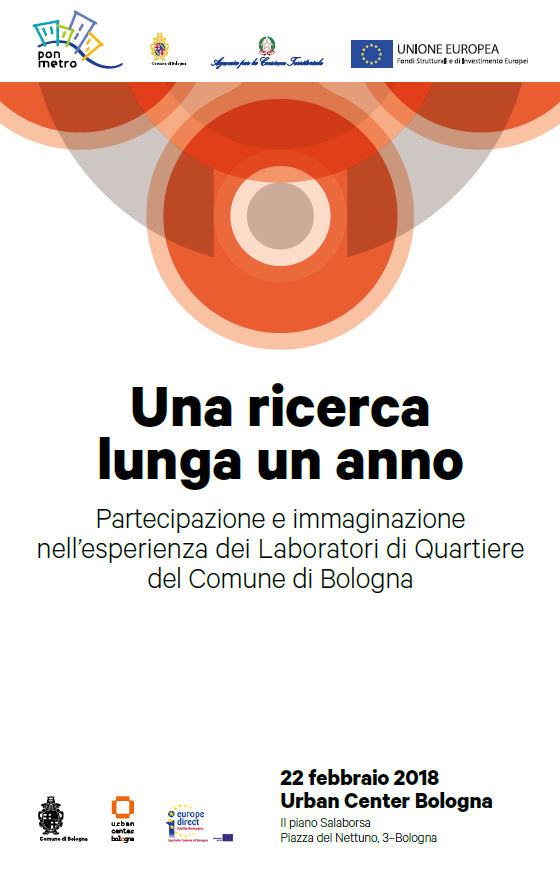
On Thursday, February 22nd, the Bologna Urban Center is going to host the seminary “A one-year-long research: participation and imagination in the experience of Bologna’s Disctrict Labs“, organized by Ces.co.com in collaboration with Bologna Urban Center and Bologna Municipality,
During the seminary experts, local administrators and academics will show the achieved results and will open a debate on social innovation, urban regeneration, participatory democracy and community entrepreneurship: an asset of themes that are crossing the bolognese experience through the hard work of Civic Imagination.
The seminary will end with a focus on the involvement of migrant citizens, with the aim of thinking about new methods of active citizenship.
The event will start with an institutional welcome from Matteo Lepore (Comune di Bologna) and Mirko degli Espositi (Bologna University).
The first session will be conducted by Roberta Paltrinieri (Ces.co.com, Università di Bologna) and will host contributions from Giovanni Allegretti (Università di Coimbra, Portogallo), Andrea Boeri (Università di Bologna), Christian Iaione (LUISS-LabGov’s co-founder), Vincenza Pellegrino (Università di Parma). Conclusions by Giovanni Ginocchini (Urban Center Bologna).
The second session will be introducted by Lucia Fresa (Comune di Bologna), will be conducted by Giulia Allegrini (Alma Mater Studiorum – Università di Bologna), Bernardo Venturi (Agenzia per il Peacebuiliding) and will host contributions by Pierluigi Musarò (Alma Mater Studiorum – Università di Bologna), Stefania Paolazzi (URBAN CENTER BOLOGNA). Conclusions by Dino Cocchianella (Comune di Bologna Iperbole Rete Civica)
The full program is available here: http://www.urbancenterbologna.it/42-urbancenter/1679-una-ricerca-lunga-un-anno-partecipazione-e-immaginazione-nell-esperienza-dei-laboratori-di-quartiere-del-comune-di-bologna
Giovedì 22 febbraio 2018 dalle ore 10.15 la sala Atelier dell’Urban Center di Bologna ospiterà il seminario “Una ricerca lunga un anno. Partecipazione e immaginazione nell’esperienza dei Laboratori di Quartiere del Comune di Bologna”

by Anna Berti Suman | Jan 22, 2018 | The Urban Media Lab
The idea of proactive citizen engagement in Science and Policy-Making has recently attracted the institutional interest at the European Union level. In particular, the Joint Research Centre of the European Commission has often dealt with the topic in recent years. Worth to be quoted is the JRC Science for Policy Report “Citizen Engagement in Science and Policy-Making” released in 2016 [1]. The report shows an open and welcoming approach from the Commission towards citizen-driven contributions to science and policy. The JRC explicitly affirms (JRC, 2016, 3) that citizen engagement in heavily ‘expert-based’ sectors can “boost in democratic legitimacy, accountability and transparent governance”. Furthermore, the JRC acknowledges the potential of citizen involvement for enhancing “trust building among citizens and institutions as well as ownership of policy outcome. The Centre recognizes a shift from the mere “info-giving” to increasingly participatory deliberation practices “at each stage of the policy-making process” (JRC, 2016, 3) and, even more relevant, a push from “asking the citizens” to “co-creating with citizens” (JRC, 2016, 32).
Apart from increasing legitimacy and trust, the JRC stresses the benefits for the EC’s strategic planning itself, by underlining that people’s inputs “can offer a unique understanding of societal concerns, desires and needs” and thus a better targeting of EC’s actions. Moreover, the value of this contribution is identified in the provision by citizens of “evidence for policy-making and evaluation of policy decisions” as well as “ideas for new policies or services.”
The JRC in its report (JRC, 2016, 4) identifies also the main challenges to a proper inclusion of inputs from laymen’s knowledge in science and policy. First, the Centre stresses how the “predominant paradigm for policy-making is based on expert inputs (evidence based) in detriment of non-expert or lay knowledge coming from other parts of society.” The advice from the JRC to the Commission seems encouraging for more participatory practice and for a reconsideration of the “usefulness and validity of non-traditional inputs coming from citizens, communities or other groups”.
However, data quality and reliability of the knowledge fed by the lay people when it comes to inclusive science and policy seems crucial, together with transparency and disclosure of possible conflicts of interests. The modalities for gathering laymen’s input should be clearly defined and integration strategies properly agreed. Lastly, the need to go “beyond usual suspects” (the tech-connected wealthy citizens) in this inclusive science and policy is underlined by the report. At p.9 of the document (JRC, 2016, 9) a series of practical examples of citizen engagement in EU’s policy and science are illustrated, such as the initiatives ‘MakingSense’, ‘MyGEOSS’ and ‘DigitalEarthLab’.
The call of the JRC for a “dialogue across co-existing worldviews and knowledge production spaces in science, society and policy” (JRC, 2016, 7) seems particularly timely in present times in which the need of a dialogue between top and bottom stakeholders seems increasingly urgent. Facing Science and Policy-Making challenges through an inclusive and open-minded approach would contribute to the establishment of this dialogue. In the end, both top and bottom players share common interests or, at least, can constructively face each other’s needs to reach together a compromise, towards the establishment of a shared interest. In cases of post-normal science problems, the achievement of this shared or common interest will be even harder. However, those problems are highly of public interest and demand for the inclusion of all the concerned stakeholders in their governance.
[1] Figueiredo Nascimento, S., Cuccillato, E., Schade, S., Guimarães Pereira, A. 2016. Citizen Engagement in Science and Policy-Making. EUR 28328 EN, doi: 10.2788/40563.
Il presente articolo illustra la crescente necessità di coinvolgere il cittadino nei processi politici e scientifici, come percepita dalle istituzioni a livello europeo. In particolare, l’articolo focalizza l’attenzione sulla prospettiva del Joint Research Center (JRC) dell’Unione Europea sul tema. Viene illustrata la posizione del JRC, il quale incoraggia la creazione di un dialogo condiviso nell’interazione tra scienza, società e politica. Tale appello sembra di particolare attualità oggigiorno, in considerazione della complessità dei problemi che la nostra società deve affrontare. In effetti, le sfide odierne spesso riguardano interessi comuni a più attori sociali, ed il compromesso tra loro, come anche il reciproco ascolto, sembrano gli unici mezzi per raggiungere una definizione di “interesse comune”.
by Giulia Ganugi | Dec 11, 2017 | The Urban Media Lab
In my previous post I presented the phenomenon of Social Street and different ways of these neighbourhood communities to interact with their urban local government. After its publication I had the chance to discuss about it with Luigi Nardacchione, administrator and member of the group Residenti in Via Fondazza – Bologna, and founder – together with Federico Bastiani – of the website Social Street Italia. Our conversation was useful for resuming what has been said about Social Street so far and to clarify once more what we are exactly talking about.

Luigi Nardacchione and Federico Bastiani, administrators of the group “Residenti in Via Fondazza – Bologna” and founders of the website Social Street Italia. Credits: Facebook group Residenti in Via Fondazza – Bologna.
At the question what Social Street is, this is the usual and immediate Luigi’s answer: Social Street is sociality. «The aim is to facilitate the relationships and the acquaintance of neighbours, to re-create the sense of sociality[1]». Sociality, therefore, is the most important goal to reach. All the initiatives, that every Social Street organizes – such as parties, walking tours, cooking laboratories, cleaning of the green public spaces, organisation of second hand markets, etc – have the single purpose to stimulate citizens in socialising. They represent a way, an “excuse”, to gather neighbours around common projects and interests. The will of maintaining members’ relations as first and main goal refers to the concept of «pure sociability[2]», considered the most authentic and transparent model of interaction. In this perspective, sociality becomes a value and a good in itself.
A higher attention towards the urban territory arises in Social Streets’ members as a consequence of the increase in sociability and in activities done together in the area of residence. Indeed, the fact that meetings and events are organized in the neighbourhood makes residents more aware of public spaces: «we feel the territory as our own house, we claim it and we take care of it». This dimension has been already underlined by some members of the group Residenti in Via Fondazza whom I interviewed three years ago. After the Social Street creation and after meeting the neighbours living in the street, they recognize the sidewalks, the arcades and the street in general as an extension of their home. This brings members of Social Streets to notice negative behaviours or lack of attention towards the urban territory and to act consequently: «In one year and a half, every Sunday we met to clean all the entrance doors, all the gates and all the walls facing the street. We do it just because we are glad to do it and because we like to meet on Sundays». The presence of residents committed to this activity give the chance to other neighbours, who initially did not participate in Social Street or who were sceptical about it, to appreciate its values and to socialize more. Besides triggering the sociality in the area, this behaviour produces a second mechanism, similar to the one described by the theory of broken windows[3]: many inhabitants of the street start to clean their own facades autonomously. «Instead than saying “it will be dirty again, why are you doing it?”, there is this virtuous mechanism, without getting angry. You do what you can without complaining».
What is fundamental, however, is that citizens’ care does not depend on the collaboration with the urban local government and it has not to be triggered in any case by the public administration’s request. «I claim the city because I live here, not because the municipality asks me to do so […] We can do everything without political and economic compromises. We want to show that this experiment [Social Street] is possible staying outside of the existing structures, because sociality is out of the system». Luigi mentions many examples of Social Streets that decided to establish a formal collaboration with the local government, both in Bologna and Milan, some of them also signing a collaboration pact[4]. In Bologna the most part of parks and green areas are managed and cured by citizens – individuals or associated in formal organizations. This citizens’ attitude is not wrong generally and Luigi is not against either citizens/committees engaged in this kind of activities or the public administration that opens up this possibility. He does not agree with it just when Social Streets give more values and importance to this aspect than to the generation of sociality. Moreover, since the subjects formally involved in the maintenance and cleaning of public spaces are already numerous, Social Street does not need to base its activity from the same starting point. The possibility to take care of the urban territory is positive – reporting Luigi’s words – and it is possible that neighbours who met thanks to Social Street, decide afterwards to engage in the management of a common good collectively. Nonetheless, it has to remain characteristic of an individual agency, not of a collective and informal subject such as the Social Street that aims, firstly, to include everyone in socialisation practices. Inclusion, indeed, is a variable that strongly matters when one Social Street has to decide whether collaborating with the Municipality. Signing a collaboration pact implies getting closer to the political party that is leading the city at that moment. Some members of the group might disagree with political decisions of this party and, thus, disagree with their Social Street’s decision as well: the result would be that these specific members get distant from the group, not feeling included and engaged anymore. In Milan, really few Social Street – 28 out of 76 – decided to enrol in the official register for informal associations[5] founded by the current municipality’s administration. According to Luigi, this happened because engaging in the research of solutions for collective problems or in the regeneration of urban spaces is not the first aim of Social Street. These aspects become important within Social Street framework only as vehicle of sociality.
Together with sociality, another solid idea emerging from Luigi’s words is that social initiatives do not need to be framed in the existing mainstream structure and political system to be innovative. They can bring innovation by being free, unformal and based on little, but always kept central, values: «Small revolutions are made on even smaller things, but these things have to be really clear».
L’articolo riassume il significato di Social Street, basato sul valore fondante della socialità. La cura verso gli spazi pubblici si sviluppa in un secondo momento e secondo Luigi Nardacchione, amministratore della prima Social Street e fondatore del sito Social Street Italia, questo non implica una collaborazione con la pubblica amministrazione. Anzi, l’intento originale è quello di non entrare nel sistema politico ed economico già esistente, ma dimostrare che le innovazioni possono svilupparsi anche da piccole iniziative, libere e indipendenti.
[1] All quotations refer to the conversation that I had with Luigi Nardacchione on 16/11/2017.
[2] Simmel G., 1997, La socievolezza, Roma: Armando.
[3] Kelling G. L., Wilson J. Q., 1982, Broken Windows: The police and neighbourhood safety, Atlantic Monthly, pp. 29-38.
[4] Regulation on civic collaboration for the urban commons.
[5] Avviso pubblico Social Street, politiche sociali, Comune di Milano

by Anna Berti Suman | Dec 4, 2017 | The Urban Media Lab
Nowadays, we are experiencing a sharp and progressive decrease of oil and gas prices.[i] Nevertheless, irresponsible and only profit-driven extractive activities continue to expand and to impose their toxic footprint on the environment and the society. The extent to which these practices conflict with the sustainability goals stated at the international level is significant. Furthermore, initiatives from state authorities and international organizations often disregard local impacts on marginalized communities, which are frequently the most exposed to extractive exploitation. From the imperative of involving communities in making companies accountable for their bad practices, arose the idea of applying advanced technologies for enabling communities to detect environmental hazards, and safely spread alerts. [ii]
When discussing bottom-up monitoring, the case of Indigenous communities living in rural and remote areas must be made. These communities indeed are particularly threatened[iii] by expanding hydrocarbon and mining industries. In this context, environmental liabilities generated by extraction practices continue to create adverse environmental and public health impacts. As a response to this challenge, a series of ongoing initiatives have been launched by Digital Democracy, an US-based organization working at the intersection of human rights and technology with marginalized communities around the world.
It seems particularly worth of attention the approach that the organization adopted, as based on three steps. First, in the ‘Direct Implementation’ stage, the community training aimed at capacity building is carried out. Subsequently, the ‘Tool Building’ stage intervenes with the aim of co-creating technological solutions in response to community’s needs. All the tools created are made available under open-source format, and are suitable for use by other interested communities. Finally, in the ‘Local-to-Global Engagement’ the local initiative is scaled up by its presentation to the broader world community, through e.g. events, workshops, and tool-kits.
Particularly timely to exemplify community-driven solutions using technology[iv] is one of the Digital Democracy’s project implemented in the Ecuadorean Amazon Rainforest. The project analysed was aimed at combining drones’ monitoring of oil spills with a mobile reporting platform to allow Indigenous communities to safely report oil contamination alerts. Sparks for further research include the need to explore the level of people’s engagement, their acceptance and trust in the process, and the goals fulfilled by the people engaged in the intiative. In addition, the legal risks and criticisms hidden in the monitoring system should be evaluated, and possible ways to neutralize them inspected.
An analysis of this case suggests that community-based early-warning systems aimed at monitoring environmental liabilities could encourage the state and corporate actors to intervene more promptly and effectively to mitigate socio-environmental impacts of environmental hazards. Pushing this analysis further, one can affirm that technology brings the potential of achieving a transformative change by giving voice to those communities who are often silent victims. As Digital Democracy uses to proclaim, “empowerment from within, rather than involvement from outside actors” is the key. Ultimately, it seems worth to reflect on the potential that such projects have in creating bridges between remote communities and the outside world, enabling them to spread denounces and awareness on environmental liabilities. Yet it must be stressed that change does not come from the technology per se, but from how people use it. Therefore, a human-centred and ethical approach result in being crucial for making such monitoring technologies in the hands of Indigenous communities a positive, responsible and sustainable innovation.

Community Monitoring, from Digital Democracy
Il presente articolo discute una serie di iniziative vertenti intorno all’uso da parte di comunità indigene di strumenti di monitoraggio remoto, al fine di tracciare rischi derivanti da attività estrattive. L’attenzione si focalizza sulle comunità abitanti zone remote, spesso lontane dagli occhi dell’opinione pubblica. Tali popolazioni sono spesso le più esposte al rischio di abusi corporativi. In riposta all’esigenza di fronteggiare tali pericoli, un’organizzazione statunitense, Digital Democracy, ha deciso di affidare droni in mano a comunità interessate al fine di tracciare in maniera sicura cattive pratiche legate all’estrazione di idrocarburi. Un’iniziativa in particolare, realizzata nell’Amazzonia Ecuadoriana, viene discussa nell’articolo. In conclusione, si sviluppa una riflessione sul potenziale, ma anche le sfide, di simili iniziative volte alla co-creazione di soluzioni tecnologiche in risposta a rischi socio-ambientali.
[i] H. Halland et al., “The Extractive Industries Sector”, International Bank for Reconstruction and Development, The World Bank, 2015 (ISBN 978-1-4648-0492-2).
[ii] F. Danielsen et al., “Environmental monitoring: the scale and speed of implementation varies according to the degree of peoples involvement”, Journal of Applied Ecology, 2010.
[iii] E. Skinnider, “Effect, Issues and Challenges for Victims of Crimes that have a Significant Impact on the Environment”, International Centre for Criminal Law Reform and Criminal Justice Police, Vancouver, March 2013.
[iv] A. Kumar Pratihast et al., “Application of mobile devices for community based forest monitoring”, Sensing a Changing World, 2012. http://www.geo-informatie.nl/workshops/scw2/papers/Pratihastetal.pdf
by Chiara De Angelis | Nov 15, 2017 | The Urban Media Lab
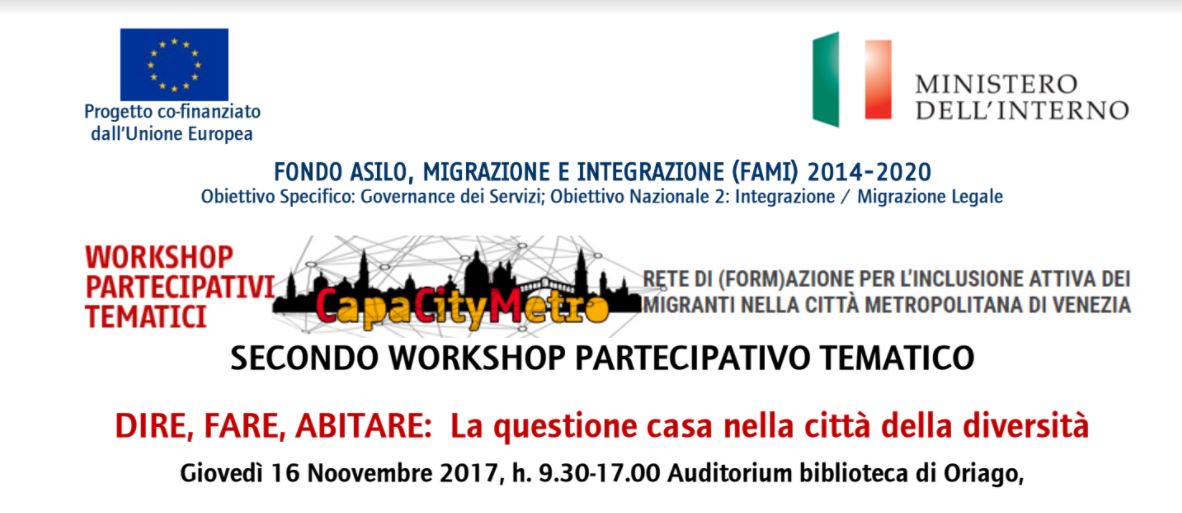
On November 16th, the Second edition of the thematic partecipatory workshop “DIRE, FARE, ABITARE: La questione casa nella città della diversità” will be held at Auditorium Biblioteca di Oriago, Via Venezia n. 171/172, Oriago di Mira (Venice), from 9.30 a.m.
With the participation of experienced teachers and those who have experimented innovative solutions for access to affordable housing, one of the most vulnerable sections of the population, the workshop will address many issues related to housing emergencies: from housing to legal instruments to tackle current issues, to solutions tried and tested practices.
In this regard, Professor Christian Iaione will discuss about innovative legal instruments.
Then, from 1.00 p.m., groups of people will work pursuant to “world cafe” method, in order to deepen practical proposals and capture the elements that will allow operators to transfer them, replicate them, draw inspiration.
Finally, the European expert Lorenzo Liguoro will pull the lines of work by giving some indication of possible fundraising channels.
The programme of the workshop can be found here.
Giovedì 16 Novembre si terrà la Seconda edizione del Workshop tematico partecipativo “DIRE, FARE, ABITARE: La questione casa nella città della diversità”, presso l’Auditorium Biblioteca di Oriago, Via Venezia n. 171/172, Oriago di Mira (Venezia), a partire dalle 9.30.


