by Chiara Fratalia | Jul 21, 2016 | Commons Press
Longtime LabGov member Elena de Nictolis and environmental law expert Chiara Prevete wrote an article on the agendadigitale.eu “Open Government Forum” section. The article describes the modus operandi adopted by LabGov in fostering the trasformation of our cities in co-cities with a collaborative governance.
The “Co-City” action carried on by LabGov promotes collaboration as a technology using “incentive prizes, crowdsourcing, and citizen science to advance national priorities, collaborating with civil societies including companies, universities, foundations, non-profits, and the public”. This action also includes a methodology to develop a collaborative government structure, which enables various kinds of collective action: not only the voluntary, individual ones, neither that of associations, but also those originated by solidarity and by the shared management of services of common interest.
The final aim of this action is to transform the cities into “co-cities“, that is collaborative cities, by means of the implementation of the governance of the commons design principles, outlined by the Nobel Prize Elinor Ostrom. This strategy aims at creating a quintuple helix institutional structure (an approach recognized by EU’s new Urban Agenda). This structure stimulates public-private partnerships, by involving five types of actors: civic (social innovators and active citizens), social (third sector organizations), cognitive (cultural institutions, schools and universities), public (public institutions) and private (local enterprises and industries).
The methodological protocol is a key-element of this strategy, and it is divided into five steps:
- constitution of a civic collaboration unit, formed by experts in different subjects, to interact with the PA and support the whole process;
- social innovation mapping, by involving citizens and exploring the territory;
- co-design paths, to coordinate the projects found in the previous step between them and with the city;
- definition of polycentric and collaborative governance tools, tailored to the specific situation;
- monitoring and evaluation of those governance tools.
As examples of this strategy and its adaptation to various local conditions, please visit www.co-roma.it, www.co-bologna.it, www.co-battipaglia.it, www.co-mantova.it.
If you are interested in this subject, please explore the full article here.
__________________________________
Elena de Nictolis e Chiara Prevete, in un articolo pubblicato su agendadigitale.eu, hanno esposto i principi e il modus operandi che guidano l’azione Co-città portata avanti da LabGov negli ultimi anni. Quest’azione mira a trasformare le nostre città in città collaborative, basate sulla gestione cooperativa dei beni comuni urbani, risultante dall’interazione efficiente e costante tra i cinque attori chiave della società (modello a quintupla elica). Questa strategia si avvale inoltre di un protocollo metodologico volto a elaborare e applicare strumenti di governance policentrica fatti su misura per il contesto in cui si troveranno a operare.

by Chiara De Angelis | Jul 3, 2016 | The Urban Media Lab
In June something interesting happened in Centocelle: LabGov organized two workshops with the local residents, with the aim of starting a collaborative process for taking care of the beautiful archeological park of Centocelle. The workshops were organized within the Co-Roma project, where LabGov is acting as a catalyst in the process of building collaborative practices for taking care of urban commons.
The first workshop took place on the 9th of June. The whole time was dedicated to the reciprocal knowledge in relation to the park. But what does it mean?

The participants were invited to write down on post-its several things: first the values they associate to the park, then their competences. By clustering the post-its, our service designer Paola Santoro helped them summarizing their knowledges and their needs too. This activity showed that the participants are animated by those values: beauty, participation, education, love for culture and sport, respect and legality.
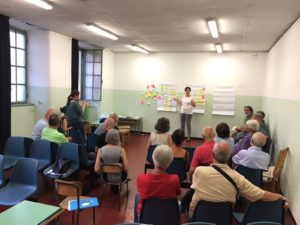 The second workshop took place on the 22nd of June. This time the laboratory focused on actions: the participants were invited to think about – and to write down on post-its, of course – the actions they daily do in the park, the obstacles they run into trying to perform those actions, and the opportunities deriving from them. After the identification of actions, obstacles and opportunity, Paola and the participants of the workshop negotiated the priorities od those things they thought to.
The negotiation has been the very first moment of collaboration and shared decision! It has been a start point for a collaborative process focused on common objectives.

The third workshop will took place on the 4th July, at 5 PM in Villa de Sanctis, Centocelle. It will be the last appointment before the summer break. The laboratory will then restart in September, but the work on field will never stop!
Nell’ambito del progetto Co-Roma, LabGov ha organizzato, nel mese di giugno, due workshop nel quartiere di Centocelle, finalizzati alla costruzione di un percorso di collaborazione per la riqualificazione del parco archeologico del quartiere. I partecipanti dei workshop, grazie alla mediazione della nostra service designer Paola Santoro, hanno avuto modo di conoscersi, di dare linee guida valoriali al processo, e di individuare azioni opportunità e rischi legati alla fruibilità del parco. Il prossimo appuntamento, l’ultimo prima della pausa estiva, sarà il 4 luglio alle 17.00 presso Villa de Sanctis.
by Chiara Fratalia | Jun 30, 2016 | Commons Press
This article is a focus on the figure of LabGov’s coordinator, professor Christian Iaione.
Christian Iaione is associate professor of public law at Guglielmo Marconi University of Rome, fellow of the Urban Law Center at Fordham University, and visiting professor of governance of the commons at LUISS Guido Carli. He is an expert of the EU Committee of the Regions and he is member of the Sharing Economy International Advisory Board of the Seoul Metropolitan Government.
Prof. Iaione has published several articles in the field of public and administrative law and, in particular, land use, public goods and the commons, public services and public contracts, urban law and local government. He has authored two books on In house publicly-owned companies. Contribution to the principle of self-organization and self-production of local governments (Jovene, 2007 – 2012, II ed.) and The regulation of urban mobility (Jovene, 2008) and has co-authored Italy of the Commons (Carocci, 2012) and The Age of Sharing (Carocci, 2015).
Here is an anthology of his publications:
Books:
- L’Italia dei beni comuni (with G.Arena), Carrocci, Rome, (2012).
- L’età della condivisione (with G.Arena) Carrocci, Rome (2015).
Recent Publications:
- La città collaborativa: la governance dei beni comuni per l’urbanistica collaborata e collaborativa, published in Agenda RE-CYCLE, Proposte per reinventare la città (Il Mulino, 2017). Available soon.
- The City as a Commons (Yale Law and Policy Review, 2016), together with Sheila R. Foster. “City space is highly contested space. As rapid urbanization takes hold around much of the world, contestations over city space – how that space is used and for whose benefit – are at the heart of many urban movements and policy debates”. Full article here.
- Lo Stato – Piattaforma di immaginazione civica, la politica e le istituzioni nel secolo del CO-, published in 25 anni di riforme della PA: troppe norme, pochi traguardi, 39 (Forum PA, Annual Report 2016). An analysis of how the State should begin to function as a Platform and of how institutions and policies should evolve in the “CO-” age – a period in which the key words seem to be community, collaboration, cooperation, communication, commons, co-design, co-production, co-management, co-housing, co-design, sharing, knowledge, etc. Full article here.
- La quintupla elica come approccio alla governance dell’innovazione sociale, published in I luoghi dell’innovazione aperta, modelli di sviluppo territoriale e inclusione sociale, 74 (Quaderni, Fondazione G.Brodolini, Studi e Ricerche, November 2016). In this paper it is stated that the “Collaborative City” (CO-City) urban co-governance framework, based on the three levels of sharing, pooling and poly-centrism, can facilitate collaborative and open knowledge production and social innovation processes within the city. Furthermore, the CO-City approach further elaborates on the triple helix governance model and develops a more complex and precise version, defined as quintuple helix model, which identifies the five actors of the polycentric governance. Full article here.
- Poolism: sharing economy vs. pooling economy (LabGov website, 2015). Sharing economy builds on new or revived social patterns having important business, legal and institutional implications: the social practices of sharing and collaboration. They both build on the well known social practice of co-operation.
Full article here.
- The Co-City (American Journal of Economics and Sociology, 2015).
This paper introduces an innovative, experimental, adaptive, and iterative approach to creating legal and institutional frameworks based on urban polycentric governance to foster collaborative urban planning. Full article here.
- The Collaborative and Polycentric Governance of the Urban and Local Commons (Urban Pamphleteer #5, 2015), together with Paola Cannavò. “Institutions, designed in a historical era in which the government handed out basic services to citizens, are nowadays required to design new types of services in collaboration with citizens. In order to define better forms of urban and local governance, it’s necessary to study and elaborate a new paradigm, to find new theories, policies and development models”. Full article here.
- Governing the Urban Commons (Italian Journal of Public Law, 2015).
The purpose of this paper is to investigate a fundamental question relating to institutional design in the public sector. After two centuries of Leviathan-like public institutions or Welfare State, do we still need full delegation of every public responsibility and/or exclusive monopoly of the power to manage public affairs? Full article here.
- La collaborazione civica per l’amministrazione, la governance e l’economia dei beni comuni (L’età della condivisione, 2015).
“In Italia i beni comuni sono ormai entrati nel lessico quotidiano. Il rischio è che «beni comuni» diventi un’espressione di senso comune, ma priva di effettivo valore semantico e, soprattutto, di rigore scientifico: casella vuota che chiunque si senta legittimato a riempire con qualunque significato”. Full article here.
- Città e Beni Comuni (L’Italia dei Beni Comuni, 2012).
“Dove va una persona se vive in una città, non ha la fortuna di possedere un giardino e sente il bisogno di immergersi in un ambiente naturale, usufruire di tutti i servizi che uno spazio verde può fornire come correre, leggere un libro su un prato all’aria aperta, respirare aria mediamente più pulita?”. Full article here.
- The Tragedy of Urban Roads: Saving Cities from Choking, Calling on Citizens to Combat Climate Change (Fordham Urban Law Journal, 2009).
This article argues that the best response to the tragedy of road congestion has to rely on market-based regulatory techniques and public policies aimed at controlling the demand-side of transportation congestion.
Full article here.
- Local Public Entrepreneurship and Judicial Intervention in a Euro-American and Global Perspective (Washington University Global Studies Law Review, 2008). “Local public entrepreneurship encompasses a variety of activities carried out by local governments designed to foster local economic development. This article presents local public entrepreneurship as a windfall of the right to local self-government”. Full article here.
A complete list of his publications is available here.
Recent articles and interviews:
- Il Giornale delle Fondazioni, “Spunti per una ri-costruzione” December 13th 2016. Available here.
- Linkiesta, “Non sarà il referendum a cambiare l’Italia, ma le città e il protagonismo delle piccole comunità”, November 26th 2016. Available here.
- New Europe – Cities in Transition, “The Possibility of a Co-city” – November 17th, 2016. Available here.
- Green European Journal, “The City as Commons” (Interview to Christian Iaione by Kati Van De Welde, ) Novembre 2016. Available here.
- Forum PA, “Christian iaione illustra il paradigma della città cooperativa” – Novembre 4th 2016 http://www.forumpa.it/citta-e-territorio/christian-iaione-illustra-il-paradigma-della-citta-collaborativa?utm_source=newsletter&utm_medium=FORUMPANET&utm_campaign=MAILUP
- Vita, “Bologna dove decolla la Pooling Economy”, November 3rd 2016 http://www.vita.it/it/article/2016/11/03/bologna-dove-decolla-la-pooling-economy/141452/
- Collaboriamo, “Co-progettare una policy sull’economia della collaborazione e della condivisione. L’esperienza di #CollaboraToscana” – September 11th 2016 http://www.collaboriamo.org/co-progettare-una-policy-regionale-sulleconomia-della-collaborazione-e-della-condivisione-lesperienza-di-collaboratoscana/
- The Academy of Urbanism, “Co-governance, building a stronger spirit of Collaboration” – July 25th 2016 https://www.academyofurbanism.org.uk/journal-co-governance-building-a-stronger-spirit-of-collaboration/
- European Cultural Fundation, Build the city Magazine, June 2016 “LabGov-Laboratory for the Governance of the Commons. A discussion between Michel Bauwens and Christian Iaione” and “Bologna celebrates one year of a bold experiment in urban commoning, by Neal Gorenflo” http://www.culturalfoundation.eu/library/build-the-city-magazine
- Shareable “Interviewed: Professor Christian Iaione on the City as a Commons” – February 17th 2015 http://www.shareable.net/blog/interviewed-professor-christian-iaione-on-the-city-as-commons
- Zavit (Israeli Environmental News Agency) – Interview with Professor Christian Iaione, 12 Aprile 2016.http://zavit.org.il/%D7%A2%D7%99%D7%A8-%D7%9C%D7%9B%D7%95%D7%9C%D7%A0%D7%95/Video available here http://www.ukayamut.com/Christian-Iaione
- Commons Transition, “The City as Commons, with Professor Christian Iaione” – March 2nd 2015 http://commonstransition.org/the-city-as-commons-with-professor-christian-iaione/
by Chiara Fratalia | Jun 30, 2016 | Commons Press
“The City as a Commons” is an article written by LabGov coordinator, professor Christian Iaione, together with Sheila Foster, and it was published in 2016 on the Yale Law and Policy Review.
As rapid urbanization intensifies around the world, so do contestations over how city space is utilized and for whose benefit urban revitalization is undertaken. The most prominent sites of this contestation are efforts by city residents to claim important urban goods – open squares, parks, abandoned or underutilized buildings, vacant lots, cultural institutions, streets and other urban infrastructure – as collective, or shared, resources of urban communities. The assertion of a common stake or interest in resources shared with others is a way of resisting the privatization and/or commodification of these resources. We situate these claims within an emerging “urban commons” framework embraced by progressive reformers and scholars across multiple disciplines. The urban commons framework has the potential to provide a discourse, and set of tools, for the development of revitalized and inclusive cities. Yet, scholars have failed to fully develop the concept of the “urban commons,” limiting its utility to policymakers. In this article, we offer a pluralistic account of the urban commons, including the idea of the city itself as a commons. We find that, as a descriptive matter, the characteristics of some shared urban resources mimic open-access, depletable resources that require a governance or management regime to protect them in a congested and rivalrous urban environment. For other kinds of resources in dispute, the language and framework of the commons operates as a normative claim to open up access of an otherwise closed or limited access good. This latter claim resonates with the social obligation norm in property law identified by progressive property scholars and reflected in some doctrines which recognize that private ownership rights must sometimes yield to the common good or community interest. Ultimately, however, the urban commons framework is more than a legal tool to make proprietary claims on particular urban goods and resources. Rather, we argue that the utility of the commons framework is to raise the question of how best to manage, or govern, shared or common resources. The literature on the commons suggests alternatives beyond privatization of common resources or monopolistic public regulatory control over them. We propose that the collaborative and polycentric governance strategies already being employed to manage some natural and urban common resources can be scaled up to the city level to guide decisions about how city space and common goods are used, who has access to them, and how they are shared among a diverse population. We explore what it might look like to manage the city as a commons by describing two evolving models of what we call “urban collaborative governance”: the sharing city and the collaborative city.
If you are interested in this subject, please explore the full paper here.
by Chiara Fratalia | Jun 29, 2016 | Commons Press
“Governing the Urban Commons” is an article written by LabGov coordinator, prof. Christian Iaione, and first published in 2015 in the Italian Journal of Public Law.
The purpose of this paper is to investigate a crucial question relating to institutional design in the public sector. After two centuries of Leviathan-like public institutions or Welfare State, do we still need full delegation of every public responsibility and/or exclusive monopoly of the power to manage public affairs? In particular, is there space for a collaborative/polycentric urban governance matrix? In the “sharing”, “peer to peer” “collaborative” age, there might be space for a new design of public institutions? Can urban assets and resources or the city as a whole be transformed into collaborative ecosystems that enable collective action for the commons?”. To investigate this question I chose the city, conceptualized as a commons, as an observation point. A large, developed urban city like Italy is a unique point of study. It is a large community of its own, and it is also developed of individual smaller communities that have their own networks.
If you are interested in this subject, please explore the full article here.


