
by Alessia Palladino | Nov 20, 2017 | The Urban Media Lab
 On Tuesday, November 21st, the Meeting “Urban Commons: towards the communitary management of public goods and services” (Comuns Urbans: cap a la gestió comunitària d’allò públic) will be held in Barcelona, starting from 10.00 a.m..
Professor Christian Iaione will be a keynote speaker at the Conference “Comunalització d’allò públic: Experiències a Europa”, starting from 12.30.
The event will be a space for dialogue, in order to give visibility and recognition to the value of communitary management of the public goods and services; it will be a chance for dialogue and construction between different social and institutional agents around the program of citizen heritage.
The Barcelona City Council, through this program, aims at giving visibility and recognition to the value of communitary management, promoting and consolidating new models of governance in accordance with principles of autonomy and sustainability.
The meeting is not only addressed to people, entities, groups and communities that manage or have managed commons, but also to all citizens.
The complete programme is available here.
Domani, 21 Novembre 2017, si terrà a Barcellona una giornata dedicata ai beni comuni urbani, “Urban Commons: towards the communitary management of public goods and services”.

by Chiara De Angelis | Nov 15, 2017 | The Urban Media Lab
On Friday, November 17th and Saturday 18th LabGov EDU will go ahead with its second session of workshop + co-working!
Friday 17th will be dedicated to “Lo Stato di Roma” (The State of Rome), a focus on the new possible models for the co-governance of local territories that are rising in the city of Rome thanks to local experimental processes.
Cities, and in particular their suburbs, are nowadays a fertile fieldwork where various collective project are being developed by active citizens who are aware of the value of urban spaces and thanks to this awareness organize themselves to re-use them and take care of them.
Projects like
Agenda Tevere and
Co-Roma are characterized by a strong seek for change, and for the capacity of accomplishing short-term compromises to reach realistic objectives. It’s from this heritage of ideas and experiences that cities should re-start defining a strategic vision for urban spaces and their re-use.
Different key actors will be hosts of the Lab and are going to share their experiences:
– Massimi Alvisi / Eloisa Susanna, Alvisi Kirimoto Architects
– Paola Cannavò, UDLab – Università della Calabria
– Carlo Cellamare, DICEA – “Sapienza” Università di Roma
– Silvano Simoni, Assessorato Sostenibilità Ambientale – Comune di Roma
– Ana Viader Soler, Institut für Landschaftsarchitektur – TU Dresden
.
The Lab will also host students from the landscaping course in Dresda’s University.
Saturday 18th will be fully dedicated to a co-working session through service design tools with LabGov EDU’s students


by Giulia Ganugi | Oct 23, 2017 | The Urban Media Lab

Credits: pictures from http://www.socialstreet.it
Four years ago, in September 2013, the Facebook group Residenti in Via Fondazza – Bologna was born: after a fast growth of its members and thank to a strong mediatic interest, the group triggered the Social Street phenomenon. The Social Street is a form of neighbourhood communities, whose purpose is to «promote socialization between neighbours in the same street in order to build relationships, to interchange needs, to share expertise and knowledges, to implement common interest projects, with common benefits from a closer social interaction […] It is a no-profit activity with social purpose. Social Street is not pursuing any political, religious, ideological view. It brings people together with the sole criterion of the proximity between area residents»[1].
Indeed, since every group is organized around a specific urban area – street, square, park, part of neighbourhood – the territory takes on strong importance, because it becomes the basis for the construction of a shared identity among Social Street members. These ones share, moreover, three main values:
- Sociality;
- Gratuitousness;
- Inclusion.
The sociality, as well as being the primary need from which the experience was born, also becomes the most important goal to reach. All the initiatives organized have the single purpose to stimulate citizens in socialising and participating in common projects. Semantically the gift implies gratitude and allows to activate virtuous circles of reciprocity and trust[2]; in addition, every donated goods and services implies a bonding value[3]. Lastly, the access to Social Street is open to everyone for total participation, regardless any ethnical, political or religious differences.
Currently there are 397 Social Street in Italy and 8 abroad – Portugal, Netherlands, Poland, US, Canada, Brasil and New Zealand. In Italy they spread more in the North and gradually less in the Centre-South of the country: Milan 86, Bologna 67, Rome 45, Palermo 21 (data are updated on 13/10/2017). Among all neighbourhood groups there is a huge diversity due to:
- geographical position;
- collocation within cities;
- birth year;
- type of activities;
- internal/external governance.
Here what I want to focus on is the external governance, meaning the relational network established by every Social Street with other socio-political subjects of the territory, such as the Municipality, the local administrative institutions and any other kind of associations belonging to civil society. From the beginning Social Street groups chose different approach to deal with this issue. The website, opened by the first Social Street’s founders, underlines that reaching the goal of sociality does not require funding, private spaces to be rent or any formal collaborations with municipalities. Therefore some group decide to follow strictly these guidelines and maintain just an informal dialogue with other urban actors. The fear to be exploited by public administration and the will not to be identified as a possible solution to local collective problems affect this choice as well. On the contrary, other groups that engage in urban regeneration or participatory projects feel the necessity to collaborate closely with public administrations, sometimes even applying for common projects with other civil society actors.
The structure arising from these practices recall the concept of multi-level governance, namely new forms of state power organization based on a double process: an increase in the distribution of power between different levels of government and the creation of policy making coalitions that only in part consist of representatives of the state, opening the participation to private and civil actors[4]. These network-based forms of governance, though, do not always have codified rules and regulations that shape or define participation and identify the exact domains or arenas of power. On the one hand, such absence of codification potentially permits socially innovative forms of organisation and of governing; on the other hand, it also opens up a vast terrain of contestation and potential conflict[5]. The innovation occurs when bottom-linked governance is achieved, that is when bottom-up initiatives combine with top-down policies, including alternative mechanisms of negotiation between various groups and networks, potentially empowering local government and embracing who disagrees with mainstream policy formulation and who presents alternative creative strategies[6]. In Italy, already in 2001, the constitutional reform of Title V – Article 118 – defined the principle of horizontal subsidiarity, underlining the support that State, regions and municipalities must give to the free exercise of general interest activities by citizens as individual and as organizations. Moreover, in 2014 the City of Bologna implemented the Regulation on civic collaboration for the urban commons, that allows to establish collaborations between local governments and citizens in order to care, re-generate and manage urban commons, tangible and intangible, functional to the individual and collective wellbeing.
Going back to Social Streets, there are many examples of both choices.
The first Social Street, Residenti in Via Fondazza, strongly claims its independence from every type of stable and formalized relationship with the public administration. This choice, nevertheless, does not prevent its members from organizing many activities and events for the realization of which they regularly ask for permissions about public spaces’ use to the City of Bologna. One of the services that this group has implemented is a system of bike sharing, after the request to the public administration to install more bicycle parking spots. Some residents have offered unused bicycles to the neighbours; now these bicycle are identified by a signboard saying that they belong to the Social Street. When one of the members needs a bicycle, he/she can directly ask for the key to the greengrocer of Via Fondazza, use the bicycle until he/she needs it and bring it back to the square at the end.

Credits: picture from the Facebook group “Residenti in via Fondazza – Bologna”
From three years, Via Fondazza is also the location of Muri Di Versi, an event of poetry, music and culture aiming to animate the surrounding area and to invite everyone to socialise exchanging every existing type of art.

Credits: picture from the Facebook group “Residenti in Via Fondazza – Bologna”
Similarly, one of the Social Streets in Verona, Residenti in Via Venti Settembre, refused the Municipality request to work closely for drawing a call for new Social Street creation. Furthermore, even if the members adopted a garden placed along the street and the small building inside it as location for their weekly meetings, taking care of both regularly, they prefer to ask the City for permission about public space use each time, instead of setting a permanent collaboration.

Credits: picture from Facebook group “Residenti in via Venti Settembre – Verona – Social Street”
Opposite attitude characterizes decisions taken by other groups. Another Social Street of Bologna, Residenti in Via Duse, was the first group of citizens to sign a collaboration pact with the Municipality through the Regulation mentioned above. Thanks to this partnership, citizens have obtained the possibility to use and take care of a public notice board, otherwise left unused, for advertising their activities/events/projects and for exchanging useful information. Moreover, they managed to associate with other civil actors active in the same urban area, such as a neighbourhood committee and a cooperative of architects, in order to develop together participatory projects and to rent an indoor space where to gather in.

Credits: picture from Facebook group “Residenti in Via Duse e dintorni Bologna – Social Street”
Similar is the case of Residenti in Via San Pio X, Social Street in Trento, where the members, animated by strong interest in networking with the local area and in spreading a conception of common management for public spaces, are collaborating with public institutions and many associations and schools. They took care of regenerating a public wall along the street; since one year and a half they garden regularly local flowerbeds; a notice board and a book-crossing library have been installed. Besides, the Social Street implemented a project within schools, spreading among students the idea of active citizenship and of common responsibility towards the local territory.

Credits: picture from Facebook group “Residenti in via San Pio X e dintorni Trento – Social Street”
Preferring to avoid the use of money, other Social Streets simply signed the collaboration pact with their own Municipality: it is the case of Residenti in Via Pitteri, in Ferrara, for example, where members, among many other activities, take care of a little urban area and a park, receiving in exchange from the City the material to keep it clean and the maintenance necessary for structures.

Credits: picture from Facebook group “Residenti in via Pitteri e dintorni – a Ferrara”
In conclusion, Social Streets can take different directions when they network within the city. This does not mean though that the groups, not willing to establish collaborations, are less careful about the local territory or about collective needs, but it only means that the latter are diverse in every context. Different are also the population living in a specific area, services offered by public institutions or third sector, the geographical configuration of the space. Therefore, it is unreasonable to identify the most efficient practice, rather it is important not to forget an analysis of geographical, social, economic and political aspects of local contexts, considering the path-dependence rooted in every Social Street and, generally, in every bottom-up movement.
Il fenomeno Social Street ha appena compiuto quattro anni dalla nascita del primo gruppo di residenti. Dopo una breve introduzione riguardo ai principali valori alla base dell’idea, in questa riflessione si vuole portare l’attenzione sulla differenza che caratterizza i vari gruppi. In particolare, i diversi approcci con cui ogni Social Street si rapporta alla pubblica amministrazione e agli attori di terzo settore, delineando diversi assetti di governance.
[1] http://www.socialstreet.it/
[2] Riccardo Prandini, 1998, Le radici fiduciarie del legame sociale, Milano: Franco Angeli.
[3] Jacques T. Godbout and Alain C. Caillè, 1998, The World of the Gift, Canada; McGillQueen University’s Press.
[4] Pradel M, Garcìa M. & Eizaguirre S., 2013, Theorizing multi-level governance in social innovation dynamics. In: Moulaert F., MacCallum D., Mehmood A. & Hamdouch Abdelillah (Eds.), The International Handbook on Social Innovation. Collective Action, Social Learning and Transdisciplinary Research, pp. 155-168, Cheltenham: Edward Elgar.
[5] Swyngedouw E., 2005, Governance Innovation and The Citizen: The Janus Face of Governace-beyond-the-state, Urban Studies, 42 (11), 1991-2006.
[6] Eizaguirre S, Pradel M., Terrones A., Matinez-Celorrio X., Garcìa M., 2012, Multilevel Governance and Social Cohesion: Bringing Back Conflict in Citizenship Practice, Urban Studies, 49 (9), 1999-2016.
by Monica Bernardi | Oct 18, 2017 | The Urban Media Lab
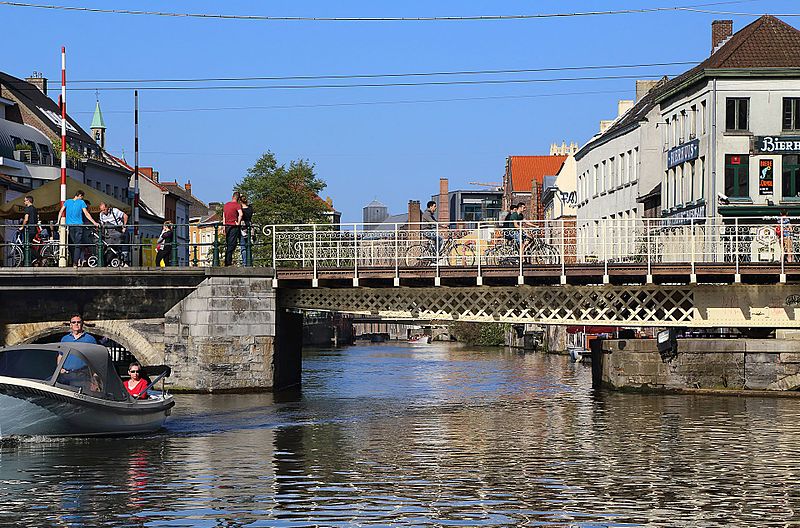
Credits: picture from https://commons.wikimedia.org/wiki/File:In_Ghent,_Belgium_J1.jpg
Commons represents an issue which has been subject of many studies and discussions. LabGov used to deal with the topic of the commons and its co-founders themselves (Prof. Sheila Foster and Prof. Christian Iaione) talk of “The City as a Commons”.
Today, indeed, we witness a rise of commons-oriented civic initiatives as a result of a growing inadequacy of Market and State. A commons can be intended as a shared resource co-governed or co-owned by its user community according to their rules and norms. In both Bollier, Bauwens and Helfrich’ opinion there is no commons without commoning, namely without active co-production and self-governance.
A commons emerges from the dynamic interaction of three related aspects: a resource, a community that gathers around it, and a protocols for its stewardship. As pointed by Bollier, it is simultaneously:
- a social system for the long-term stewardship of resources that preserves shared values and the community identity;
- a self-organized system by which community managed resources with no reliance on the Market or State; the wealth that we create and pass on to the next generation (based on gift of nature, civic infrastructure, cultural and creative works, traditions and knowledge);
- a sector of the economy that create values in ways that are often taken for granted – and often jeopardized by the Market-State.
The commons becomes a challenge for the city, that should become what Bauwens defines a “partners city”, enabling and empowering commons-oriented civic initiatives. For the market, that should sustain the commons and create livelihoods for the core contributors; and for the civil society organizations, that still have bureaucratic forms of organization and management, not in line with the commons initiatives.
Bauwens has recently released a report based on the study of the City of Ghent, conducted together with Yurek Onzia – project coordinator and editor-in-chief, with the support of an artistic makerspace (Timelab), the P2P Lab scholar Vasilis Niaros and Annelore Raman from the city council. The study was commissioned and financed by the City of Ghent, in the northern Flanders, with the support of the mayor, Daniel Termont, of the head of the mayor’s staff, the head of the strategy department, and the political coalition of the city (Flemish Socialist Party SPA, Flemish Greens – Groen, and Flemish Liberal Party – Open VLD).
The main request of the administration was to document the emergence and growth of the commons in the city and identify strategies and public policies to support commons-based initiatives, involving the citizens. The three-month research took inspiration from other cities (such as Barcelona, Seoul, Bologna) already engaged in the recognition and promotion of commons practices. It culminates in a Commons Transition Plan that describes the role, the possibilities and the options for optimal public interventions in terms of reinforcing citizens initiatives.
During the research, the team:
- Mapped 500 commons-oriented projects per sector of activity (from food to transportation, energy, etc.) using a wiki
- Interviewed 80 leading commoners and project leaders
- Administered a written questionnaire to over 70 participants
- Managed 9 open workshops divided per theme (Food as a commons, transportation as a commons….)
- Developed a Commons Finance Canvas workshop based on the Hinton methodology (economic opportunities, difficulties, models used by the commons projects)
Bauwens described the city of Ghent (300,000 inhabitants) as a city with a distinct presence of commons-oriented initiatives (more than 500), a lively urban tissue sprinkled by smart young, as well as coworking, fablabs and maker spaces, active civil society organizations that support urban commons projects, and an active and engaged city administration. The city indeed is already involved in actions for carbon and traffic reduction, and it has a staff of social facilitators, connectors, street workers engaged in enabling roles at the local level. In addition, there is an important policy to support the temporary use of vacant land/building by community groups.
Nevertheless, the research highlighted some weakness points of the city:
- the initiatives are often fragmented;
- there are some regulatory and administrative obstacles (especially about the mutualized housing);
- fablabs and coworking spaces lack of real production’s activities;
- there is no connection between university and the commons project, neither a propensity to open source and design projects;
- many commons-project are set in post-migration communities and limited to ethnic and religious memberships;
- civil society organizations often perceive the projects as mainly directed towards vulnerable categories and not as general productive resources; the cooperative sector gives a weak support; the major potential commons are vulnerable to private extraction.
Despite these weakness points, the City showed a great commitment in finding ways to improve and expand the urban commons at local level since it is aware of its potentials for the social and economic life: 1. “the commons are an essential part of the ecological transition”;
- they “are a means for the re-industrialization of the city following the cosmo-local model which combines global technical cooperation in knowledge commons with smart re-localization of production”;
- they “are based on self-governance of the value producing systems and are therefore one of the few schools of true democracy and participation”
The report is divided in four parts:
- The context on the emergence of urban commons (largely increased in the Flanders in the last ten years). This part provides information on the challenges for the public authorities, for the market players and for the traditional civil society organisations and on the opportunities related with the spread of the commons (i.e more active participation of citizens as city co-creators, in solving ecological and environmental issues and in creating new forms of meaningful work at local level).
- An overview of urban commons developments globally and especially in European cities.
- The analysis of the urban commons in Ghent with its strengths and weaknesses.
- A set of 23 integrated proposals for the creation of public-commons processes for citywide co-creation.
The part 3 with the map of the urban commons projects highlights some similarities with the commons-driven digital economy, demonstrating some specificities:
- productive communities are based on open contributions;
- the urban commons and their platforms may bring to generative market forms;
- the communities, platforms and possible market forms require, and receive, facilitative support from the various agencies and functionaries of the city, and the civil society organisations.
About the proposals in the part 4, the report presents:
- some public-social or public-partnership based processes and protocols to streamline cooperation between the city and the commoners. Taking as example the Bologna Regulation for the Care and the Regeneration of the Urban Commons, the report suggests that commons initiatives present their projects and ideas to a City Lab in order to sign a “Commons Accord” with the city. With this contract the city sets-up specific support alliances combining the commoners and civil society organisations, the city itself, and the private sector;
- a cross-sector institutional infrastructure for commons policy-making and support divided in transition arenas and based on the model of a pre-existing practice around the food transition.
Among the recommendations and suggestions listed in the report there are:
- The creation of a juridical assistance service consisting of at least one representative of the city and one of the commoners, in order to systematically unblock the potential for commons expansion, by finding solutions for regulatory hurdles.
- The creation of an incubator for a commons-based collaborative economy, which specifically deals with the challenges of generative start-ups.
- The creation of an investment vehicle, the bank of the commons, which could be a city bank based on public-social governance models.
- Augmenting the capacity of temporary land and buildings, towards more permanent solutions to solve the land and housing crisis affecting commoners and citizens.
- Support of platform cooperatives as an alternative to the more extractive forms of the sharing economy.
- Assisting the development of mutualized commons infrastructures (‘protocol cooperativism’), through inter-city cooperation (avoiding the development of 40 Uber alternative in as many cities).
- Make Ghent ‘the place to be’ for commoners by using ‘Ghent, City of the Commons’ as an open brand, to support the coming of visitors for commons-conferences etc.
- As pioneered by the NEST project of temporary use of the old library, use more ‘calls for commons’, instead of competitive contests between individual institutions. Calls for the commons would reward the coalition that creates the best complementary solution between multiple partners and open sources its knowledge commons to support the widest possible participation”.
In addition, the team also propose:
- A specific project to test the capacity of “cosmo-local production” to create meaningful local jobs (organic food for school lunches) and to test the potential role of anchor institutions and social procurement.
- The organisation of a CommonsFest on the 28th of October, with a first Assembly of the Commons.
- A pilot project around circular finance in which “saved negative externalities” which lead to savings in the city budget can directly be invested in the commons projects that have achieved such efficiencies (say re-investing the saved cost of water purification to support the acquisition of land commons for organic farmers).
- The setting up of an experimental production unit based on distributed manufacturing and open design.
- Projects that integrate knowledge institutions such as the university, with the grassroots commons projects.
The report is the executive part of a short book on the Ghent experience that will be soon available. Many useful indications and more precise recommendations can be found in the “COMMONS TRANSITION AND P2P: A PRIMER”. This Commons Primer co-published with the Transnational Institute, explains the Commons and P2P, in terms of interrelations, movements and trends, and how a Commons transition is poised to reinvigorate work, politics, production, and care, both interpersonal and environmental.
La città di Ghent nell’estate del 2017 ha promosso una ricerca sui beni comuni con lo scopo di mappare le iniziative commons-oriented e identificare le migliori strategie e politiche pubbliche per supportarne lo sviluppo coinvolgendo i cittadini. Il team di ricerca era guidato da Michel Bauwens della P2P Foundation che ha lavorato con Yurek Onzia, Vasilis Kostakis e Annelore Raman del Comune di Ghent, insieme a un makerspace artistico locale. La ricerca ha portato alla realizzazione di un Commons Transition Plan. L’executive summary è disponibile sul sito http://commonstransition.org e l’articolo di LabGov inquadra e presenta i principali risultati del report.

by Chiara De Angelis | Oct 13, 2017 | The Urban Media Lab

In February 2017 the report “Value in the Commons Economy – Developments in Open and Contributory Value Accounting” has been co-published by P2P Foundation and Heinrich Böll Foundation.
The authors, Michael Bauwens and Vasilis Niaros, address several question in the report, like “is anything good coming up from the crisis”, or “is a new system able to grow from within an old one”: they focus on a main thesis, describing the “value crisis” that is affecting our current world as a sign of a silent transformation in our “value system”.
Starting from the analysis of real case studies, the authors try to explore how the new value regimes emerging from pioneering communities can represent a shift towards post-capitalist practices. In the “commons’ transition” approach, that would mean that commons themselves could represent a new economy emerging within the old system.
The report offers an overview on how the new commons-based approaches are attempting to deal with some significant questions regarding the evolution of value, such as:
- What is value in our “digitalized” and “networked” societies where knowledge commons are playing a fundamental role?
- What should value be in a world marked by ecological and resource constraints?
- In a world of social and cultural diversity, can a new value system incorporate all the values that are not recognized by capitalism?
Three main case studies are therefore analyzed, namely: Enspiral, an entrepreneurial coalition of mostly mission-driven entities that calls itself an ‘open cooperative’ because of its commitment to both the production of commons, and an orientation towards the common good, Sensorica, an open collaborative network committed to the design and deployment of sensors and sense-making systems, utilizing open source software and hardware solutions, and Backfeed, a system based on the use of the blockchain ledger, which imagines itself as a full infrastructure for decentralized production, which comes with sophisticated capabilities to develop incentives and express them through crypto-currencies..
Bauwens’ and Niaros’ analysis also shows some different perspectives and approaches regarding what determines values. All the analyzed approaches, however, agree on the fact that we are going through a “value crisis”, characterized by an increasing capacity to create commmon value through commons-based peer production and other practices from the collaborative economy.
The main question that the authors address, in this sense, is not what is value nowadays, but what if value is becoming a driver for change. The possible consequences are mainly two: a complete shift of paradigm, where a translation of capitalism’s features in new terms is necessary, and a scenery of coexistence of the different realities, with the doubt of an effective possibility of preservation of the characteristics of each one.
And what is the role of commons in this shift of paradigm?
In this scenery, Bauwens’ and Niaros’ approach really matches with LabGov’s co-founders’ (prof Sheila Foster and Prof Christian Iaione) one, who in “The City as a Commons” affirm that “What we are interested in is the potential for the commons to provide a framework and set of tools to open up the possibility of more inclusive and equitable forms of “city-making”. The commons has the potential to highlight the question of how cities govern or manage resources to which city inhabitants can lay claim to as common goods, without privatizing them or exercising monopolistic public regulatory control over them.”
LabGov is in fact currently carrying out a research on the CoCities approach, investigating what are the variables that conduct a city in the process of a commons transition. The output of the research will be soon available on www.commoning.city
The full report is available here: http://commonstransition.org/value-commons-economy/
A febbraio 2017 è stato pubblicato il report Value in the Commons Economy – Developments in Open and Contributory Value Accounting, che analizza il concetto di valore e quale sia la sua prospettiva e il ruolo dei beni comuni nel cambio di paradigma che la crisi sta generando


