by Sofia Mazzuco | Nov 21, 2018 | The Urban Media Lab
Warrior Without Weapons (1) is a 32-days leadership immersion for social entrepreneurs to enhance their ability to positively impact communities – a program created by Instituto Elos (2), a Brazilian institute focused on community building through bottom-up and collaborative approaches to placemaking.
Every year around 40-60 participants from all over the world are selected to partake in the program, based on their readiness to take action. I was ready and lucky to be part of the 2018 edition and to live for the whole month of July 2018 in the city of Santos, state of São Paulo, to learn and act alongside amazing people from 10 different countries including Brazil, Congo, Zimbabwe, Senegal, Turkey, Germany, Italy, The Caribbean, USA, and Mexico, while absorbing Elos philosophy which was develop over the course of 20 years of practice of Elos Institute.

Photo: Isabela Senatore.

Photo: Isabela Senatore.
Over three months after the completion of the program, I still feel I am in the process of truly becoming a Warrior Without Weapons. It is not easy to describe what it takes to becoming a Warrior, a deep transformation that allows being attentive to how we can collectively recreate the world around us; I will make my best to tell you this story.
It all started with a dream, a collective dream. Instituto Elos emerged out of the dream of young architecture students to make of the design and construction phases a collaborative process that brings value in the building of not only places, but also (and mainly) of communities. Elos Phylosophy gradually became a channel for groups of people and communities to dream together their spaces and development processes.
Elos Philosophy (3) is based on a 7-step methodology, that being:
1 – Gaze (Olhar); as stated in The Little Prince, “what is essential is invisible to the eye”; we can only see with our hearts and when we silence our minds and judgment. This first step proposes to not only see, but to feel the energy of a community before acting in it, finding its visible and invisible beauties and resources.
2 – Affection (Afeto); a call to walk around the community being open to meaningful conversations with local people. A time to listen more than talk, to be carried throughout stories of those who dwell in the place being discovered; a time to offer not only open ears but mainly open hearts for real connection.
3 – Dream (Sonho); we are all driven by dreams. There are both individual and collective dreams, all worth being shared. Some say happiness is only real when shared; we, Warriors, must agree…this is why we go around a community and instigate the sharing of dreams, supporting the dreamers to trust that, if it can be dreamt, it can be accomplished. And this takes us to the next step…
4 – Care (Cuidado); this is the moment to match dreams and plan their collective accomplishment. A time leading to making dreams tangible by planning their strategic steps and creating opportunities for community action.
5 – Miracle (Milagre); here, people, resources and action all come together to make the dream come true. A time for hands-on, collective effort and to reassure that, yes, it is possible to transform the world we live into the world we dream of.
6 – Celebration (Celebração); gratefulness matters. This is why celebrating accomplishments – the miracle itself – is an important part of the path to development. It is when people acknowledge their collective efforts and invite more action and change into their community.
7- Re-Evolution (Re-evolução); what is needed to keep working on all the dreams that were brought to life in action or thoughts? Each community has its own paths…this is what the Re-Evolution step proposes – finding out which strategies work best in a given place to keep the ‘dreams come true’ process alive.

Elos methodology into 7 steps (Image source: http://elosfoundation.org/elos/elos-philosophy.html)
Experiencing this 7-steps in the path of becoming a Warrior Without Weapons at Santos in July 2018 has shown that beyond the methodology itself, so much more happens that cannot be predicted in the script; each step presents myriad of surprises both for individual and collective learning, while making the process richer and more intriguing. The 38 Warriors-to-be were divided into 3 different communities to take action during 21 days.
The community where I lived this process with a wonderful group of 16 Warriors is called Vila dos Pescadores (Fisherman’s Village), located next to Santos in a city called Cubatão, right into the mangrove ecosystem. A community with a population of more than 30 thousand people, most dwelling on stilt-houses with structures that go as deep as 10 meters into the sand to allow stability. While the village is considered to be an irregular occupation, the question of replacing the population elsewhere is delicate to consider (like in many other communities in Brazil).

Photo: Isabela Senatore.
We were invited into this community to establish a relationship of mutual learning; they have taught us so much during the 21 days we spent together, and so much energy we brought to support the collective accomplishment of a dream of theirs. But mainly, hope is what was exchanged of most valuable. We have brought the hope that, as a community, they can act to accomplish their dreams and there that are people from outside the community who are there to support them. Meanwhile, Vila dos Pescadores taught us, Warriors-to-be, that there is so much more beyond what we can see with the eyes, that a lot can be made out of little, that we all have the capacity for resilience…
Experiencing Elos methodology at Vila dos Pescadores allowed us to get to know the story of that wonderful place and of the wonderful people who dwell there. Their culture of fishing which is passed from father to son, the meditative state of mind that takes local fisherman to seek not only fishes but also peace and contemplation while alone in the sea, the mangrove regeneration effort that was carried by a local fisherman who is now remembered with pride and which has brought back a species of bird called Guará that was extinct, the care of an elderly lady who lives with her cats and gives plants to her neighbours as a way of showing affection, the infinite love and curiosity from the local children, the wise man who owns ten dogs and collects discarded objects on the streets to upcycle them into new objects…so many stories were discovered in the process of being open to that community and to a way of life that was unknown for most of us becoming Warriors.

Photo: Isabela Senatore.

Photo: Isabela Senatore.

Photo: Isabela Senatore.

Photo: Isabela Senatore.
Once we, Warriors, became more familiar with the place, and the local community more familiar with us, it was time to Dream; we went out on the local streets offering people a Brazilian desert called sonho (which means dream) in exchange of them telling us a personal or collective dream. We came to learn that the community dreamt of having a space for their children to play, learn and flourish. So we started to work on this plan! In the Care-step we invited the community to collectively design the space they dreamt of, supporting the definition of strategies for collective action and identifying a place inside Vila dos Pescadores to materialize the children’s center.

Photo: Isabela Senatore.

Photo: Isabela Senatore.
Plan defined, place defined; it all seemed right and ready to go. But then, the unpredictability factor came in – namely the inability to use an area for building the children’s center that the local municipality initially granted permission, but then went back on the decision (this unpredictability factor is something that usually happens when working in communities and that invites presence and lightness for a new plan to emerge). One day before the Miracle-step, consisting of a 4-days hands-on collective intervention, we did not have it all figured out any longer. But still, Warriors are warriors…we were there the next day, ready to do whatever needed to be done to serve the Fisherman’s Village and to support the building of their dream. And then, really like a Miracle, it all came together. How? This is what I wrote by the end of our 1st day of hands-on action: “…last night, the lack of clarity of a path to follow was very present. But today I realised that it was all part of something bigger, which was a call to fit the puzzle together with the community and at the right time. That was it, letting the puzzle fit in a spontaneous and genuine way – as it happened, and which made me realize that whatever happens is right. ”

Photo: Isabela Senatore.
From painting the floor and walls, to building new public space furniture, all was created jointly by the hands of locals at Vila dos Pescadores, the Warriors, and people from other communities (with joint efforts also in the donation of construction materials). What came out of the Miracle were a regenerated plaza, a sports court and playground with new furniture, and a temporary container where the children can now play and learn. The awe in the eyes of the children and of all the community who took part in this process showed that the faith factor was being reinforced by each collective accomplishment. Deep inside, they always knew they could do it, and we Warriors were there as a catalyst to redirect this faith into action (both their faith and our faith of empowered communities). There are many reasons why, at the end of the 4-days of hands-on action, we Celebrated with a sense of joy and gratefulness the work that had been done on the physical and subtle level of both the place and the expanded community that helped build it.

Photo: Isabela Senatore

Photo: Isabela Senatore

Photo: Isabela Senatore.

Photo: Isabela Senatore.
Right at this moment, the Fisherman’s Village is in the Re-Evolution process. This means that the hands-on was not the final piece but a seed and a prototype of what can be done through community action. Instituto Elos and the Warriors Without Weapons are now working with the community via different meetings to help potentialise community action and make it into more tangible dreams. So much awareness of their capability to act is coming out of this process and it has been beautiful to see how they find their own ways of organising new strategies.
Not only Vila dos Pescadores, but also we Warriors are living a Re-Evolution process. I can say that one does not suddenly become a Warrior Without Weapons after the 32-days immersion…one gradually becomes a Warrior while allowing the learning to mature in its own timing and practicing it on the day-to-day life. For me, this has been a multiple experience of practicing the dream muscle, being more attentive to the abundance and the beauties presented daily, and caring more for the needs of all around me. Becoming a Warrior Without Weapons has taught me that the more I give, the more I feel complete and that serendipity (unplanned and fortunate discoveries) will always come along in the beautiful complexity of community action, and of life. More and more I believe that the world we dream of is being built, right now, while we put our love – which is something natural – into action.

_
Guerrieri Senza Arme è una immersione di 32 giorni creata dal Istituto Elos (1), che succede a Santos (Brasile) per che imprenditori sociali possano assorbire tecniche di leadership per il lavoro in comunità, imparando la metodologia creata tramite la pratica del istituto per 20 anni in varie comunità. Sono stata fortunata di partecipare dell’immersione a Luglio 2018 con altri trentasette giovani di dieci paesi, un’esperienza che ha causato un impatto veramente positivo e mi ha insegnato che è possibile, collettivamente, creare il mondo in cui sogniamo.
_
- http://institutoelos.org/gsa/
- http://institutoelos.org/
- http://institutoelos.org/o-elos/#filosofia

by Margherita Valle | Oct 17, 2018 | The Urban Media Lab, ULCR San José Lab 2018
Versión en español a continuación
As part of the LabGov research and extension program for Costa Rica, the Architecture students of the Universidad Latina continue to apply the concepts of common goods to the city, collaborating with the community of the Cedros neighborhood, in San Pedro de Montes de Oca, an area of the capital of Costa Rica, San José.
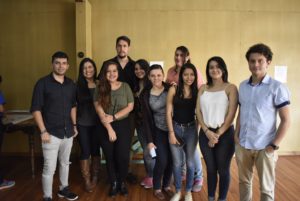
The process that was carried out in the first months of 2018 began with the realization of an analysis of the community, followed by the setting of objectives and schedule of activities to be carried out as a laboratory and as workshops. The project could be carried out thanks to the help of the community and also of the Scouts group in the area. Starting the investigation, surveys and talks were conducted in order to have more accurate information to project the needs. The best option was to involve the community around the coexistence space that belongs to it and is part of their daily routine: the neighborhood park and the community hall.
As a result of the activities carried out, certain problems were determined in the community, specifically in the sector near the Community Hall and the School of Cedars, which, indeed, as had been observed in the first stage, are the areas most used by the neighbors.
Based on the LabGov methodology, the research group applied the Co-city protocol: knowing, mapping, practicing, prototyping, testing and modeling. In order to achieve a shared city, it was proposed from the beginning to promote in the community the appropriation of public space through specific interventions and achievable with short-term actions that did not come exclusively from the group of researchers, but from the members of the community itself. In this way it was concluded to carry out an intervention with urban furniture, since fundamentally public areas only lend themselves to certain defined uses (field/court sports and indoor congregation activities) and lack comfortable and simple facilities to sit, rest and socialize in the outdoors.
KNOWING
An initial challenge, before starting any project, was to make the community aware of what the common goods are. And how this information could be transmitted in a way that was co-constructed among all.
The commons are resources and networks that sustain life, and although their legal possession may be of a certain group or community, or an individual, they are used by all and of all is the benefit.
Taking into account that every resource becomes common through a process of work and regulation, we wanted to focus on finding and recognizing the Common Goods with the Cedros Community, as well as later introducing a set of new goods to take care of and reproduce: the urban furniture produced with recycled pallets as the main material, which were implemented according to the needs of the community.
The common goods, in addition to achieving citizen participation and creating urban awareness, also help to create an environment of collaboration and equality: as it is related in Peter Linebaugh’s book about “El Manifiesto de la Carta Magna” and the Forest Charter, for a long time, humanity has sought to create a more equitable society, through documents created so that common goods are preserved and protected. Based on these texts it has been shown how this legacy has remained over the years and it is our obligation as citizens to watch over the common goods, since being shared brings benefits for all. Likewise, not only should they be preserved, but improved with the help of a community structure that, in mutual agreement, fosters good communication and teamwork. With this, goods can be renewed over time and could be used by our society and inherited by future generations [1].
On the other hand, as clarified in the book “La Carta de los Comunes”, common goods are not only translated into public space or, in the case of our intervention, in urban furniture, but they go much further, contemplating the goods to which we all have access in our daily life, such as water, air and other natural elements. It is from these fundamental commons that awareness must arise for responsible use. In other words, we cannot limit ourselves to taking care of the benches of our park, if our rivers and seas are full of garbage. For this reason we have sought ways to encourage the recognition of different types of common goods by the young population of the community, involving them in the first person in the care of these goods; so that in a broader way they focus on taking care not only of the community’s assets, but also beyond, an heritage such as water [2].
MAPPING

The decision about the prototype to be proposed was taken after making several field visits and noting that the large green areas had a space dedicated to a small playground and a court. However these are not used due to various problems, among them, the easiest solution was to solve the absence of adequate equipment for living areas. Therefore, it was decided to create functional and modular furniture that could later be replicated by people, remaining as a prototype model that the community could build alone, when it needed more furniture. Trying to create a quiet, cozy and safe space to share with the children, this also required garbage dumps, to have a space free of waste and at the same time educate the recycling.
PRACTICING
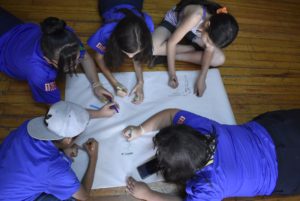
Within the activities programmed to achieve this project, the workshop was aimed at young people between the ages of 9 and 16. This got a very positive response from them after working on the book quoted above from the “La Carta de los Comunes” [2]. With this, they were able to understand the importance of greater participation and allowed to spring up in them a sincere interest for the care of our goods.
PROTOTYPING

In the development of this project, a positive response was observed from the members of the community to get involved in decision-making. This was proven in the workshops held, such as the furniture-manufacturing workshop, in which the young people were willing to collaborate and thus they were even more incentivized to preserve these goods, since they were involved in the design process as well as manufacturing, manifesting feelings of appropriation on his part.
This type of activities developed together with the neighbors, generate a tangible impact on the communities, since that attitude arouses the interest of other nearby communities, making it replicate and have an impact at the country level, and at a global level as part of the LabGov program, which aims to be a network of local efforts as the ultimate goal of these actions.
As an added value, in the case of this urban laboratory in the Community of Cedros, it was intended from the beginning to strengthen and promote self-management and not the resolution of a specific problem by external actors. Therefore, the necessary tools were provided for any citizen to be able to repeat or adapt the models proposed in this prototype, through an open technical manual and editable 3D files, accessible to anyone who requires it, within the framework of the Creative Commons concept.
It is very important for urban life to achieve coexistence among its citizens through the use of public spaces that the city offers us. However, the urban space by itself does not work, because it needs to be thought for and by the citizens, used and cared for by them in a continuous and organic way. For this reason, academic interventions are not an achievement but a stimulus to revitalize these spaces as social nodes.
In Costa Rica, despite the renowned democratic culture, people still need to be empowered on the subject of civic rights and duties, and to become active and participatory members of the city’s spaces [3]. This is achieved through the management, methodologies and tools of citizen participation, which give a reason of real use to those spaces. The development of this management was done in coordination between the Creative Campus of the Latina University of Costa Rica, the Cedros Integral Development Association of Montes de Oca and Plataforma de Integración Ciudadana, thanks to the participation of the community and organized groups as the Guides and Scouts of Costa Rica.

The LabGov program of Costa Rica seeks to involve the students of urban design courses in a process of research and extension in order to experience and understand processes of innovation in urban design, not limited to the drawing stage but to processes of co-design management. This not only in order to achieve a broad citizen participation and create an urban awareness of care and maintenance of the urban commons, but also to understand the students as qualitative researchers and community stakeholders, which can – and should – be involved in social projects.
1 Linebaugh, P. (2013). El Manifiesto de la Carta Magna, Comunes y libertades para el pueblo. Madrid: Traficantes de Sueños.
2 madrilonia.org. (2011). La Carta de los Comunes, Para el cuidado y disfrute de lo que todos es. Madrid: Traficantes de Sueños.
3 PNUD. 2013. Informe Nacional sobre Desarrollo Humano 2013, Aprendiendo a vivir juntos: Convivencia y desarrollo humano en Costa Rica. San José, C.R.: Programa de las Naciones Unidas para el Desarrollo – PNUD Costa Rica, p. 233-235.
EL IMPACTO DE LA ACADEMIA EN LA SOCIEDAD: JUGANDO CON LOS BIENES COMUNES BARRIALES
Como parte del programa de investigación y extensión LabGov para Costa Rica, los estudiantes de Arquitectura de la Universidad Latina continúan aplicando los conceptos de bienes comunes a la ciudad, colaborando con la comunidad del barrio Cedros, en San Pedro de Montes de Oca, una área de la capital de Costa Rica, San José.
El proceso que se llevó a cabo en los primeros meses del 2018 comenzó con la realización de un análisis de la comunidad, seguido por el planteamiento de objetivos y cronograma de actividades a llevar a cabo como laboratorio y como talleres. El proyecto pudo realizarse gracias a la ayuda de la comunidad y también del grupo Scouts de la zona. Dando comienzo a la investigación se realizaron encuestas y charlas con el fin de tener información más acertada para proyectar las necesidades. La mejor opción era involucrar a la comunidad alrededor del espacio de convivencia que le pertenece y es parte de su rutina diaria: el parque barrial y el salón comunal.
Como resultado de las actividades realizadas, se determinaron ciertos problemas en la comunidad, específicamente en el sector cercano al Salón Comunal y a la Escuela de Cedros, que, efectivamente como se había observado en la primera etapa, son las zonas más utilizadas por los vecinos.
Basándose en la metodología del LabGov el grupo de investigación aplicó el protocolo Co-ciudad: saber, mapear, practicar, prototipar, probar y modelar. Con el fin de lograr una ciudad compartida, se planteó desde el inicio promover en la comunidad la apropiación del espacio público por medio de intervenciones puntuales y alcanzables con acciones a corto plazo que no vinieran exclusivamente del grupo de investigadores, sino de los miembros de la comunidad misma. De esta manera se concluyó realizar una intervención con mobiliario urbano, ya que fundamentalmente las áreas públicas no se prestan más que a ciertos usos definidos (deportes en cancha y actividades de congregación bajo techo) y carecen de instalaciones comodas y simples para sentarse, estar, descansar y relacionarse en los exteriores.
MAPEAR
La decisión acerca del prototipo que se quería proponer fue tomada luego de realizar varias visitas de campo y notar que las amplias zonas verdes, contaban con un espacio dedicado a un pequeño parque infantil y una cancha, sin embargo no son aprovechados debido a diversos problemas, entre ellos, el de más fácil solución, era resolver la ausencia de un equipo adecuado para zonas de estar. Por lo tanto, se decidió crear un mobiliario funcional y modular que pudiera posteriormente ser replicado por las personas, quedando como un prototipo modelo que la comunidad pudiera construir sola, quando esta necesitara más mobiliario. Tratando de crear un espacio tranquilo, acogedor y seguro para compartir con los niños, se requerían también basureros, para contar con un espacio libre de desechos y que al mismo tiempo educara al reciclaje.
SABER
Un desafío inicial, antes de comenzar cualquier proyecto, era hacer que la comunidad conociera cuáles son los bienes comunes. Y, sobre todo, cómo podría transmitirse esta información de una manera que fuera co-construida entre todos.
Los bienes comunes son recursos y redes que sostienen la vida, y aunque su posesión legal puede ser de un cierto grupo o comunidad, o de un individuo, son utilizados por todos y de todos es el beneficio.
Tomando en cuenta de que todo recurso se convierte en común a través de un proceso de trabajo y reglamentación, se quiso dar enfoque en buscar y reconocer los Bienes Comunes con la Comunidad de Cedros, así como posteriormente introducir un conjunto de nuevos bienes que cuidar y reproducir: el mobiliario urbano producido con pallets reciclados como material principal, los cuales fueron implementados según las necesidades de la comunidad.
Los bienes comunes, además de lograr una participación ciudadana y crear conciencia urbana, también ayudan a crear un ambiente de colaboración e igualdad: como se relata en el libro del Peter Linebaugh acerca de “Manifiesto de la Carta Magna” y la Carta del Bosque, ya hace mucho tiempo la humanidad ha buscado generar una sociedad más equitativa, a través de documentos creados para que los bienes comunes fueran preservados y protegidos. Con base en estos textos se ha mostrado como ese legado ha permanecido a través de los años y es nuestra obligación como ciudadanos velar por los bienes comunes, ya que siendo compartidos traen beneficios para todos. De igual manera no sólo se deben de preservar, sino mejorar con ayuda de una estructura comunitaria que, estando en mutuo acuerdo, fomente una buena comunicación y trabajo en equipo. Con ello los bienes pueden ir renovándose con el tiempo y podrían ser utilizados por nuestra sociedad y heredados por las generaciones futuras (Linebaugh, 2008).
Por otro lado, como se aclara en el libro “La carta de los Comunes”, los bienes comunes no solo se traducen en espacio público o, en el caso de nuestra intervención, en mobiliario urbano, si no que van mucho más allá, contemplando los bienes a los que todos tenemos acceso en nuestra vida cotidiana, como lo son el agua, el aire y demás elementos naturales. Es de estos bienes comunes fundamentales que debe surgir la concientización para su uso responsable. Es decir no podemos limitarnos a cuidar las bancas de nuestro parque, si nuestros ríos y mares están llenos de basura. Por esta razón hemos buscado la manera de incentivar el reconocimiento de diferentes tipos de bienes comunes por parte de la población joven de la comunidad, involucrandoles en primera persona en el cuido de estos bienes; para que de una manera más amplia se enfocaran en cuidar no sólo los bienes de la comunidad, si no más allá, un bien de la humanidad como lo es el agua (Madrilonia.org, 2011).
PRACTICAR
Dentro de las actividades programadas para lograr este proyecto, el taller fue dirigido a jóvenes de edades entre los 9 y los 16 años. Esto obtuvo una respuesta muy positiva por parte de ellos luego de trabajar en el libro citado anteriormente de la “Carta de los Comunes”. Con esto se logró que ellos entendieran la importancia de una mayor participación y permitió que brotara en ellos, un interés sincero por el cuido de nuestros bienes.
PROTOTIPAR
En el desarrollo de este proyecto se observó una respuesta positiva de los miembros de la comunidad para involucrarse en la toma de decisiones. Esto se comprobó en los talleres realizados, como el taller de la fabricación del mobiliario, en el que los jóvenes se mostraron anuentes a colaborar y así se logró aun más incentivar el interés por preservar estos bienes, pues estuvieron involucrados en el proceso tanto de diseño así como el de manufactura, manifestando sentimientos de apropiación de su parte.
Este tipo de actividades desarrolladas en conjunto con los vecinos, generan un impacto tangible en las comunidades, ya que esa actitud suscita interés de otras comunidades cercanas, haciendo que se replique y pueda tener un impacto a nivel de país, y a nivel mundial como parte del programa LabGov, el cual plantea ser una red de esfuerzos locales como el objetivo final de estas acciones.
Como valor agregado, en el caso de este laboratorio urbano en la Comunidad de Cedros, se pretendió desde el inicio fortalecer y promover la autogestión y no la resolución de un problema puntual por parte de actores externos. Por lo tanto se brindaron las herramientas necesarias para que cualquier ciudadano fuera capaz de repetir o adaptar los modelos propuestos en este prototipo, mediante un manual técnico que fue diseñado para ser “open” y archivos 3D editables, accesibles para toda persona que lo requiera, en el marco del concepto Creative Commons.
Es de suma importancia para la vida urbana lograr la convivencia entre sus ciudadanos mediante el aprovechamiento de los espacios públicos que nos brinda la ciudad. Sin embargo el espacio urbano por sí solo no funciona, pues necesita ser pensado para y por los ciudadanos, usado y cuidado por ellos mismos de forma continua y organica. Por esta razón las intervenciones académicas no son un logro si no un estímulo a revitalizar dichos espacios como nodos sociales.
En Costa Rica, a pesar de la renombrada cultura democrática, las personas todavía se deben empoderar en el tema de derechos y deberes civicos, y lograr ser miembros partícipes y activos de los espacios de la ciudad. Esto se logra mediante la gestión, metodologías y herramientas de participación ciudadana, que den una razón de uso real a dichos espacios. El desarrollo de esta gestión se realizó en coordinación entre el Campus Creativo de la Universidad Latina de Costa Rica, la Asociación de Desarrollo Integral de Cedros de Montes de Oca y la Plataforma de Integración Ciudadana, gracias a la participación de la comunidad y de grupos organizados como los Guías y Scouts de Costa Rica.
El programa LabGov de Costa Rica busca involucrar los estudiantes de los cursos de Diseño Urbano en un proceso de investigación y extensión con el fin de experimentar y entender procesos innovativos de diseño urbano, no limitados al dibujo sino a los procesos de gestión participada del diseño. Esto no sólo con el fin de lograr una amplia participación ciudadana y crear una conciencia urbana de cuido y mantenimiento de los Bienes Comunes Urbanos, sino además entender a los estudiantes como investigadores cualitativos y actores integrantes de la comunidad, los cuales pueden y deben involucrarse en proyectos sociales.
Referencias
Linebaugh, P. (2008). Manifestación de la Carta Magna.
Madrilonia.Org. (2011). Carta de los Comunes.
by Elisa Del Sordo | Sep 3, 2018 | The Urban Media Lab
The Scottish Expert Advisory Panel conceived in April 2017, has surely contributed to accumulate food for thought around new issues concerning the Collaborative Economy. The Scottish Government issued its response to the Panel’s report in July 2018.
The purposive character of the said Panel was to provide advice and technical expertise to the on-going policy development on the collaborative economy; its programmatic nature instead, envisioned a series of recommendations addressed to the Scottish Government. The latter’s response, published in the July report, seems nevertheless to be perfectly aligned with the Panel’s recommendations and inclinations.
According to the Government, the collaborative economy undeniably constitutes a powerful tool to connect individuals and communities through online platforms and allowing goods and services to be shared without the need for ownership. Its huge potential is said to contribute to a fairer and more socially responsible economy for Scotland, supporting a responsive and agile regulatory environment with a focus on platforms that deliver fair work while contributing to inclusive growth.
The focus on Scotland’s role in the digital economy for instance, has resulted in the coming into being of public-private partnerships projects, such as Digital Tourism Scotland. As a matter of fact, the so-called “visitor economy” contributes significantly to a country’s growth. Major concerns have been devolved to transport infrastructures, cultural heritage and recreational opportunities.
Additionally, the Panel underlined the growing importance of social or collaborative finance, such as crowdfunding. The latter is considered to be an emerging source of finance that involves open calls to the public to finance projects or platforms. Usually, we distinguish between two types of support: reward based crowdfunding and donation based crowdfunding. The benefits of crowdfunding are multiple: its inclusiveness, its flexibility and its scope.
Diverse and new economic models are fundamental for a de facto community-led urban development; the following topic has been explored during the conference Funding the Cooperative City held in Rome during the month of May. Here, local and international speakers discussed and shared their innovative collaborative methodologies, between environmental sustainability, collaborative governance and social economy.
Finally, another point of interest for the Panel is fostering digital collaborative platforms to accelerate the development of businesses and social enterprises, and to develop new strategies to support peer to peer collaborations between social enterprises.
The Scottish Government underlines then the launch of ShareLab Scotland as a pilot innovative and collaborative platform. Progresses have been made in the energy sector where crowdfunding has been employed to support community owned renewable energy.
Similarly, a workshop of the local support group of the Urbact Network Urbinclusion recognized the need to develop new economic models applied to public-private partnerships to foster community welfare, under the flag of three imperatives: regulation, responsibility and governance.
In conclusion, the Scottish Government’s efforts will try to respond to the growing imperatives underlined by the Panel in order to create a fairer and more equal Scotland centered on a sustainable and inclusive economic growth.