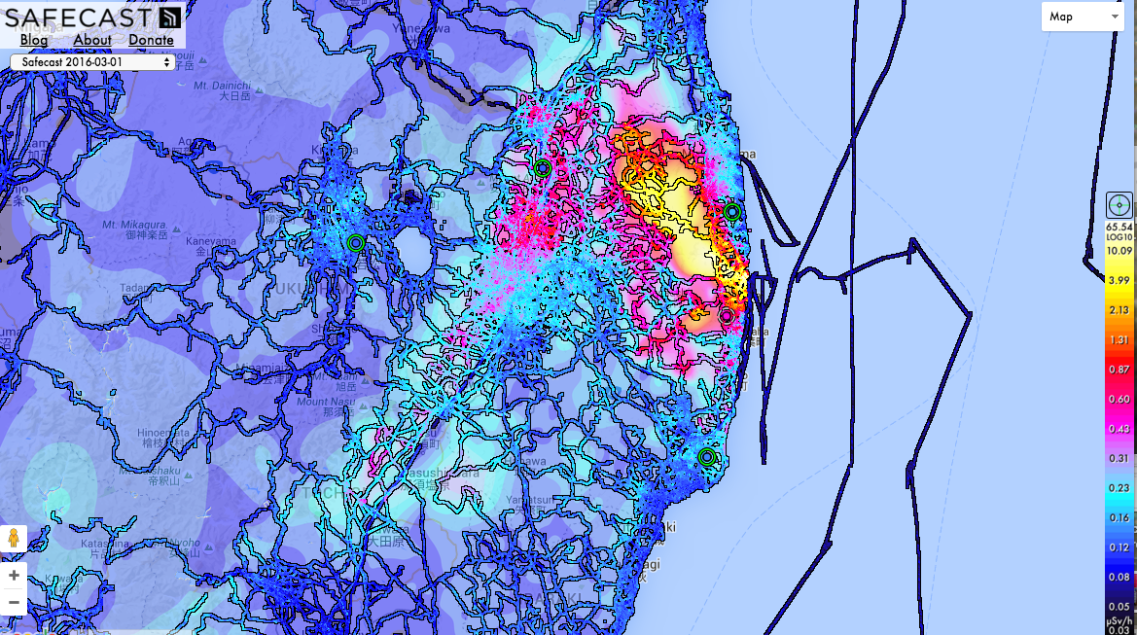
Credits: Image from the Safecast map (http://blog.safecast.org/maps)
It is nowadays plain that climate change, pollution and other environmental hazards directly and indirectly affect the physical, social, and psychological health of humans. This public and environmental health risk could be minimized with effective adaptation strategies and proper governance. People are increasingly becoming aware of the preventability of these risks, and push for a change in the way in which the risk is communicated and managed. When the institutional players responsible for taking action show a dominant attitude of inertia, lay citizens tend to react in defence of their right to an healthy environment and – in case of urban settings – their right to the city. This contribution focuses on how non-expert people take advantage of technology (in particular sensors and open access data infrastructures) to visualize, monitor, report and combat threats caused by environmental factors to public health. The practice is labeled as ‘Citizen Sensing’ standing for bottom-up initiated monitoring initiatives based on ICT, in general, and, in particular, on sensors.
The ‘Citizen Sense’ [1] project (2013 – 2017) states the following about Citizen Sensing: “Practices of monitoring and sensing environments have migrated to a number of everyday participatory applications, where users of smart phones and networked devices are able to engage with similar modes of environmental observation and data collection. Such ‘citizen sensing’ projects intend to democratize the collection and use of [..] sensor data in order to facilitate expanded citizen engagement in environmental [health] issue”.
From this statement, it can be inferred that Citizen Sensing is a practice of monitoring environmental (health) factors using smartphones and networked devices, which may foster citizen participation in tracking environmental (health) factors, including risks. The words ‘everyday participatory’, ‘democratize the (data) collection’ and ‘expanded citizen engagement’ may show a link with the underlying values that inform the governance of the commons. Citizen Sensing finds indeed its legitimacy and justification in the right the citizens have to the collective governance of the benefits and risks that have impact on their health and wellbeing. This goes from the co-governance of a park for the better living of a neighborhood, to the co-management of a risk (e.g. air pollution) which affects a certain community.
The potential of Citizen Sensing for an urban renaissance can be illustrated through an example regarding a well-known case. On 12 March 2011, a hydrogen explosion occurred in the Japanese Fukushima Daiichi nuclear power plant [2]. The residents of the area were advised to stay inside and avoid any contact with the surrounding environment, including breathing the outside air and drinking tap water. The population living in the surroundings of the plant was evacuated. A second explosion occurred on 14 March worsened the radiation level. Soon, the shortcomings of the government monitoring system emerged (Hemmi and Graham, 2014) [3]. The state system was indeed based on a network of fixed sensors that used models to calculate radiation levels. This meant that numerous locations could not have been checked, which caused anxiety and mistrust in the dwellers exposed to the risk of radiations. The state approach in this case is a clear example of the ‘linear’ way of governing environmental risks to public health by the institutional actors responsible for those risks (Fisher, 2017) [4]. Generally, the institutional approach is based on high quality monitoring equipment requiring a considerable expense and continuous labour, which often leads to low spatial and temporal resolution. Furthermore, this monitoring often leads to results which are not easily accessible by non-professional citizens, thus contributing to create a knowledge gap between those exposed to a certain risk and those having the recognized ‘expertise’ to address that risk. As registered in the Fukushima case, this approach is likely to cause a sense of public skepticism about how the institutions are facing a certain risk. This leads, on one side, to a disruptive tendency (criticizing and rejecting the established system of risk governance), but, on the other side, it constructively stimulates alternative ways for governing a risk, and a push for a co-governance of it.
In the case presented, the aforementioned tendency can be identified in an increase in the sales of radiation monitors purchased by citizens who wanted to measure their exposure to radiation. And they did not limit to that. They organize themselves in an organization, “Safecast” [5], devoted to open Citizen Science for the environment and, in particular, for radiation monitoring after the Fukushima accident. The web-based platform was established in 2011 by a group of volunteers with the aim to make publicly available accurate and trustworthy radiation information, with a view to complementing or substituting the insufficient official information. On the today still existing platform, the data are visualized using Google Fusion Tables to produce maps. Specifically, the Safecast Map depicts over 4,000,000 radiation data points. The map is fed with ad hoc data collected by citizens through low-cost radiation monitors. The data are licensed with a Creative Commons 0 license, which allows anyone anywhere in the world to use the data for any purpose. The trend from few, expensive, state-owned sensors to many, widespread, publicly-owned monitoring devices shows the need for an horizontal transparency, which entails even access to information and reliance on bottom-up produced knowledge. The success of the initiative demonstrates how technological innovation can play a key role in enabling collaboration and sustainability within and beyond the city, and can enhance co-governance of common resources as well as of common risks.
Cases like Safecast indicate the willingness of people to see their right to live in a healthy environment in action, and their commitment to have it enforced through the legal, social and even technological avenues available to them. Thorough research is needed on the influence of bottom-up citizen sensing on the governance of public/environmental health risks and on its acceptability from institutional stakeholders. There is a high demand for reflections on alternative/complementary ways to face today challenges and Citizen Sensing practices may be part of the answer. Despite its potential, Citizen Sensing will be often disputed on the basis of alleged deficits of legitimacy. Nevertheless, the values deriving from theories of urban co-governance, the principles supporting the right to a healthy environment and a conceivable right to the co-city/co-governed living environment may lay the foundations for contesting similar arguments.
Il presente articolo illustra il desiderio emergente del cittadino di fare uso dell’innovazione tecnologica (in particolare sensori e infrastrutture informatiche) al fine di visualizzare, controllare, riportare e combattere minacce causate da fattori ambientali alla salite umana. Tale pratica – qui definita come ‘Citizen Sensing’ – viene analizzata attraverso un caso studio, quello della piattaforma di monitoraggio dell’inquinamento nucleare creata da membri della società civile in risposta all’esplosione della centrale nucleare Giapponese Fukushima Daiichi. Il caso si presenta come occasione di riflessione sulla possibilità che iniziative di Citizen Sensing possano trovare legittimazione nei valori che informano la co-gestione dei beni comuni e, da ultimo, nel diritto del cittadino alla co-gestione della città e in generale dell’ambiente abitato. Tale co-gestione può interessare una risorsa condivisa, come ad esempio un parco, ma anche un rischio condiviso, come appunto l’inquinamento nucleare nel caso presentato.
[3] Akiko Hemmi & Ian Graham (2014). “Hacker science versus closed science: building environmental monitoring infrastructure”. Information, Communication & Society, 17:7, 830-842, DOI: 10.1080/1369118X.2013.848918.
[4] Fisher, E. 2017. “Framing risk regulation: A critical reflection”. European Journal of Risk Regulation 4(2): 125-132. doi: 10.1017/S1867299X00003299.
In the last few years, the commons have enriched themselves with their entry into political institutions at the level of states, large cities or regions, whether in Bolivia, Ecuador, Spain, Britain, France, Italy, and elsewhere in the world. How can this encounter inspire us? How does the commons paradigm fit with other proposals for a post-capitalist alternative, such as de-growth, social and solidarity economy, political ecology, open cooperativism, and much more? How to avoid the “commons washing” and recovery of the project and the values of the commons in the dominant discourse?
Professor Christian Iaione, LabGov coordinator, was between the experts and practitioners interviewed in this occasion. In his speech he touches on different topics: from the experiences that are taking place in numerous Italian cities around the urban commons to the importance of creating a stronger network of cities committed to addressing emerging urban issues; from the understanding of the value of experimentation to development of the capacity to address failure; from the importance to involve all local actors in the care and regeneration of the urban commons to the exigency of rethinking the role of the State and of the local administration.
The 2013 edition of the Biennial saw the approval of the Charter of Public Space (available here in Italian), which “aims to be the document for all those who believe in the city and in its unique capability of fostering sociability, meeting, coexistence, freedom and democracy; and in its vocation to express and realize all these values through public spaces”. Therefore, the Biennial speaks to local administrations, universities, cultural associations, experts and practitioners, citizens and students, with the aim of promoting interdisciplinary projects involving the main urban actors.
In line with this view, this year’s edition of the Biennial addresses the topic of planning and managing public space from different perspectives and thanks to the contribution of numerous actors active in this field. The program of the event, available on the website, is the result of the call “Making Public Spaces” launched in December, which saw the contribution of small and medium municipalities, schools, universities, cultural associations, provincial architects orders and regional sections of the National Institute of City Planning.
The activities of the Biennial will begin on the 25th, with the opening greetings and the speeches of the promoters, followed by a series of workshop that will address different aspects of urban regeneration: mobility, accessibility, reuse, security, environmental resilience, management, social innovation, technologies.The workshops will continue on the morning of the 26th, and will be followed by two roundtables where the coordinators of the workshops will come together to draw some proposals and suggestions that will be presented during the final day. On the 27th, after the screening of the movies that won the “Filming the City” call, there will be a final debate, which will see the participation of members of foreign city administrations, from Lubiana to Bogotà and Johannesburg.
LabGov will be present at the event, where we will take part in different roundtables: on the 25th Paola Cannavò (representing LabGov and UD Lab, UniCal) will be between the discussants in a workshop titled “Travel in the Governance of the Commons”, while Chiara Prevete (LabGov’s executive director) will take part in the working table “Conflicts: resistances met and transformations obtained”, within framework of the same workshop. On the 26th LabGov will also be present at the workshop “Green and Blue Infrastructures in the Project of the Contemporary City”.
Here is the complete program of the Biennial:
………………………………………………………………………….
Dal 25 al 27 maggio 2017 avrà luogo a Roma la quarta edizione della Biennale Dello Spazio Pubblico, promossa dall’Istituto Nazionale di Urbanistica assieme alla sua sezione laziale, dal Consiglio Nazionale degli Architetti Pianificatori Paesaggisti e Conservatori, dall’Ordine degli architetti di Roma e dal Dipartimento di Architettura dell’Università Roma Tre, con la collaborazione di UN – Habitat e di ANCI.
“Dopo l’apertura dei lavori, prevista il 25 maggio con i saluti istituzionali e gli interventi dei promotori, nel pomeriggio della stessa giornata e nella mattina del 26 maggio si svolgeranno i workshop che affronteranno diversi aspetti della rigenerazione urbana: mobilità, accessibilità, riuso, sicurezza, resilienza ambientale, gestione, innovazione sociale, tecnologie. Nel pomeriggio del 26 maggio i coordinatori dei 27 workshop si riuniranno in due tavole rotonde dalle quali emergeranno indicazioni, proposte e suggerimenti da presentare nella giornata conclusiva che prevede anche un dibattito al quale prenderanno parte amministratori di città di altri paesi, la premiazione e la proiezione dei video vincitori della call “Filmare la città”, iniziativa realizzata assieme all’International Fest Roma Film Corto – Independent Cinema”.
Il programma completo dell’evento è disponibile qui.
The conference “Il nuovo codice dei contratti. Strumenti a disposizione delle Pubbliche Amministrazioni nella relazione con le imprese ordinarie e le imprese cooperative” (The new contracts code. Instruments for the Public Administrations in relation to ordinary and cooperative enterprises) will take place in Bergamo on Friday the 12th of May 2017.
The event, which is mainly addressed to members and functionaries of the local administration, is organized by Confcooperative Bergamo together with Legacoop Bergamo, AGCI Bergamo and some of the major Italian working unions (Cgil,Cisl e Uil), and is part of a series of initiatives aiming at promoting cooperation.
These initiatives originate from a widespread awareness of the potential of collaboration for local development, but also of the need for institutions and civil society to work together in order to realize this potential.
Professor Iaione, LabGov coordinator, will take part in the roundtable “Institutions and communities between new models and new needs”, together with Michele Bertola, Director General of the Municipality of Bergamo and Giuseppe Guerini, President of Confcooperative Bergamo.
Here is the complete program of the event:
…………………………………………………………………….
“Venerdì 12 maggio, dalle 9.00 alle 13.00 presso la Sala degli Angeli della Casa del Giovane in via Gavazzeni 13, il convegno “Il nuovo codice dei contratti. Strumenti a disposizione delle Pubbliche Amministrazioni nella relazione con le imprese ordinarie e le imprese cooperative” rivolto principalmente ad amministratori e funzionari degli enti locali per sensibilizzarli ad una logica progettuale e consapevole nella programmazione e nella realizzazione delle procedure di affidamenti”.
Between 1999 and 2012 around 300 million cubic meters of new constructions have been created in Italy. Following the crash of the real estate market in 2007, this construction boom resulted in the presence of an enormous amount of unfinished and unused building in the territories which were hit by the economic crisis. We can count at least 6 million empty houses and 10 million vacant properties; 20 million square meters of railways areas fallen (or falling) into disuse and around 5 thousand kilometers of unused railways; around 20 thousand kilometers of roads laying in abandonment, out of which 2600 are not used; and additionally, we can’t even begin count the number of abandoned stores and industrial hangars.
Such numbers call for a serious reflection. This is exactly what the book “Agenda RE-CYCLE, Proposte per reinventare la città”, published by Il Mulino, does. Based on a research developed at national level and involving legal experts, economists and city planners, the book aims to study the possibility to reduce the normative obstacles that prevent or make the regeneration of architectural and urban resources difficult. This contributes to the creation of an agenda of policies and actions which could foster new life-cycles for real estate and urban vacant assets.
Professor Christian Iaione, LabGov co-founder, contributed to this knowledge creation process through the article “La città collaborative: la governance dei beni comuni per l’urbanistica collaborata e collaborativa”, in which he speaks about the possibility of transforming urban governance and creating collaborative cities through collaborative city planning and collaborative governance of the urban commons.
The book can be purchased here in its Italian version.
——————————————————————————-
“Tra il 1999 e il 2012, e poi con minore intensità fino a oggi, sono stati realizzati in Italia circa trecento milioni di metri cubi all’anno di nuove costruzioni: un boom edilizio che, dopo il crollo del mercato immobiliare del 2007, ha lasciato sui territori investiti dalla crisi economica un’enorme quantità di opere incompiute o inutilizzate. Si contano almeno sei milioni di case vuote su più di dieci milioni di immobili sfitti; venti milioni di metri quadrati di aree ferroviarie dismesse o in dismissione; circa cinquemila chilometri di linee ferroviarie non in uso; ventimila chilometri di strade in abbandono, di cui duemilaseicento inutilizzati; non si conta, infine, il numero degli esercizi commerciali e dei capannoni industriali abbandonati. Sono numeri che impongono una riflessione seria. Ce la propone questo libro, frutto di una ricerca nazionale che ha coinvolto giuristi, economisti e urbanisti, con l’obiettivo di studiare le effettive possibilità di ridurre gli ostacoli di carattere normativo che impediscono o rendono difficoltose le azioni tese a favorire il riciclo dei beni architettonici e urbani: un utile contributo per la costruzione di un’agenda di politiche e azioni che favoriscano nuovi cicli di vita del patrimonio immobiliare e urbano abbandonato”.
All’interno del libro è possibile trovare il contributo del Professor Christian Iaione, co-fondatore di LabGov, che con l’articolo “La città collaborative: la governance dei beni comuni per l’urbanistica collaborata e collaborativa”, propone una nuova visione della città e della governance urbana basata su collaborazione e cura dei beni comuni.