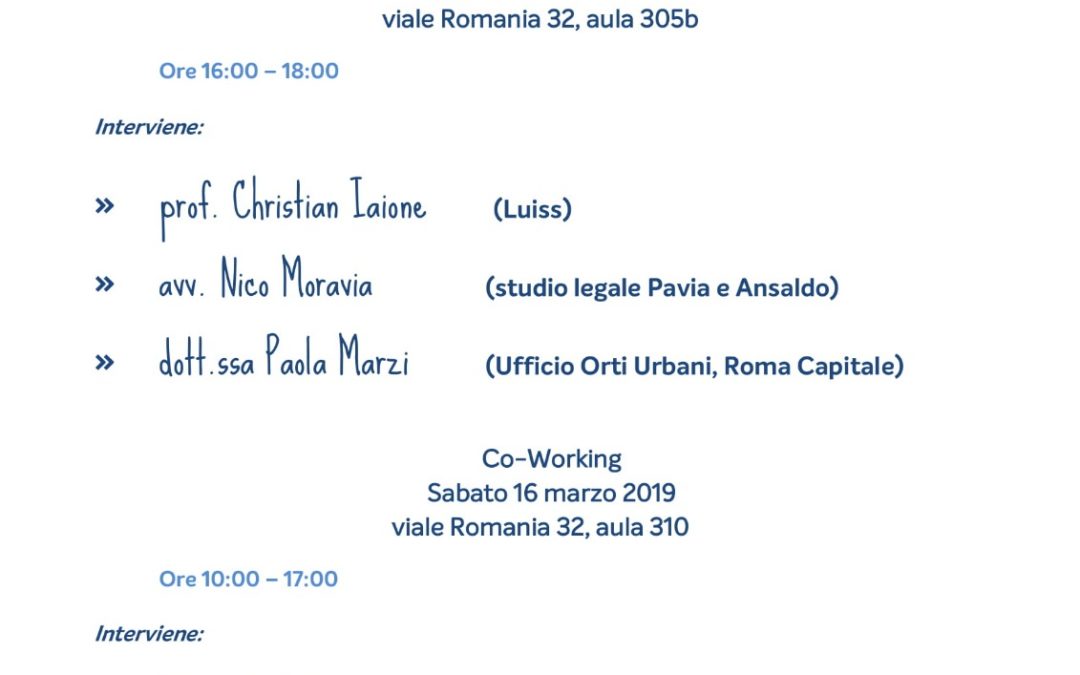
The third workshop of the Urban Clinic EDU@LabGov 2019 took place on Friday the 15th of March into the Viale Romania Campus of LUISS University. The workshop has inaugurated the start of the third module of the course. The module was dedicated to “Urban Law and Policy”. Indeed, the Laboratory hosted three important experts on these themes: prof. Christian Fernando Iaione, lawyer Nico Moravia, and dr. Paola Marzi.
Prof.
Iaione, the scientific co-director of LabGov, teaches Urban Law and Policy and
Urbanistic Law at LUISS University.
Lawyer
Moravia is partner of the law firm Pavia-Ansaldo (administrative law department).
Dr. Paola
Marzi is an official of the municipality of Rome as Head of the office for the
Urban Gardens, and has a long experience on these themes since she has
participated in the drafting of the Regulation of Urban Gardens of Rome.
The
workshop was introduced by the speech of Prof. Iaione, who talked about his
experiences in the urban regeneration field. He exposed the project of
Co-Bologna (http://co-bologna.it/): the
program started 7 years ago and its effects were such as to spread his
principles in Italian cities like Turin, Rome and Reggio-Emilia, but also in
others parts of the world like New York, Amsterdam and Sao Paulo.
All these
experiences demonstrated how important is to rewrite administrative and
urbanistic legislation in order to face all the problems brought in the cities
by the changes of the third millennium. What is fundamental in this process is
the participative paradigm, that means involving as much as possible all the
different urban stakeholder in order to re-define the way of living the urban
centers.
Indeed, lawyer
Moravia showed how it worked in the roman context, by showing the case of the
Ex-Dogana: an un-used space, owned by Cassa Depositi e Prestiti, brought back
to life by the efforts of four young entrepreneurs. The cohesion of legal,
human and economics competences, made possible to find a new and simple
solution, like a temporary leasing contract, and create what now is one of the
most important experiences of this kind in Rome.
One of the
sectors where the participative paradigm is more successful and better applied
is the urban garden’s one. Dr. Marzi explained how gardens are the place where
it is possible to focus all the energies and differences of a neighborhood, not
only as a place where plants grow, but as an instrument of social inclusion,
that generates wellness and new solutions to co-live the city by building up new
forms of community.
Co-Working
The 3rd
Module of the Urban Clinic LabGov EDU 2019 continued with the Co-Working
session, held on March 16th. The co-working session is facilitated
by Chiara De Angelis, Friends of LabGov’s ex-president.
The
Co-Working session took place in the LUISS Campus of Viale Romania and it started
at 10 am with Pasquale Tedesco’s testimony, expert of Confagricoltura (http://www.confagricoltura.it/ita/).
He talked about
the importance of the relationship between Earth and Nature and the fortune to
enjoy some products that Earth offers.
After this
inspirational session, Chiara De Angelis explained the Labgovers service
design, an important passage to complete and improve the idea that they’re
developing during this A.A. of LabGov EDU. For this reason, the LabGovers were
divided into groups in order to select the “personas” (consumer type) of their
product/service, basing on their previous research.
In the afternoon, the LabGovers developed the user journey map to describe the possible experience consumers might have through the platform that they are developing.
Save
the date: next Saturday, 9th March we will host the first EDU@LabGov
community gardening session in Luiss Community Garden from 10 am to 12am.
The
LabGovers will work with recycled materials in order to build a prototype that
they will install in Luiss and in the city of Rome. If you are interested in
following their work, follow our official social network!
During
the community gardening session, the LabGovers will put into practice what they are learning during the forms in the classroom
therefore it will represent ahead important footstep in the realization of
their project.
The assisted gardening is not only a didactic
moment but an activity of practical collaborative among the boundaries of the University
Luiss Guido Carli, that then the students will experiment on the field in the
city of Rome.
Stay tuned!
Save the date: Sabato 9 marzo si terrà
il primo community gardening della Clinica Urbana EDU@LabGov presso l’#OrtoLuiss
dalle 10:00 alle 12:00.
Durante la sessione di community
gardening i LabGovers, divisi dapprima in quattro gruppi sulle diverse aree di
lavoro, dovranno presentare i dati raccolti nel corso della settimana e
iniziare a dar forma al loro progetto. Inizieranno quindi un laboratorio di
auto-costruzione che, tramite l’utilizzo di materiali riciclati, li porterà a
realizzare un prototipo che installeranno nella città di Roma. Se volete
saperne di più rimanete connessi ai nostri account social ufficiali quel
giorno!
L’obiettivo
è mettere in pratica ciò che gli studenti stanno apprendendo durante i moduli
in aula, quindi rappresenterà un importante passo avanti nella realizzazione
della loro idea.
Il gardening assistito non è solo un
momento didattico ma un’attività di pratica collaborativa tra le mura
dell’Università Luiss Guido Carli, che poi gli studenti sperimenteranno sul
campo nella città di Roma.
The Open Heritage Second Consortium Meeting will be held on the 28th and 29th of November. Open Heritage is an Horizon 2020 research project that identifies and analyses good practices of adaptive heritage re-use, and tests them in selected Cooperative Heritage Labs in six European cities. Open Heritage is formed by a consortium composed of research institutions, universities, financial organisations, developers and community involvement experts that studies existing policies and legal frameworks, development procedures, multi-stakeholder cooperations, crowdsourcing mechanisms, financial instruments and shared management formats. LUISS is a partner of the Open Heritage project, working on both the comparative analysis of observatory case studies and on field experimentation, with the Rome Collaboratory (Centocelle; Alessandrino; Torre Spaccata).
During the two day Consortium meeting the partners will share the progresses of their research and work together on the challenges. During the meeting there will also be a way to talk about Work Package 2, where LUISS is task leader of the comparative analysis of 16 comparative case studies (the “Observatory Cases”). This analysis will be very useful to provide new ideas for the six CHLs, the six Cooperative Heritage Labs where the governance model for the adaptive heritage reuse will be tested. One of the CHL will be carried out by LUISS, the “Rome collaboratory” which will work on the footsteps of the Co-Rome process and develop a sustainability mechanism for innovative adaptive re-use of cultural heritage.
Among others, the Consortium will be attended by: Ania Rok and Iryna Novak (ICLEI), Beitske Boonstra and Karim van Knippenberg (UGENT), Heike Overmann and Markus Kip (UBER), Sofia Dyak (Center for Urban History), Hanna Szemző and Andrea Tönkő (MRI), Loes Veldpaus, John Pendlebury (UNEW), Levente Polyák, and Daniela Patti (EUTROPIAN). Representing LUISS Dr. Benedetta Gillio and Professor Christian Iaione will participate to the meeting.
On October the 14th, LabGov started the first co-working session in which Paola Santoro, an expert designer, exposed the “hero’s journey” having as protagonists Alessandra and Urio: the spokespersons of the raising Community of the Public Park of Centocelle. This is the #Co-Rome project (www.co-roma.it): an audacious initiative in which achievements and failures characterized the essence of the challenge.
The core topic of the meeting was to understand,also through creative games, what is “la facilitazione dei beni comuni”, more specifically how LabGov assisted the community as mentors, not imposing themselves as superior entities capable of solving problems, rather as an enterprising group that can offer them all the means to improve the environmental situation of a public park, with the common goal to fill-in the gap between the community’s unsatisfied social reality and the dreamed one. This “green” forgotten area, that at a first glance might appear as common as any other park in Rome, deep inside has embedded all the shared values that gradually arose once that a touch-point between the park’s users and the object used was fixed.
Dal 26 al 30 settembre 2016 presso il Palazzo Mediceo di Ottaviano, bene confiscato alla camorra, si svolgerà la IV edizione della summer school di Libera Campania. Il tema generale di studio scelto quest’anno è “Libera il welfare: i beni confiscati per un nuovo modello di sviluppo”. I 20 giovani tra i 18 e i 35 anni selezionati tramite il bando diffuso da Libera Campania approfondiranno, con vari esperti, il concetto di welfare universale ed inclusivo come fondamento di un nuovo modello di sviluppo sostenibile. L’ambizioso ed innovativo obiettivo della scuola è quello di formare giovani che possano fondare la loro attività imprenditoriale si due tratti distintivi: innovazione e responsabilità sociale. In questo contesto assumono grande rilevanza i casi di gestione di beni confiscati, in quanto forme d’impresa sociale dove l’attivismo antimafia converge verso la responsabilità sociale. Questo genere di esperienze, infatti, permettono di attivare forme di imprenditorialità creativa ed innovativa, e riescono, grazie all’indotto economico che generano e al lavoro svolto in sinergia dai vari attori coinvolti, ad ottenere forte consenso per generare un futuro migliore.
Christian Iaione, co-fondatore di LabGov, sarà presente in qualità di relatore martedì 27 settembre nel pomeriggio, durante la sessione dedicata al tema “I distretti di economia civile“, insieme ad Enrico Fontana (Legambiente) e Alessandra Clemente (Assessore del Comune di Napoli), per parlare dei beni comuni come energia per lo sviluppo economico locale di comunità.