
by Benedetta Gillio | Mar 2, 2016 | EducationLabs, Luiss LabGov 2015-2016
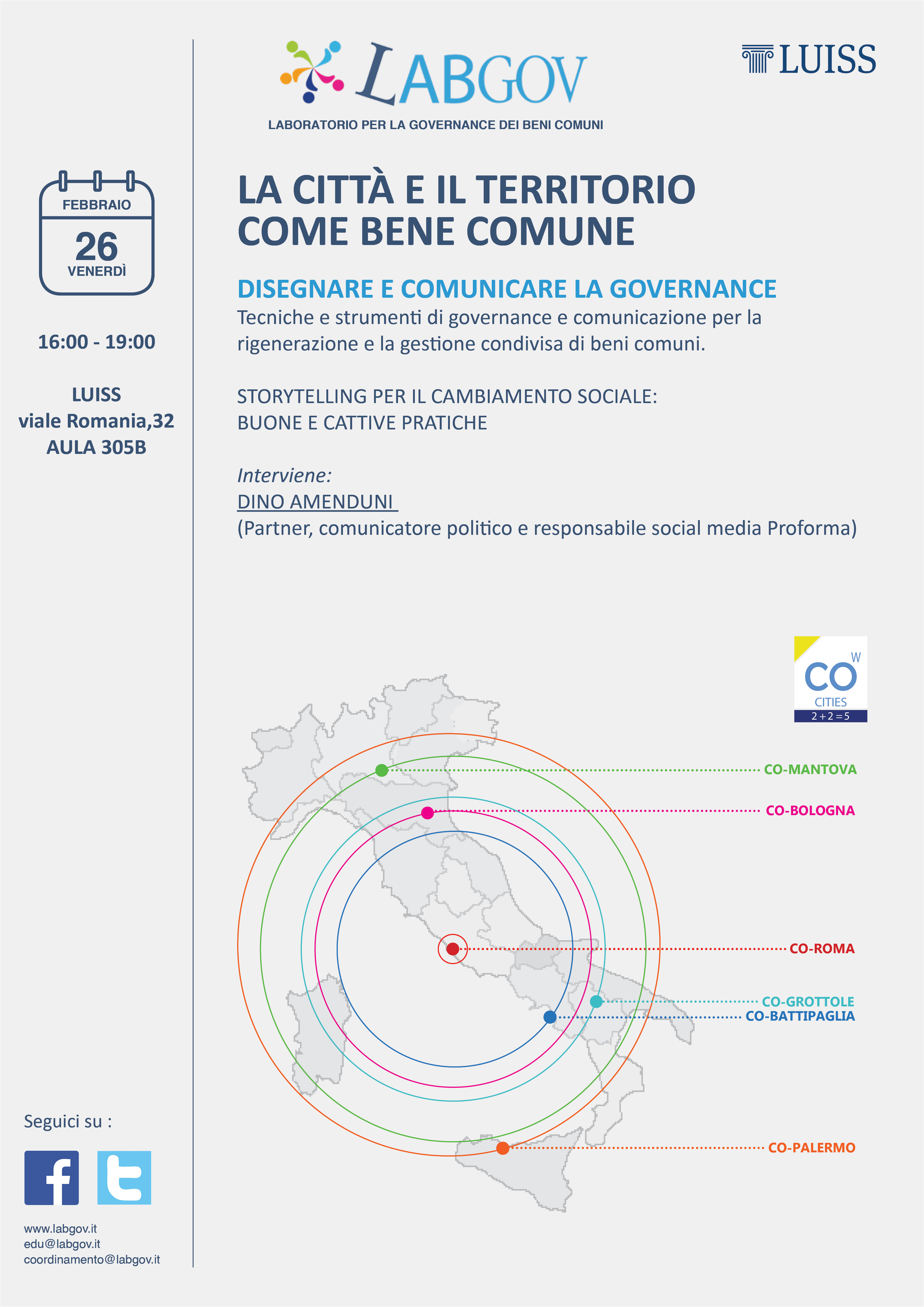
Dino Amenduni, political communicator and Proforma partner who first formulated the idea and the logo of the co-cities, was the star of the workshop organized by LabGov last February 26.

The topics covered in his lecture were Storytelling and digital reputation.
The practice of storytelling has gradually changed over the years, even with the changing of the objectives that communication has tried to achieve in meeting the needs of “commercial” society. Until 1990, the main goal of communication was the sale of a product, but in the subsequent years it was realized that the brand’s credibility depended on the success or failure of a product. So there has been a passage through a product communication to a brand communication. Since 2000 the most used technique in the world of communications is first to tell stories that can capture the attention of the advertising recipient to make such a product more “personalized” and not something completely objective and generalized. Look for and chasing original ideas that are affordable for everyone. How you answer a success story? With a story of the same calibre, the same characteristics, and never with different characteristics. Doing a good storytelling implies the awareness of having daily a good story to tell, even more if there is a witness aware of that story it would be better to make him tell the story so as to achieve better result. Needed is the consistency between the message and biography; even more important is the credibility of the narrator and the message itself. The most effective stories are those that promote the knowledge sharing , that incite to act, which impart values, the ones that talk about the future inspired by the past. An example of a successful storytelling was the ValigiaBlu Case, about the independent journalism, in which Amenduni himself was involved: built a crowdfunding campaign based on a series of compensations, on a written appeal explaining the project, the kind of journalism (of quality) promoted by Valigia Blu and the economic aim. Crowdfunding is not easy to realize, but if done right leads to excellent results. The campaign worked thanks to the reputation of Valigia Blu, compensations, transparency, a follow-up guarantee, preparatory work, solidity and homogeneity of the working group.
The digital reputation is instead what others think about a particular brand or product or records that can characterize the person of whom you are dealing. Very important is the self-irony and reveal first a point of weakness so as to make it become a strength point. What matters in the communication field is the speed of the proceedings, “staying on track” as journalists would say; It matters most a mediocre element but of immediate impact and dissemination, rather than a well done content but which has yet to be disclosed. The importance of the involvement of all members of the organization and the homogeneity in the actions of the same since the digital reputation is built in the same way by everyone. An example of what is called real time marketing occurred during the blackout that happened during the Super Bowl in the United States: the team of the famous brand OREO within only six minutes was able to make a compelling advertising of them cookies realizing ironic image that took over what was happening at that time ( OREO cookies can be soaked in the dark) capturing the attention of millions of viewers making sure a more than effective advertising. This all because in recent years there are creating random public that can only be intercepted through social and which are unrepeatable. Therefore the communication chain will need to be reviewed in the future.
How can this all be useful for us? In the process that is taking shape in Co-Roma, communication will play a major role in involving even more actors in the collaborative process also for establishing a relationship of trust. As Professor Iaione has repeatedly pointed out, the course that is being established in this “city of a hundred cities”, that is Rome, must be persuasive and for this in turn the communication must be captivating, since you can not always enter a city by the same door.
——————————————————————————
Dino Amenduni, comunicatore politico e partner di Proforma che per primo ha formulato l’ idea ed il logo delle co-città, è stato protagonista del workshop organizzato da LabGov lo scorso 26 Febbraio.
I temi trattati nella sua lezione sono stati Storytelling e reputazione digitale.
La pratica dello storytelling è progressivamente cambiata nel corso degli anni, anche con il mutare degli obiettivi c he la comunicazione ha cercato di raggiungere nel soddisfare le esigenze della società “commerciale”. Fino al 1990 l’obiettivo della comunicazione è stato la vendita di un prodotto, tuttavia negli anni successivi ci si è accorti che dal successo o dal fallimento di un prodotto dipendeva la credibilità del brand. Così si è passati da una comunicazione di prodotto ad una comunicazione di brand. A partire dal 2000 la tecnica maggiormente utilizzata nel mondo della comunicazione è quella di raccontare prima di tutto storie che possano catturare l’attenzione del destinatario della pubblicità per rendere così un prodotto maggiormente “personalizzato” e non una cosa del tutto oggettiva e generalizzata. Cercare e rincorrere idee originali che siano alla portata di tutti. Come si risponde ad una storia vincente? Con una storia dello stesso calibro, dalle stesse caratteristiche e mai con caratteristiche differenti. Fare un buon storytelling implica la consapevolezza di avere quotidianamente una buona storia da raccontare, in più se c’è un testimone a conoscenza di quella stessa storia è bene farla raccontare a lui così da ottenere risultato migliore. Necessaria è la coerenza tra messaggio e biografia; importantissima la credibilità del narratore e del messaggio stesso. Le storie più efficaci sono quelle che favoriscono la condivisone di conoscenze, che incitano all’azione, che trasmettono valori, che parlano di futuro prendendo spunto dal passato. Un esempio di storytelling di successo è stato il Caso ValigiaBlu, sul giornalismo indipendente, di cui lo stesso Amenduni ne è stato protagonista: costruita una campagna di crowdfunding basata su una serie di ricompense, su un appello scritto che spiegava il progetto, il tipo di giornalismo ( di qualità ) promosso da Valigia Blu e l’obiettivo economico. Il crowdfunding non è semplice da realizzare, ma se fatto bene conduce ad ottimi risultati. La campagna ha funzionato grazie alla reputazione di Valigia Blu, ricompense, trasparenza, garanzia di un follow up, lavoro preparatorio, solidità e omogeneità del gruppo di lavoro.
Le reputazione digitale è invece ciò che gli altri pensano di un determinato brand o prodotto o dei trascorsi che possono caratterizzare il personaggio di cui si sta trattando. Molto importante è l’autoironia e svelare per primi un punto di debolezza così da farlo divenire un punto di forza. Ciò che conta nell’ambito della comunicazione è la celerità della stessa, “stare sul pezzo” come direbbero i giornalisti; conta maggiormente un elemento mediocre ma di immediato impatto e divulgazione, piuttosto che un contenuto benfatto ma che tarda ad essere divulgato. Importanza del coinvolgimento di tutti i membri dell’organizzazione e un’omogeneità nelle azioni degli stessi dal momento che la reputazione digitale è costruita in ugual modo da tutti. Un esempio di quello che viene definito real time marketing si ebbe durante il black-out avutosi durante il super bowl negli Stati Uniti: il team del famoso brand OREO nel giro di soli sei minuti fu in grado di realizzare un avvincente spot pubblicitario dei suoi biscotti realizzando un’immagine ironica che riprendeva quanto in quel momento stava accadendo ( I biscotti OREO li puoi inzuppare anche al buio) riuscendo a catturare così l’attenzione di milioni di telespettatori assicurandosi una più che efficace pubblicità. Tutto questo perché negli ultimi anni si stanno creando dei pubblici casuali che possono essere intercettati solo tramite i social e che sono irripetibili. Bisognerà quindi rivedere in futuro la catena di produzione della comunicazione.
Quanto a noi può essere utile tutto ciò? Nel processo che si sta delineando in Co-Roma la comunicazione giocherà un ruolo importante nel coinvolgere sempre più attori nel processo di collaborazione anche per istaurare un rapporto di fiducia. Come il Professor Iaione ha più volte ricordato, il percorso che si sta instaurando in questa “città dalle cento città” che è Roma deve essere convincente e per questo a sua volta la comunicazione deve essere coinvolgente, dato che non si può entrare in una città sempre dalla stessa porta.
by Benedetta Gillio | Feb 22, 2016 | EducationLabs, Luiss LabGov 2015-2016
On the 26th of February the keynote speaker will be Dino Amenduni, one of the best international experts in social communication. He is partner of Proforma, the communication agency who d esigned the campaigns of political characters as Vendola and Renzi, of organizations such as CGIL, of companies and various multinationals.
We will ask him advices on how to communicate our project ( CO-Roma ) to the city and how to mobilize the resources of the crowd. We are going to talk about storytelling, what is and where storytelling came from .
Firstly he will explain us how to make a campaign through ten fundamental points. In a second moment, LabGov will discuss with him about his last project and his work of Rome’s commons mapping: LabGov is waiting for Dino Amenduni and his suggestions. Nowdays communication and how to comunicate is the first step to bring the projects to succeed; Dino Amenduni will share with us him knowledge about it.
————————————————————————————-
Il 26 febbraio il keynote speaker sarà Dino Amenduni, uno dei maggiori esperti nazionali di comunicazione social. È partner di Proforma, l’agenzia di comunicazione che pensato le campagne di comunicazione di personaggi come Vendola e Renzi, organizzazioni come CGIL, aziende e multinazionali varie. Chiederemo a lui consigli su come comunicare il progetto nella città e su come mobilitare le risorse del crowd per contribuire con noi alla mappatura.
rticle written by many hands from Benedetta Gillio, Adriana Marasco
by Christian Iaione | Feb 15, 2016 | EducationLabs
Adam Smith used the image of the Leviathan State to depict the command-and-control State, Vincent Ostrom together with some collegues coined a new image for the welfare state.
Since Reagan and Tatcher attack on Big Government, advocating for Small Government, until the moderate progressives decide to come to terms with conservatives and dilute the idea of Big Government, suggesting to take a third way (Blair and Clinton) which is after all bigger Government than Small government and a smaller government than Big Government.
Obama kicks in and at least start a new discourse. “It’s not an issue of big government versus small government. It’s an issue of smart government“. He says in 2010. That’s something similar to what I purported for local government in 2006 with local public entrepreneurship, which will then better framed and expanded to the national level by Marianna Mazzuccato who spke of an “entrpreneurial state”. But we were not framing the question in the right way. I started studying government through the lenses of the people and no longer through the lenses of an expert studying and advising government, local or national. In 2008 I started studying government through the lenses of city inhabitants. And there I realized we should have asked what Bob Reich today calls the most was able to conclude with
Ubuntu is a complete desktop Linux operating system, freely available with both community and professional support. The Ubuntu community, backed by Canonical, is built on the ideas enshrined in the Ubuntu Manifesto: that software should be available free of charge, that software tools should be usable by people in their local language and despite any disabilities, and that people should have the freedom to customise and alter their software in whatever way they see fit. “Ubuntu” is an ancient African word, meaning “humanity to others”. The Ubuntu distribution brings the spirit of Ubuntu to the software world. Ubuntu 12.04 LTS is the current long term support version, released in April 2012, codenamed Precise Pangolin. Take an online tour: http://www.ubuntu.com/tour/en/
by Benedetta Gillio | Dec 23, 2015 | EducationLabs, Luiss LabGov 2015-2016
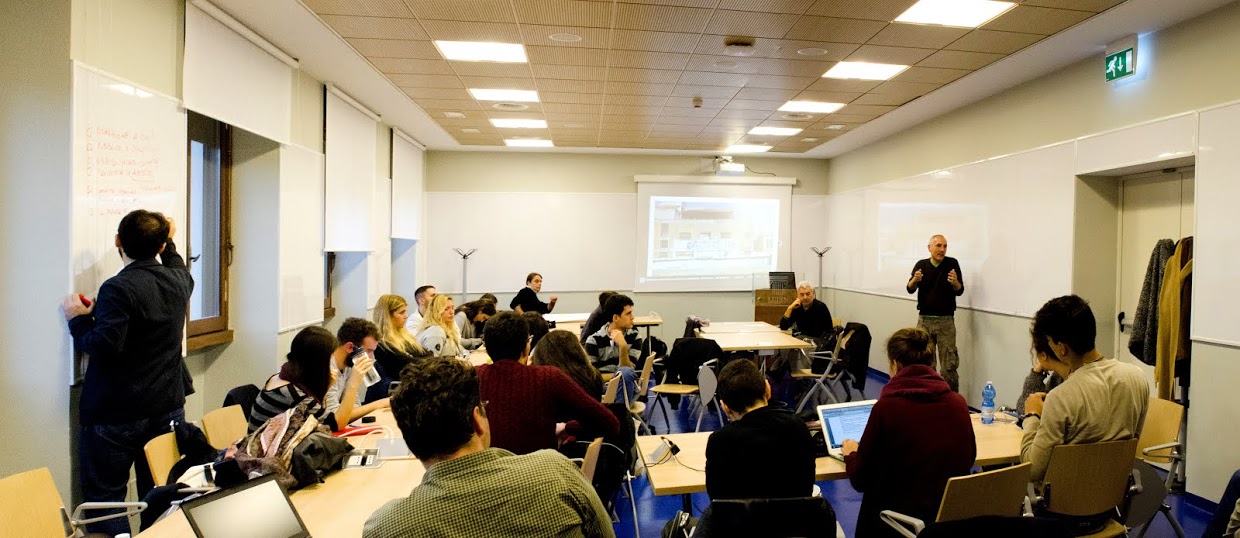
 On Friday November 20th , the first day of the LabGov weekend, was dedicated to the activities of co-design. The labgovers listened the experiences carried out in the four sites of experimentation identified: Garbatella, Appia Antica, Ostia and Municipio V.
In each of the four areas, the new labgovers have visited some really active environments meeeting and their activators and founders. Together they reasoned about the difficulties they face every day and how to intervene to continue to carry on their efforts, with strong aggregation and deep innovation. At Garbatella, for example, they have been visited the co-working Millepiani, the CSOA La Strada and the FabLab. These collaborative spaces, as explained Maurizio Moretti, are signals of the needs and demand of citizens. In every field, they found more or less the same problematic situations, with this lack of dialogue with the administration every obstacles seems giant.
In particular, in the neighborhood a common good of cognitive nature of Ostia was identified, namely the Istituto Tecnico Urbani, a high school with great potential. It is a school characterized by a very proactive teaching body, but at the same time a place in unsuitable conditions, nearby a very large and completely abandoned park. The situation is further complicated by the detached school of Acilia, which has the same administration and headmaster that is facing enormous difficulties due to the management of the two institutions apart from each other. The idea is to intervene to make the most of these cognitive and cultural heritage useful for the students and citizens,most of the hardest part of the project is to find the necessary funds to buy the materials for the schools and teachers to enable them to work better.
Another school has been mapped Pisacane school in the district Prenestino, a real intercultural concentration in one of the Romans with the highest number of immigrants. In Municipio V, in addition to the school, other milestones have been the Alveare and the former factory Cantarini. The Alveare is one of the first co-working space with Babysitting in Rome, as the main problem of the allocation of space now expiring. you need to find a way clear and quick assignment of collaborative spaces to ensure the many citizens and professionals who revolve around them to continue their activities. Another stop on Municipio V has been precisely the former factory Cantarini, an abandoned industrial area in 2014 that could become an important resource for the whole neighborhood.
Finally, the inspection of the Appia Antica Park was primarily organized in three milestones: the first in the Hortus Urbis, not a simple garden! The Labgovers listened to the stories and experiences of some of the people who work there, it is a real place of integration and dissemination of knowledge. They were subsequently visited the Cartiera Latina, a structure which often hosts exhibitions and conferences, and the Casale di Vaccareccia, for now largely abandoned. They focused on another highly critical point of the park represented by the mobility obstacle, in particular cycling is practically impossible.
This was followed by a moment of co-design, during which the labgovers, having posted placards, each with a theme, started to write on post-its their ideas, highlighting on the critical issues, opportunities and actions to solve the various problematic ideas identified. Then a moment of confrontation follows with experts from various sectors, such as Roberta Franceschinelli, creator of the Culturability Competition for the foundation Unipolis, Prof. Luigi Corvo, who stressed the importance to intercept the civic need to intervene where there is a more concrete need.
This concept was then taken up by Michele Gradoli, who argued that the objective must be thought in concrete and deep manner with a strong knowledge of the places where you are going to work. Instead ,Nicola Cabria for Human Foundation invited the labgovers to take this model of analysis in all areas of life: turning problems into opportunities, reversing the negative situation into a positive is the best mantra.
The architect Eloisa Susanna recalled that the temporary use can be a very important tool for urban regeneration that allows the immediate reactivation of the abandoned areas.
The second day, November 21st, was divided into two parts: the first during which Giorgio De Finis, director of the MAAM (Museo dell’altro e dell’Altrove), told them about the Museum and its development, and second part during which the students, around the tables of co-design, continued to give shape to their ideas in the search for the termination to the problems and limits identified for each common good.
The tables of co-design and, more generally, these two days have shown what can be challenged, and what Rome really needs. All this first phase, in fact, served just to try to understand the city, its problems, its needs and desires. We understand that it will be a long and difficult process, but so worth it to wait and to get busy on.
————————————————————
Sessione di co-progettazione del 20/21 Novembre
La prima giornata del workshop, venerdì 20 Novembre 2015, è stata dedicata alle attività di co-progettazione. I ragazzi hanno raccontato i sopralluoghi effettuati nei quattro cantieri di sperimentazione individuati: Garbatella, Appia Antica, Ostia e Municipio V.
In ciascuno dei quartieri, i nuovi labgovers hanno visitato alcune delle realtà attive e hanno conosciuto i loro attivatori; insieme hanno ragionato sulle difficoltà che incontrano ogni giorno e su come poter intervenire per continuare a svolgere le proprie funzioni di formazione, aggregazione e innovazione. A Garbatella, ad esempio, è stato visitato il co-working Millepiani, il CSOA La Strada e il FabLab. Questi spazi collaborativi, come ha spiegato in un secondo momento l’arch. Moretti, tra le loro funzioni hanno quella di segnalare i bisogni e le richieste dei cittadini. Riscontrano tutti più o meno la stessa problematicità, ovvero il mancato dialogo con l’ amministrazione, i cui tempi e meccanismi di funzionamento non sono altro che un ostacolo.
In particolare, nel quartiere di Ostia è stato individuato un bene comune di natura cognitiva, ovvero l’Istituto Tecnico Urbani. Si tratta di una scuola caratterizzata da un corpo docenti molto propositivo e desideroso di fare, ma al tempo stesso da luoghi in condizioni non idonee, ad esempio uno spazio verde, adiacente alla scuola, molto grande e completamente abbandonato. La situazione è resa ancor più complicata dalla sede distaccata di Acilia, che ha la stessa amministrazione che quindi incontra enormi difficoltà dovute anche alla gestione dei due istituti distanti l’uno dall’altro. Bisognerebbe intervenire e riuscire a sfruttare al meglio questi beni cognitivi e culturali e trovare i fondi necessari per acquistare i materiali utili agli studenti e ai docenti per metterli nelle condizioni di lavorare al meglio.
Altra scuola mappata è stata la scuola Pisacane, nel quartiere Prenestino-Centocelle, un vero e proprio presidio interculturale in uno dei quartieri romani con il più alto numero di immigrati. Nel Municipio V, oltre alla scuola, altre tappe sono state l’Alveare e l’ex fabbrica Cantarini. L’ Alveare è uno dei primi co-working con spazio baby di Roma, ha come problema principale quello dell’assegnazione di uno spazio ormai in scadenza. E’ necessario trovare una modalità chiara e rapida di assegnazione degli spazi collaborativi in modo da garantire ai tanti cittadini e professionisti che ruotano intorno ad essi di proseguire le loro attività. Altra tappa del Municipio V è stata appunto la ex fabbrica Cantarini, un’area industriale dismessa dal 2014 che potrebbe diventare una importante risorsa per tutto il quartiere.
Infine, ma non per questo meno importante, il sopralluogo nel Parco dell’Appia Antica organizzato essenzialmente in tre tappe: la prima nell’Hortus Urbis, non un semplice orto! Ascoltando le storie ed esperienze di alcuni dei soggetti che vi operano, si tratta di un vero e proprio luogo d’integrazione e diffusione di conoscenze. In seguito sono stati visitati la Cartiera Latina, struttura che ospita spesso mostre, convegni, (anche se va registrato un suo grande limite: l’assenza di un impianto di riscaldamento non ne consente il suo pieno utilizzo), ed il Casale della Vaccareccia, ormai per gran parte in stato di abbandono. Un’altra grande criticità del parco è rappresentata, inoltre, dalla mobilità, in particolare ciclabile, praticamente impossibilitata.
A ciò è seguito un momento di co-progettazione, durante il quale i ragazzi, dopo aver affisso dei cartelloni, ciascuno avente un tema, hanno iniziato a scrivere su dei post-it le loro idee, evidenziando le criticità, le opportunità e le azioni possibili per risolvere le varie problematicità individuate. A seguire un momento di confronto con esperti di vari settori come Roberta Franceschinelli, ideatrice del Concorso Culturability della fondazione Unipolis, il Prof. Luigi Corvo, che ha sottolineato l’ importanza di intercettare il bisogno civico e di intervenire laddove c’è una maggiore concretezza di intervento.
Quest’ultimo concetto è stato poi ripreso da Michele Gradoli, sostenendo che bisogna pensare all’obbiettivo in concreto e conoscere approfonditamente i posti su cui si sta andando a lavorare. Nicola Cabria, per Human Foundation, ha invitato i ragazzi ad assumere questo modello di analisi in ogni campo della vita: trasformando i problemi in opportunità, ribaltando la situazione negativa in positiva. L’architetto Eloisa Susanna ha ricordato come l’uso temporaneo possa essere uno strumento di rigenerazione urbana molto importante che consente la riattivazione immediata di spazi abbandonati, come ad esempio nel caso delle aree industriali dismesse e Maurizio Moretti di ADLM architetti ci ha mostrato in un video come questo tema potrebbe essere declinato all’interno del V Municipio.
La giornata successiva del 21 Novembre si è divisa in due momenti: un primo durante il quale Giorgio De Finis, direttore del MAAM (Museo dell’ Altro e del’Altrove), ha raccontato di come è nato il Museo e dei suoi sviluppi, ed un secondo momento durante il quale i ragazzi, attorno a dei tavoli di co-progettazione, hanno continuato a progettare, a dare una forma alle proprie idee nella ricerca di quella risolutiva per i problemi e limiti individuati per ciascun bene comune.

I tavoli di co- progettazione e, più in generale, queste due giornate hanno dimostrato quanto possa essere stimolante ed efficiente unire le forze, ed è proprio quello di cui ha bisogno Roma. Tutta questa prima fase, infatti, è servita proprio a cercare di capire la città, i suoi problemi, i suoi bisogni e desideri, con la consapevolezza che sarà un processo lungo e difficile, ma per cui vale la pena di aspettare e soprattutto darsi da fare.

by Diletta Di Marco | Dec 22, 2015 | EducationLabs, Luiss LabGov 2015-2016
On 13 November at the LUISS Campus of Viale Romania, LabGovers met several experts who carried out in Rome experiences of digital, institutional and scientific mapping.

With them they discussed on the importance of mapping as a tool of knowledge and reaserch on the territories, as well as an opportunity to adopt a different view and a chance to experiment alternative ways to transform the city. Mapping means to find places, structures, realities and, consequently, activators of innovation. Namely those people who “lit the spark” transforming the urban assets (tangible and intangible) in commons. The first speaker was Ilaria Vitellio, urban planner and founder of Mappina, a platform of collaborative mapping that gives a different view on cultural cities through critical contributions of its inhabitants. Her project was born in Naples, including 430 mappers, the core idea is to enable anyone to geotag photos, videos, sounds and texts to redefine the image of the city by its own subjects. Here mapping the city goes through a collective narrative experience. Mappina uses online activities, they organize several workshops on “mapping and re-imagining” the abandoned spaces to reclaim these places according to their actual needs and according to desires of the citizens. The collaborative mapping allows not only to read a map, but it can be rewritten based on the experiences and knowledge of the community on which it is tailored and to which it is addressed.
The evening continued with Liliana Grasso, Mattia Diletti, Silvia Lucciarini, researchers and coordinators of MappailPD, a project born with the aim of assessing the path of the Democratic Party in Rome.
This kind of method try to find the strengths and weaknesses, the good aspects as well as the negativities of the city, starting with the construction of a base-quantitative data analysis relative to the circles of the Democratic Party and economic and social areas of the city.
The main use of this PD maps is to identify for each area the ability to understand and represent the needs, especially the ones of the most vulnerable neighborhoods, they try to attract young people and their skills to adopt new participation methods.
The meeting then continued with Stefano Simoncini, speaker for the project RETER Mutazioni Urbane, an experiment of critical and collaborative mapping through an extensive network of local associations, committees, local authorities and university departments.
The labgovers had the opportunity to reflect on the complexity of the space that daily determines our lives conditioning our lifestyles and wellbeing. This “geosocial sphere” is a third space, where you can create a new dimension and protype a functional map for the territory in favor of collective intelligence. The discussion continued with Giulia Pietroletti, deputy in charge for the Public Administration in Rome. She told of this part of the city, the Municipio V, with the highest rate of immigrants for residents, characterized by a very active and proactive citizenship as a perfect field for experimentation. She showed us the “Charter of Regeneration” in which it were collected all the different realities of the City of Rome, divided into areas (natural, archaeological, historic) to preserve the need for care and attention of our heritage.
Therefore, there is an increasingly evidence that we need a new development model, which allows these places to become the cultural centers for active citizenship and to see realized the desires of the citizens living in these degrading situations. Finally took the floor, Maurizio Moretti, creator of a mapping work on the Municipio V, based on subsidiarity ,which showed this city as an example of active citizenship.
The problem is the fact that there is a tangible desire to reuse the abandoned spaces, but their problematic nature result by the fragmentation of responsibilities obstacle this idea of innovation. It is necessary, therefore, to intervene in these realities to implement democratic experimentalism and collaborative citizenship to create a real impact.
——————————
CONOSCERE PER SAPERE
Workshop 13 novembre: La mappatura e lettura del territorio
 Nella giornata del 13 Novembre, nella sede di Viale Romania della LUISS Guido Carli, i ragazzi di LabGov hanno incontrato diversi esperti, che hanno portato avanti a Roma esperienze di mappatura digitale, istituzionale e scientifica. Con loro hanno discusso e riflettuto sull’ importanza Della mappatura come strumento di conoscenza e ascolto dei territori che apre ad un diverso sguardo, una occasione per sperimentare modi alternativi di attraversare e di trasformare la città.
Con questo termine si indica l’ individuazione di luoghi, strutture, realtà, e, di conseguenza, dei vari attivatori, ossia quelle persone che “accendono la scintilla” trasformando tali assets ( materiali e immateriali ) in beni comuni. Ed è importante per capire come si può e si deve intervenire al meglio.
La prima a prendere la parola è stata Ilaria Vitellio, urban planner e fondatrice di MappINA, una piattaforma di collaborative mapping che dà un’immagine culturale diversa delle città attraverso il contributo, critico ed operativo, dei suoi abitanti. Un progetto nato a Napoli, che prevede la partecipazione di 430 mappers, e che consente a chiunque di georeferenziare foto, video, suono e testi e che contribuisce a ridisegnare l’immagine della città ad opera dei suoi stessi abitanti. La mappatura intesa quindi come narrazione collettiva. Alle attività on line vengono organizzati diversi laboratori di mappatura e di reimmaginazione degli spazi abbandonati con l’ obbiettivo di riappropriarsi di questi spazi ripensandoli secondo gli effettivi bisogni e desideri dei suoi abitanti. Si è discusso, poi, dei vari progetti di cui si è occupata e, più in generale, della collaborative mapping, una nuova attività che permette non soltanto di leggere una mappa, ma di poterla riscrivere in base alle esperienze e ai saperi della comunità su cui poggia e a cui si rivolge.
La riflessione è continuata con Liliana Grasso, Mattia Diletti, Silvia Lucciarini, ricercatori e coordinatori di MappailPD, progetto nato con l’ obiettivo di valutare l’operato del partito democratico a Roma una “mappatura” dei punti forza e di debolezza, del buono e del cattivo, dei singoli circoli della città. La mappatura è partita dalla costruzione di una base-dati quantitativa relativa ai circoli del PD e allo stato economico-sociale dei territori della città per poi individuare per ogni circolo la capacità di comprendere e rappresentare i fabbisogni, specie della parte più vulnerabile della città; di attrarre giovani e competenze; di adottare metodi nuovi di partecipazione. Per fare ciò è stato necessaria la diffusione di un questionario, per poter capire come intervenire e risolvere i punti deboli del partito.
È intervenuto, poi, Stefano Simoncini, che si occupa del progetto RETER Mutazione Urbane, un esperimento di cartografia critica e collaborativa in fase di realizzazione attraverso un’ampia rete territoriale di associazioni, comitati, enti locali, dipartimenti universitari già attivi in questo ambito o dotati di strumenti e banche dati utili. I ragazzi hanno avuto l’occasione di riflettere sulla complessità dello spazio, aumentata in seguito alla nascita -del web che contrapponendosi a quello concreto, della vita quotidiana determina condizionamenti non indifferenti.Il geosocial è una terza spazialità, dove è possibile creare una nuova dimensione e mappe funzionali al territorio in favore dell’intelligenza collettiva.
La discussione è proseguita con Giulia Pietroletti, Assessore all’ambiente, decoro, intercultura e innovazione nella Pubblica Amministrazione nel Municipio Roma V. Municipio con il più alto tasso di immigrati e residenti, caratterizzato da una cittadinanza molto attiva e propositiva. L’Assessore ci ha mostrato la Carta della Rigenerazione in cui sono state raccolte tutte le diverse realtà presenti nel Municipio, suddivise in aree da preservare ( aree naturalistiche, archeologiche, casali storici ) che necessitano di cura e attenzione, così da poter essere giustamente valorizzati, e di politiche attive così da poterne continuare a godere, noi e le generazioni future; e poi aree da rigenerare come per indicare zone caratterizzate da parcheggi sotterranei ormai in stato di abbandono e da edifici municipali abbandonati e difficili da gestire. Vi sono poi anche altre zone del Municipio in gravi situazioni di degrado o abuso, basti pensare al Parco di Centocelle. È sempre più evidente, quindi, che c’è bisogno di un modello di sviluppo nuovo, che permetta, ad esempio, a questi luoghi di divenire dei poli culturali e di formazione e alla cittadinanza di vedere realizzato il proprio desiderio di non vivere più in situazioni degradanti che da molto, forse troppo tempo, caratterizzano quelle zone. Ha preso la parola, in seguito, Maurizio Moretti che ha proprio realizzato un lavoro di mappatura sul Municipio V, basato sulla sussidiarietà e dal quale è emerso un Municipio che si dovrebbe prendere come esempio di cittadinanza attiva.
Infatti il problema non è tanto il fatto che non ci sia la volontà di riutilizzare gli spazi in stati di abbandono, quanto, invece, le problematicità dell’ uso degli stessi e la frammentazione delle competenze. È necessario, quindi, intervenire proprio in queste realtà già esistenti e bisognose cercando di attuare lo sperimentalismo democratico e collaborativo.

by Diletta Di Marco | Oct 27, 2015 | Luiss LabGov 2015-2016
Last weekend, on 16 and 17 October LabGov held the first co-working session for 2015-2016. On Friday afternoon, the new LabGovers came together to discuss and to co-design a new idea for Rome together. Students were inspired by foremost experts in the field of regeneration and care of the commons. Each expert, with his or her own particular approach, could make an important contribution to the discussion.
The afternoon began with the intervention of the famous architect Massimo Alvisi, promoter of the project CO-Battipaglia and G124. The intervention has shown, through its key points for urban regeneration and using as example the cities of Turin, Catania and Rome, how collaborative relationships between the city and its inhabitants can stimulate active citizenship in the care for the commons. Massimo Alvisi told of the importance of working in a multidisciplinary environment and acting with determination in the territory. Because public buildings are a common good, participation is a key issue, especially for citizens. His method for participation was simple, with small interventions that have created wealth and stimulated energy. The focus is how citizens who are reclaiming their places in the city should not transform the territories but synthesize impactful solutions for the things that have gone wrong. Massimo Alvisi also demonstrated how a city can be developed through simple ideas in the service of its people to really meet the needs of a city. It can care of all its participants, where every small stimulus is a big step towards a path of cooperation. It is precisely in the areas most abandoned and suffering, that the presence of basic services can activate citizenship. That is where you have the key role of urban regeneration and the creation of a barrier-free city.
The second intervention involved Professor Sheila Foster, Professor of Law and Faculty Co-Director, Fordham Urban Law Center. She told the student how being an an activist and at the same time an expert could impact on things at different levels. She worked with environmental groups in New Jersey, Philadelphia, and New York and she reported to the students with energy her experiences. At LabGov, she discussed how the city can benefit from new forms of collaboration and participation through a new administrative approach. The creation of links is the basis of trust in a smart city.She focused on there the difference between “planning vs. doing” things, in order to help the administrations with experts to re-design and plan the commons.According Sheila Foster, collaboration is already a practice but we should push that to the next level, especially here in Rome.
The afternoon dedicated to building a new Rome, also had the pleasure of hosting a prominent communication expert. Michele D’Alena currently works at the Press and Communications Office of the City of Bologna, for which he also coordinated the process of the Digital Agenda and the project of the new civic network. Michele trasmetted to LAbgov students the basic know-how to enable them to change the administration with a buttom-up process, for Michele, that means first of all change the connection between citizens and the communication and transparency of their legislators and public policers. The proper communication, the marketing and the co-design of the processes shoulb be aimed at creating an active citizenship and an open-government.
The last guest was Flavia Barca, former commissioner of the culture of Rome, who gave us a very personal contribution on how, in Rome, to overcome the crisis, we must recognize the importance of cultural heritage. The impact that cultural heritage can have on economic, cultural and social, is the cornerstone of a new way of doing politics. This idea of culture for us is new, and we must rethink and revive the historical memory. Re-inhabiting the ruins, the past must be reconsidered and switched to instrument. The 1st part of the session was also attended by Lavinia Pastore, Paola Cannavò, Enrico Parisio for Mille Piani and Sara Seganti for Human Foundation.

The second part of the session was held on Saturday morning, from 10 am to 5 pm. Students spent their first hour in the garden with expert Zappata Romana. Strategists organized lectures with students in which they explained the three stages of analysis, mapping and testing. During the first co-working session, LabGovers they split into groups to co-create and start the process. The sustainability group led by Professor Luigi Corvo and Lavinia Pastore had the goal of making feasible the economic-financial, social and environmental ideas of the design group.
During this first session, it was considered necessary to dwell on the economic-financial profile, specifically analyzing the cost items and revenue to be leveraged to make the project sustainable. In particular to do so, after highlighting the various categories of stakeholders potentially affected, we focused on tools for fundraising, to the increase revenue of the project, and crowdsourcing, to reduce their costs. The former included mainly spontaneous donations, especially necessary to start a communication campaign that can reach large groups of people, and corporate investments, both civil and institutional. The latter are needed to lower start-up costs of the project.Special thanks also goes to the point of view reported by Sara Seganti for Human Foundation, thanks to her our students understand the importance of a proper evaluation for investments, and more than anything else the impact that these have on the whole society.
The design team, with the help of Eloisa Susanna, Serene Baldari and Paola Cannavò, worked on areas in which to intervene, reviewing areas and imagining solutions to get in touch with the people. One of the objectives that arose in this group was identifying the potential and the critical places. Another key thing that this group set out to do was to analyze existing structures, in particular those that are already based on collaborative structures such as co-working spaces and fablabs. A short-term objective essential for the group is mapping the area by taking a cue from existing best practices.
The third group worked on the difference between assets and assets not mappable mappable with Guglielmo Apolloni, especially, on how to experience an active search for these on the territory. The Communication’s role more sensitive in the process of starting the project, work on their balance is based on the purpose of receiving more visibility and transparency as possible.
The meeting gave the students a chance to take to the field, having acquired the know-how. The next goal is to go and visit the site to review its territory and its needs. Students have identified the managers of several sites to develop with them a relationship of partnership and trust. On November 13, the group will launch the second module of LabGov 2016 where all the students will report their experiences in comparison with the “collaboration-yards” studied.


 he la comunicazione ha cercato di raggiungere nel soddisfare le esigenze della società “commerciale”. Fino al 1990 l’obiettivo della comunicazione è stato la vendita di un prodotto, tuttavia negli anni successivi ci si è accorti che dal successo o dal fallimento di un prodotto dipendeva la credibilità del brand. Così si è passati da una comunicazione di prodotto ad una comunicazione di brand. A partire dal 2000 la tecnica maggiormente utilizzata nel mondo della comunicazione è quella di raccontare prima di tutto storie che possano catturare l’attenzione del destinatario della pubblicità per rendere così un prodotto maggiormente “personalizzato” e non una cosa del tutto oggettiva e generalizzata. Cercare e rincorrere idee originali che siano alla portata di tutti. Come si risponde ad una storia vincente? Con una storia dello stesso calibro, dalle stesse caratteristiche e mai con caratteristiche differenti. Fare un buon storytelling implica la consapevolezza di avere quotidianamente una buona storia da raccontare, in più se c’è un testimone a conoscenza di quella stessa storia è bene farla raccontare a lui così da ottenere risultato migliore. Necessaria è la coerenza tra messaggio e biografia; importantissima la credibilità del narratore e del messaggio stesso. Le storie più efficaci sono quelle che favoriscono la condivisone di conoscenze, che incitano all’azione, che trasmettono valori, che parlano di futuro prendendo spunto dal passato. Un esempio di storytelling di successo è stato il Caso ValigiaBlu, sul giornalismo indipendente, di cui lo stesso Amenduni ne è stato protagonista: costruita una campagna di crowdfunding basata su una serie di ricompense, su un appello scritto che spiegava il progetto, il tipo di giornalismo ( di qualità ) promosso da Valigia Blu e l’obiettivo economico. Il crowdfunding non è semplice da realizzare, ma se fatto bene conduce ad ottimi risultati. La campagna ha funzionato grazie alla reputazione di Valigia Blu, ricompense, trasparenza, garanzia di un follow up, lavoro preparatorio, solidità e omogeneità del gruppo di lavoro.


