by Benedetta Gillio | Sep 8, 2016 | EducationLabs, Luiss LabGov 2015-2016
On the 15th of April, Labgovers met Professor Luigi Corvo. They discussed together about the meaning of sustainability. What does sustainable mean? It is the ability that a process has of leaving to the next generation the same opportunities that the current generation enjoyed! And sustainability can can be threefold: we have social, economic and environmental sustainability.
We are in a transition phase: we are moving from the capitalism era to the collaboration era! The old model faced a crisi s, it is no more suitable for the contemporary society. But where there is an inefficiency, there is an opportunity, and the emerging collaborative forces represent the solution: we move from strict regulation to the co-design, a process during which there is the opportunity to discuss problems and needs rather than directly providing solutions, which will result from a debate with more actors. So we can talk about social enterprises, whose aim is the satisfaction of social needs, taking into account the economic sustainability.
On the 16th of April Labgovers continued to discuss with Professor Corvo about the change we are experiencing, living in a period characterized by new business plans and culture.
Than they tried to elaborate a business plan for a project of rehabilitation for people suffering from autism. First of all, they had to solve some problems, answering to some questions like: Should our service have a price? How would we define the price for the families involved? In which order would you make people bear the following costs? Etc..
Some of the most important parameters to respect are the timings, so here are the first things we need to work on: credibility and sustainability.
————————————————————————————————
Nella giornata di Venerdì 15 Aprile i ragazzi del Laboratorio per la Governance dei Beni Comuni hanno avuto la possibilità di confrontarsi con il Professor Luigi Corvo, con il quale hanno ragionato sul significato di sostenibilità e sui cambiamenti sociali, economici e culturali che stiamo vivendo e che hanno dato vita ad esempio a nuove forme di economia, come quella collaborativa.

Nella giornata successiva, insieme si sono cimentati nella costruzione di un business plan. Tale attività ha richiesto innanzitutto una riflessione su alcuni problemi da risolvere come ad esempio la questione del far pagare o meno i servizi offerti e perché; successivamente si sono confrontati sulle modalità di fissazione dei prezzi stabiliti. Infine sono stati definiti i passaggi e l’ordine in cui essi sarebbero dovuti avvenire, tenendo conto del costo di ciascuno e dell’ obiettivo preposto: ottenere finanziamenti così da realizzare il progetto, che consisteva nella ristrutturazione di un luogo dove giovani disabili avrebbero potuto ottenere il giusto monitoraggio e cure, rendendolo ovviamente sostenibile per le generazioni future.

by Benedetta Gillio | Sep 8, 2016 | EducationLabs, Luiss LabGov 2015-2016
 On the 5th of March 2016, at the LUISS Campus of Viale Romania, LabGovers came together to discuss and find solution to the problems related to the School Pisacane. They divided themselves in five groups in order to organize the various activities for the days of 8 and 9 April. Each group had it’s own task. This division in groups allowed the labgovers to organize every single aspect of those two days of celebration at the school Pisacane. Two were the main issues of every discussion in each group: the sustainability and the duration of the effects created by the intervention of LabGov at the school Pisacane. The first group focused on different possibilities of games for the children involved in those two days; the second group had to think about a serious matter: cleaning the schoolyard and keep it clean also on the long term. The third group paid
  attention to the communication of the event, by preparing the script for a video that should narrate the event and explain the experimentations made by LabGov. A concrete sign of the intervention of the LabGovers was developed by the fourth group and it is the realization of small gardens for the schoolyard, realized by the children of the school with the help of the LabGovers and the parents and the teachers. The fifth group looked after another relevant feature: the illumination of the schoolyard; this is a problem underlined by the teachers and the parents. This day of reasoning and researches gave the labgovers the opportunity to improve their knowhow in organizing events and in taking care of a common good.
Nella giornata del 5 Marzo, nel Campus Luiss di Viale Romania, i LabGovers si sono riuniti ed insieme hanno organizzato le giornate dell’ 8 e 9 Aprile, nella scuola Pisacane. I due giorni saranno dedicati alla rigenerazione degli spazi costituenti la scuola e della comunità che la vive. Le attività, che verranno svolte dai LabGovers insieme ai bambini, insegnanti, genitori ed associazioni del luogo, saranno le seguenti: rigenerazione del cortile interno, costruzione e cura di orti in cassone, trovare delle soluzioni sostenibili al problema illuminazione, organizzazione dei giochi e video.

by Cristiano Gatti | Aug 4, 2016 | EducationLabs, The Urban Media Lab
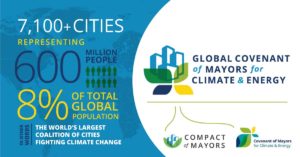 Brussels, 22 June 2016. The EU Covenant of Mayors and the Compact of Mayors announced the formation of the first international initiative of cities and local governments in matter of climate change. Since they are the primary city-led climate change initiative, this project will create the largest global coalition of cities engaged in climate leadership: we are talking about more than 7,100 cities from 119 countries and six continents, representing more than 600 million inhabitants, over 8% of the world’s population. This initiative, called Global Covenant of Mayors for Climate Change & Energy is a result of the historic Paris climate change conference (December, 2015) where cities and local governments played a crucial role for the final agreement. The aim of the world’s largest coalition of mayors is to promote and support voluntary action to combat climate change and move to a low-carbon economy.
It is important to remember that the Covenant of Mayors was launched in 2008 by the European Union after the adoption of the 2020 European Union Climate and Energy Package. The Covenant of Mayors covers 6800 cities in 585 countries with an investment of over €110 billion and currently is operated by CEMR, Climate Alliance, Energy Cities, Eurocities and FEDARENE. On the other hand, the Compact of Mayors was launched in September 2014 by UN Secretary-General Ban Ki-moon, UN Secretary-General’s Special Envoy for Cities and Climate Change Michael R. Bloomberg and mayors from global city networks C40, ICLEI and UCLG with support from UN-Habitat, the UN’s lead agency on urban issues.
In connection with the announcement of the initiative, European Commission Vice-President Maroš Šefčovič said that the strength of the European Covenant lied on bottom-up and close-to-citizens approach. It is precisely this characteristic that European mayors will lead to the Global Covenant of Mayors for Climate & Energy. It is an important factor because this low-carbon and resilient coalition is truly unique on the global scene and: “Never before have so many cities joined forces, eager to inspire each other and committed to collectively taking the path to a low-carbon, resilient society.”
Then, UN Secretary-General’s Special Envoy for Cities and Climate Change Michael R. Bloomberg, who will Co-Chair the new Global Covenant of Mayors for Climate & Energy underlined cities efforts to fight climate change. According to him, unity is the strength of this covenant because it makes possible to magnify influence on the global stage.
By increasing and unify city-led initiatives, the Global Covenant of Mayors for Climate & Energy will increase funding to support city action on sustainable energy and climate change building connections and bridging gaps among the actors. This proposal will take advantages of investment powers of European Union and Bloomberg Philanthropies including the importance of worldwide city network partners such as C40, ICLEI, UCLG, Eurocities, Energy Cities and Climate Alliance. This will strengthen the role of local authorities in the work of UN Framework Convention on Climate Change.
The new initiative will provide also a common platform that brings together relevant data on cities’ energy and climate actions reported to the current EU Covenant platform and the platforms supporting the Compact of Mayors, allowing for comparison of cities’ achievements to other cities all around the world, and make them publicly available through a new Global Covenant of Mayors website, to be launched by January 2017.
These two projects will capture the collective impact of city action and create a momentum for city-led climate action. A single coalition will promote participation (cities will be free to focus on a single commitment with both local relevance and global impact), provide greater clarity and ensure more consistent and comparable data – a crucial aspect for investors.
Hence, it is clear that the Global Covenant of Mayors for Climate Change & Energy will be an important role for achieving one of the most important political goal of the Juncker Commission’s Energy Union strategy, c’est-à-dire a resilient and forward looking climate policy that facilitates transition to a low-carbon, secure and competitive economy.
For more information, please visit the Compact of Mayors website, and the Covenant of Mayors website.
———————————————————————————————————————————————————————————-
Sulla scia dell’accordo di Parigi sul clima, EU Covenant of Mayors e Compact of Mayors lanciano un grande progetto, chiamato Global Covenant of Mayors for Climate Change & Energy con lo scopo creare la più grande coalizione mondiale di sindaci e città per la promozione e il supporto di azioni mirate a combattere il cambiamento climatico e facilitare il passaggio verso un’economia sostenibile.

by Cristiano Gatti | May 25, 2016 | EducationLabs, The Urban Media Lab
Henry Mintzberg, Cleghorn Professor of Management Studies at McGill University, wrote an interesting article about the identity and the role of Plural Sector. This article was published on Stanford Social Innovation Review in Summer 2015.
The article talks about the third sector that has not been able to settle on an acceptable label: indeed, third sector reminds a third-rate thing, non-profits and non-governmental organisations are not clear because governments are literally non-profit and businesses non-governmental. If we call it voluntary, we will underline the role of volunteers, if civil society, we will consider it in opposition to an uncivil society. Social sector is a good label only if it is used with political and economic sector.
The author thinks that the label plural sector is the best choice for two reasons: first of all, because of the variety of this sector’s associations and their range of ownerships and secondly, because it can take its place naturally alongside the labels public and private.
In addition, it is clear that this sector is really plural: there are associations owned by their members (i.d. Mondragon, the world’s largest federation of worker cooperatives) and associations owned by no one such as foundations, religious order, think tanks, activist NGOs and service NGOs. On this point, the article “The Invisible World of Association by Henry Mintzberg et al., shows an interesting categorization of the associations:
- Mutual associations which serve their own members (book clubs);
- Benefit associations which serve other people (food banks);
- Protection associations which advocate for their members (chambers of commerce);
- Activist associations which advocate for the needs of others (Amnesty International).
A lot of these associations are formally organized but the most significant are the spontaneous one. There are two types:
- Social movements: their aim is to struggle some aspects of the status quo such as the occupation of Wall Street and the American Tea Party movement.
- Social initiatives: their goal is to defend programs of social change, first in local communities such as Grameen Bank.
Then, according to the author, plural sector has been attacked by different forces and it is trying to defend itself by the pressures from the other two sectors and the consequences of new technologies. In history, both communism and capitalism have been undermining the plural sector where they have dominated. Communists government have never loved community associations, in fact, the first crack in the URSS was caused by two plural sector organisations: the Catholic Church and the Solidarity Union in Poland. Even democratic governments sometimes had a strange relationship with community organisations: i.d. the amalgamations of small towns into bigger cities as a consequence of economic growth no matter the social outcome. If it is possible, the private sector is more “dangerous”: an example of this is the struggle between fast food chains and local cuisines.
At this point, the author affirms that: “There is a homogenizing effect in globalization that is antithetical to the distinctiveness of communities. As a consequence, while private sectors have been expanding their powers globally, plural sectors have been withering locally”.
New technologies even are detrimental for the plural sector because the new social media connect people creating network not communities. The New York Times columnist Thomas Friedman, reporting an Egyptian friend about the role of social movement, says that Facebook really helped people to communicate but not to collaborate.
In Mintzberg’s opinion, today, it is time to rebalance society. People require attention to three basic needs: protection provided by governments, consumption provided by businesses and affiliations found in communities. A healthy society combines these three factors balanced. Weaken any one of these and a society falls out of balance.
It is clear that there was not balance in communist regimes because the public sector dominated the other two, but it is also easy to understand that in the “developed” world consumption has become excessive. So, communist regimes collapsed because they were out of balance but US are out of balance (demise of democracies, ongoing denigrations of ourselves, …).
The question is: “Who will lead radical renewal?” Certainly not the private sector because the imbalance favors many of them. The answer is, of course, the plural sector: the renewal will have to begin in communities on the ground.
Although the plural sector seems to be obscure, surely it is not impotent: a good point is attributed to the independence and flexibility of many of its associations. If the private sector is about individual ownership and the public sector is about collective citizenship, the plural sector is about shared communityship (these associations are able to function as communities of engaged human beings rather than collections of passive human resources).
The plural sector is not perfect but it offers a way to restore balance in society, in other words, constructive social movements and social initiatives, carried out in local communities and networked for global impact, are the greatest hope we have for regaining balance in this troubled world. But something will first have to change in the plural sector.
In the last part of the article, Mintzberg says that the main problem is that the sector does not act collectively because of its plurality. This is not a problem for the private sector because it is less dispersed especially when profit is involved. This does not mean that the plural sector should imitate business practices but it can learn from it (and vice versa). According to him, “it [the plural sector] has to focus on its distinctiveness. Let’s welcome partnerships across institutions of the three sectors, as long as they are balanced, with full recognition of the contributions that can be made by each of the partners”. In conclusion, what plural sector needs are partnerships for the cause of better balance in the world.
L’etichetta “terzo settore” non mostra chiaramente e senza alcun dubbio l’identità e le caratteristiche di questo settore. Henry Mintzbeg in questo articolo spiega come il “terzo settore” meriti un nome migliore in ragione dell’importanza che ha nel ristabilire un equilibrio in questo mondo tormentato.

by Adriana Marasco | Apr 8, 2016 | Luiss LabGov 2015-2016

On 8 and 9 April LabGov with his students , our labgovers , will have two days of Co-working.
On 8 April we will share ideas and we will discuss with professor Christian Iaione about the future of CO-Roma project ; trying to apply what learned in the previous lessons , also with the help of more experienced Labgovers.
On 9 April we will continue in our mission : build gardening boxes , in which will help us Zappata Romana and our vegetable gardens manager Fabio.
We will two days to share , to learn , to co-design .
———————————————————
8 e 9 Aprile due giorni di co-working per i nostri labgovers , in cui applicare quanto imparato e proseguire nella nostra missione di costruzione dei “gardening boxes”.

by Adriana Marasco | Mar 3, 2016 | EducationLabs

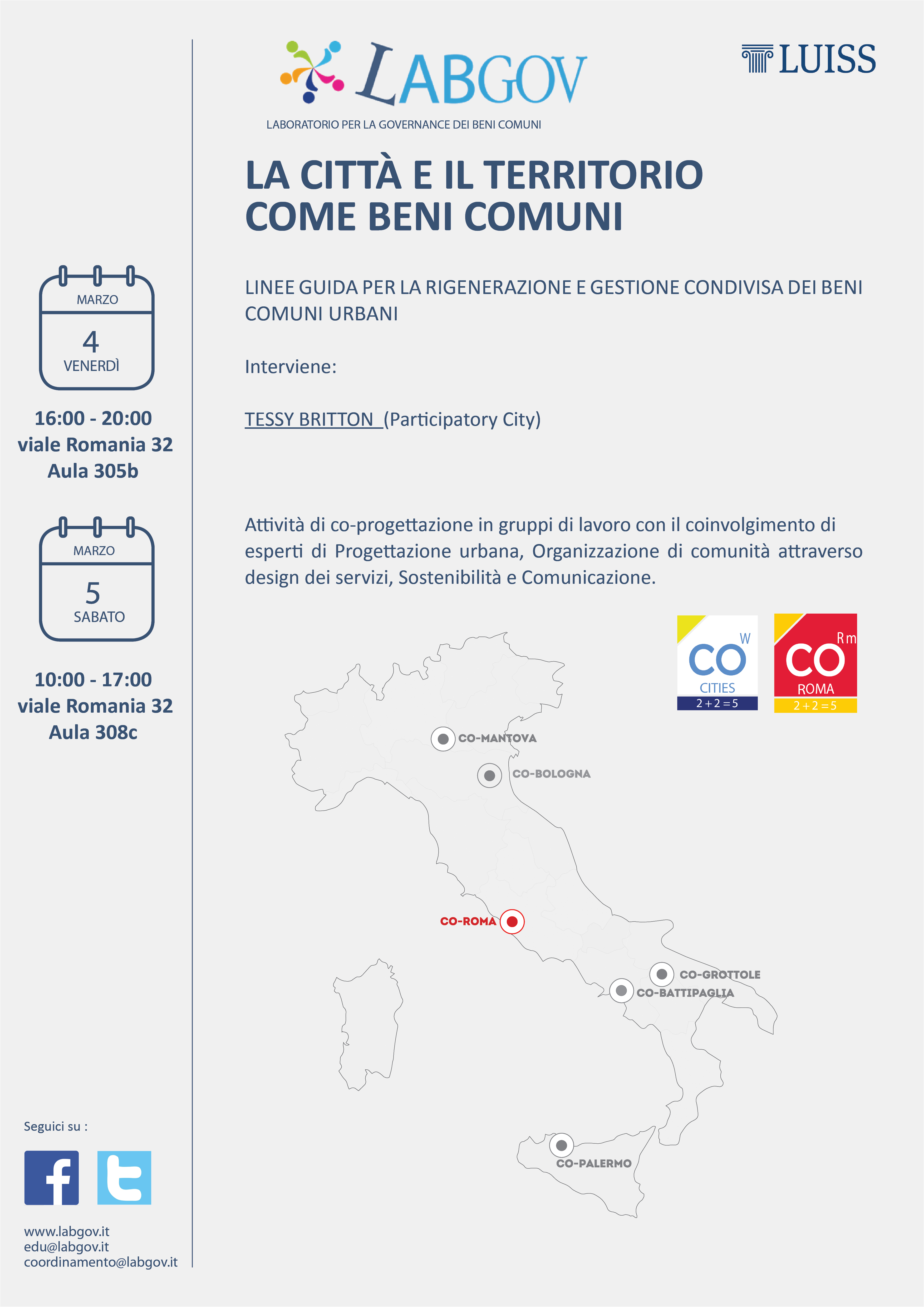
On the 4th of March Tessy Britton will be the guest of Labgov for the next workshop. She is going to explain us her brilliant project: Participatory City. That project was born for the necessity of people to live more sustainably, participating all together. It is a new participatory system in London: together with residents they designed and tested new projects to re-organise the neighbourhood for every day benefits. The place will offer opportunities and conditions where people can cultivate themselves.
In the second part of the workshop and on the 5th of March we will continue to work on our project CO-Roma with some experts.
They will be exciting days!!
——————————————————————————————–
Nella giornata del 4 Marzo sarà ospite di LabGov Tessy Britton, direttrice e co-fondatrice del progetto Participatory City a Londra. Nella prima parte del workshop illustrerà il suo lavoro e nella seconda, che si concluderà il giorno seguente 5 Marzo, seguiranno le attività di co-progettazione del processo CO-Roma.

 s, it is no more suitable for the contemporary society. But where there is an inefficiency, there is an opportunity, and the emerging collaborative forces represent the solution: we move from strict regulation to the co-design, a process during which there is the opportunity to discuss problems and needs rather than directly providing solutions, which will result from a debate with more actors. So we can talk about social enterprises, whose aim is the satisfaction of social needs, taking into account the economic sustainability.