
by Diletta Di Marco | Oct 14, 2015 | EducationLabs
On 16 and 17 October, Labgov will present the first co-working session for Labgov 2016.
This two-day workshop is based on the proposal to imagine Rome in an innovative way.
The project CO-ROMA is focused on the idea that a city should learn to share, collaborate and cooperate with the institutions, the civil society, universities and all the possible stakeholders in order to create a collaborative community, that wants to improve the quality of life and save the Italian cognitive and cultural heritage.
The programme of this first co-working-day will be structured into four working groups, which will be: urban design; communication; community organization through service design, and sustainability.
The most competent experts in every field will hold the round tables; they will transfer their know-how to the neo-labgovers, and they will imagine all together this transformation for Rome.
Several forces are already present in this new collaborative city: active citizens, voluntary associations, schools, urban gardens, co-working spaces, fab-labs, business leaders, and professionals for the common good.
Moreover, on Saturday morning at 9.00 am, the 2016 Labgov students will work for the first time in the garden, with our technical partner for horticulture, Zappata Romana. It will be a fantastic weekend, full of experiences and adventures. The detailed programme will be published as soon as possible.
For further information, please write to our official address.

by Diletta Di Marco | Oct 7, 2015 | EducationLabs
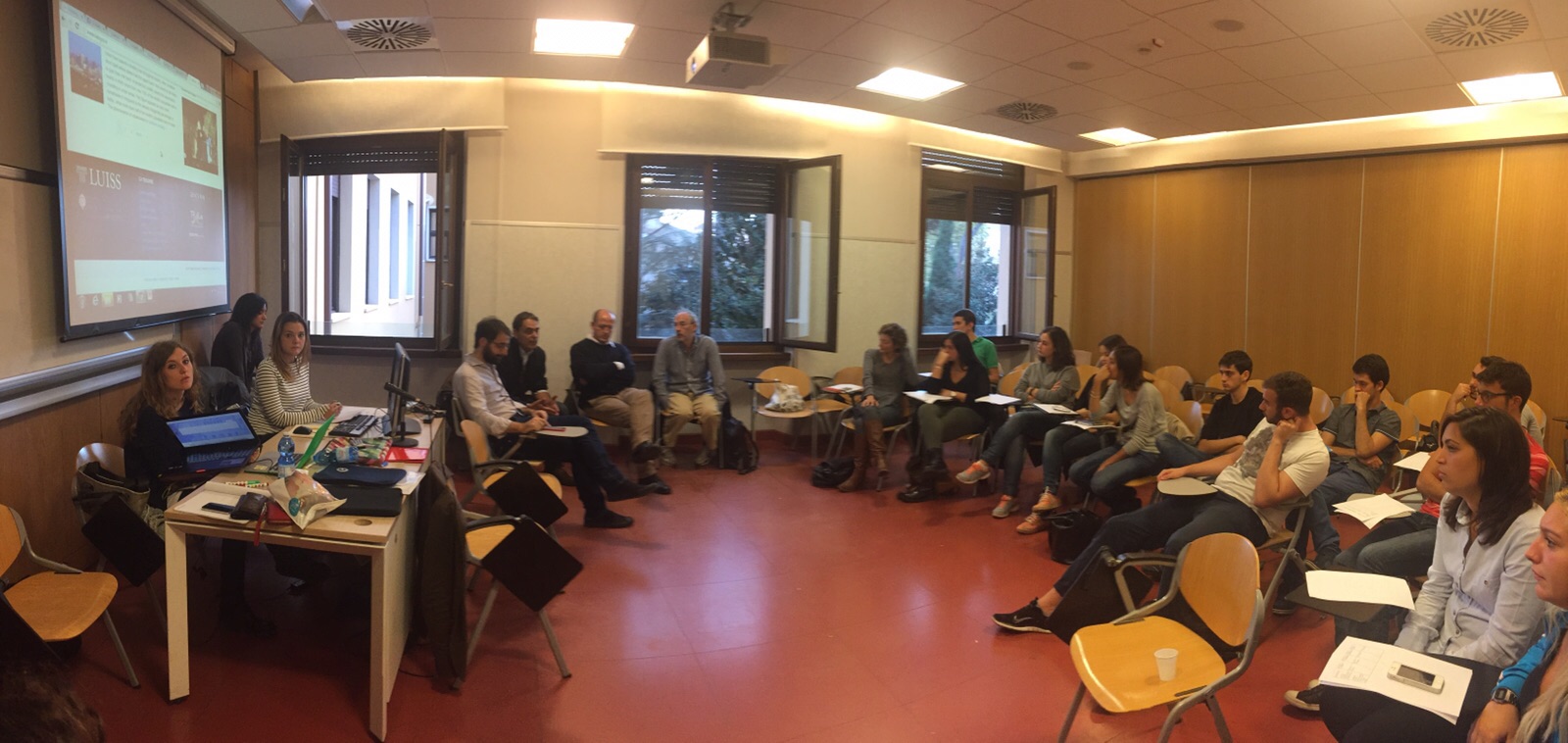
October 2nd we launched LabGov once again for the new academic year 2015/2016! On our first afternoon of the year, full of emotions and debates, we started with a very ambitious and challenging project. In the presence of the new LabGovers (Law, Economics, and Political Science students)several professors, staff members and illustrious experts had the chance to work together, listen to the inspiring words of one another’s previous experiences and imagine a new project for this year. We expect great ambition and willpower, as well as excellent results to share!
The meeting was attended by the Rector of the University Massimo Egidi, the famous Architect Massimo Alvisi and other partners of LabGov, including Luca D’Eusebio for Zappata Romana, Luca Parisio, Serena Baldari and Antonello Caporale. During the afternoon, the new program for the year was introduced by the name of CO-Rome, a project that involves the study of Rome as a city in which we try to build an innovative institutional future, with different and better views . The five souls of the collaborative governance (social innovation, public authorities, schools/universities, businesses, organized civil society) will work together to re-design our own city, making it more economically sustainable.
The goal of LabGov is to form new professional figures: “the practitioners of the commons.” These are people who are able to work in government, in business and in societies. They employ and enhance the resources, ideas, energy, skills and talents of these businesses and societies, which are widespread in the community and in the territories.
Autonomy, accountability, transparency and international openness are the values that make LabGov an incubator of innovative ideas built to establish a new economic and institutional paradigm.
The objects of analysis and experimentation will be as follows: collaborative urban and local governance; and economic, institutional and legal technology applied to the commons (urban, industrial, environmental, cultural, cognitive, digital, etc.). These objects promote processes of local economic development and strategic planning, based on innovation and civic collaboration between the public, private and community.
We will start with an initial mapping phase with a careful reading of the territory and its forms of collaboration. We will then have two phases of design and a follow-up.

As we have already done before, we will apply the CO-Cities approach, based on a strong partnership between institutions, the private sector and the community with significant help on the research side by the academic field.
This year, the co-design will be the fundamental instrument to create a prototype for effective governance and to identify tools based on the needs and characteristics of this city. We have to create a governance tool for the city of Rome that is suitable to the city’s peculiarities. This is our challenge: CO-Roma! In our research, we indentified different areas for testing urban cooperation, which are located on the outskirts of Rome: Garbatella neighborhood, the Appia Antica Park, a high school in Ostia and the V Municipality (Prenestino-Centocelle).
They represent four different types of urban commons to regenerate and invest in. This year, the Lab will focus on a very stimulating challenge for the City. A very stimulating journey cha in the City with many allies, partners and friends who will provide insightful advice to prototype a Commons-based collaborative governance for Rome. The Laboratory stays open to contributions, help and advice. The fourth edition of the Lab will take place in two phases. The former phase will focus on the workshops (October 2/2015, November 13/2015, February 26/2016 and April 8/2016). The latter phase will include co-working sessions (16/17 October 2015, 20/21 November 2015, 04/05 March 2016 and 15/-16 April 2016).
During the project, students will also engage in the field. They will cultivate the garden within LUISS University, a real testing ground of governance. In these 100 hours of pure innovation, together we will discover new stimulating and exciting forms of cooperation! For any information please write to our official account.

by Benedetta Gillio | Sep 30, 2015 | EducationLabs, Luiss LabGov 2015-2016
The fourth edition of LUISS LabGov Educational Lab (workshops, co-design sessions and fieldwork) will re-start on October 2nd, 2015! The meeting will be held in Viale Romania, 32 – 00198 Rome at 4.00 PM.
After focusing on Bologna, Mantua and Battipaglia, the new Edu Lab will a ddress Rome, its potentials and weaknesses at a very difficult time for the city, its institutions, and its society. The Laboratory will aim to design a Commons-based collaborative governance tool tailored to the needs and characteristics of the Italian Capital City. As we have done until now, we will apply the CO-Cities approach, based on a strong partnership between institutions, the private sector and the community. The five souls of the collaborative governance (social innovation, public authorities, schools/universities, businesses, organized civil society) will work together to re-design their own city, making it more economically sustainable.
The CO-Cities approach requires opening experimentation grounds. LabGov 2015/2016, together with many partners representing CO-Rome, will open and manage several urban cooperation grounds in different areas of the City: The Lab will focus on Garbatella neighborhood, the Appia Antica Park, a high school in Ostia and the V Municipality (Prenestino-Centocelle). They represent four different types of urban commons to regenerate and invest in. The Lab will take this long, but very stimulating journey in the City with many allies, partners and friends who will provide insightful advice to prototype a Commons-based collaborative governance for Rome. The Laboratory stays open to contributions, help and advice. Collaboration will run Rome as a Commons, because Commons need appropriate governance tools.
_____________________
La quarta edizione di LUISS LabGov (workshops, sessioni di co-design e fieldwork) ripartirà il 2 ottobre 2015 alle ore 16.00 in Viale Romania, 32 – Roma!
Dopo i grandi risultati ottenuti a Bologna, mantova e Battipaglia, il nuovo LABoratorio per la GOVernance dei beni comuni riprenderà le sue attività concentrandosi sulla Città Eterna: Roma. Anche in questo caso, le 5 anime della governance collaborativa (social innovation, istituzioni, Università , imprese e società civile) collaboreranno per RIcostruire Roma, rendendola più vivibile e sostenibile.
Vi aspettiamo!

by Leonardo Rossi | May 15, 2015 | EducationLabs
What happens when a region is scourged by a natural disaster, like an earthquake? There is the time grief, of course, and the time of reconstruction, involving an extremely delicate phase: the healing of the victims’ souls.
That was the motivation that pushed the Ministry of the Tourism and Cultural Activities to fund an initiative, the “Beni Comuni Project”, that gathered the ETR Foundation, ATER and eleven Provinces (Campogalliano, Carpi, Cavezzo, Cento, Concordia sulla Secchia, Finale Emilia, Mirandola, Novi di Modena, San Felice sul Panaro, San Possidonio, Soliera). Their goal was to recover and reunite the spirits of the communities threatened by the 2012 earthquake by an active participation in the organization of public events with the main goal to foster the sharing sense.
This idea is much needed in a time where society tends to be more and more egoistic, full of technological barriers that allows people to communicate easily with one another, but at the same time tends to label those who cannot afford such connections as “social pariah”. Stimulate the spark of active cooperation and sharing may ignite again an essential characteristic of the human soul that is slowly dying as the society evolves.
The Project reunites 24 partners: from schools to theatres and music schools: through the organization of public events, shows, concerts and readings, this group wishes to foster the reconstruction of the populations that survived the earthquake, thanks to arts and artistic expression. In the words of a member of the Project: “a way to allow the community to restore the spaces destroyed by the earthquake and start again with a stronger sharing spirit”.
This approach is really valuable, also because allows the people’s mind to wander off such grief and crisis and their souls to understand that nothing is over and everything can be solved, as long as there is a common goal and a common support. Act as one, survive as a whole.
—————-
Cosa accade a una comunità quando essa viene distrutta da un cataclisma naturale, come un terremoto? Ovviamente c’è il tempo del dolore, e dopo la ricostruzione inizia una fase delicatissima: la rigenerazione degli spiriti dei cittadini.
A tale proposito è stato finanziato dal Ministero dei Beni e delle Attività Culturali e del Turismo e promosso dal Comune di Carpi in collaborazione con ERT Fondazione e ATER il “Progetto Beni Comuni”.
Esso coinvolge undici Comuni (Campogalliano, Carpi, Cavezzo, Cento, Concordia sulla Secchia, Finale Emilia, Mirandola, Novi di Modena, San Felice sul Panaro, San Possidonio, Soliera) del cratere sismico con l’obiettivo di rinsaldare e ricostruire le identità delle comunità minacciate dal terremoto del 2012 attraverso la partecipazione attiva alla costruzione di eventi artistici che abbiano come orizzonte primario il senso della condivisione e dello stare in comune.
L’idea alla base del Progetto è encomiabile, e potrebbe essere spiegata in vari modi, ma il modo migliore è utilizzare le parole di un esponente del Progetto: “Il progetto Beni Comuni ha un valore intrinseco e speciale. Non è solo un programma destinato alla fruizione, ma un laboratorio di produzione culturale che coinvolge professionisti dello spettacolo ma anche e soprattutto i cittadini. Uno spazio artistico composto da tanti luoghi […]. Un modo concreto per le comunità di rimpadronirsi degli spazi violentati dal sisma e ripartire, con uno spirito di socialità condivisa”.
Questa idea è necessaria anche per un altro motivo: essa consente di far vagare la mente delle vittime del sisma lontano dal dolore e dalla sofferenza, e far capire che nulla è perduto e tutto è superabile, se si collabora e ci si aiuta nella comunità: Agisci come uno, sopravvivi come gruppo.

by Marco Quaglia | Apr 28, 2015 | EducationLabs

The project is called “Greenmore”, its creators are IED and Coldiretti Giovani and the city of Milan is the first Italian hub. What am I writing about? A project on sustainable agriculture designed and promoted by young people for the rooftops and other unconventional spots of our cities.
The idea stems from the fact that by 2050, 80% of the world’s population will live in urban areas. One of the biggest challenge of this phenomenon of migration is that agriculture, as it was known all along, will need to adapt to the urban environment. The possibility to move at least part of the daily production of food in the city is something that needs ideas and further analysis.
In Italy, 1 out of 4 people, spend some time on do-it-yourself agriculture. However, the majority of these people are adults. New generations, on the other hand, are not involved, and apparently, not interested in this topic. Apparently.
In 2009 a pilot project called Campagna Amica was at the base of the biggest European network of food trade, with more than 20,000 points of sale. This campaign represented the starting point of a cultural trend that is gaining more and more momentum, also among young people.
Thanks to a working process of some 4 month, IED and Coldiretti Giovani, developed a project that is ready-to-use for all the municipalities and farmers that may be interested in implementing urban agriculture. What it does emerge is that through the use of platforms – mobile and social connection – it is really possible to promote the consumption of food and products that are made “in your backyard”. Literally.
The creative process was based on the experience of other realities – Detroit in particular, a city that was destroyed in the aftermath of the collapse of its industrial structure, and that, only through a change in the attitude of its most dynamic citizens is experiencing a second birth. From motor-town to farmer-town.
The project designed by these young people is easy to replicate, appealing, cozy, open and technological. LabGov, this year, was the promoter and the designer of a garden for the LUISS University. For this, and many other reasons, the Greenmore project and its future development will be observed and studied with great attention.
For more info: http://www.corriere.it/tecnologia/15_febbraio_24/sfida-ied-rendere-orti-milanesi-piu-affollati-discoteche-02f415ea-bc2f-11e4-9889-956e36696542.shtml
http://www.benessereorg.it/index.php/lo-sviluppo-sostenibile-delle-citta-digital-il-progetto-greenmore-ied-coldiretti-giovani/
Gli orti urbani stanno prendendo piede in tutto il mondo. In Italia anche ci sono delle esperienze che stanno emergendo in termini di innovazione, replicabilità e apertura ad un pubblico eterogeneo.
Il progetto, chiamato Greenmore, è stato sviluppato a seguito di 4 mesi di incontri, da giovani designer dello IED e di Coldiretti Giovani. L’idea è quella di creare un modello che possa rendere il più facile possibile l’avvio di piccoli orti in contesti urbani, sfruttando i principi e i benefici della sharing economy.
Il coinvolgimento dei giovani è favorito da l’utilizzo di piattaforme che garantiscano la creazione di spazi smart e conviviali, in cui anche l’estetica gioca un ruolo essenziale. Questo progetto, e quelli simili che nascono, meritano tutta l’attenzione possibile. Portare un po’ di verde e di profumi tra i tetti e i palazzi delle grandi città è un fine meritorio di per sé. LabGov da questo punto di vista non fa e non farà mancare il suo impegno.
by Marco Quaglia | Apr 26, 2015 | EducationLabs

The city of Rome will host on May 21-24, the “Biennial of Public Space”, at the headquarter of the department of Architecture (University of RomaTre). The event, promoted by the Public Administration, the University and many associations of citizens has one goal: comparing experiences, best practices and future challenges in the field of social innovation.
The three thematic areas of this year will be: the road, urban regeneration and the unequal city. We should spend some words for each of them. Roads are the most common public spaces in the world – in fact they occupy the majority of the surface of our cities. It is not by chance that one of the most typical case study of what is now known as the “tragedy of the commons” (Garrett Hardin, 1968) is the traffic jam. Mobility is clearly the first element that pops up to everyone’s mind, but is not the only one. If you cannot move easily and reasonably fast, so many things will be precluded to our lives. Long story short: the road is the quintessential connective element of our life.
The second topic, urban regeneration, is something definitely more common to us at LabGov. Public urban spaces are central to our social life, and play a big role in the development of new ideas and other forms of innovation – just think at all the co-working spaces that are emerging. Rome, in particular, needs to re-think and re-shape its phenomenal public space, which in many cases, corresponds to its historical heritage. (On our site you can read just about everything on this topic).
The third and final day will be devoted to the unequal city. Years of globalization and the recent economic crisis are leaving a legacy that is also a challenge: the majority of the world’s population is living or is about to live in cities. Many of our cities were and still are unprepared to receive and accomodate with dignity this mass of people. Peripheries in particular, are under greater and greater pressure, and we are not that far from reality if we say that, it is precisely in these forgotten and sometime neglected spaces, at the border of our urban conglomerates, that some of the most problematic issue are overstocking, and about to explode.
The legacy of the event will be a document called “The message of the Biennale” that will receive international attention, and that will be hopefully, an important step towards an operational turn to the Charter of Public Space, and other similar documents that are getting credit at the international level.
LabGov will be following the event closely; but the Biennale is open to all. So if you are in Rome, and are interested to get a better grasp of what is going on around you, don’t hesitate.
(more info at http://www.biennalespaziopubblico.it/blog/nav-2015/il-profilo-della-biennale-2015/; http://unhabitat.org/habitat-iii/)
Dal 21 al 24 maggio, Roma, nello specifico negli edifici della sede di architettura di RomaTre, sarà il luogo di incontro della “Biennale dello Spazio Pubblico”. Con lo scopo di mettere a confronto idee, azioni e soggetti, la biennale sarà un momento chiave in questo anno, per avere una visione più ampia su alcune delle tematiche più interessanti nell’ambito dell’innovazione sociale degli spazi pubblici.
Le tre aree tematiche saranno: la strada, la rigenerazione urbana e la città diseguale. Ognuno di questi temi, a cui sarà dedicata un’intera giornata, saranno dei punti di partenza per altre decine di tematiche collegabili.
L’eredità della tre giorni sarà un documento chiamato “Il messaggio della Biennale” che aspira ad essere un contributo importante nel dare rilevanza operativa alla “Carta dello Spazio Pubblico” e ad altri documenti analoghi emersi in ambito internazionale.
Aperta a tutti, si possono avere maggiori informazioni al seguente sito: http://www.biennalespaziopubblico.it/blog/nav-2015/il-profilo-della-biennale-2015/?lang=en.
Vedi anche: http://unhabitat.org/habitat-iii/


