
by Marina Bassi | Mar 10, 2015 | EducationLabs, Luiss LabGov 2014-2015
 On March 17th, 2015, LabGov will host the Conference Land and new forms of legal order at LUISS University of Rome. The Conference – that will start at 4:30 PM in Aula Nocco, Via Parenzo 11, LUISS School of Law – will address the issue of collaborative governance for the commons as a tool to fight corruption and organized crime, safeguard the territory and promote legal economic growth and social progress.
Following the experiences developed in Mantova with the CO-Mantova, a collaborative governance territorial pact, and in Bologna with the Regulation on public collaboration, participants will focus on new forms of collaboration between public institutions, social innovators, businesses, civil society organizations and knowledge institutions.
The conference is part of the LabGov workshops series that this academic year has been focused on Land as a commons: environment, agriculture and food.
Giovanni Lo Storto, LUISS General Director, and Roberto Pessi, professor of Labor Law and LUISS Vice Provost for education, will open the Conference. Main session will see the keynote addresses of Paola Severino, professor of criminal law and LUISS Executive Vice Provost, and Giancarlo Caselli, president of the “Osservatorio Agromafie” scientific committee. Antonella Manzione, Head of the Council of Ministries Presidency Legislative and Regulatory Affairs Department, will act as discussant. Second session will be a roundtable with LUISS professors Melina Decaro (professor of public comparative law), Gian Candido De Martin (professor of public law), Antonio La Spina (professor of public policies) and Bruno Frattasi (Head of the Interior Ministry Legislative and Regulatory Affairs Department).
Raffaele Bifulco, professor of constitutional law at LUISS, will chair the two sessions of the conference. The conference will end with the closing remarks of Claudio Rossano, professor of public law.
Full program of the conference is available at the following link:
Territorio e nuove forme di legalità – programma
______________________________________________
Territorio e nuove forme di legalità: la governance collaborativa è la strada?
Il prossimo 17 marzo 2015 LabGov – LABoratorio per la GOVernance dei beni comuni organizza la conferenza “Territorio e nuove forme di legalità” presso la LUISS Guido Carli. L’incontro, che avrà luogo nell’Aula Nocco della Facoltà di Giurisprudenza, Via Parenzo, 11, Roma, indagherà il rapporto fra legalità e salvaguardia del territorio attraverso forme di sperimentazione ispirate alla governance collaborativa, come il Regolamento sulla collaborazione per la cura e rigenerazione dei beni comuni urbani di Bologna e CO-Mantova, il patto di collaborazione territoriale per uno sviluppo economico locale orientato ai beni comuni.
I lavori saranno aperti dai saluti istituzionali del dott. Giovanni Lo Storto, direttore generale della LUISS Guido Carli, e del Prof. Roberto Pessi, Prorettore LUISS per la didattica. Le relazioni principali sono affidate alla Prof.ssa Paola Severino, ordinario di Diritto Penale e Pro-Rettore Vicario LUISS, e al dott. Gian Carlo Caselli, Presidente del Comitato scientifico dell’Osservatorio Agromafie. La dott.ssa Antonella Manzione, Capo Dipartimento per gli affari giuridici e legislativi della Presidenza del Consiglio dei Ministri, agirà in veste di discussant. Seguirà una tavola rotonda con la Prof.ssa Melina Decaro, il Prof. Gian Candido De Martin, il Prof. Antonio La Spina e il prefetto Bruno Frattasi. ll Prof. Claudio Rossano concluderà i lavori della giornata.
Il Prof. Raffaele Bifulco coordinerà i lavori dell’incontro.
Per consultare il programma della giornata:
Territorio e nuove forme di legalità – programma

by Marina Bassi | Mar 5, 2015 | EducationLabs, Luiss LabGov 2014-2015
After a brief pause, the LabGov workshops restart again Friday, March the 6th. During the next two months, LUISS University will host leading experts in governance, social and cultural innovation and many other issues.
Last semester LabGov hosted lots of debates concerning different topics and across intresting points of view. We dealt with social and rural innovation, new administrative ways to create collaborative governance and other forms of collaboration for the commons.
Among the many LabGov guests who will speak, there will be the great opening of Ernesto Belisario. Ernesto is a an administrative lawyer and successfully engaged in several institutional working groups to manage the Italian Digital Agenda – He is also been appointed as digital champion last year.
With Ernesto, LabGov will address the possibility to open administrative procedures to a more collaborative approach by using open data tools.

_____________________________
I nuovi workshop di LabGov sono pronti. Si comincia il 6 marzo!
Dopo una breve pausa, i workshop di LabGov ricominciano il prossimo venerdì, 6 marzo. Nei prossimi due mesi, LUISS University ospiterà grandi esperti di governance, innovazione sociale e culturale e tanti altri.
Il primo tra i molteplici ospiti di LabGov, che interverrà venerdì 6 marzo, sarà Ernesto Belisario. Lui è avvocato e partecipa ai tavoli di lavoro per l’Agenda Digitale Italiana presso la Presidenza del Consiglio dei Ministri e insieme a lui affronteremo il tema OPEN DATA: TRASPARENZA E PROCESSI DI APERTURA AMMINISTRATIVA E ISTITUZIONALE.

by Leonardo Rossi | Feb 5, 2015 | EducationLabs

February the 2nd was an important milestone for the people of LabGov. On that day happened the first harvesting of some products farmed by the students: spinach, mushrooms and lemons.
The day started with the General Director Lo Storto paid a visit to greet all the students, professors and the LUISS staff which met for this special occasion. In his opening addressing, Dott. Lo Storto stressed the importance of rediscovering a “slow” kind of life, an idea gradually replaced by the modern “fast” lifestyles.
The LUISS Community Garden, inaugurated on November, is a perfect example of common good managed by the people and on how to apply the collaborative governance to the commons, such as the environment, agriculture and food. These are also the topics of the Laboratory of this year that involve students in the design, management and communication of this garden sited in our Campus placed in Viale Romania. The university students gathered ideas and resources and, thanks to the precious help and supervision of the LUISS staff, managed to start a system that is willing to become a way to gather the efforts of students interested in the rediscovering of the joy of growing fresh products.
In any case, the work is far from over: in the following months there will be the harvesting of other products, such as broccoli and fennels in February, since the complete harvesting at the end of March. Moreover, work has already started for the realization of a vineyard that is going to be inaugurate in the near future.
Quoting professor Iaione: “We eat together, we save money, we share advices on exams and other problems of everyday life and we seek solution for the challenges of our generation. We should follow a healthier and greener lifestyle. We should project the future and we should ask ourselves how we are going to nudge more and more people to join us, and have fun with us. Break free from Facebook and from its fast-relationships by building offline relationships more stable and enduring. We want to be the driving force of change, not a simple a leading élite. Patience and tenacity are our distinctive features as farmers of the relations that needs to be developed to make changing, innovation and collaboration blossom”.

Orto Luiss: il primo raccolto e la (ri)scoperta delle piccole gioie della vita


Il 2 Febbraio LabGov, insieme a dipendenti e professori LUISS, ha effettuato la prima raccolta di alcuni prodotti del LUISS Community Garden. In particolare sono stati raccolti spinaci, funghi e limoni. Anche il Direttore Generale Lo Storto ha fatto visita all’Orto per salutare il gruppo che si è riunito per questa occasione.
Il LUISS Community Garden può essere considerato un esempio perfetto di come si può applicare la governace collaborativa ai beni comuni, come l’ambiente, l’agricoltura e il cibo. Questi sono infatti i temi del Laboratorio di quest’anno, che vede i nuovi labgovers impegnati nella progettazione, comunicazione e organizzazione di questo nuovo spazio all’interno del Campus di Viale Romania.
Fino a Marzo ci sarà la raccolta di altri prodotti, tra cui ad esempio i broccoli, i finocchi, la verza, i cavolfiori. Nel prossimo futuro si aprirà la vigna.
Nelle parole del professor Iaione: “Dobbiamo progettare il futuro e liberarci da Facebook e dalle sue relazioni rapide costruendo interazioni offline stabili e durature. Vogliamo essere la forza motrice del cambiamento, non una semplice classe dirigente. Pazienza e costanza sono i nostri tratti distintivi come coltivatori delle relazioni che devono essere sviluppate per far nascere il cambiamento, la collaborazione e la collaborazione”.

by Edoardo De Stefani | Dec 3, 2014 | EducationLabs
The second edition of Sharitaly, the first Italian event entirely dedicated to the sharing economy, was a great occasion for launching the “sharing school” program that will be held in the city of Matera on January 2015, the 23rd.
The four days full immersion is a program based on a “learning by doing approach”, which aims at forming participants on the raising theme of sharing economy.
The possibility to experiment collaboration among participants is the pivotal practice of the school. Through active participation, cooperation, inclusion and strong theoretical background, the program aims at analyzing recent trends and best practices of the sharing economy and to provide the necessary instruments for designing and managing community services.
The school is thus recommended for all those people, enterprises or public actors which seek to deepen their knowledge of practices related to the Commons, as well as to the sharing economy.
Matera, elected as European Capital of Culture 2019, is the perfect place for hosting the “sharing school” because of its public spaces and because of the high rate of sensitivity to innovation of the civic community that lives in Matera.
CasaNeutral is an example of how the paradigm of co-working can become social innovation as well as a leading professional experience.
Moreover, thanks to the collaboration of all partners, the school will be able to host highly qualified professionals and experienced innovators.
For inscriptions and more info please click on the link below:
http://www.sharingschool.it
La seconda edizione del Sharitaly, il primo evento italiano interamente dedicato alla economia della condivisione, è stato una grande occasione per il lancio del programma school sharing che si terrà nella città di Matera a partire dal 23 gennaio 2015. Matera, eletta Capitale Europea della Cultura 2019, è il luogo ideale per ospitare la sharing school per i suoi spazi pubblici e per l’alto tasso di sensibilità per l’innovazione della comunità civica che ci vive. La full immersion di quattro giorni è un programma basato su un “learning by doing”, che mira a formare i partecipanti sul tema raccolta di sharing economy.
Per le iscrizioni e per maggiori info:
http://www.sharingschool.it

by Silvia Arena | Nov 25, 2014 | EducationLabs, Luiss LabGov 2014-2015
What makes LUISS University unique? The answer may be more than one: we could talk about its students, its faculty, its staff and all the associations existing within it. Recently it has been developed a project that aims at riching the capital of our university and it is the “community garden”. The idea, which has been proposed and implemented by the dean of the University, Mr. Giovanni Lo Storto, immediately captured the attention of a group of student swho, thanks to the Laboratory for the Governance of Commons, had the opportunity to discover the benefits and privileges of being able to share a garden within the University. The laboratory gives the possibility to concretely understand the meaning of words such as “sharing“, “cooperation” and “sustainability“. Moreover it aims at making the LUISS community aware of the huge benefits that could be gained from the garden management. Through the ideas, efforts, energies, skills and talents shared within LabGov we were able to put in practice our talents and creativity. Thanks to the garden ,we discovered a place where the mind can finally be unbound from competitiveness, daily stress and negative thoughts. Working in the garden, having a contact with the nature and having the possibility to work with your own hands, allows you to liberate your mind from classical procedurals chemes and to develop collateral talents and skills. Planting a tree, a vegetable or anaromatic plant and observing its daily growth gives you a sense of pride and satisfaction. It’s not an individual work but a social one. The garden needs a lot of care and attention which comes from the cooperative work of the community. However it is amazing how sharing experiences could be so entertaining and constructive at the same time.
The two fold experience of manual work and theoryis a perfect combination for refining ours kills; moreover, not only the experience of the laboratory is a perfect way for developing an eco-friendly attitude and lifestyle, but it also creates the bases for building a strong professional figure and character. LabGov could be defined as a genuine community, an incubator of passions and talents, made out by different people which share similar interests and that believe in values such as sustainability, collaboration and care for the Commons. LabGov is open to everyone and welcomes enthusiastically all the new people who want to get involved. The entire LUISS community is welcomed at the opening event on 26th November, where we will have the pleasure to inaugurate the garden. We are sure that you will all be fascinated by this unique world.
__________________________________
LUISS: unica nel suo genere!
Cosa rende Luiss unica nel suo genere? Semplice! Un orto condiviso.
Il progetto ha subito avuto successo all’interno della comunità Luiss, e grazie al supporto del Laboratorio per la governance dei beni comuni l’interesse degli studenti per la sostenibilità, la collaborazione e la condivisione si è concretizzato. L’orto è motivo di orgoglio e soddisfazione e sarà inaugurato il 26 novembre 2014, così da dare a tutti coloro che ancora non hanno avuto la fortuna di ‘sporcarsi le mani’ di mettere in pratica le proprie capacità.

by Edoardo De Stefani | Nov 12, 2014 | Luiss LabGov 2014-2015
We already talked about urban regeneration, as something that goes hand in hand with the structuring of the urban network and its spaces.
Without any doubt, the territory is full of qualities and resources that are not only physical assets.
However since there is no power without control, regeneration is also about participation and governance.
We are used to imagine the urban environment as something populated by a collection of independent individuals and rational decision makers, which make choices as a consequence of an opportunistic calculation.
Fortunately there are actors and situations that prove that such assumption is biased: indeed there is a crescent flow of urban stakeholders that are guided and inspired by a model of deliberative democracy, which resides in the right to participate to a collective decision by influencing the content.
To make it simple, we strongly believe that the discourse is nowadays oriented toward a community development, whereas the dominant paradigm becomes the collaborative governance.
In this sense, the urban resources have to be filled with a technological content, the social one, which shall permit active participation by citizens and cooperation with institutions, administrations, corporations, associations and universities.
The real value added is the latent potential of people, not their hyper individualization.
Certainly, the discourse cannot omit a range of issues that have to be prioritized: economic sustainability, availability of assets and mapping of resources, urban architecture and the relationship with institutional actors.
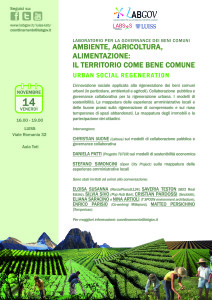
On 14th November at 16.00 in LUISS Guido Carli University, we will have the chance to meet several experts and to launch a debate upon the urban social regeneration.
With the participation of Daniela Patti (project TUTUR) and Stefano Simoncini (Open city project), LabGov will have the pleasure to host the conference; the objective is to transform the meeting into a co-working session and to promote the dialogue between all the participants.
We aim at creating a concrete and usable output for all the presents.
Further info about participants and program at :

 On March 17th, 2015, LabGov will host the Conference Land and new forms of legal order at LUISS University of Rome. The Conference – that will start at 4:30 PM in Aula Nocco, Via Parenzo 11, LUISS School of Law – will address the issue of collaborative governance for the commons as a tool to fight corruption and organized crime, safeguard the territory and promote legal economic growth and social progress.


