
by Stefano Speranza | Nov 12, 2014 | Luiss LabGov 2014-2015, The Urban Media Lab
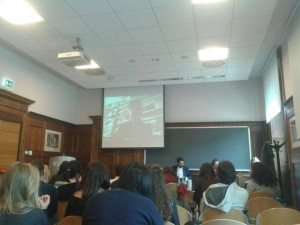
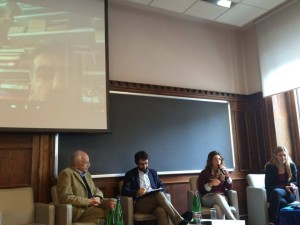
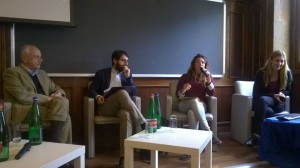
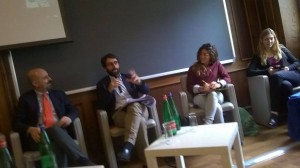
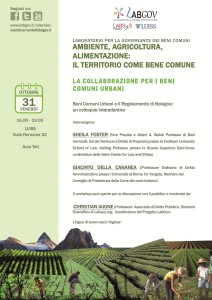 On October, 31st Professor Christian Iaione – LabGov’s coordinator – along with the LabGov’s tutors and the new Labgovers, had the possibility to have an inter-atlantic dialogue with two internationally prominent scholars about the collaboration for the Urban Commons.
Actually, the audience listened to the speeches and then debated with Professor Sheila Foster – Vice Dean and Albert A. Walsh Professor of Real Estate, Land use and Property law at Fordham University School of Law, Visiting Professor at Scuola Superiore Sant’Anna, co-director of the Stein Center for Law and Ethics and Professor Giacinto della Cananea – Full professor of Administrative Law at University of Rome Tor Vergata and member of the Presidential Council of the Italian Supreme Audit Institution.
The topic of the workshop was the Urban Commons, particularly focusing on the Bologna regulation on public collaboration and its comparison with some international practical examples. Professor Iaione opened the workshop, saying what LabGov is and how it works. He soon gave the floor to Professor Sheila Foster.
Professor Foster gave us a theoretical framework and seemed excited and pleased of being there. “I have studied and looked to the Bologna regulation with great passion, and I do believe that LabGov is my field” she soon affirmed. Her enriching speech moved towards three directions.
Firstly she gave to the audience a general idea of the commons especially in the urban context, then she moved to some ideas about how the government/management of the commons comes up and finally she went in depth by underlining how the Bologna regulation approaches these questions.
It was an enriching speech because of its clarity and linearity, through which she explained that we must consider the Commons as opposed to an asset or a mere good, so as a shared and open thing. Shared by everyone and open in the sense that it provides open access to the people who should be involved and obviously not excluded.
“Of course the natural world contains Commons but exist other types such as cultural, digital and Urban Commons” Professor Foster explained, but “many collectively shared Urban Commons shares the same dilemma that Hardin wrote about in his essay regarding the tragedy of the Commons”, she continued and “The debate that Elinor Ostrom launched, goes in two directions: privatization and shared government control with the people”. Since Professor Foster and Labgov operate in the this last context, it was interesting reflecting together about the need of a public regulation even because an unregulated context does not exist.
Moreover, “contemporary Commons’ dilemmas arise not in open spaces but in highly regulated spaces” Professor Foster explained. This is Foster’s point of view, that is shareable by everyone who realize that in urban areas we have all seen open spaces where public authority have rules and we all see tragedies, such as degradation but even crimes. “This regulatory slippage in the urban contexts creates the tragedy or the Commons dilemma”, Foster affirmed.
So, how do we deal with these dilemmas? Some scholars proposed a public way, others a simple privatization of the Commons but what is the core idea, for a Commoner, is the collective management of the Commons.
After having provided the audience with same cases, such as what happened in New York’s Central Park and the Guardian Angels, and some examples concerning the commercial sector, Foster told the audience that these are the cases in which groups of users cooperate to allocate resources even if they could be temped by individualism or personal use. And she wrote extensively about these situations. “What is interesting is not the cooperation or the collaboration, but the collective action in the pure sense” she pointed out. And soon after, she made the audience meditate on the question concerning the Government, if it supports and helps citizens in doing actions for the general interest. A Government that facilitates the creation of partnerships or agreements is praiseworthy.
And by analysing this point it was easy to move to the Bologna regulation, on which Professor Foster made some comments and suggestions. These regarded the definition of Urban Commons, that in the regulation is similar to the one of public goods and should be revised, by getting it tighter. But Sheila Foster said that the regulation does a very good job in bringing together citizens for public goals.
The second part of the workshop had as lecturer Professor Giacinto della Cananea, and we saw the Bologna regulation on public collaboration in the administrative and constitutional Italian context, considering the legal categories that the regulation touches and challenges. “We are having a huge public debate in Italy about the commons, but a little bit misleading”, Professor Iaione stated and gave the floor to the lecturer.
Starting with a distinction between ownership and management and underlining that the concept of ownership is fully explained and contained in the Italian Civil Code, Professor della Cananea reminded the audience that only the national Government can legislate on matters regarding topics expressed in the Civil Code. But this is not true in the United States, for example, where different civil codes coexist.
After having pointed out this issue, della Cananea stated that there is “a confusing debate about ownership and use of common goods” and for this reason the question of the Bologna regulation on public collaboration is of importance to him.
And he followed a clear outline in order to illustrate his arguments, after having clarified that the translation into English of the regulation could not mean the same of the Italian one, as Professor Foster said before him.
In particular, Professor della Cananea stated that the Bologna regulation is a tool of public policy, it is precious because a similar document is still missing in Italy, and it is unique because it is not a political document, it is an ideological one.
He pointed out some issues regarding the question of the ethical principles in the regulation, the question placed by the art. 33 of the regulation regarding conciliations in case of eventual disputes, problems in the definitions of the concepts of urban commons and active citizens, liability and inertia.
Moreover, Professor della Cananea went in depth in the analysis of the practises of the local governments, especially at the regional level.
Italy is differentiated from north to south and, following the ideas of Robert Putnam, he affirmed that the different performances of the local public institutions are mainly, not only, caused by the different city traditions. And this brilliant examination led him to ask a basic but fundamental question: “is this a very helpful tool or a dangerous tool? Not all the Italian areas are like Bologna and we obviously know something about criminal organizations. As a lawyer I must raise this question”.
For sure, it was a passionate and punctual dissertation made by Professor della Cananea that left the students with a lot of food for thought.
Finally, Professor Iaione spoke. He thanked both the scholars very much for their very precious contributions and emphasized on the meaning of the art. 35 of the regulation: “Art. 35 is the mission impossible of Labgov’s intents, this regulation was an experiment and that is why we are here today, to discuss and improve our capabilities” was the closing remark which was followed by a passionate debate with the students from the audience.

by Edoardo De Stefani | Oct 28, 2014 | Luiss LabGov 2014-2015
We feel very honored to have been offered the pleasure to host two internationally prominent scholars:
Professor Sheila Foster – Vice Dean and Albert A. Walsh Professor of Real Estate, Land use and Property law at Fordham University School of Law, Visiting Professor at Scuola Superiore Sant’Anna, co-director of the Stein Center for Law and Ethics,
Professor Giacinto Della Cananea – Full professor of Administrative Law at University of Rome Tor Vergata and member of the Presidential Council of the Italian Supreme Audit Institution.
Once upon a time, under the Fordist regime of capital accumulation, there was no space for considering collective action as a means for reflecting on the urban commons.
However the economic crisis and the post modern socio-cultural upheaval have drawn the contours for a new urban outline, in the sense of refreshing the understanding of collective action and its nexus with the neighbourhood.
The perception here is that of a transformative evolution of the capacity of the citizens to serve and cultivate urban life.
Truly it is not surprising that cities are not viewed anymore as storage loci for the depletion of common resources, albeit we cannot simply consider the realm of Commons as a ready to go policy.
In effect the fairy tail of the urban commons faltered on the slippery terrain of the regulatory framework.
On the other hand, the congestion and the rivalry upon the use and exploitation of resources leave no room for development and growth, at least if the current structural paradigm is not questioned.
Europe and America are currently experiencing the nightmare of resources degradation, thus our challenge is to find and implement solutions for the governance of the Commons, in such a way that all the community should eventually play a positive sum game.
The workshop, moderated by Professor Christian Iaione, aims at opening a discussion with the audience for understanding and debating the Urban Commons, with a specific focus on the Inter-Atlantic dialogue and on the Bologna Regulation on Public Collaboration. The English version has been edited by 2013/2014 Labgov interns and it is now the official version adopted by the City of Bologna.
LUISS and LabGov are pleased to welcome you on October 31st on the Viale Romania 32 Campus, Toti Classroom, from 16.00 to 19.00


by Edoardo De Stefani | Oct 26, 2014 | EducationLabs
#fondatisullacultura is a convention promoted by Roma Capitale and “Commissione Cultura, Politiche Giovanili e Lavoro in collaboration with #fondatisullacultura.
The panel will be held in Rome at MACRO and will host four thematic sessions on culture.
The introductory panel will be lead by On. Michela Di Biase, President of The Commission “Cultura, Politiche Giovanili e Lavoro di Roma Capitale“, which will introduce the debate with highly qualified professionals.
Following, the experts will give us the opportunity to understand the dynamics of the cultural enterprises and their aggregate value, both in the sense of economic production and socio-cultural output; it will be crucial to comprehend which are the products and recipients of the economy of culture, as well as addressing the key issue of resources’ management.
There is a recurrent necessity to confront principles and norms with the challenges of the new cultural demands, but on top of all, it is vital to analyze the possible strategies and the existing administrative instruments (and loopholes) that serve to coordinate and produce public policies.
LabGov will be as always on the frontline, represented by its Coordinator and Professor Christian Iaione.
Public participation is welcomed.
FREE ENTRANCE, Via Nizza 138 h.9:30-18:00

by Maria Felicita Ferraro | Oct 24, 2014 | EducationLabs, Luiss LabGov 2014-2015
Thursday, October 23rd, LUISS Guido Carli in Rome held the opening conference of LabGov, with the presence of the general manager Giovanni Lo Storto, of the vice headmaster of research, professor Leonardo Morlino, of the President of Coldiretti Giovani Imprese Maria Letizia Gardoni, and the Director of the contents of the italian pavilion at Expo 2015, Paolo Verri.
The guests have debated around the topic of the governance applied to the topic of Environment, Agriculture and Food: Territory as a Common. Shared management, they stressed, is perceived as an opportunity of national change, responsibility and the engagement of young enterpreneurs for the protection of the beauty of our territory, fand or the importance of Made in Italy.
“Commons are fundamental as they are linked to a better quality of democracy” said professor Morlino. In mentioning electoral and interistitutional accountability, responsiveness, participation and competitiveness as the main dimensions of a properly assessed democracy, he said that commons are evaluation standards: “Our challenge is to continue a concreet analysis of indicators of quality in public policies, through the promotion of direct participation, equality and rule of law to overcome the last century’s crisis”.
President Gardoni has stressed that the number of young people that operate today in the agroalimentary sector is growing “thanks to the cultural revolution that aims at spreading the idea of rural activities as means to restart our country’s economy and society”.
And Verri confirmed this point, presenting events such as Expo 2015 as ways to promote change and to export our culture and skills abroad. “We need to start spreading the word about our capabilities and perspectives!”, he encouraged.
In wishing the project all the best, the general manager of LUISS, Lo Storto, talked about future and hope. “Listening is a means of personal and collective growth, and we have the responsibility of listening and growing together, in order to build our own future and achieve our dreams”.
Professor Iaione, LabGov’s Coordinator, has presented the Laboratory as a program of co-production of knowledge and research applied to institutional innovation through the cooperation of public and private subjects of governance. And he announced the newest addiction to our project: the shared garden inside the university campus, that is going to be inaugurated next month.

by Alessandra Feola | Oct 6, 2014 | Luiss LabGov 2014-2015
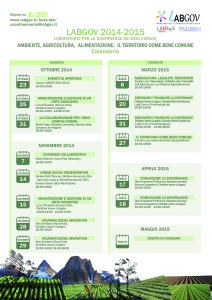
 Sono aperte le iscrizioni per la nuova edizione di LabGov, che quest’anno sarà dedicato a “Ambiente, Agricoltura, Alimentazione: il territorio come bene comune”.
Il corso, nato nel 2013 dalla collaborazione tra Labsus – Laboratorio per la sussidiarietà e LUISS Guido Carli, vuole formare una nuova figura professionale, quella dei professionisti della governance: giovani donne e uomini capaci di pensare, progettare e realizzare nuove forme di collaborazione tra cittadini, imprese e istituzioni per promuovere le comunità intelligenti sia in ambito urbano che rurale.
Il Laboratorio è aperto agli studenti iscritti, per l’a.a. 2014/2015, al II o III anno di uno dei Corsi di Laurea Triennale del Dipartimento di Impresa e Management, Scienze Politiche, Economia e Finanza o al IV o V anno del Corso di Laurea in Giurisprudenza, della LUISS Guido Carli di Roma. Per la partecipazione al Laboratorio vengono riconosciuti 4 CFU per Altre Attività.
LabGov è un percorso di educazione non formale (del tipo in house clinic) pensato per innovatori sociali, imprenditori di futuro, agenti di cambiamento e giuristi creativi. Il campo di sperimentazione è quello dei beni comuni. LabGov trova la propria ragion d’essere nell’affermazione e nello sviluppo di una nuova, potente classe sociale, la “classe creativa” (i.e. cittadini attivi, startuppers, creativi, makers, sharers, prosumers, rural innovators, digital stars, ecc.). Gli studenti che parteciperanno al laboratorio avranno la possibilità di entrare in contatto con la classe creativa e avranno come responsabilità primaria quella di costruire o sviluppare progetti che dovranno prender vita, contribuendo concretamente all’implementazione dell’innovazione sociale, economica, istituzionale e giuridica che la classe creativa richiede in aree o settori dove l’innovazione non è ancora arrivata o accelerare il potenziale innovativo di esperimenti di innovazione preesistenti.
Nell’a.a. 2014-2015 oggetto di analisi e sperimentazione sarà la green governance intesa come tecnologia sociale, economica, istituzionale e giuridica applicata ai beni ambientali e paesistici, al territorio, agli stili di vita. Questi beni e la loro tutela o cura verranno riletti alla luce dei principi e delle tecniche tipiche della governance dei beni comuni, al fine di giungere alla costruzione di formule collaborative per la cura e rigenerazione di risorse fondamentali per il benessere individuale e collettivo, come l’ambiente, il paesaggio, il cibo che possono essere fonte di nutrimento, sostentamento, sviluppo, cultura, progresso. Lo scopo ultimo del LabGov sarà quello di riflettere, elaborare e applicare una strategia di governance idonea a configurare il “territorio come bene comune”.
Per partecipare è possibile consultare il bando e il programma qui.
Per aderire all’iniziativa sarà sufficiente inviare una e-mail a softskills@luiss.it nel periodo compreso tra il 30 settembre ed il 17 ottobre 2014 indicando:
- nome e cognome
- matricola
- Corso di Laurea a cui si è iscritti
- Volontà di acquisire i CFU per Altre Attività attraverso il LabGov
Inscriptions are now open for the new edition of LabGov, dedicated to “Environment, Agriculture and Food: the territory as a commons”.
The course was born in 2013 as a successful output of the partnership between Labsus and LUISS Guido Carli. It aims at creating new professional figures and experts of the governance who are able to promote social innovation and to manage the complex of rural and urban communities.
The Lab is open to all the students currently enrolled at the 2nd or 3rd year of one of the bachelor courses of the following departments: Impresa e Management, Scienze politiche, Economia e Finanza. Moreover, students coming from the 4th or 5th year of the Law Department may apply. Four CFU will be awarded to the participants as “Altre Attività”
For calendar, inscriptions and events please refer to the following links:
http://www.luiss.it/studenti/soft-skills-and-training-opportunities/con-cfu/corsi-di-laurea-triennale-e-magistrale-cic-1
Program
Per maggiori informazioni/ Further info at
Prof. Christian Iaione: ciaione@luiss.it
LabGov: coordinamento@labgov.it

by Maria Felicita Ferraro | Oct 1, 2014 | EducationLabs
Article by: Maria Felicita Ferraro
When the neo-liberal approach of “marketisation” began to spread, it was rooted on a particular critique of state-run services. They were indeed perceived as top-down, inefficient and out of touch with people’s needs, knowledge and preferences. The public service agenda of the following governments has more often than not been based on market competition and consumer choice, with the aims of reaching lower costs, increasing quality and respond better to consumers’ preferences.
As rightful as all of these aims sound, though, it doesn’t seem like they have been reached. Public services often leave very little power to citizens, in favor of experts and politicians. What did we expect, though? Competition tends to lead to fragmentation and opposition between stakeholders, it discourages partnerships and it induces private companies to prioritise shareholder-return, which contrasts with public policy priorities such as meeting social needs. And while competition has been negative on the public sector, an alternative model of commissioning would allow for a collaborative partnership between different publicly oriented institutions.
The New Economic Foundation (NEF) has hence recently argued that public services should be delivered democratically and with the help of other not-for-profit community and civil society groups. It proposed a top-down approach that could bring more power to citizens thanks to a series of steps:
The first is co-production among experts and citizens who are recipients of a service, in order to combine their knowledge.
Then there is participatory democracy, that allows service users more control over decisions, over public spending (through participaroty budgeting) and even over political decisions (an example is Iceland, who recently tried to “crowdsource” its new constitution).
One more measure to shift power is the reformation of public agencies so that they resemble the model of cooperative governance structures, by granting less hierarchical working cultures that ensure more autonomy and trust to their staff, as Newcastle has succesfully demonstrated.
Indeed, there already are positive outcomes coming from the implementation of this approach: some public agencies, across the UK and beyond, are already enjoying the benefits of co-production, seeing services designed and delivered through an equal partnership between professionals and service users.
The NEF stressed the importance of power decentralization, starting from schools, which should come back under local authority control, and councils which should get back the power to raise taxes progressively in order to boost revenue. If everyone is able to participate and benefit from more decentralized and redistributed measures, a government’s actions to tackle inequalities would be more efficient and governments would be able to invest more in public services, rather than promoting austerity measures.
For further info: http://www.neweconomics.org/
http://leftfootforward.org/


