
by Federica Maranesi | Sep 29, 2014 | EducationLabs, Luiss LabGov 2014-2015
 Giovedì 2 ottobre, alle ore 17.30 il gruppo LabGov (Laboratorio per la Governance dei beni comuni) ha il piacere di invitare gli studenti LUISS presso la sede di Viale Romania 32, aula 304 A, per presentare il Laboratorio e i suoi contenuti, insieme al programma e alle attività previste per l’a.a. 2014/2015. Questo sarà un appuntamento che precederà l’inizio dei lavori del laboratorio, un momento di incontro nel quale i Labgovers avranno modo di parlare direttamente agli studenti, spiegando nel dettaglio che cos’è LabGov, di cosa si occupa e altre informazioni utili per l’iscrizione. LabGov però non è soltanto un laboratorio universitario. E’ un mondo in cui le capacità personali e le competenze professionali vengono inserite in un contesto di collaborazione, rielaborate, sviluppate e potenziate, per affrontare non solo le sfide e i progetti proposti all’interno del laboratorio, ma anche per arricchire un bagaglio di conoscenze utile per il futuro. Il Laboratorio per la Governance dei beni comuni, nasce proprio con lo scopo di sperimentare l’approccio del learning by doing attraverso una in house clinic applicata al tema dell’innovazione sociale, economica, istituzionale e giuridica. Idee potenti come cambiamento, cittadinanza attiva, beni comuni, innovazione sociale, sharing economy, condivisione, collaborazione, making e creatività, co-design e co-production stanno spingendo verso la società, l’economia, le imprese e le istituzioni verso nuove frontiere. Gli studenti costruiscono o portano negli appuntamenti della clinic e nel Laboratorio progetti che devono prendere o avere vita nel mondo reale, contribuendo a dare loro attuazione pratica o sostegno nel loro processo di innovazione. Nell’a.a. 2014-2015 oggetto di analisi e sperimentazione sarà la green governance intesa come tecnologia sociale, economica, istituzionale e giuridica applicata ai beni ambientali e paesistici, al territorio, agli stili di vita. Lo scopo ultimo è quello di elaborare una strategia di governance idonea a configurare il “territorio come bene comune” e per questo motivo LabGov indagherà i seguenti ambiti di studio e ricerca: “Ambiente, Agricoltura, Alimentazione”. Vi aspettiamo numerosi, non mancate.
Il Gruppo Labgov

by Edoardo De Stefani | Jul 21, 2014 | EducationLabs
Social economy has become nowadays a fashionable argument within the panel of the public administration forum; indeed in time of cultural and social crisis, new paths for social innovation are to be fully explored.
It would be nonsense trying to define univocally what social innovation is and how it should be made, however it is possible to track a mainstream in terms of where the compass has to be set: this is the case of the new frontier of social cooperation, which entails the possibility to create a physical and digital hub whereas people work together exchanging ideas, projects, competencies and experimenting innovation as consequence of the autonomous initiatives.
In this sense we can talk about active citizenship, both in terms of liberal expression as well as a function for a renewed economic productivity.
Thus it seems that a structural revolution shall be started from below, as far as the bottom up approach is eventually able to capture the sensitivity of the urban spaces and people.
Again, the idea of creating a common co-working space is the best option to fit the needs of a socio-economic renovation.
The mounting sense is to design a meta-content for social enterprises, which could promote occupation, economic production and social equity and fairness.
The time for urban re-generation has come, so that building a strong network of active citizenship has become the unavoidable premise for social innovation.
Bearing in mind that the founding idea of social innovation is the creation of tangible areas whereby it could be possible to install ideas and incubate projects, we should focus our attention on the working laboratories and their typologies.
To this end, it is worth mentioning the FabLAb initiatives that are very active on the urban territories.
In particular the “Millepiani co-working space” in Rome (http://www.millepiani.eu) hosted an important event on 18/7/2014 to set the basis for launching a territorial network of FabLabs.
The event aimed at exchanging ideas, experiences, suggestions and reflections among those interprets of the social fabric in order to collect and express a common sentiment to the public administration.
The new politics of collaboration, whose basis is promoted within the “Lazio Creativo” planning, is currently providing funds for the development of cultural activities.
In parallel, the regional legislation of “Regione Sicilia” seems to be able to set a milestone in terms of institutional innovation, since it has started recognizing the value of social innovation and its capacity building both in terms of economic productivity or as a form of social inclusiveness.
However, the institutional apparatus is still anchored to a persistent fragmentation of the territories and to an uncertainty of the governance method.
Given all the uncertainties and concerns about the future of the social innovation, in terms of development of active hubs for citizens, the working group composed by the associations that attended the meeting has committed itself to investigate the following dynamics and themes:
1) Fundraising and accession criteria
2) Added value of the social enterprise
3) Governance method and redefinition of public space
4) Pact of collaboration with the public administration
5) Census of actors and activities
6) Real estate speculation
7) Political project – civic targeting- social dialogue
Stay tuned.
by Maria Felicita Ferraro | Jun 30, 2014 | EducationLabs, The Urban Media Lab
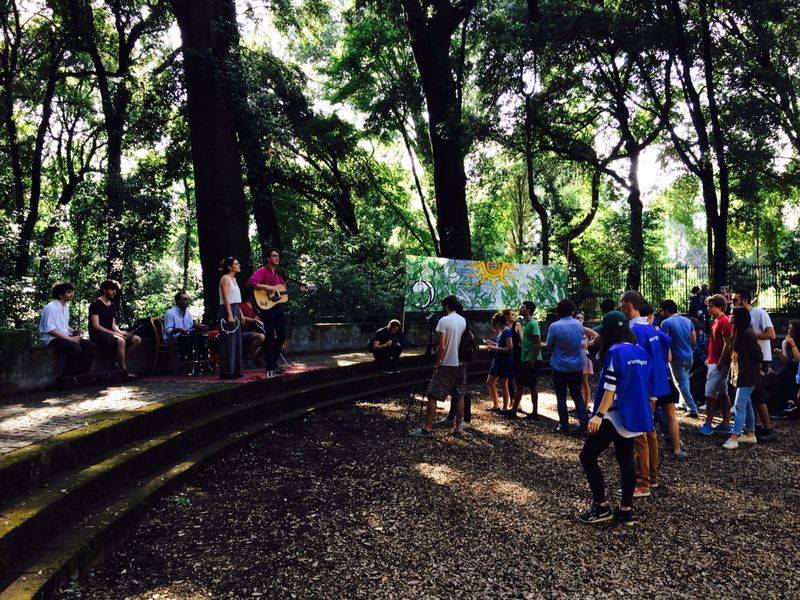
 On June 26th, 2014, LabGov has organized an event together with the social and cultural club La Calzoleria to regenerate the Temple of Flora in the roman park Villa Ada. The event has been organized with the cooperation of the Roman Superintendence for the Cultural Goods and the representatives of the public Administration have been willing to work together with the students, their professors and the General Manager of LUISS Guido Carli, Giovanni Lo Storto. Among the authorities who joined us, there were Alberta Campitelli, Manager of the Roman Historical parks, Agnese Micozzi, Cultural Assessor of the II Municipality and Giuseppe Gerace, President of the II Municipality of Rome. Following the words of the Head of the Political Science Department of LUISS professor Sebastiano Maffettone, who during his readings about Gandhi and Kant stressed “the importance of changing ourselves before pretending that others change”, the Labgovers decided to continue the work that had been started last October. The first ReinventAda event had been meant to restore the original beauty of the Temple. This time, the regeneration has been followed by “Intimismi”, an event of cultural entertainment provided by La Calzoleria with live music by the band Marcello e il mio amico Tommaso, and Luca Bertelli, who played a Swiss uncommon instrument called Hang. Moreover, thanks to the collaboration with Urban Decorations the guests have been able to assist to a live painting exhibition by the artist Lorenzo Properzi. The aim of the Laboratory was to set an example for the future, of active citizenship and a collaboration with the various associations, institutional entities, as well as civic and business subjects interested in achieving cultural and entertainment activities to re-appraise the Temple of Flora and restore its former function of meeting place and cultural exchange. We hence presented a Pact of Collaboration for the care and shared governance of urban commons, starting with the Temple. “Regeneration -as professor Christian Iaione declared- means a permanent and continuous care and shared responsibility.”

by Marco Quaglia | May 28, 2014 | EducationLabs, The Urban Media Lab
In the face of new models for the management and policy making of today’s society, which kind of role should the public sector have towards new actors? This question, among the others, is at the core of the Forum PA 2014 held at the Palazzo dei Congressi (EUR, Rome): the annual Italian fair for confrontation between the public sector and the society.
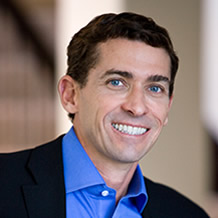
On May, 27, William D. Eggers, Research Director for Deloitte, was the international guest for the panel “From governing with the network, to the State-partnership”. In this occasion it was presented his new book ‘The Solution Revolution’ co-authored with Paul Macmillan.
The main idea behind it, is that to each societal problem corresponds a societal solution. Therefore, the main challenge today is to unite the ever-growing universe of problem solvers around a single problem; rather than expect the government to do the job.
To date, organizations or individuals around the world changed the approach to classic problems; but very often they failed for they work in an highly uncoordinated way. While, governments burdened by financial constraints simply could not find concrete solution in a majority of cases.
For this reason a new model is needed: the one of collaboration, between new and old players. Individuals, NGO, public and private sector; anyone is involved in this run to solve local and global inefficiencies. Governments in particular should be the enablers of this revolution, by facilitating initiatives.
At the end of the day, to create markets around markets failure is the goal of what has been called ‘solution economy’. According to Eggers, all the pieces of this puzzle are there, for anyone to take it. The only creative effort required is to look at old problems with new eyes.

by Alessandra Feola | May 18, 2014 | EducationLabs, Luiss LabGov 2013-2014
LuissLab
MEETING MINUTES 9TH MAY 2014
Katia Ballacchino, professor and anthropologist held the meeting about the theme of Intangible Cultural Heritage and Community. Specifically, an attempt was made to discuss ‘an anthropological analysis of the recent conventions starting from ethnographic case studies – a research methodology that provides technological activity by the individual’. This analysis passes through eight years of study. These years proved to be crucial for our country, for they started from a milestone decision of UNESCO of 2003, which recognized intangible goods as proper Cultural Heritage
What is an Intangible Good? It covers a whole range of practices, traditions, folklore, customs, which a community perceives it as a belonging. Moreover, it does not remain static over time, but it changes and becomes dynamic as the community itself changes. Some examples are the Festa dei Gigli di Nola, Santa Rosa in Viterbo, Candelieri Sardi and Carresi del Basso in Molise. First experiment of a participated national inventory has been when the Ministry for Cultural Heritage asked to think about the UNESCO candidacy as an indirect form to catalogue Intangible goods in their new consideration as proper assets. The idea arose from the debate on the food culture in the vicinity of Lake Bolsena
What is the advantage of gaining recognition from UNESCO? It is basically a matter of intangible value. It brings a series of advantages ranging from commercial to political. Just think of how easily a promotion can be built on it, or how strong a political campaign can be starting from this success. As already said participation is today fundamental. Pompei, UNESCO World Heritage since ever, is paradigmatic. In the last years it has been registered a loss of interest from the community.
Ballacchino tell about the case of Festa dei Gigli of Nola in Campania. During the fest eight obelisks (heigt 25 meters and weight 25 quintals) are built and destroyed each year by the community on a self-financed base. They represents the guilds of crafts and an homage to the saint Paulinus of Nola. Today’s obelisks are the result of an evolution of this tradition. St. Paulinus of Nola returns to the city on a boat to save Nola and its citizens. Nola has no sea , but historically extended to Torre Annunziata. Malformations of the shoulder due to the weight of the Gigli (Callus of San Paulinus). Such a disturbing image increases the idea of belonging to the community. The physical sacrifice to carry each Giglio is an honor for every man. In the Campania region a processes of dissemination of the festival occurred. In many others community (Barra, Brusciano, Casavatore, Crispano, Cimitile, Mariglianella, just to name a few, some similar festivals took place every year). The paradox concerns the creation of a conflict between the neighboring towns, rather than a collaboration between areas with similar traditions. Which festival is ‘original’? Is there something as an ‘original festival’?
According to art. 2 of the Agreement of Faro, a convention for the protection of cultural rights, cultural heritage is defined as a group of resources inherited from the past that some people identify, regardless of who owns the property, as a reflection and expression of their values, beliefs, knowledge and traditions. It evolves as time goes by. It includes all aspects of the environment derived from the interaction over time between people and places. A community asset is made up of people who attach value to aspects specific of their cultural heritage which they wish, within the framework of public action, sustain and transmit to future generations.
Other two examples have been given:
The Sicilian Puppets: Since being recognized by UNESCO as world heritage, the families of puppeteers paradoxically had more problems in terms of the traditional technique. After the production of the roof, thousands of young people have started to create “puppets”, although not perfect from in terms of production. This overproduction ended up in creating conflict, competition and lowering the overall quality of the festival.
The Carreri del Basso in Molise: Feast of just few minutes. It encompasses oxen and horses tied together to pull a wagon. Animal rights activists, for some time now, have denounced the violent attitude towards the animals. Horses are told to be doped for the festival, and the bleeding that can happen during the event, is just another alarm bell from this perspective. On the other hand, managers who run the stables are generally very careful towards their animals, and these are treated well all year long. This attitude is a reflection of a spirit of participation and respect towards animals.
by Federica Maranesi | May 16, 2014 | EducationLabs, Luiss LabGov 2013-2014
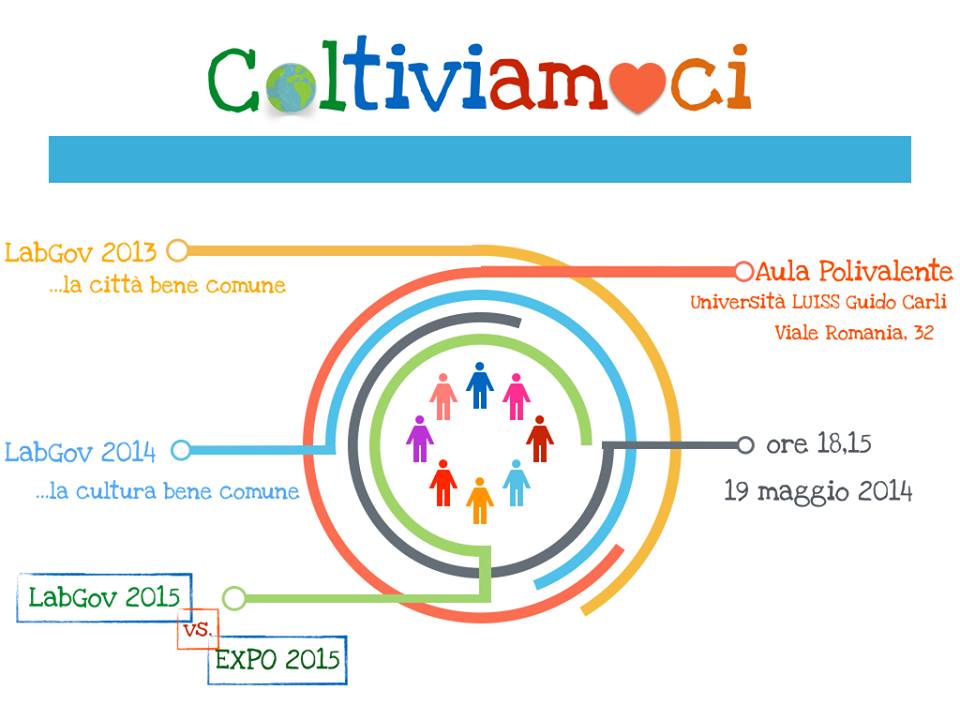
 On Monday, May 19th at Luiss Guido Carli University, will be held the event ‘Coltiviamoci‘. LabGov will host in Viale Romania 32, Aula Polivalente, a workshop focused on collective management of urban and environmental commons and on the development of institutional economic and social innovation. LabGov students will present the results achieved with the Lab’s activities and initiatives of 2014, and they will have also the pleasureto share knowledge, experiences and ideas with representatives from Coldiretti, Zappata Romana and Lazio Region Expo 2015 Steering Committee. This will be a unique event to talk about participatory processes aiming at actively involving actors on Expo 2015 major themes: ‘Feeding the Planet, Energy for Life’. Thus the workshop will focus on concrete, sustainable, technological solutions put forward by active citizens, such as community gardens, and by agricultural entrepreneurs taking care of the land as a commons.
Program:
- h 18.15 video show of LabGov2014 activities
- h 18.20 presentation of LabGov2014 results
- h 18.30 LabGov 2015 vs Expo2015
Speakers:
Giovanni Lo Storto – Luiss Guido Carli General Director
Maria Letizia Gardoni – President of Giovani Coldiretti
Luca D’Eusebio – Zappata Romana/ Hortus Urbis
Albino Ruberti – AD and President of Zétema and Coordinator of the Expo2015 working group for the region Lazio
- Concluding remarks: Gregorio Arena and Christian Iaione (Labsus)
- h 20.00 Awarding of participation certificates for LabGov’ s students; awarding of gratitude certificates for LabGov guest speakers


