by Anna Berti Suman | May 14, 2025 | Aware, Event, News, The Urban Media Lab
On May 14, 2025, we convened the event “Bootcamp 2025: The Puglia System for Just Sustainable Innovation”. The event represented a one-day immersive experience that engaged high school and university students, emerging scholars, young entrepreneurs, professionals from organizations, companies, and public institutions in a collective journey of co-design. Organized by Luiss University, LabGov ETS, Acquedotto Pugliese, and supported by the AWARE project partners (https://www.aware-eu.eu/) —Autorità Idrica Pugliese, the University of Salento— and with the support of the Mayor of Castellana Grotte, Region Apulia, the Apulian Regional Agency for Environmental Protection (ARPA Puglia), and the Apulian Regional Agency for Technology, Technology Transfer and Innovation (ARTI Puglia), the Bootcamp addressed real-world challenges in the just and sustainable management of water and natural resources, integrating technical, legal, social, institutional, and economic dimensions. The initiative was inspired by recent policy and legislative developments, including the Italian draft decree of 2023 on wastewater reuse, EU Regulation 2020/741 on minimum requirements for water reuse, and the new EU Directive 2024/3019 on urban wastewater, all of which seek to harmonize national and European standards to foster more sustainable agriculture and public sector innovation, particularly through tools like Article 36 of Law Decree 76/2020.
Participants included over 50 students from Luiss University, CIHEAM Bari (Mediterranean Agronomic Institute of Bari), the Universities of Bari, Foggia, Salento, and the Polytechnic of Bari, along with high school students and their teachers from IISS Luigi dell’Erba and IISS Consoli Pinto. They worked closely with mentors from Acquedotto Pugliese, Autorità Idrica Pugliese, ARPA Puglia, ARTI Puglia, Confindustria Bari, Innova, the University of Salento, CIHEAM, Luiss and LabGov ETS. One week before the event, five interdisciplinary teams were formed and assigned their challenges—rooted in five different infrastructure sites across the region—to ensure participants could begin shaping their responses ahead of time.
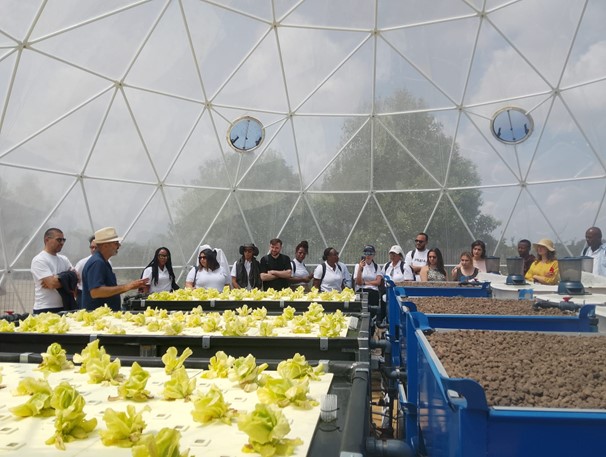
The day began in Castellana Grotte with a site visit to the AWARE aquaponics pilot plant, where participants experienced firsthand how reclaimed water can support sustainable food production through the integration of fish and vegetable farming (see https://www.aware-eu.eu/the-project/). It was a moment where inspiration met investigation, as students collected data, listened to keynote interventions from experts and from local and project leaders, and launched into a challenge that mirrored real regulatory, environmental, social and economic constraints. In the afternoon, the group moved to Bari, where they visited the headquarters of Acquedotto Pugliese and met with representatives from regional institutions such as ARPA and ARTI Puglia. There, the co-design workshops continued, as participants—supported by their mentors—refined their solutions and pitched them to a panel of experts, receiving valuable feedback and recognition for the quality, feasibility, and relevance of their proposals.
The challenges addressed were diverse and grounded in specific sites and community contexts. Challenge 1 focused on the AWARE pilot plant in Castellana Grotte, asking how to ensure its economic sustainability after the project’s end, what business models could be applied, and how the model could be replicated across other plants in Puglia and the wider Mediterranean, even adapting fish species to local ecosystems. Challenge 2, based in Lecce, explored how treated wastewater from the Ciccio Prete treatment plant could be reused through phytoremediation to irrigate the University of Salento’s Botanical Garden, closing the loop between urban water and green public spaces. Challenge 3 addressed the Poggiorsini treatment plant and proposed a Renewable Energy Community to make the facility self-sufficient, while also tackling sustainable sludge management through phytoremediation. Challenge 4 examined how biodiversity can be enhanced around wastewater treatment plants, with examples from Noci, Casamassima, and Melendugno, focusing on pollinators, native species, and green infrastructure integration. Finally, Challenge 5 asked how the Taranto desalination plant could be transformed into a hydroponic system for brine management, including which species can thrive in environments with higher salinity.
Throughout the Bootcamp, the methodology remained clear: mentorship-driven, challenge-based learning grounded in real policy frameworks and technical limitations. Participants were asked not only to imagine but to prototype tangible solutions through co-design canvases and briefs. All work revolved around five interlinked dimensions—technology, law, society, economy, and environmental impact—ensuring systemic thinking across all levels of proposal development. While all teams delivered strong contributions, the team working on Challenge 3 stood out with its innovative yet community-centred and intergenerational approach to integrating renewable energy and sustainable water reuse at the Poggiorsini site with considerations on local culture and local traditions.
The experience of Bootcamp 2025 also set the stage for the upcoming XYZ Camp 2025, an intergenerational research and innovation bootcamp that brings together Generation X, Y, and Z to respond to the challenges of ecological and digital transitions. It is not only a continuation of the co-design process but a reinforcement of the idea that learning and innovation must happen across generations. Students from the Strategic Management, Innovation and Sustainability and Law, Digital Innovation and Sustainability programs will pitch their ideas to leading European managers and institutional leaders, leveraging the insights gained through real-life experimentation and the strategic integration of social sciences and innovation management.
Interested in the XYZ Camp 2025?
Register at https://luiss.formstack.com/forms/xyz_camp_2025
Bootcamp 2025 was more than a workshop. It was a real testbed for inclusive, forward-looking innovation—locally rooted, globally connected, and powered by cooperation across sectors, disciplines, and generations! Get a glimpse of the day through this short video: WP5-AWARE-Bootcamp video.mov
Interested in replicating this experience? Contact us at staff@labgov.it
Follow AWARE at https://www.linkedin.com/company/aware-eu/posts/?feedView=all
Interested in the AWARE project? Contact us at info@aware-eu.eu.
Authors:
Anna Berti Suman
Marijana Krstic
Researchers at LabGov ETS and LUISS Law School

by Staff | Apr 30, 2025 | News, PUI - Santa Maria della Pietà
On April 29, 2025, the Luiss – Labgov Team for the immaterial valorisation of the Santa Maria della Pietà complex met at the Co.bra.gor headquarters, The pupils of the elementary and middle classes of the Istituto Comprensivo Paolo Stefanelli and the students of the hotel and agricultural branch of the Domizia Lucilla higher education Institute (IIS), as well as the students of LUISS GrinLab and the course “Innovation and sustainable development law and policy”. The students were joined by the principal of the project, Prof. Christian Iaione, the President of the 14th Municipality, Marco della Porta, and the vice-president Enrico Sabri and the councillor for Educational and School Policies, Claudia Salerno. At approximately 9.30 am, the groups began visiting the territories managed by Co.bra.gor with Emanuele Manta illustrating the sustainable agricultural practices implemented by the Cooperative, focusing on the different types of crops and the specific characteristics of the territory, also highlighting the benefits of beekeeping carried out on site. The group was also able to access an Etruscan tunnel. At approximately 11:00 am, the group benefited from refreshments with organic fruit juices, bread and oil produced by the Cooperative.
Around 11.30 am, Michele Mansi from the Historical Ortisti Cooperative led the group to the Fosso delle Campanelle, bringing attention to the valley’s history adjacent to the SMdP and its future prospects in the path aimed at creating the largest urban vegetable garden in Europe. The visit ended around 12.30 pm.

by benedictaquarcoo | Mar 20, 2025 | Event, News, The Urban Media Lab
In a world increasingly shaped by climate catastrophe, voices from the most vulnerable regions are rising, not in desperation, but with determination and power. One of the most powerful examples comes from the Pacific Islands, where young climate leaders are reframing international law and policy with their courage and clarity.
At the forefront is Cynthia Houniuhi, president of Pacific Islands Students Fighting Climate Change (PISFCC) and a law student at the University of New South Wales. In March 2023, she watched as the United Nations General Assembly voted overwhelmingly in favor of a resolution to seek an advisory opinion from the International Court of Justice (ICJ) on countries’ legal obligations to address climate change.
“Our world is an island, and it is drowning because of inaction,” Cynthia wrote.
A Movement Born in a Classroom
What began in a law classroom in Vanuatu has grown into a global legal movement. In 2019, 27 students from eight Pacific Island nations explored bold legal pathways to hold major polluters accountable. Their boldest idea to petition the ICJ quickly gained traction with the support of their government and international allies. In 2023, that dream became reality.
But for these students, climate change is not a theory, made-up concept or story. It is a live crisis that is happening, they are in it, they feel it and experience it daily. Cynthia, who grew up in the Solomon Islands, speaks not of abstract models or rising graphs, but of lost homes, flooded ancestral lands, and a cultural identity slowly being eroded by rising seas.
“Climate change is the deaths of our people, whose losses we feel… It is wanting to move back to our childhood homes but knowing they will be flooded in a matter of years.”
The island, which is Cynthia’s hometown, Fanalei has already been severely impacted. On a return trip to bury her grandfather, Cynthia saw firsthand how over 80% of residents had been forced to relocate due to food shortages and rising sea levels.
The Power of Legal Action
The ICJ case, although advisory, could reshape the global climate response. While not legally binding, an ICJ opinion would carry strong moral and legal authority, influencing national courts and international negotiations alike. It’s a bold move by young activists who’ve learned that climate justice requires legal teeth.
“In the face of an existential threat to our people, ambition is what we need,” she explains.
And it is not just ambition, it is leadership, stewardship and ownership. These young islanders are demanding global accountability. They are redefining what it means to lead in the climate era, not from behind closed doors in boardrooms, but from communities already feeling the water rise.
A Call to All Generations
Cynthia’s story is deeply personal. She plans to one day pass down her grandmother’s rorochara, a traditional shell headpiece, to her future children. But she worries that by then, there may be no island left to connect that heirloom to its origin. This painful uncertainty drives her and others to action, not just as climate activists, but as guardians of their cultural memory and identity.
The students’ campaign is not just a legal movement; it is a moral awakening. They urge the global community to act with urgency, to not let the slow machinery of international diplomacy leave their islands submerged and forgotten.
“Look at your home and imagine it disappearing under water, as mine is. Ask yourself what action that motivates you to take.”
Why This Story Matters
This movement is not just about the Pacific. It is a signal to all of us that climate change is not a distant threat; it is a present reality. And it calls for more than sympathy; it calls for shared responsibility, ambition, and above all, solidarity.
As policymakers debate carbon markets and transition timelines, Cynthia and her peers remind us that real lives and cultures hang in the balance. Their courage shows what is possible when grassroots advocacy meets global legal action.
To learn more about the Pacific Islands Students Fighting Climate Change campaign, visit https://www.pisfcc.org.
Based on: Cynthia Houniuhi, “Pacific Islands students fight climate change,” Nature, vol. 618, 2023.

by Valeria Lembo | Dec 6, 2024 | Event, News
The second edition of the “Technology Transfer” program has come to an end. On December 5th, at the CTE Roma – Casa delle Tecnologie Emergenti, in the presence of the Councilor for Productive Activities and Equal Opportunities, Monica Lucarelli, the six selected SMEs presented their projects, developed in collaboration with the four partner universities (Luiss Guido Carli University; Università di Roma Tor Vergata; Sapienza Università di Roma; Università degli Studi Roma Tre).
Following this, a roundtable discussion took place, moderated by Aleardo Furlani (INNOVA – Technology Transfer and Valorisation), titled: “Governance and Continuous Learning: Challenges, Best Practices, and Success Factors of Technology Transfer Offices.”
The panel included: Michela Michilli (Head of Space Economy Accelerator & Technology Transfer Lazio Innova); Leonardo Massa (Managing Director MSC Cruises); Valentina Gazzarri (Intellectual Property Lawyer BUGNION SpA); Vittorio Cesarotti (Director of the Executive MBA Università di Roma Tor Vergata); Christian Iaione (Co-Director MSc Strategic Management, Innovation & Sustainability Luiss Guido Carli University).


by Valeria Lembo | Dec 5, 2024 | Event, News
LABTECH Reggio Emilia: “Energy Communities: What They Are and How They Work”.
On December 4th, at the Orti Spallanzani Neighborhood Center in Reggio Emilia, the President of LabGov, Alberica Aquili, and Davide Testa, a Ph.D. candidate at Luiss Guido Carli University, presented “Organizational Models for Energy Communities.”
These are four training and information sessions dedicated to the topics of energy transition. During yesterday’s meeting, the focus was on the legal and governance models of energy communities, to foster a fair and democratic energy transition.


by Valeria Lembo | Dec 4, 2024 | Event, News
On December 3, 2024, at 4:30 PM, an event will take place at CSV Lazio ETS (Via Liberiana, 17 – Rome), inspired by the book 𝘐𝘰 𝘤𝘪 𝘴𝘰𝘯𝘰. 𝘎𝘭𝘪 𝘢𝘵𝘵𝘰𝘳𝘪 𝘥𝘦𝘭 𝘤𝘪𝘷𝘪𝘴𝘮𝘰 𝘦 𝘥𝘦𝘭𝘭𝘢 𝘴𝘰𝘭𝘪𝘥𝘢𝘳𝘪𝘦𝘵à: 𝘮𝘶𝘵𝘢𝘻𝘪𝘰𝘯𝘪 𝘮𝘰𝘭𝘦𝘤𝘰𝘭𝘢𝘳𝘪 𝘦 𝘱𝘳𝘰𝘤𝘦𝘴𝘴𝘪 𝘤𝘰𝘴𝘵𝘪𝘵𝘶𝘦𝘯𝘵𝘪 by Giuseppe Cotturri.
Professor Christian Iaione, Professor of Public and Administrative Law at Luiss Guido Carli University and Co-Director of LabGov, will also participate.
The event will be moderated by Renzo Razzano from CSV Lazio ETS and offers the option to join online via the following link: https://lnkd.in/diAaCWhR


