
by Stefano Speranza | May 3, 2015 | Governance labs, The Urban Media Lab
 Before going to the first civic Collaboration Fest in Bologna, we will travel down south to Campania.
In Battipaglia – a fifty-thousands inhabitants town in the province of Salerno – on the 7th of May at 10.30 a.m. and at 2.30 p.m at the De Amicis school, two co-working sessions on “Regenerate Battipaglia” and “Green Battipaglia” will take place.
The names of the two debates are not fortuitous. On the contrary, they are the two names of two of the four pieces in which CO-Battipaglia is being built (the website is already online).
What is worth to underline is the delicate context in which CO-Battipaglia is coming into being.
Actually, in April 2014, Battipaglia’s city council was dismissed over “mafia infiltratation” allegations. After few weeks, the prefect designated the architect Massimo Alvisi for designing an unprecendented urban strategic plan which, thanks to the participation of LabGov, will be imagined in a collaborative way.
Let’s go back for a moment.
On the 21st of April 2015, the team who is working on CO-Battipaglia, together with the citizens of Battipaglia, imagined the operations to carry on in order to assemble a “Creative Battipaglia” and a “Public Battipaglia”.
During those debates, the participants talked about the way in which the city will build its future, that is on education and knowledge, using the former school De Amicis, the Castelluccio and the Tabacchificio as strategic places for the cognitive development of the city. Through this, Battipaglia will turn into a meeting point for learning, knowledge, culture, and research.
Secondly, since there is a serious lack of public spaces in the whole town, it is necessary to recover and regenerate them wherever they are available, as soon as possible.
Thanks to next week’s debates, it will be possible to propose ideas and projects for regenerate dismissed or abandoned spaces and to convert the whole city into a CO-city. In particular, issues concerning the health of the territory (making the citizens aware of the hydro-geological instability, the contamination of the aquifers and sustainable mobility) will be faced.
All these precious events, organised by Battipaglia Municipality together with LabGov, Alvisi Kirimoto and partners, LUISS and INSITI, will lead to the draft of the strategic guidelines of the new Battipaglia’s urban management plan, that will have the collaboration at his core.
The last event will take place in June, when it will be possible to put into effect what has been talked about from February 2015 on, following the three axis through which CO-Mantova (the prototype of the co-cities) was designed, that is to say living together (collaborative services), growing together (co-ventures) and making together (co-production).
Further information can be retrieved following these links, stay tuned!
http://www.co-battipaglia.it/
http://www.massimo.delmese.net/84344/battipaglia-collabora-parte-il-progetto-di-rigenerazione-urbana-collettiva/
http://www.progettarearchitettura.it/massimo-alvisi-per-battipaglia-con-labgov/
http://www.massimo.delmese.net/81189/nuovo-puc-battipaglia-incarica-alvisi-e-adotta-i-20-comandamenti-di-renzo-piano/
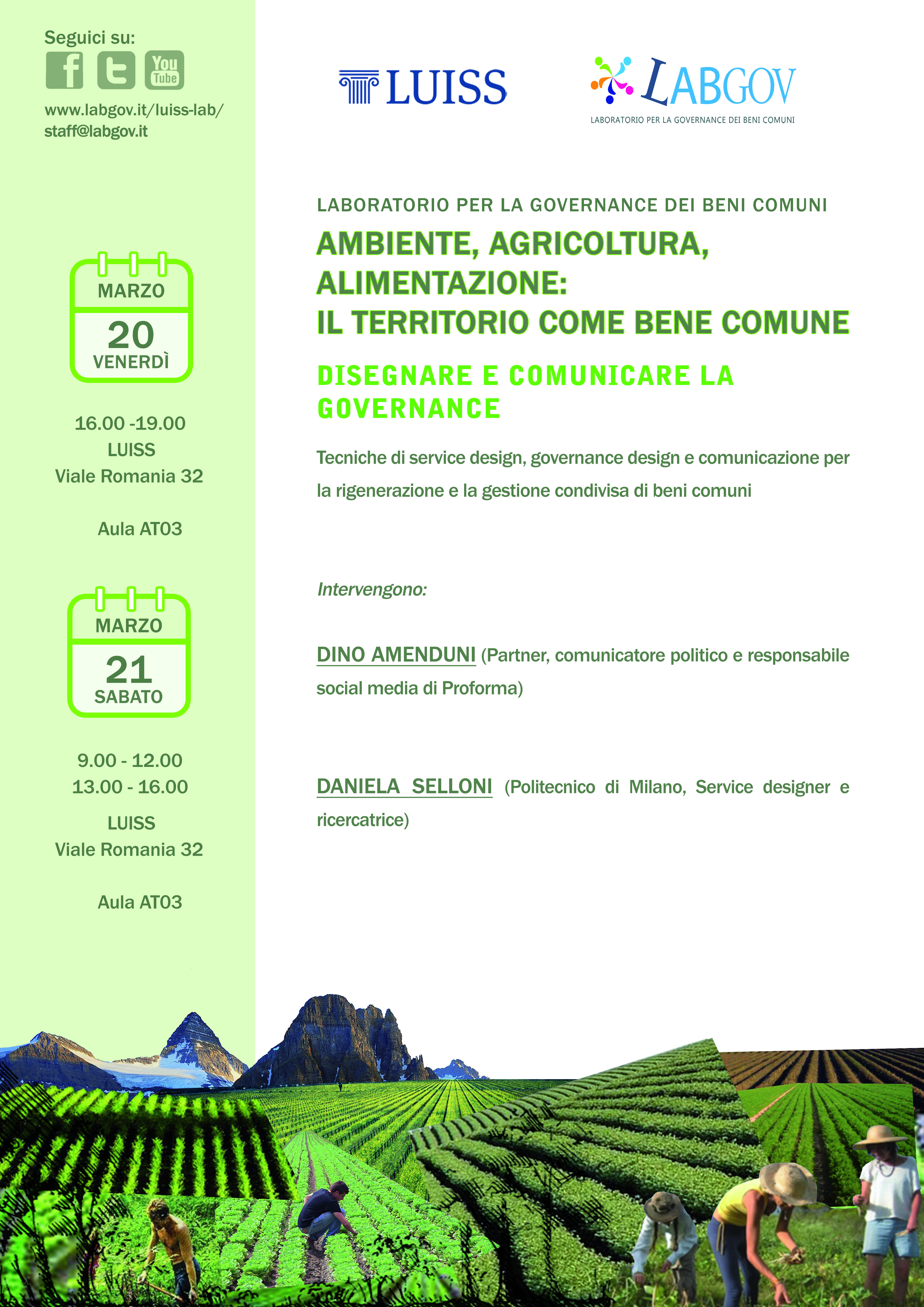
by Francesca Spigarolo | Mar 22, 2015 | EducationLabs, Luiss LabGov 2014-2015
 Is it possible to develop new forms of legal order through a strategy that better protect the territory of our country? How can legality become a cultural element shared by our community rather than being an abstract concept? These were some of the questions raised at the conference “Territorio e nuove forme di Legalità” that took place on March, 17th at LUISS University in Rome.
The conference was an opportunity for the Labgovers to show the projects, activities and achievements of the Laboratory, to receive valuable feedbacks and advices from the participants and to listen at their opinions on the topic of land and governance, which holds a fundamental importance of 2014/2015 LabGov’s edition.
The meeting was opened by LUISS General Director Giovanni Lo Storto, who explained that the reason behind his choice to create a community garden inside the University was “to allow the students to change the state of affairs by providing them with the instruments they need” and to provide them with “a gym where the students can share knowledge and grow together”.
The first speaker to take the floor was Paola Severino, professor of Criminal Law and LUISS Executive Vice Provost who affirmed that through “concreteness and fantasy”, students contribute to the debate. This qualities, which are fully shared by LabGov, are essential to develop the idea itself and the benefits generated by the Commons and to “make the concept of legality something concrete rather than abstract”. “Legality must be recovered with the contribution of the citizens, it cannot be passively waited”. The Professor then spoke about the importance of having “effective sanctions which can lead to concrete results” and which must be developed along with a strong “culture of legality”.
Then, the floor was taken by Gian Carlo Caselli, president of the “Osservatorio Agromafie” scientific committee. Dr. Caselli, started his speech from his personal experience against organized criminality in Palermo, and spoke about the importance of creating “citizenry participation through which the hegemony of corruption and misconduct can be interrupted”. According to Caselli, we need of “new paths to build legality which will allow us to enjoy rights in our territory”. “Trust in the Institutions must be built”, so that “legality will be seen not only as a set of rules but as bringing advantages to the whole community”. Caselli then concluded his speech with a critique to the indifference which amounts to “not taking care of the polis when we could instead cooperate and contribute to its development”.
The second part of the conference took the form of a round table in which the speakers contributed to the discussion by providing their numerous opinions on the topic.
Professor Melina Decaro, professor of public comparative law, asserted that “more than talking about the right to food, it would be more accurate to speak about a right to the natural capital”.
Professor Gian Candido De Martin, professor of public law, underlined the importance of “building a culture that can function as a frame for the rules”, because “what we need is not prohibition, but awareness of the value of common resources”.
Then, Bruno Frattasi (Head of the Interior Ministry Legislative and Regulatory Affairs Department) focused on the idea of “security and legality as shared goods that must be achieved through an alliance between public and private actors”, followed by professor La Spina (professor of public policies) who spoke about the need to have an “integration between a regulation coming from the centre and an organization from the bottom”.
Finally, the floor was given to Antonella Manzione, Head of the Council of Ministries Presidency Legislative and Regulatory Affairs Department , whose starting point was the importance of “creating the culture of legality and building an active citizenship through education in schools and families”. To properly manage the territory we need the citizens to participate and take care of it, but for this to be possible we need to support with some concrete normative instruments those individuals that are willing to get involved. Attempts to create these instruments have been made, as we can see in the article 24 of the “Decreto Sblocca Italia”, but this pieces of legislation are mostly unknown and unapplied. Manzione concluded her speech by reporting the words of a 17 year old girl, saying that what is really needed is “a space, both physical and mental, in which hope and future can be built”.
The conference was concluded with a greeting by Maria Letizia Gardoni, President of Coldiretti Giovani Impresa, and with her wish to see “the growth of daily gestures showing social and political responsibility”.

by Marina Bassi | Mar 10, 2015 | EducationLabs, Luiss LabGov 2014-2015
On March 17th, 2015, LabGov will host the Conference Land and new forms of legal order at LUISS University of Rome. The Conference – that will start at 4:30 PM in Aula Nocco, Via Parenzo 11, LUISS School of Law – will address the issue of collaborative governance for the commons as a tool to fight corruption and organized crime, safeguard the territory and promote legal economic growth and social progress.
Following the experiences developed in Mantova with the CO-Mantova, a collaborative governance territorial pact, and in Bologna with the Regulation on public collaboration, participants will focus on new forms of collaboration between public institutions, social innovators, businesses, civil society organizations and knowledge institutions.
The conference is part of the LabGov workshops series that this academic year has been focused on Land as a commons: environment, agriculture and food.
Giovanni Lo Storto, LUISS General Director, and Roberto Pessi, professor of Labor Law and LUISS Vice Provost for education, will open the Conference. Main session will see the keynote addresses of Paola Severino, professor of criminal law and LUISS Executive Vice Provost, and Giancarlo Caselli, president of the “Osservatorio Agromafie” scientific committee. Antonella Manzione, Head of the Council of Ministries Presidency Legislative and Regulatory Affairs Department, will act as discussant. Second session will be a roundtable with LUISS professors Melina Decaro (professor of public comparative law), Gian Candido De Martin (professor of public law), Antonio La Spina (professor of public policies) and Bruno Frattasi (Head of the Interior Ministry Legislative and Regulatory Affairs Department).
Raffaele Bifulco, professor of constitutional law at LUISS, will chair the two sessions of the conference. The conference will end with the closing remarks of Claudio Rossano, professor of public law.
Full program of the conference is available at the following link:
Territorio e nuove forme di legalità – programma
______________________________________________
Territorio e nuove forme di legalità: la governance collaborativa è la strada?
Il prossimo 17 marzo 2015 LabGov – LABoratorio per la GOVernance dei beni comuni organizza la conferenza “Territorio e nuove forme di legalità” presso la LUISS Guido Carli. L’incontro, che avrà luogo nell’Aula Nocco della Facoltà di Giurisprudenza, Via Parenzo, 11, Roma, indagherà il rapporto fra legalità e salvaguardia del territorio attraverso forme di sperimentazione ispirate alla governance collaborativa, come il Regolamento sulla collaborazione per la cura e rigenerazione dei beni comuni urbani di Bologna e CO-Mantova, il patto di collaborazione territoriale per uno sviluppo economico locale orientato ai beni comuni.
I lavori saranno aperti dai saluti istituzionali del dott. Giovanni Lo Storto, direttore generale della LUISS Guido Carli, e del Prof. Roberto Pessi, Prorettore LUISS per la didattica. Le relazioni principali sono affidate alla Prof.ssa Paola Severino, ordinario di Diritto Penale e Pro-Rettore Vicario LUISS, e al dott. Gian Carlo Caselli, Presidente del Comitato scientifico dell’Osservatorio Agromafie. La dott.ssa Antonella Manzione, Capo Dipartimento per gli affari giuridici e legislativi della Presidenza del Consiglio dei Ministri, agirà in veste di discussant. Seguirà una tavola rotonda con la Prof.ssa Melina Decaro, il Prof. Gian Candido De Martin, il Prof. Antonio La Spina e il prefetto Bruno Frattasi. ll Prof. Claudio Rossano concluderà i lavori della giornata.
Il Prof. Raffaele Bifulco coordinerà i lavori dell’incontro.
Per consultare il programma della giornata:
Territorio e nuove forme di legalità – programma

by Marina Bassi | Mar 5, 2015 | EducationLabs, Luiss LabGov 2014-2015
After a brief pause, the LabGov workshops restart again Friday, March the 6th. During the next two months, LUISS University will host leading experts in governance, social and cultural innovation and many other issues.
Last semester LabGov hosted lots of debates concerning different topics and across intresting points of view. We dealt with social and rural innovation, new administrative ways to create collaborative governance and other forms of collaboration for the commons.
Among the many LabGov guests who will speak, there will be the great opening of Ernesto Belisario. Ernesto is a an administrative lawyer and successfully engaged in several institutional working groups to manage the Italian Digital Agenda – He is also been appointed as digital champion last year.
With Ernesto, LabGov will address the possibility to open administrative procedures to a more collaborative approach by using open data tools.

_____________________________
I nuovi workshop di LabGov sono pronti. Si comincia il 6 marzo!
Dopo una breve pausa, i workshop di LabGov ricominciano il prossimo venerdì, 6 marzo. Nei prossimi due mesi, LUISS University ospiterà grandi esperti di governance, innovazione sociale e culturale e tanti altri.
Il primo tra i molteplici ospiti di LabGov, che interverrà venerdì 6 marzo, sarà Ernesto Belisario. Lui è avvocato e partecipa ai tavoli di lavoro per l’Agenda Digitale Italiana presso la Presidenza del Consiglio dei Ministri e insieme a lui affronteremo il tema OPEN DATA: TRASPARENZA E PROCESSI DI APERTURA AMMINISTRATIVA E ISTITUZIONALE.

by Edoardo De Stefani | Oct 18, 2014 | The Urban Media Lab

Luiss Guido Carli, LabGov and LabSus are pleased to launch the activities for the academic year 2014-2015 at the presence of renewed experts, academic specialists and brilliant professionals of the Commons.
The Director General of Luiss Guido Carli Dott. Lo Storto Giovanni will introduce the panel and lead the introductory presentation, followed by the intervention of Professor Morlino L., Prof. Arena G., Dott.ssa Gardoni M.L., Dr. Verri P. and Prof. Iaione C.
As fellows of the leading wave of the Commons, we are very pleased to open the Lab and to present the activities of the new project cycle, as well as welcoming all our special guests and contributors.
The input for the creation of LabGov was given by the founding fathers in 2012, as a means for managing the emerging expectation of corporations and public institutions, which are more and more concerned about the issue of resources’ shortages and governance methods to fill the gap among social needs and scarce management of supplies and assets.
The Lab, which was born as collaboration between LabSus and LUISS, managed to fulfill great expectations and to deliver concrete results: indeed, through a dynamic and non-conventional educational scheme (clinic house) it was possible to mold the character and build relevant skills for a new category of professionals of the governance of the commons.
Stay Tuned !


