
by Monica Bernardi | Aug 24, 2017 | The Urban Media Lab

In Seoul the village movement is exploding as a form for a sustainable local development and a model for commons-based services for the neighborhood.
To solve problems like poverty, imbalance between the poor and the rich and between the rural and the urban, as well as social injustice, social exclusion and marginalization, the Seoul Metropolitan Government bet on the “urban community village”, a community-driven form of development, and created the Village Community Movement (VCM) and the Seoul Community Support Centre (SCSC) to provide important initiatives on alternative ways to promote sustainable development, not only in economic and environmental terms, but overall in social and relational terms. The village is considered by the government a new framework for rebuilding the entire country and the VCM and the SCSC are the tool used to develop local capacity through citizen participation (Park, 2013). Stressing the autonomous decision making and the strength of local networks they seek to facilitate community participation. They can be considered a form of community building based on participatory, bottom-up and multi-sector approaches that aim to involve local people to solve common problems using a system of interaction and interrelation that fuels the social life (Wolfram, 2017).
The belief that this kind of local model could work comes from the success story of the Sungmisan Village (Sungmisan Maeul), a small neighborhood in northwest Seoul of about 700 families whose adventure begins in 1994. These families fought to save a nearby forest from development (Mt. Sungmi), forming in this way a community that together decided to create an alternative form of care for their children. Around 20 double-income couples unsatisfied with the educational offer coming both from the public and the private sector and disappointed with the materialistic and individualistic approach of the society, decided to join and start an independent kindergarten for their children (Lee, 2010). They launched the “Woori Childcare Center”, the first childcare co-ops for neighborhood families, followed soon by the “Nareuneun Childcare Center” and in 1999 by another after school cooperative. The active involvement of parents created from the beginning a strong team spirit and attracted new residents that shared the community-minded childcare philosophy of “raising our children together”. In 2001, after the success of these childcare co-ops, and recognizing the importance of sharing common values, the community started a consumer co-op for eco-friendly goods and along the way it formed clubs for almost everything: parenting, studying, gardening, hiking, photography, and more… and it started to host regular concerts, festivals and theatrical events in the neighborhood. Through the consumer co-op the Sungmisan Village expanded its connections with local residents and today it counts more than 5,500 members, representing a reference point for all the community life. In addition, from 2001 and 2003, the sense of belonging inside the community became stronger fighting to stop the waterworks project since the government wanted push urban redevelopment (Park, 2013).

Following the cooperative model during the years many different new cooperatives has born: a restaurant, a village cafè, a sharing kitchen, a cohousing building, cooperatives for elderly, to promote culture, to protect the environment, etc.… these cooperatives circulate funds and products, allow co-production, consumption, and distribution and create new job opportunities for the community residents; at the same time they enable the reorganization of the community around networks of reciprocity and solidarity, showing how the revitalization and the enhancement of the communities can come from the joint work inside the cooperatives (Lee, 2010).

But the most important and successful project realized by the community, which solidifies the community life itself, was the creation of the Sungmisan Village School in 2004. It is the first K-12 grade alternative school in Korea (from elementary through high school) and it represents a concrete alternative to the traditional public school education, in which peer and collaborative learning, mutual responsibility and mutual support are the core values. Alongside traditional topics, students learn organic farming, pottery, and other skills from community members, many of them elders. In this way, residents feel that the school is their schools since they are actively involved. As reminded by Shareable.net “with a focus on sustainability, healthy food and connectedness, village schools are more than educational institutions—they’re hubs for learning, sharing, growing and community-building”. This school represents the most important infrastructure for the village since it provides 20 years of pre-adult education; it is a remarkable approach to education and it is part of the village as well the village is an explicit attempt to return to a pre-modern vision of social relations (Pastreich, 2012).

Inside the Sungmisan Village decisions are taken during official meetings by consensus and not by the majority, meaning that people continue to discuss until everyone reaches a consensus. It can be considered a kind of “let’s get to the bottom of it” discussion; even if it seems an inefficient way of making decisions that take a lot of time and energy, on the contrary, it is an effective way of mediating differences of opinion respecting everyone involved and recognizing differences. Discussions continue for a long time but people in this way gain awareness and empathize each other. Alongside the official meetings there are also other opportunities for discussion: the after party, informal moments in which to review and alternative from other perspectives, to find a creative solution, to discuss minority topics or arguments that didn’t find space during an official meeting (they are always debated at the next official meeting). In addition, also the chatter, the informal communication, is very important. It gives additional information, integrates the official communication, supports the building of consensus and it is very useful especially for the new villagers (Yu, 2012).
The success of the Sungmisan Village has inspired numerous urban villages around Seoul. To date have been created more than 1700 urban villages thanks to the governance model implemented by the Seoul Metropolitan Government and based on the VCM and the SCSC. “Urban villages rekindle a lost sense of community and, through village schools, provide a way for young people to grow up in a hands-on, educational community rather than an overly-competitive and isolating learning environment” (Johnson, 2015). Today it really represents a concrete way to rebuild relations and social ties in a mega city where usually people have lost any sense of community, cannot rely on local solidarity networks, don’t know their neighbors and live in an isolated and individualized way. Neighbors who share the needs of everyday life, in fact, enhance solidarity trying to solve the problems together, they create mutually beneficial networks and this is what a village is all about.
***
Johnson, C., 2015, How One Neighborhood in Seoul Sparked a Movement of Urban Villages, Shareable.net [https://www.shareable.net/blog/how-one-neighborhood-in-seoul-sparked-a-movement-of-urban-villages].
Lee, K., 2010, “Creating Urban Reciprocal Community Economy Network by Cooperative Solidarity -The Case Study of Sungmisan-Maeul in Mapogu, Seoul”, in South Korea Cooperative Association, vol.28, n.2, pp. 143-171.
Park, T., 2013, “Empirical Study Of Sustainable Community Development In South Korea: A Special Focus On Village Community”, in OIDA International Journal of Sustainable Development vol.6, n.2.
Pastreich, E., 2012, Sungmisan School in Seoul: A remarkable Approach to education, Circles and Squares [https://circlesandsquares.asia/2012/05/27/sungmisan-school-in-seoul-a-remarkable-approach-to-education/].
Wolfram, M., 2017, “Village Communities and Social Innovation Policies in Seoul: exploring the urban dimension of grassroots niches” in N.Frantzeskaki, Castán Broto, V., Coenen, L. e Loorbach, D. (eds), Urban Sustainability Transition, Routledge, New York and London.
Yu, C. B., 2012, Relations, Communication and Cooperative Operation. Case of Sungmisan Village, Brixtongreen.org [http://www.brixtongreen.org/seoul-city-visits-brixton-green-social-innovationmayor/].
***
Per far fronte ad alcune delle principali problematiche che affliggono una grande metropoli come Seoul (isolamento, emarginazione, alienazione, povertà…), il Seoul Metropolitan Government sta scommettendo sul modello dei villaggi urbani comunitari. Le parole chiave sono partecipazione attiva dei membri della comunità (di solito un quartiere), approcci dal basso e multi settoriali, iniziative di stampo cooperativistico, processi decisionali autonomi e community building. Un esempio di successo, che ha inspirato lo stesso governo coreano a supportare questo modello di sviluppo locale, è il Sungmisan Village, una comunità collaborativa coesa, resiliente e sostenibile nata nel 1994.

by Francesca Spigarolo | May 19, 2017 | The Urban Media Lab

What is the role that public administrations should – and must – have in the creation of a new economic development paradigm able to generate sustainable and equitable wellbeing? This question will be at the heart of the series of conferences and workshops organized within the framework of FORUM PA 2017, which will take place from the 23rd to the 25th of May in Rome.
The common thread will be given by the Global Agenda for Sustainable Development and by the related Sustainable Development Goals (SDGs), that the General Assembly of the United Nations aims to achieve by 2030.
Within this general framework, the participants will discuss the importance of innovating public administration in order to provide answers to the pressing and ever growing issues faced by citizens. From unemployment to the right to health care, from raising inequalities to concerns about security, and much more. It is important for the PA to speak not only about itself and with itself, but to focus instead on why this innovation is deeply needed.
To be able to address these complex themes, the program of the convention is organized into 4 different kind of events: “scenarios”, “thematic conferences, “workshops” and “academies”. The complete program of the event is available here.
LabGov will take part in several events:

On the 23rd Professor Christian Iaione, LabGov’s coordinator, together with Giovanni Vetritto, from the Presidency of the Council of Ministers, will be chair of a conference titled “Sharing and Local Public Services”, which will take place from 9h30 to 11h30.
In the afternoon, from 14h30 to 18h00, we will be present during the conference “Social Innovation and Municipalities: from experimentations to policies”, promoted in collaboration with ANG, ANCI and RENA.
On the 24th Professor Christian Iaione will be chair of a conference titled “PARTICIPATION: models, policies and interventions in Italian cities”, an event which is developed within the framework of the Integrated project on Participation and Communication promoted by the Municipality of Palermo, which will be represented during the conference by Giusto Catania, Councillor for Participation, Communication, Decentralization, Demographic Services and Migration. The event will take place from 11h45 to 13h30.
On the 25th, during the national meeting of Italian cities participating in the URBACT network, which will go on from 11h00 to 14h00, Professor Christian Iaione will give a speech on the topic “Italian cities, between innovation and participation”.

…………………………………………………………………………………..
FORUM PA 2017 sta per iniziare: dal 23 al 25 maggio a Roma si terranno una serie di conferenze e workshops, attraverso cui si affronterà il tema dell’innovazione nella pubblica amministrazione. L’interrogativo con cui questa edizione di FORUM PA vuole confrontarsi è quello del ruolo che le amministrazioni pubbliche possono e devono avere nella costruzione di uno sviluppo economico e sociale che garantisca benessere equo e sostenibile.
Il programma completo dell’evento è disponibile qui.

by Francesca Spigarolo | May 9, 2017 | The Urban Media Lab
The PRIN conference “Attraversando la crisi, Innovazione e vita quotidiana” (Through the crisis, innovation and everyday life) will take place on Friday the 12th of May 2017 at Università Cattolica del Sacro Cuore in Milan.
The event, organized by the Sociology Department and by the research center Modacult, will be an occasion to present and discuss the research “Pratiche sostenibili di vita quotidiana nel contesto della crisi: lavoro, consumo, partecipazione”, financed by the MIUR within the framework of Prin 2010-2011 and coordinated by Laura Bovone from the University Cattolica. Furthermore, during the conference the book “Resistere. Innovazione e vita quotidiana”, written by Laura Bovone and Carla Lunghi, will also be presented to the public.
Through a series of speeches, debates, workshops and roundtables the event will offer the opportunity to reflect on different topics: from sustainable consumption to work’s intimacy, from the urban commons to universalism and community services, from everyday practices to innovations. The conference will see the participation of numerous speaker, between which Alan Warde, from Manchester University, and Melissa Gregg, from Intel Corporation.
Professor Christian Iaione, LabGov coordinator, will take part in the roundtable “Innovation and everyday life”, which will take place at the end of the day.
Here is the complete program of the conference:

……………………………………………………………….
Venerdì 12 maggio 2017 presso l’Università Cattolica del Sacro Cuore di Milano avrà luogo il convegno PRIN “Attraversando la crisi – Innovazione e vita quotidiana”, un’occasione per riflettere su diversi argomenti: dal consumo sostenibile alla work’s intimacy, dai beni comuni all’universalismo nei servizi alla comunità. Ma soprattutto un occasione per confrontarsi sulla crisi e sulle risposte sviluppate per affrontarla, delle pratiche quotidiane alle numerose innovazioni.
Il Professor Christian Iaione, coordinatore di LabGov, sarà presente all’evento e prenderà parte alla tavola rotonda “Innovazione e vita quotidiana”.

by Francesca Spigarolo | Mar 6, 2017 | The Urban Media Lab
During the last decade, Community Land Trust has been welcomed in many European countries by grassroots movements and policy makers alike as a valuable response to the increasing difficulties that a large portion of the population encountered to get access to decent and affordable housing. When trying to enter the housing market, people often face two obstacles. First, expensive private rent and even more high-priced individual private ownership have become out of reach for those who lack the financial power to afford it; secondly, the supply and quality of social housing has proven unable to meet the demand of a growing number of low-income people who seek access to it[1]. In spite of the lack of a long-term stable framework for the affordable housing sector in Europe,[2] a whole range of piece-meal solutions aimed at increasing the supply of affordable housing have been put in place through both public policy interventions at a State and regional level, and the activism of not-for-profit housing cooperatives, housing associations, and self-organized groups of people.

Especially concerned with the long-term affordability of housing for low- or moderate-income people, Community Land Trust has gained ascendancy among those solutions that are capable of responding to the pitfalls of the housing market and has consequently known an unprecedented spread throughout Europe during the last decade. Community Land Trust (also known by its acronym CLT) is a land ownership scheme capable of fostering housing long-term affordability while at the same time allowing the broad participation of the community involved[3]. Community Land Trust arrived on the scene in the United States in the late 1960s as an outgrowth of the Southern Civil Rights Movement and was originally used as a mechanism for African-American farmers to gain access to agricultural land[4]. Since then, CLT has steadily grown in importance across the United States, so far as it has been employed in urban and rural areas as a means to provide an alternative to low- and moderate- income people for affordable housing and neighborhood revitalization[5]. According to the National Community Land Trust Network (NCLTN), which represents the major association for CLTs in the United States[6], there were in 2011 “a total of 246 CLTs in the network with coverage in 45 states and probably about 6,000 homes in the land trusts’ hands across the country”[7].
Community Land Trust is a membership-based, non-profit organization chartered to hold and manage land in trust for the benefit of a given community. These three main elements – land, trust and community – are the core of the CLT model. As to the first element, land is held in trust by the CLT for the benefit of the community. Actually, the CLT acquires land through purchase or donation with an intention to retain title in perpetuity and to remove the land from the speculative market[8]. While permanently retaining title to the land, the CLT enters into long-term agreements with prospective low- or moderate-income residents, which are thus given ownership of buildings and improvements on the land. The result is a split between the ownership of land and improvements. As to the element of trust, stewardship or “trusteeship”[9] of the land for the long term is ensured by the CLT in different ways. Firstly, the ground lease set out a range of mutually agreed restrictions between the CLT and residents, such as resale-price, buyer-eligibility, occupancy, and use restrictions, which ensure that homes remain affordable for future buyers over time. Secondly, the CLT does not disappear once homes are eventually sold by leaseholders; on the contrary, CLT may retain an option to repurchase the buildings located on the land when residents wish to sell them and, in the event a resident defaults on her mortgage, the CLT may have a right to step in to prevent foreclosure[10]. As to the third element – community – the democratic governance structure of the CLT reflects the idea that CLT operates within a given community (a single neighborhood or an entire city) and that all members of the community should have a degree of control over the way the land is managed. First of all, membership of the CLT is open to anyone living within the boundaries of the community and not only to residents, each group having the responsibility of electing one third of the governing body. Moreover, the board of trustees – normally called Board of Directors – is tripartite and includes representatives of (i) residents of the trust-owned land, (ii) members of the community who do not lease land from the CLT, and (iii) other people who are meant to represent the public interest, such as public officials and non-profit organizations and funders.
The CLT model, including all the features described above, has been given legal recognition into the federal Housing and Community Development Act of 1992, where it is defined as
“a community housing development organization […]
(1) that is not sponsored by a for-profit organization;
(2) that is established to carry out the activities under paragraph (3);
(3) that:
(A) acquires parcels of land, held in perpetuity, primarily for conveyance under long-term ground leases;
(B) transfers ownership of any structural improvements located on such leased parcels to the lessees; and
(C) retains a preemptive option to purchase any such structural improvement at a price determined by formula that is designed to ensure that the improvement remains affordable to low- and moderate-income families in perpetuity;
(4) whose corporate membership is open to any adult resident of a particular geographic area specified in the bylaws of the organization; and
(5) whose board of directors:
(A) includes a majority of members who are elected by the corporate membership; and
(B) is composed of equal numbers of
(i) lessees pursuant to paragraph (3)(B);
(ii) corporate members who are not lessee, and
(iii) any other category of persons described in the bylaws of the organization”[11].
Since then, CLTs have steadily spread throughout the United States. The expansion of the CLT movement has been pushed by different factors. First, non-profit organizations have committed themselves to help groups to identify and reclaim vacant land and turning it into a community resource, as is the case for 596 Acres. Secondly, CLT has been increasingly welcomed by local administrations as a valuable response to the shortfalls of the public housing market. An example of this is the Request for Expressions of Interest (RFEI) recently issued by the New York City Department of Housing Preservation and Development (HPD), whose objective is to identify qualified groups who are interested in forming a CLT[12]. The formal recognition of CLT by legislation, the growth of a national CLT network, along with the increased attention of public authorities, have also favored the diffusion of the CLT model outside the United States. Along these lines, both groups and local authorities in several European countries have attempted to adapt the CLT model to national contexts and promote its use, being attracted by its ability to preserve long-term housing affordability while triggering neighborhood revitalization, both of which are much-needed in large European urban centers.
[1] For a thorough analysis of the situation of the housing market and related policy development in each of the European member States, see The State of Housing in the EU 2015, Housing Europe, the European Federation for Public, Cooperative and Social Housing
Brussels, available for download at http://www.housingeurope.eu/resource-468/the-state-of-housing-in-the-eu-2015 (last accessed on December 26th, 2016).
[2] This is one of the key findings of « The State of Housing in the EU 2015 ». A summary of the report is available for download at http://www.housingeurope.eu/resource-468/the-state-of-housing-in-the-eu-2015 (last accessed on December 27th, 2016).
[3] Its first advocates described CLT as “a social mechanism which has as its purpose the resolution of the fundamental questions of allocation, continuity and exchange”: The Community Land Trust. A guide to a New Model of Land Tenure in America, International Independence Institute, Center for Community Economic Development, 1972 (reprint 2007). In the book, the basic structure of CLT is also carefully explained.
[4] J. E. Davis, Origins and Evolution of the Community Land Trust in the United States, in J. E. Davis (ed.), The Community Land Trust Reader, The Lincoln Institute of Land Policy, Cambridge, Massachusetts, 2010, p. 3-47.
[5] According to Abramovitz, the reasons for the increased emphasis on affordability in the US are to be linked to “the massive number of low- and moderate-income rental units built under various subsidy programs in the late 1960s and early 1970s that have been in danger of being lost as affordable housing through mortgage prepayment. […] In addition, the rapid housing price inflation experienced in many parts of the country during the 1980s further strained the ability of the private housing market to sustain an adequate supply of affordable units”: D. M. Abramowitz, Community Land Trusts and Ground Leases, in 1 J. Affordable Hous. & Cmty. Dev. L. 5 1991-1992, p. 5.
[6] Information about the CLT network in the United States are available at http://cltnetwork.org
[7] See S. Soifer, “Community Land Trust”, in The Encyclopedia of Housing, 2012, p. 2.
[8] “A Community Land Trust takes land off the speculative market and places it in a regional, membership-based, non-profit corporation”: The Community Land Trust Handbook, Institute for Community Economics, 1983.
[9] J. E. Davis, Origins and Evolution of the Community Land Trust in the United States, cit., p. 18-19.
[10] For details concerning the functioning of CLT, see the CLT Technical Manual, available at http://cltnetwork.org/2011-clt-technical-manual/.
[11]See Housing and Community Development Act of 1992.
[12] http://www1.nyc.gov/site/hpd/developers/request-for-proposals/CLT-RFEI.page
Fabiana Bettini, Postdoctoral Researcher, Sciences Po Law School, Paris
This article is drawn from a broader research conducted in the framework of the ERC-funded project “INCLUSIVE” (2014-2019) led by Professor Séverine Dusollier and hosted by the Sciences Po Law School, Paris
——————————————————————
Nell’ultimo decennio il modello del Community Land Trust (CLT), sviluppatosi negli Stati Uniti, ha iniziato a diffondersi in Europa grazie all’impegno della società civile e di diverse amministrazioni e policy makers. I CLT offrono una valida risposta alle crescenti difficoltà che una un’ampia porzione della popolazione incontra nell’individuare soluzioni abitative vivibili ed economicamente accessibili.
by Chiara De Angelis | Feb 13, 2017 | The Urban Media Lab
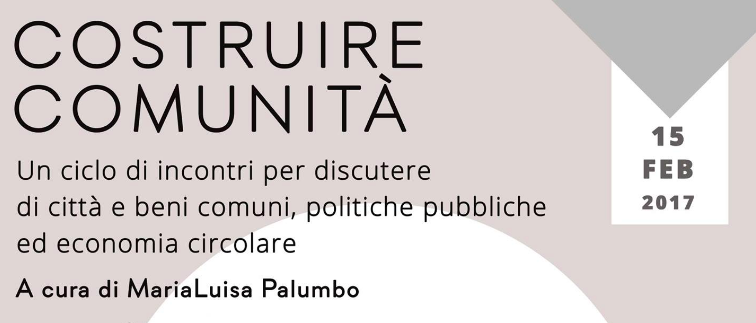
On Wednesday the 15th of February, the cycle of seminars “Building Communities” (Costruire Comunità) will start its course at INARCH, the National Institute of Architecture, in the context of the master degree in Sustainable Architecture. The cycle is composed by three seminars with three experts coming from different fields of study but still complementary with architecture, in order to promote a reflection on the link between environmental sustainability and the social sustainability of urban regeneration and city governance.
This first seminar is going to host Christian Iaione, LabGov’s co-founder and expert of the co-governance of commons, who is going to focus on the idea of the city as a commons.
The next two seminars will host respectively:
- Maria Cristina Antonucci, researcher in social studies at CNR – 22th of March
- Filippo Celata, professor in Economic Geography and expert in local politics – 5th of April
The focal point of the events will be the relationship between public and private, as well as the idea of community, and several methods, models and instruments to re-think our cities will be discussed.
The events are open and public. More info here: http://www.inarchedu.it/seminario-la-citta-bene-comune/

Venerdì 15 febbraio INARCH ospiterà la prima sessione del ciclo di seminari “Costruire Comunità”, organizzato nell’ambito del master in Architettura Sostenibile. Tre incontri con tre esperti (Christian Iaione, Maria Cristina Antonucci e Filippo Celata) per discutere del rapporto pubblico-privato e dell’idea di comunità.
I seminari sono aperti e pubblici. Più informazioni a questo link: http://www.inarchedu.it/seminario-la-citta-bene-comune/
