by Francesca Spigarolo | Nov 10, 2016 | The Urban Media Lab
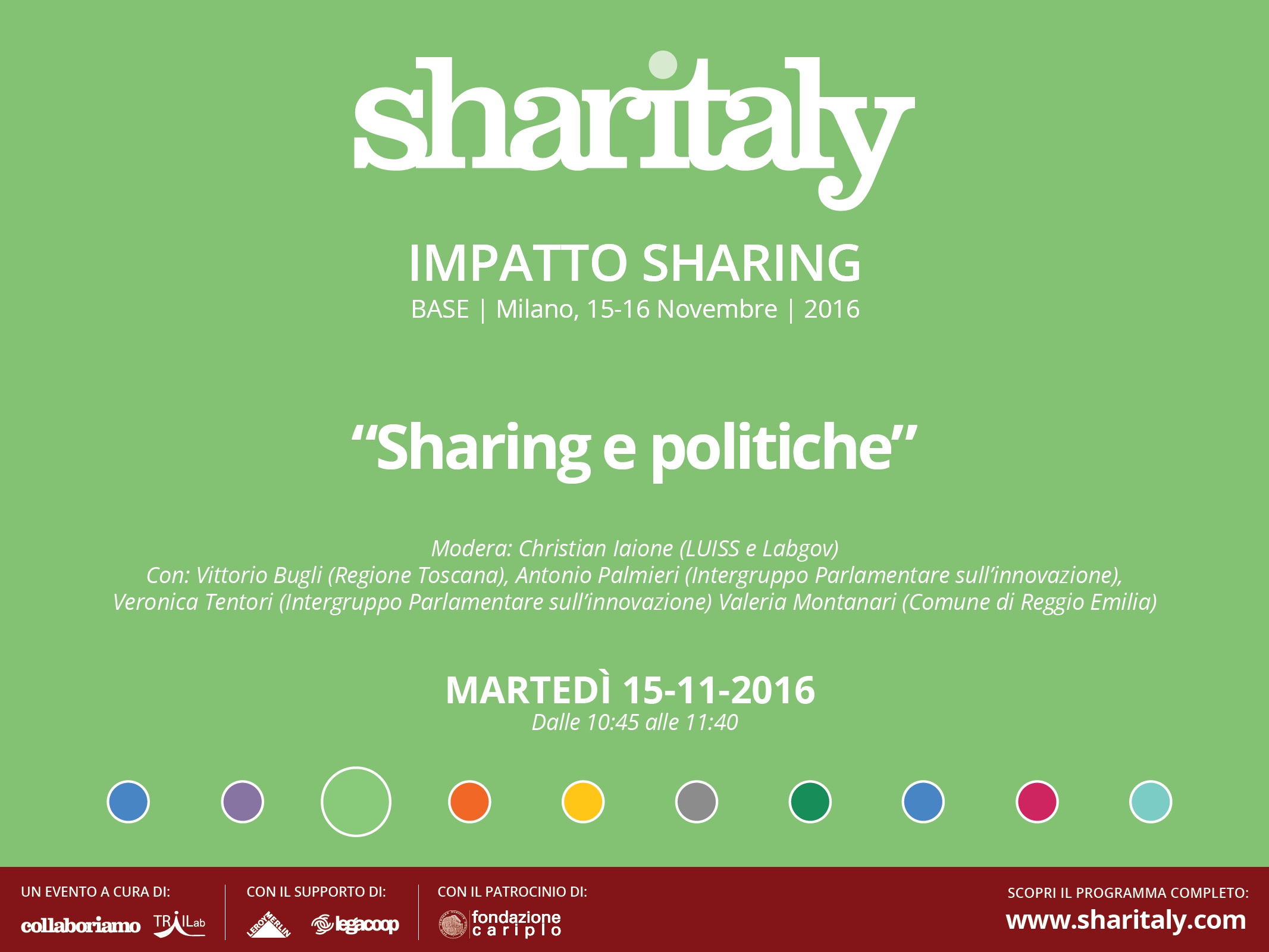
On Tusday the 15th and Wednesday the 16th on November people from all Italy will gather in Milan to take part inthe 4rth edition of Sharitaly, leading event on collaborative economy at national level. Organized by Collaboriamo and Trailab, Sharitaly aims at fostering the debate on sharing economy and promoting the exchange of good practices by bringing together communities, platforms, firms and administrations. In this 4th edition, titled Sharitaly: Sharing Impact, the focus will be on assessing the degree of diffusion of sharing economy in Italy and on evaluating its impact in the country.

In the last few years sharing economy has been the object of numerous debates that presented it under the most diverse lights: from the passionate supporters who saw it as a solution to the economic crisis to the more skeptics who began to worry about its “dark sides”, a lot has been said.
Shareitaly will be the occasion to consider all these views and to further investigate the role of sharing economy in the contemporary society. Through debates, laboratories and case studies the participants will get together and will confront the most pressing questions on the topic: Does sharing economy destroy employment or does it contribute to the creation of new opportunities and competences? Is it the source of new inequalities or can it produce new forms of collaborative welfare? Does it manage to build new forms of intermediation in the markets? Is it sustainable?
Multiple and complementary answers to these questions will be found throughout the event, as the phenomenon of sharing economy will be observed within different thematic frameworks: from collaborative and distributive finance to open data and local governance, from culture to collaborative living, from citizens’ science to tourism, mobility, employment and manifacture 4.0.

LagGov will be present at the event, where its co-founder Professor Christian Iaione will moderate the discussion on “Sharing and Politics”, discussion that will also see the participation of Vittorio Bugli (Tuscany Region), Nicola Danti (European Parliament), Valeria Montanari (Municipality of Reggio Emilia) Antonio Palmieri and Veronica Tentori (both members of the Parliamentary Intergroup on Innovation).
The complete program of the event and a list of speakers are available on the official website: http://sharitaly.com/
Tickets for the event are available and can be purchased here.
To discover more about the previous editions : 2013, 2014, 2015.
——————————–
Martedì 15 e mercoledì 16 Novembre a Milano si terrà la quarta edizione di Sharitaly, dal 2013 evento leader in Italia sull’economia della collaborazione. L’evento mira a promuovere il dibattito e lo scambio di pratiche favorendo la contaminazione tra comunità, piattaforme, amministrazioni e aziende, e in questa sua quarta edizione si concentrerà nello specifico sull’osservare la diffusione e l’impatto dell’economia collaborativa oggi in Italia.
Il programma completo dell’evento e una presentazione dei relatori che interverranno sono sono disponibili qui.

by Caterina Gianni | Oct 25, 2016 | Storytelling 2016-2017
On October the 14th, LabGov started the first co-working session in which Paola Santoro, an expert designer, exposed the “hero’s journey” having as protagonists Alessandra and Urio: the spokespersons of the raising Community of the Public Park of Centocelle. This is the #Co-Rome project (www.co-roma.it): an audacious initiative in which achievements and failures characterized the essence of the challenge.
 The core topic of the meeting was to understand,also through creative games, what is “la facilitazione dei beni comuni”, more specifically how LabGov assisted the community as mentors, not imposing themselves as superior entities capable of solving problems, rather as an enterprising group that can offer them all the means to improve the environmental situation of a public park, with the common goal to fill-in the gap between the community’s unsatisfied social reality and the dreamed one. This “green” forgotten area, that at a first glance might appear as common as any other park in Rome, deep inside has embedded all the shared values that gradually arose once that a touch-point between the park’s users and the object used was fixed.

by Chiara De Angelis | Jul 28, 2016 | The Urban Media Lab

Synergia is an international network of individuals and organizations united together with the aim of implementing new models of economic and social practices which can be able to transition societies to a more sustainable, democratic and social just model of political economy based on the principles of cooperation and the common good.
In order to explore those models and to share the experiences of some of the leading experts and practitioners in those fields, the Synergia Institute will organize a two-weeks Summer School in September, titled “Transition to Co-operative Commonwealth: Pathways to a New Political Economy”. The Summer School will take place in Monte Ginezzo, Tuscany, from September 11th to September 23rd. The overarching focus of the Synergia program is to answer the question: What is the ethical economy and how does it work?
The program blends together lectures and workshops with site visits to leading co-operatives and common activities in Tuscany and Emilia Romagna, in order to unite the global with the local through the diffusion of ideas, models and practices. The instructors of the courses will be some of the very finest minds and practitioners in their respective fields of study and practice:
- Michel Bauwens: Founder, P2P Foundation; Co Author, Network Society and Future Scenarios for a Collaborative Economy.
- Pat Conaty: Fellow, New Economics Foundation; Research Associate, Cooperatives UK; Co Author, The Resilience Imperative.
- Renate Goergen: President, Le Mat Europe; Board Member, European Social Franchise Network (ESFN).
- Christian Iaione: Associate Professor of Public Law, Guglielmo Marconi University of Rome; Fellow, Urban Law Center at Fordham University; Director, LabGov – Laboratory for the Governance of the Commons.
- Mike Lewis: Executive Director, Canadian Centre for Community Renewal; Co Author, The Resilience Imperative.
- Julie MacArthur: Assistant Professor, Environmental Politics & Public Policy, University of Auckland; Author of Empowering Electricity: Sustainability Co-operatives and Power Sector Reform in Canada.
- Jason Nardi: Co-ordinator, RIPESS Europe.
- John Restakis: Executive Director, Community Evolution Foundation; Adjunct Professor, Simon Fraser University, Author – Humanizing the Economy – Co-operatives in the Age of Capital.
- Marco Tulli, Emiliano Cecchino, Davide Bonsignore: Off Grid Academy.
The deadline for applications for the Synergia Summer Institute is August 12th. The course is now available at a lower rate. You can have a look at the updated brochure for more details and at Synergia Institute’s Facebook page for updates.
Il Synergia Institute organizza una Summer School di due settimane a Settembre, per esplorare, studiare ed implementare nuovi modelli di pratiche economiche e sociali. La Summer School avrà luogo a Monte Ginezzo (Toscana) dall’11 al 23 Settembre. Le iscrizioni chiudono il 12 Agosto: è un’occasione da non perdere!
by Ieva Punyte | Jul 28, 2016 | The Urban Media Lab

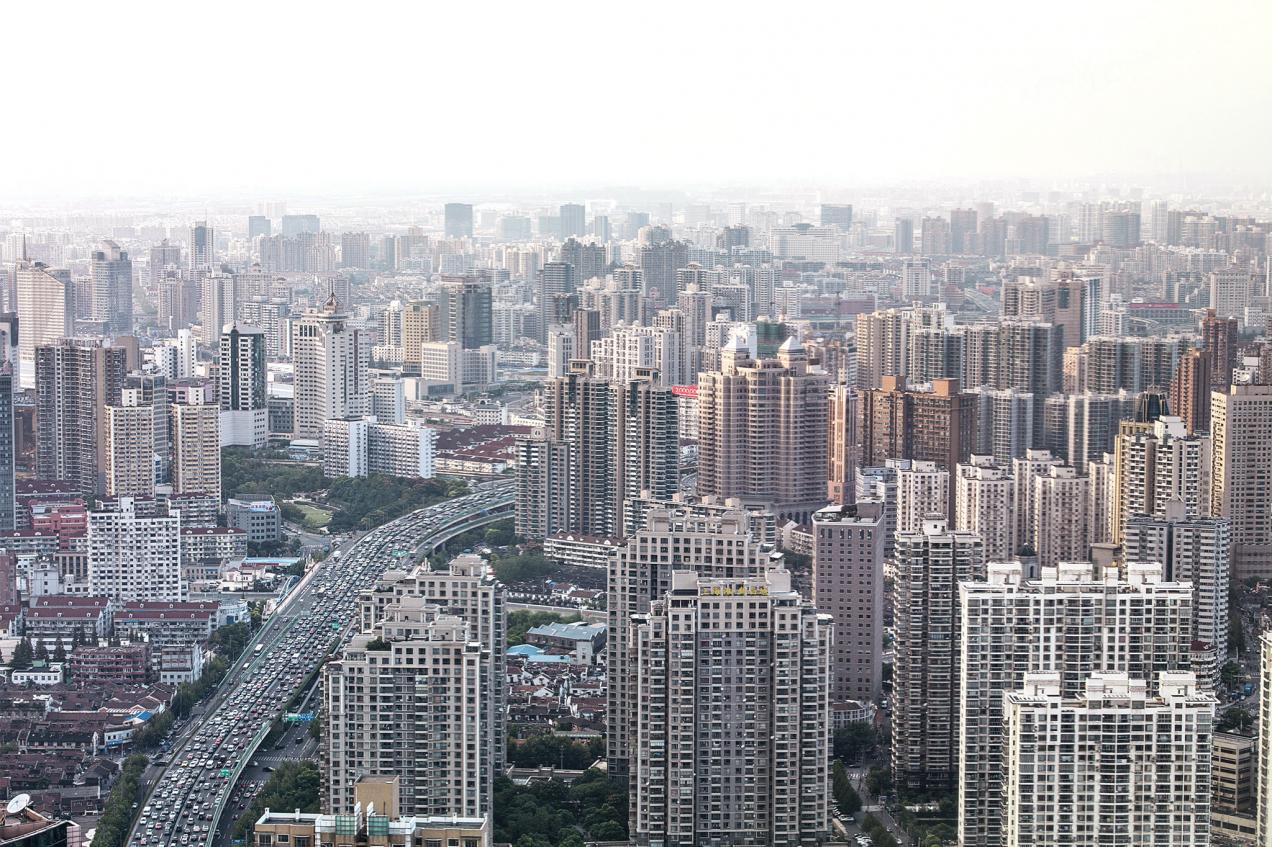
Image From The Urban Age “Shaping Cities” conference (July 14-15) hosted by La Biennale di Venezia
Cities are paradoxical spaces. On one hand, it is commonly known that, for instance, migration has been one of the most effective ways to increase the standard of living. In theory, when coming to the big cities, people are offered a surplus of opportunities to work, get educated, create a family and enjoy the lives they want. Therefore, the rush to settle down in cities, particularly in emerging economies, has been sparked by the image of a better life, full of diverse opportunities and, hence, as the economies have concentrated in the cities, so have the people. On the other hand, it is not a secret that the cities of today are extremely unequal places having a major part of their population, usually characterised by the poor and uneducated, excluded from the above-mentioned image. Disturbingly, exclusion has not only been relevant to the new-comers, but also to the residents who have lived in the urban centres for generations, and this is linked to the process of gentrification.
Thus, who owns the city? – a question addressed by S. Sassen, a Dutch-American sociologist – is very relevant today. Due to the growing foreign investment the major part of cites, in particular the central infrastructure, is now owned by foreign large corporations or shell companies [see more about this topic here]. This creates a kind of meta-reality, because it is an invisible project. Nobody knows that some of the buildings are foreign owned, yet cities slowly become privatised entities, closed from the general public. Additionally, this contributes to the paradoxical lost of urbanity within the cities, because despite the fact that cities are becoming more and more dense, they are becoming less urban. Today “rather than a having spaces for including people from many diverse backgrounds and cultures, our global cities are expelling people and diversity.” – stress S. Sassen. Unsurprisingly, as the diverse public spaces are disappearing and the exclusion based on the socio-economic considerations, frequently tied to the racial or religious minority groups, is increasing, this has a direct contribution to the fragmentation of our societies and often results in an increase in social tensions and criminality. This fact has been addressed also by Suketu Mehta, an Associate Professor of Journalism at New York University, a writer and a winner of multiple awards in literature. Professor Metha has focused on the universal topic of exclusion and noted that “[t]o build a great city, a just city, we have to look at who’s included and who’s excluded. Then we should follow three principles: don’t exclude anybody from the law. Don’t exclude anybody from the conversation. And don’t exclude anybody from the celebration” of a city [a full article can be found here, or a discussion on the same topic between Suketu Mehta and Richard Sennett is available here].
The McKinsey Global Institute (MGI) calculates that between 2015 and 2025, the world’s urban population will grow by 65 million people a year, or almost 179,000 every day [see more about this here]. Therefore, already having more than a half of the world’s population living in the urban settlements, the topics on inclusion and exclusion are extremely relevant while addressing planning, urban commons and governance – the future our cities. Having stressed the fact that cities are being sold off, this constitutes a great challenge for urban planners to secure the ability for everyone to take ownership of their city and ensure the true urban experience.This is the reason why in the annual Urban Age “Shaping Cities” conference, which is jointly organised by the LSE Cities at the London School of Economics and Political Science and Deutsche Bank’s Alfred Herrhausen Gesellschaft in a partnership with United Nations Habitat III, scholars and practitioners, despite their respective expertise, implicitly or explicitly, yet continuously reflect upon the issues on exclusion in the cities – how to manage it today and reduce it in the future.
“The cities everyone wants to live in should be clean and safe, possess efficient public services, be supported by a dynamic economy, provide cultural stimulation, and also do their best to heal society’s divisions of race, class, and ethnicity” –stressed Richard Sennett, a Centennial Professor of Sociology at the LSE and University Professor of the Humanities at New York University, while addressing the open system of cities in “Shaping Cities” conference [find original essay here]. Although, having addressed the paradoxical nature of the cities this is not necessarily the reality.
Cities are enormously expanding as well as they are full of religious, cultural, ethnic diversities whereby individuals belong to different communities at the same time. However, who actually shapes the life of our cities? Is it the voice of the diverse society, or the absence of this voice? Having addressed the urban diversity, S. Sassen identifies a city as a mixity of complexity and incompleteness, which has the capacity to thrive for a very long life [see her talk on this at this year’s “Shaping Cities” conference here]. However, stressing the above-mentioned foreign investment threat, cities are losing their dynamic cityness and are even de-urbanised, which contributes to the completeness of the cities. This is caused by the ownership and the construction of new glass boxes and predictable commercial spaces or isolated enclaves for homogeneous uses and users that prevents urban dynamism from even coming into existence.
Therefore, having in mind the social dynamics and diverse currents of our cities, it is very important to understand the social dimensions and ramifications as well as implications of urban planning and of certain governance policies to the society. And this is what Suketu Mehta means by not being excluded from the conversation – the conversation around urbanism. It is crucially important for urban planners and society to share the same language. Planners therefore should be public intellectuals, because “without political will, all our grand city plans will remain on the drawing board. And political will can only be generated if we get the public informed and excited about planning. The public is ready, because they’re already excited to be in the city”– stresses Mehta.
Coming back to S. Sassen’s definitions of the city, she additionally stresses that even if infrastructural density “for someone is enough to have a city, there is more, because the large cities especially are one of the few places where those without power get to make a history, a culture, a neighborhood economy”. Cities, according to the sociologist, “are also today’s frontier zone where powerless and power encounter each other”. This goes together with the considerations by Jane Jacobs, (1916-2006) a famous urban writer and activist who tried to understand what results when places become both dense and diverse, as in packed streets or squares, their functions both public and private. She stressed that out of such conditions comes the unexpected encounter, the chance of discovery and of the innovation. Out of this encounter between, for instance, low wage workers and the wealthy, comes learning as well as positionality.
Thus, all the above-mentioned scholars could agree that city needs common spaces where the real life can take place: where local economies can be made and where local cultures can thrive, because this phenomenon does not happen in the large private and complex corporate setups. This comes hand in hand with S. Mehta’s statement that no one should be excluded from the celebration and, I would add, the celebration of the cityness – city’s diversity, complexity and incompleteness. Here everyone is not excluded from being part of this celebration which indeed should be open, affordable and accessible. Additionally, this is closely tied to R. Sennett’s notion of the porous city, – a concept that he developed after visiting Nehru Place market in Delhi. “It’s a completely porous spot in the city, people of all castes, classes, races and religions coming and going, doing deals or gossiping about the small tech start-ups in the low offices which line the square; you can also worship at a small shrine if you’re so minded, or find a sari, or just lounge about drinking tea.” [see the article here]. According to the scholar, a porous city is based on the “opening up and blurring the edges of spaces so that people are drawn in rather than repulsed; they emphasize true mixed use of public and private functions . . . they explore the making of loose-fit spaces which can shift in shape as people’s lives change”. Porous spaces of the city are closely related to the urban commons. Spaces produce a fertile medium to take the ownership of live in the unpredictable setting, experience urbanity by surprise, and provide social and economic possibilities for all citizens – this therefore represents a truly inclusive city.
Lastly, in the Shaping Cities conference Ed Glaeser, a professor of Economics at Harvard University said that “so much of what we find most precious about our successful cities are the common spaces, are the spaces that provide a form of equity, meaning that anyone can come and enjoy”. These spaces, according to the scholar, are open spaces welcoming everyone’s experience regardless of their socio-economic background – if they are able or not to afford a drink in a square where everybody gathers. The promotion of social inclusion hence is done by creating these democratic spaces – “a forum for . . . strangers to interact”– as stresses R. Sennett. However, the creation and maintenance of these spaces is a long and experimental process, because communities to grow time and space are needed, since the bonds of an inclusive “community cannot be conjured in an instant, with a stroke of the planner’s pen”. This is fully reflected by the main principles of the City as a Commons, and it is not the alternative rather the only – inclusive and sustainable- way to help us live together. Thus, urban commons provide democratic “spaces of unplanned interactions that so often make one of the most precious things that happen in cities” – said Ed Glasear. Scholar adds that the promotion of open and shared spaces, which are the attempts of truly inclusive cities, should not be just merely defined, but actively defended, and this should incluively be done by reforming governance institutions, some of which could be purely public, some – purely private and some could occupy the space in between and this is the way to include everybody in the law, in the conversation, and in the celebration of cities and dynamic urbanity.
————————————————-
Le città sono spazi complessi e colmi di paradossi. Se da un lato per coloro che scelgono di migrare verso la città si aprono maggiori opportunità di successo economico e mobilità sociale, che possono condurre ad una migliore qualità della vita, dall’altro, come ben sappiamo, le città sono il luogo in cui diseguaglianza ed esclusione si manifestano in modo più accentuato. Diventa perciò sempre più importante interrogarsi, come molti studiosi stanno facendo, su quali soluzioni possano essere adottate per far si che l’ambiente urbano sia sempre di più uno spazio di incontro tra le diverse realtà sociali e culturali che coesistono nella città, in cui si generino comprensione e inclusione. In quest’ottica il ruolo dei beni comuni urbani come “spazio democratico di interazione pianificata” emerge come un elemento fondamentale nell’immaginare un percorso verso uno sviluppo urbano sostenibile.


