The first module will be dedicated to Open Innovation and Open Business modeling.
On Friday the 21st the
first workshop will take place in classroom 305b from 4pm to 6pm in the Luiss
campus located at Viale Romania 32.
The Urban Clinic will host Maria Isabella Leone, professor at the
department of Business and Management and executive director of the master in
Open Innovation and Intellectual Property. As an expert in open innovation she
will analyze some examples of firms that successfully adopted approaches based
on open innovation. This workshop will provide students many insights to
stimulate their creativity so to come up with some ideas to tackle our
challenge.
On Saturday the 22nd the firs co-working session will take place in classroom 103b from 10am to 5pm at the Luiss campus located in Viale Romania 32.
The Urban Clinic will host Alessandro Piperno, Luiss PhD student in Management. During the co-working session, the students will be divided into three groups, each group has to develop an idea’s proposal able to overcome our challenge. Every group will then present its idea to the rest of the students and work on a power point presentation to redefine it and analyze in depth the topic. Once the idea generation process will be gone underway, Alessendro Piperno will explain to students the basic notions to carry out a business model so to provide students with practical skills that will help them turn their ideas into reality.
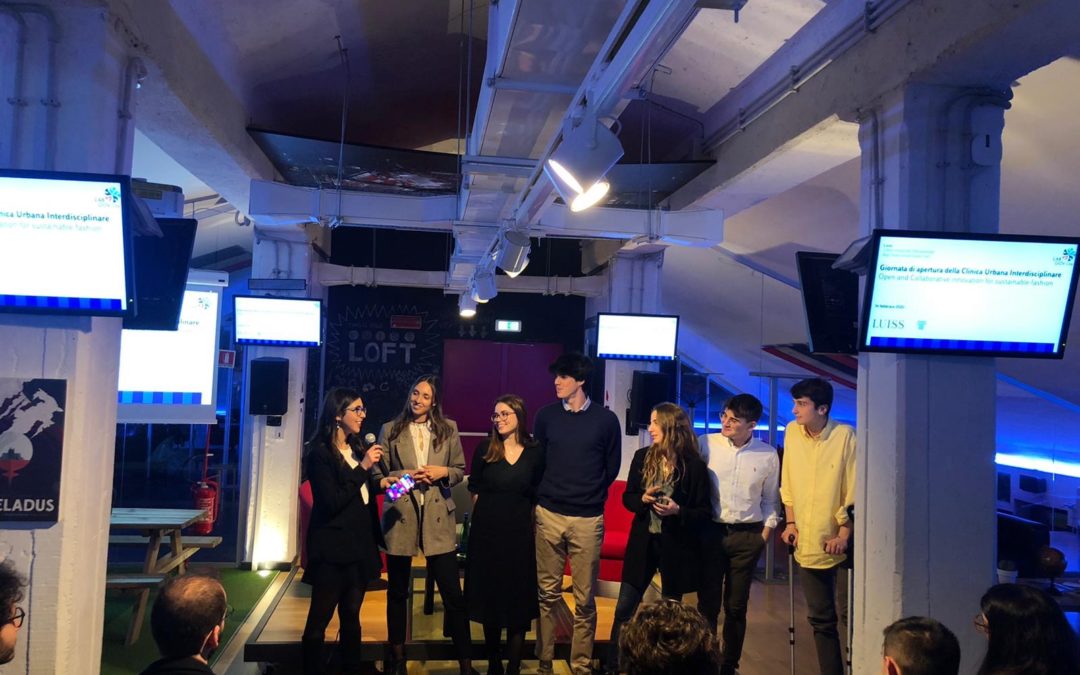
On Friday, February 14th, the opening meeting of the LabGov 2020 Interdisciplinary Urban Clinic took place at the LOFT of the Luiss Guido Carli University .
The theme of the meeting was the Open and Collaborative Innovation for Sustainable Fashion and we had the honor to host the Luiss General Manager, Giovanni Lo Storto, Professor Maria Isabella Leone, Executive Director of the Master in Open Innovation & Intellectual Property at Luiss Business School and Dr. Luciana Delle Donne, founder and CEO of Made in Carcere.
Credits to Luiss Loft
The first part of the meeting was dedicated to the LabGov.City team presentation to the students with a focus on the projects carried out so far and the future goals that will see them involved. It was Dr. Lo Storto who welcomed the new LabGovers (the students of the Urban Clinic) and recalled the true meaning of the word “sustainability” that means awareness and coherence and sustain in the sense of creating and sustaining long lasting beauty. LabGov represents this kind of support as well as the exact edge of the role that a university and a training place should have in empowering students to the value of preserving the planet, the value of physical work, the respect for the city and the maintenance of public heritage with the final scope to train not only technicians but good citizens.
The meeting continued with an informal talk between Professor Maria Isabella Leone and Dr Luciana Delle Donne: with them we have combined both the theoretical and practical approach. In particular, Prof Leone highlighted the importance for a company to adopt Open Innovation’s methodology to be competitive in the market and improve the resilience of an enterprise. The real challenge, prof Leone points out, is to transform an Open Innovation methodology into concrete results by creating new business models that have a positive economic and social impact. Together with Dr. Luciana Delle Donne, we observed how innovative and sustainable social enterprises can be generated, involving fragile communities. Luciana told us her story, in particular her “second life” when after twenty years of employment in the world of finance she decided to devote herself to social entrepreneurship: in 2007 the brand “Made In Carcere” was born. The project aims to generate awareness and responsibility by including the inmates of Lecce prison in a dynamic process that gives them a job, a salary and above all the ability to face the world once their detention is over. The real challenge in social innovation is to go against the general trend because habits and mentality are the hardest thing to change.
The second phase of the meeting witnessed the presentation of numerous initiatives that will be invited to cooperate in the Urban Clinic, including the project of Francesco Malitesta and Edoardo Croce creators of the Artwear Lab “X-novo”, a roman start-up based on the exchange and reuse of garments that involves the participation of roman street artists. Flavia Romei told us about her atelier at Pigneto “Cheap Lobster” which creates tailor-made skirts with a mix of fabrics from textile scraps coming from fashion industries.
Finally, during the Magic City, the Christmas market promoted by Luiss, LabGov collaborated with Viving, a local NGO, and Young Ethos, a group of students of the Luiss Business School, to create a collection point of used clothes in order to donate them, regenerate and reuse them.
Claudia Chimenti, President of Viving and Beatrice Signoretti and Jacopo Ventura representing Young Ethos, told us about the evolution of Magic City. A part of these garments will be regenerated during the Urban Clinic thanks to the collaboration of several actors.
Next appointment on February 21st with the first module “Idea Generation Lab” and the workshop on the theme of “Open Innovation” presented by Prof. Leone, and the co-working with Dr. Alessandro Piperno on “Sustainable and Open Business Modelling Lab”. It will be a key moment to pique students’ interest, unite the Edu LabGov 2020 community and find the starting point from which to start a co-design process.
Nella giornata di Venerdì 14 Febbraio si è svolto l’incontro di apertura della Clinica Urbana Interdisciplinare di LabGov 2020 presso il LOFT dell’Università Luiss Guido Carli.
Durante l’apertura dell’ottava edizione della Clinica Urbana abbiamo approfondito il tema dell’Open and Collaborative Innovation for Sustainable Fashion. Abbiamo avuto l’onore di ospitare non solo il Direttore Generale, Giovanni Lo Storto ma anche la professoressa Maria Isabella Leone, Executive Directore del Master in Open Innovation & Intellectual Property presso la Luiss Business School e la dottoressa Luciana Delle Donne, fondatrice e CEO di Made in Carcere.
Credits to Luiss Loft
La prima parte dell’incontro è stata dedicata alla presentazione di LabGov.City agli studenti della Clinica Urbana 2020 con un focus sui progetti svolti sin ora e gli obiettivi futuri che li vedranno coinvolti. Ma a dare il benvenuto ai nuovi LabGovers (gli studenti della Clinica Urbana) è stato proprio il dottor Lo Storto che ha ricordato il vero significato della parola “sostenibilità” che, sottintendendo i requisiti di consapevolezza e di coerenza, aggiunge l’elemento di “sostegno” e della durevolezza che crea bellezza. LabGov rappresenta tale sostegno nonché la punta esatta del ruolo avanzato che una università e un luogo di formazione dovrebbero avere per responsabilizzare i ragazzi al valore del rispetto dei luoghi in cui si vive. Il valore del lavoro fisico e del rimboccarsi le maniche, il rispetto della città e il mantenimento del patrimonio pubblico, se assunti anche nei luoghi di formazione, aiutano a formare non solo tecnici ma anche buoni cittadini..
Dopodiché l’incontro è proseguito con una discussione informale tra la professoressa Maria Isabella Leone e la dottoressa Luciana Delle Donne: con loro abbiamo coniugato sia l’approccio teorico e di ricerca sia un’approccio pratico con l’esempio di Made in Carcere. In particolare, la professoressa Leone ha fatto emergere l’importanza per un’azienda di utilizzare la metodologia di Open Innovation per essere competitivi sul mercato e per migliorare la resilienza dell’impresa stessa. La vera sfida, ha sottolineato la professoressa Leone, è trasformare una metodologia di Open Innovation in risultati concreti creando nuovi modelli di business che abbiano un impatto positivo sia economico che sociale. Insieme alla dottoressa Luciana Delle Donne abbiamo visto come si possono generare imprese sociali innovative e sostenibili, coinvolgendo e rendendo protagoniste comunità con fragilità. Luciana ci ha raccontato la sua storia, in particolare la sua “seconda vita” quando dopo venti anni di impiego nel mondo della finanza ha deciso di dedicarsi all’imprenditorialità sociale: nasce così il brand “Made In Carcere”. Il progetto mira a generare consapevolezza e responsabilità, inserendo le detenute del carcere di Lecce in un processo dinamico che conferisce loro un lavoro, uno stipendio e soprattutto la capacità di affrontare il mondo una volta terminata la loro detenzione. La vera sfida nell’innovazione sociale è andare controcorrente perché le abitudini e la mentalità sono la cosa più difficile da cambiare.
La seconda fase dell’incontro ha visto la presentazione di numerose iniziative che potranno creare sinergie con gli studenti della Clinica Urbana, tra cui il progetto di Francesco Malitesta e Edoardo Croce creatori del Artwear Lab X Novo, una startup romana sullo scambio e riutilizzo di capi che conta la collaborazione di street artist romani. Flavia Romei ci ha raccontato del suo atelier al Pigneto “Cheap Lobster” che crea gonne su misura con mix di stoffe provenienti da scarti tessili di aziende di moda.
Infine, durante la Magic City, il mercatino promosso dalla Luiss nel periodo di Natale, LabGov ha collaborato con l’Associazione Viving del II Municipio e Young Ethos, un gruppo di studenti della Luiss Business School, per creare un punto di raccolta di abiti usati col fine di donarli, rigenerarli e riutilizzarli. Sono dunque intervenute Claudia Chimenti presidente dell’associazione Viving e Beatrice Signoretti e Jacopo Ventura in rappresentanza di Young Ethos per raccontarci l’evoluzione della Magic City e come parte di questi capi verranno rigenerati durante la Clinica Urbana grazie alla collaborazione di diversi attori e professionalità.
Prossimo appuntamento Venerdì 21 Febbraio con il primo modulo “Idea Generation Lab” e il workshop sul tema dell’Open Innovation curato dalla Professoressa Leone, e il 22 Febbraio per il co-working “Sustainable and Open Business Modelling Lab” con il dottor Alessandro Piperno, PhD Student di Management Luiss. Sarà un momento fondamentale per suscitare l’interesse degli studenti e unire la community Edu LabGov 2020 nonché trovare il punto di partenza da cui avviare un processo di co-progettazione.
On the occasion of Ermenegildo Zegna XXX Winter 2020 Fashion Show entitled #usethexisting, the installation “Art for Earth” by Anne Patterson has been exposed so to address consumer’s attention to a more sustainable and ethical behaviour in the fashion world.
The exposition was open to the public from the 13th to the 31st of January. The work was commissioned by the fashion house Ermenegildo Zegna in occasion of the Winter Fashion Show. The name of the installation, Art for Earth, designed by the American artist Anne Patterson, draws the attention to the increasing damages caused to the environment by the fashion industry since the phenomena of fast fashion and the era of consumerism took over. The artwork is made by thousands of tapes of recycled fabric, to underline the company’s aversion to waste, to consumer and observers. This immersive installation was admired by visitors who were able to interact with the artwork and become an integral part of it so to be caught by the message that is the very purpose of the work: become responsible consumers and citizens for the Earth on which we live and for future generations: #usethexisting in a creative way, regenerate instead of buying compulsively. We need to start appreciating more what we have instead of continuously desire what we don’t.
The fashion industry accounts for 4% of the Italian GDP and the global clothing production has more than doubled in the last 20 years[1]. Greenpeace estimates that, if sales have risen from 1 trillion dollars in 2002 to 1.8 trillion in 2015,[2] in 2025 they will reach 2.1 trillion[3]. Additionally, about 24% of Italians purchase clothing over their own economic capacities[4]. Therefore, these trends confirm one the one hand an increase in sales caused by the phenomenon of fast fashion, and on the other hand, an increase in the “Made in Italy” shopping by foreign consumers. Fashion represents the emblematic sector for Italy in the world. The challenges that many brands and textile producers are constantly faced to is to find alternative ways to revive the very famous Italian’ craftsmanship so to maintain sales constant, without causing further damage to the environment or future generations. Eco-friendly fabrics, clean-up days, circular economy, innovation and transparency are the cardinal points needed to face these challenges and to stand out from all those big companies that deceive customers with commercial tactics to build an Eco-friendly image of themselves, hiding behaviours that are not sustainable at all.
The high-fashion industry is
engaging itself in subverting this propensity to consume and waste. This is the
case of Pitti Uomo and Milanounica, events that have chosen to dedicate this
year editions to the issue of sustainability. Pitti Uomo was inaugurated with a
video of Prince Charles of England to underline the commitment to an
increasingly sustainable fashion and to promote the campaign for wool, a
project launched in 2010 to promote pure wool, encouraging breeders, retailers
and designers to collaborate for a common cause. MilanoUnica also has selected
the theme “Ecorotica”, combining the commitment to sustainability with the
pursuit of pleasure, two fundamental characteristics in our society.
The collaboration between Zegna
and Anne Patterson is one of many examples of sustainable initiatives in the
fashion world. Indeed, the collaboration between a company that boasts several
years of innovation in sustainable fashion and an artist who commits her
artwork to combat waste of fabrics and other recyclable materials does not simply
impact the observer, but aims to let the spectators dive into the artwork and
be overwhelmed by a sense of
responsibility that can hopefully encourage changes in everyday choices.
Pushed by the urgency to act
and inspired by the commitment of start-ups and associations all over Italy,
the LabGov EDU team will address the topic of sustainable fashion as part of
its soft skill course, with the desire to generate, starting from the university
environment, a first engine of change promoting the role played by students as of “sustainable fashion’ ambassadors’. More
specifically, the Clinic will enhance
cooperation so to connect different urban stakeholders: public, private,
social, cognitive (universities and schools) and above all the urban community.
Fundamental is to consider the trends of
the circular and new sustainable economies, therefore, we believe it is
necessary to “re-think the topic of sustainable fashion” counting on the experience
of many start-ups which are developing fabrics from regenerated raw materials
and local associations specialised to give a rebirth to clothes that were
donated during the Luiss Christmas winter market “Magic City”. The Laboratory
will start on friday 14th and updates will be constantly uploaded on the
instagram page @labgov.city [5]
The Luiss viale Romania Campus hosted the Luiss Debate “Civic Engagement, Heritage and Sustainability” organized by the Luiss School of Law and Luiss LabGov.City in collaboration with the Roma Tre University Architecture Department and Eutropian.Org. The Debate was organized in the framework of the Third Consortium Meeting of the Horizon 2020 project “Open Heritage” (https://openheritage.eu/ ), that aims at creating sustainable models of heritage asset management by putting the idea of inclusive governance of cultural heritage sites together with development of heritage communities at its center (it involves an open definition of heritage, not limited to listed assets but also involving those buildings, complexes, and spaces that have a symbolic or practical significance for local or trans-local heritage communities). This means empowering the community in the processes of adaptive reuse. LabGov – Luiss is part of the project, thanks to its engaged research conducted in Rome.
Luiss Rector, Andrea Prencipe, opened the meeting underlining the importance of the three key words: Sustainability, a crucial theme in these days; Heritage, as Rome is the homeland of cultural heritage; and Civicness, as Luiss students must be Engaged and good Citizens before being professionals.
The Vice Dean of the Department of Law Antonio Punzi continued exposing how relevant are civic engagement, heritage and sustainability in innovating and updating the academic curricula of the Luiss Law Department, through the creation of a master degree in Law, Digital innovation and Sustainability.
The debate, moderated by Raffaele Bifulco (Professor of Constitutional law – Department of Law Luiss University) continued following the keynote speeches from national and international scholars and members of European institutions, an interesting discussion on civil engagement and sustainability as cross-cutting principles for the governance of cultural heritage. Among the participants, Erminia Sciacchitano, Eu Commision DG Culture Policy Officier and Chief Scientific Advisor EYCH 2018, exposed the new EU cultural policy framework underlining the crucial role of an Open Governance through the Urban Innovative Actions, an initiative of the EU that englobes all the pilot projects for sustainable urban development, launching the 5th call for proposals that will expire on December the 12th.
Mark Thatcher, Luiss Professor of Political Science, has deal with the link between identity and markets within the Eu Cultural Heritage. What he stated is that the “EU can create a cultural identity through markets, but markets are too technical and therefore lack of political participation and support”. In addition, he highlighted that, even though Europe is a young Union, this does not mean that a cohesive identity cannot be created. It is thus necessary to create a link between political identity and markets so to create a parallel european citizenship that does not overcome the national one.
Luisella Pavan Woolfe, on behalf of the Council of Europe, exposed “the role of the Faro Convention for the promotion of equality, inclusion, and development of local communities and minorities trough heritage”. The focus was on the relevance of the role played by a community itself. As a consequence, it is essential to work together in order to preserve and protect the Cultural Heritage for the present and future generations.
Moreoever, as underlined by Sandra Gizdulich, member of the Urban Agenda Partnership for Culture and Cultural Heritage and Italy Territorial Cohesion Agency, one cannot left behind the importance of preserving the quality of landscape. To do so, it is necessary to build a stronger environmental heritage. This is not an objective itself, but the greatest aim necessary to achieve social and ecological cohesion. She in facts added that as Urban Partnership on heritage they will launch an action on better regulation to apply the legal approach used by Turin, Bologna and Naples on commons.
The debate continued with Esmeralda Valente (Contemporary creativity and Urban Regeneration Directorate – Italian Ministry of Culture) presenting “Cultura Futuro Urbano”, an innovative public policy based on promoting the adequate conditions for citizens to improve their creativity and human talent. This is, in her words, one of the most ambitious projects launched by MiBact and it has been created with the scientific support of LabGov.City and the Luiss Business School.
Not to leave behind the Cultural Heritage’s role when dealing with Archaeology, Peter G. Gould, from the University of Pennsylvania Museum of Archaeology and Anthropology and Professor of Archaeology at the American University of Rome, explained the success factors associated with economic development projects within communities adjacent to archaeological and heritage sites. Under his view, the success of community projects is linked to the mechanism community members use to govern their projects activities. He also cited the work of Elinor Ostrom and her attention to the polycentricity principle.
The Luiss Debate was concluded with the intervention of Giovanni Caudo, from the Roma Tre University’s Architecture Department and Elena De Nictolis post doc of the Department of Political Science. The Open Heritage project and the whole debate has shown that there is possible room for improving, thought the commons approach, trough better regulations, institutions and communities’ inclusion. All these realities are fundamental in creating a new regulatory framework, new policies, and in general an higher awareness and knowledge in managing the Cultural Heritage. The Debated ended with the greetings of Professor Iaione.