
by Marina Bassi | Mar 10, 2015 | EducationLabs, Luiss LabGov 2014-2015
 On March 17th, 2015, LabGov will host the Conference Land and new forms of legal order at LUISS University of Rome. The Conference – that will start at 4:30 PM in Aula Nocco, Via Parenzo 11, LUISS School of Law – will address the issue of collaborative governance for the commons as a tool to fight corruption and organized crime, safeguard the territory and promote legal economic growth and social progress.
Following the experiences developed in Mantova with the CO-Mantova, a collaborative governance territorial pact, and in Bologna with the Regulation on public collaboration, participants will focus on new forms of collaboration between public institutions, social innovators, businesses, civil society organizations and knowledge institutions.
The conference is part of the LabGov workshops series that this academic year has been focused on Land as a commons: environment, agriculture and food.
Giovanni Lo Storto, LUISS General Director, and Roberto Pessi, professor of Labor Law and LUISS Vice Provost for education, will open the Conference. Main session will see the keynote addresses of Paola Severino, professor of criminal law and LUISS Executive Vice Provost, and Giancarlo Caselli, president of the “Osservatorio Agromafie” scientific committee. Antonella Manzione, Head of the Council of Ministries Presidency Legislative and Regulatory Affairs Department, will act as discussant. Second session will be a roundtable with LUISS professors Melina Decaro (professor of public comparative law), Gian Candido De Martin (professor of public law), Antonio La Spina (professor of public policies) and Bruno Frattasi (Head of the Interior Ministry Legislative and Regulatory Affairs Department).
Raffaele Bifulco, professor of constitutional law at LUISS, will chair the two sessions of the conference. The conference will end with the closing remarks of Claudio Rossano, professor of public law.
Full program of the conference is available at the following link:
Territorio e nuove forme di legalità – programma
______________________________________________
Territorio e nuove forme di legalità: la governance collaborativa è la strada?
Il prossimo 17 marzo 2015 LabGov – LABoratorio per la GOVernance dei beni comuni organizza la conferenza “Territorio e nuove forme di legalità” presso la LUISS Guido Carli. L’incontro, che avrà luogo nell’Aula Nocco della Facoltà di Giurisprudenza, Via Parenzo, 11, Roma, indagherà il rapporto fra legalità e salvaguardia del territorio attraverso forme di sperimentazione ispirate alla governance collaborativa, come il Regolamento sulla collaborazione per la cura e rigenerazione dei beni comuni urbani di Bologna e CO-Mantova, il patto di collaborazione territoriale per uno sviluppo economico locale orientato ai beni comuni.
I lavori saranno aperti dai saluti istituzionali del dott. Giovanni Lo Storto, direttore generale della LUISS Guido Carli, e del Prof. Roberto Pessi, Prorettore LUISS per la didattica. Le relazioni principali sono affidate alla Prof.ssa Paola Severino, ordinario di Diritto Penale e Pro-Rettore Vicario LUISS, e al dott. Gian Carlo Caselli, Presidente del Comitato scientifico dell’Osservatorio Agromafie. La dott.ssa Antonella Manzione, Capo Dipartimento per gli affari giuridici e legislativi della Presidenza del Consiglio dei Ministri, agirà in veste di discussant. Seguirà una tavola rotonda con la Prof.ssa Melina Decaro, il Prof. Gian Candido De Martin, il Prof. Antonio La Spina e il prefetto Bruno Frattasi. ll Prof. Claudio Rossano concluderà i lavori della giornata.
Il Prof. Raffaele Bifulco coordinerà i lavori dell’incontro.
Per consultare il programma della giornata:
Territorio e nuove forme di legalità – programma

by Marina Bassi | Mar 5, 2015 | EducationLabs, Luiss LabGov 2014-2015
After a brief pause, the LabGov workshops restart again Friday, March the 6th. During the next two months, LUISS University will host leading experts in governance, social and cultural innovation and many other issues.
Last semester LabGov hosted lots of debates concerning different topics and across intresting points of view. We dealt with social and rural innovation, new administrative ways to create collaborative governance and other forms of collaboration for the commons.
Among the many LabGov guests who will speak, there will be the great opening of Ernesto Belisario. Ernesto is a an administrative lawyer and successfully engaged in several institutional working groups to manage the Italian Digital Agenda – He is also been appointed as digital champion last year.
With Ernesto, LabGov will address the possibility to open administrative procedures to a more collaborative approach by using open data tools.

_____________________________
I nuovi workshop di LabGov sono pronti. Si comincia il 6 marzo!
Dopo una breve pausa, i workshop di LabGov ricominciano il prossimo venerdì, 6 marzo. Nei prossimi due mesi, LUISS University ospiterà grandi esperti di governance, innovazione sociale e culturale e tanti altri.
Il primo tra i molteplici ospiti di LabGov, che interverrà venerdì 6 marzo, sarà Ernesto Belisario. Lui è avvocato e partecipa ai tavoli di lavoro per l’Agenda Digitale Italiana presso la Presidenza del Consiglio dei Ministri e insieme a lui affronteremo il tema OPEN DATA: TRASPARENZA E PROCESSI DI APERTURA AMMINISTRATIVA E ISTITUZIONALE.

by Silvia Arena | Nov 25, 2014 | EducationLabs, Luiss LabGov 2014-2015
What makes LUISS University unique? The answer may be more than one: we could talk about its students, its faculty, its staff and all the associations existing within it. Recently it has been developed a project that aims at riching the capital of our university and it is the “community garden”. The idea, which has been proposed and implemented by the dean of the University, Mr. Giovanni Lo Storto, immediately captured the attention of a group of student swho, thanks to the Laboratory for the Governance of Commons, had the opportunity to discover the benefits and privileges of being able to share a garden within the University. The laboratory gives the possibility to concretely understand the meaning of words such as “sharing“, “cooperation” and “sustainability“. Moreover it aims at making the LUISS community aware of the huge benefits that could be gained from the garden management. Through the ideas, efforts, energies, skills and talents shared within LabGov we were able to put in practice our talents and creativity. Thanks to the garden ,we discovered a place where the mind can finally be unbound from competitiveness, daily stress and negative thoughts. Working in the garden, having a contact with the nature and having the possibility to work with your own hands, allows you to liberate your mind from classical procedurals chemes and to develop collateral talents and skills. Planting a tree, a vegetable or anaromatic plant and observing its daily growth gives you a sense of pride and satisfaction. It’s not an individual work but a social one. The garden needs a lot of care and attention which comes from the cooperative work of the community. However it is amazing how sharing experiences could be so entertaining and constructive at the same time.
The two fold experience of manual work and theoryis a perfect combination for refining ours kills; moreover, not only the experience of the laboratory is a perfect way for developing an eco-friendly attitude and lifestyle, but it also creates the bases for building a strong professional figure and character. LabGov could be defined as a genuine community, an incubator of passions and talents, made out by different people which share similar interests and that believe in values such as sustainability, collaboration and care for the Commons. LabGov is open to everyone and welcomes enthusiastically all the new people who want to get involved. The entire LUISS community is welcomed at the opening event on 26th November, where we will have the pleasure to inaugurate the garden. We are sure that you will all be fascinated by this unique world.
__________________________________
LUISS: unica nel suo genere!
Cosa rende Luiss unica nel suo genere? Semplice! Un orto condiviso.
Il progetto ha subito avuto successo all’interno della comunità Luiss, e grazie al supporto del Laboratorio per la governance dei beni comuni l’interesse degli studenti per la sostenibilità, la collaborazione e la condivisione si è concretizzato. L’orto è motivo di orgoglio e soddisfazione e sarà inaugurato il 26 novembre 2014, così da dare a tutti coloro che ancora non hanno avuto la fortuna di ‘sporcarsi le mani’ di mettere in pratica le proprie capacità.

by Edoardo De Stefani | Nov 12, 2014 | Luiss LabGov 2014-2015
We already talked about urban regeneration, as something that goes hand in hand with the structuring of the urban network and its spaces.
Without any doubt, the territory is full of qualities and resources that are not only physical assets.
However since there is no power without control, regeneration is also about participation and governance.
We are used to imagine the urban environment as something populated by a collection of independent individuals and rational decision makers, which make choices as a consequence of an opportunistic calculation.
Fortunately there are actors and situations that prove that such assumption is biased: indeed there is a crescent flow of urban stakeholders that are guided and inspired by a model of deliberative democracy, which resides in the right to participate to a collective decision by influencing the content.
To make it simple, we strongly believe that the discourse is nowadays oriented toward a community development, whereas the dominant paradigm becomes the collaborative governance.
In this sense, the urban resources have to be filled with a technological content, the social one, which shall permit active participation by citizens and cooperation with institutions, administrations, corporations, associations and universities.
The real value added is the latent potential of people, not their hyper individualization.
Certainly, the discourse cannot omit a range of issues that have to be prioritized: economic sustainability, availability of assets and mapping of resources, urban architecture and the relationship with institutional actors.
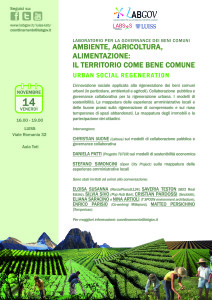
On 14th November at 16.00 in LUISS Guido Carli University, we will have the chance to meet several experts and to launch a debate upon the urban social regeneration.
With the participation of Daniela Patti (project TUTUR) and Stefano Simoncini (Open city project), LabGov will have the pleasure to host the conference; the objective is to transform the meeting into a co-working session and to promote the dialogue between all the participants.
We aim at creating a concrete and usable output for all the presents.
Further info about participants and program at :

by Stefano Speranza | Nov 12, 2014 | Luiss LabGov 2014-2015, The Urban Media Lab
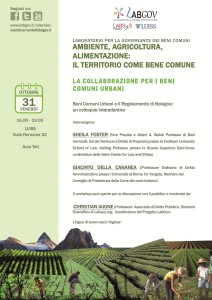 On October, 31st Professor Christian Iaione – LabGov’s coordinator – along with the LabGov’s tutors and the new Labgovers, had the possibility to have an inter-atlantic dialogue with two internationally prominent scholars about the collaboration for the Urban Commons.
Actually, the audience listened to the speeches and then debated with Professor Sheila Foster – Vice Dean and Albert A. Walsh Professor of Real Estate, Land use and Property law at Fordham University School of Law, Visiting Professor at Scuola Superiore Sant’Anna, co-director of the Stein Center for Law and Ethics and Professor Giacinto della Cananea – Full professor of Administrative Law at University of Rome Tor Vergata and member of the Presidential Council of the Italian Supreme Audit Institution.
The topic of the workshop was the Urban Commons, particularly focusing on the Bologna regulation on public collaboration and its comparison with some international practical examples. Professor Iaione opened the workshop, saying what LabGov is and how it works. He soon gave the floor to Professor Sheila Foster.
Professor Foster gave us a theoretical framework and seemed excited and pleased of being there. “I have studied and looked to the Bologna regulation with great passion, and I do believe that LabGov is my field” she soon affirmed. Her enriching speech moved towards three directions.
Firstly she gave to the audience a general idea of the commons especially in the urban context, then she moved to some ideas about how the government/management of the commons comes up and finally she went in depth by underlining how the Bologna regulation approaches these questions.
It was an enriching speech because of its clarity and linearity, through which she explained that we must consider the Commons as opposed to an asset or a mere good, so as a shared and open thing. Shared by everyone and open in the sense that it provides open access to the people who should be involved and obviously not excluded.
“Of course the natural world contains Commons but exist other types such as cultural, digital and Urban Commons” Professor Foster explained, but “many collectively shared Urban Commons shares the same dilemma that Hardin wrote about in his essay regarding the tragedy of the Commons”, she continued and “The debate that Elinor Ostrom launched, goes in two directions: privatization and shared government control with the people”. Since Professor Foster and Labgov operate in the this last context, it was interesting reflecting together about the need of a public regulation even because an unregulated context does not exist.
Moreover, “contemporary Commons’ dilemmas arise not in open spaces but in highly regulated spaces” Professor Foster explained. This is Foster’s point of view, that is shareable by everyone who realize that in urban areas we have all seen open spaces where public authority have rules and we all see tragedies, such as degradation but even crimes. “This regulatory slippage in the urban contexts creates the tragedy or the Commons dilemma”, Foster affirmed.
So, how do we deal with these dilemmas? Some scholars proposed a public way, others a simple privatization of the Commons but what is the core idea, for a Commoner, is the collective management of the Commons.
After having provided the audience with same cases, such as what happened in New York’s Central Park and the Guardian Angels, and some examples concerning the commercial sector, Foster told the audience that these are the cases in which groups of users cooperate to allocate resources even if they could be temped by individualism or personal use. And she wrote extensively about these situations. “What is interesting is not the cooperation or the collaboration, but the collective action in the pure sense” she pointed out. And soon after, she made the audience meditate on the question concerning the Government, if it supports and helps citizens in doing actions for the general interest. A Government that facilitates the creation of partnerships or agreements is praiseworthy.
And by analysing this point it was easy to move to the Bologna regulation, on which Professor Foster made some comments and suggestions. These regarded the definition of Urban Commons, that in the regulation is similar to the one of public goods and should be revised, by getting it tighter. But Sheila Foster said that the regulation does a very good job in bringing together citizens for public goals.
The second part of the workshop had as lecturer Professor Giacinto della Cananea, and we saw the Bologna regulation on public collaboration in the administrative and constitutional Italian context, considering the legal categories that the regulation touches and challenges. “We are having a huge public debate in Italy about the commons, but a little bit misleading”, Professor Iaione stated and gave the floor to the lecturer.
Starting with a distinction between ownership and management and underlining that the concept of ownership is fully explained and contained in the Italian Civil Code, Professor della Cananea reminded the audience that only the national Government can legislate on matters regarding topics expressed in the Civil Code. But this is not true in the United States, for example, where different civil codes coexist.
After having pointed out this issue, della Cananea stated that there is “a confusing debate about ownership and use of common goods” and for this reason the question of the Bologna regulation on public collaboration is of importance to him.
And he followed a clear outline in order to illustrate his arguments, after having clarified that the translation into English of the regulation could not mean the same of the Italian one, as Professor Foster said before him.
In particular, Professor della Cananea stated that the Bologna regulation is a tool of public policy, it is precious because a similar document is still missing in Italy, and it is unique because it is not a political document, it is an ideological one.
He pointed out some issues regarding the question of the ethical principles in the regulation, the question placed by the art. 33 of the regulation regarding conciliations in case of eventual disputes, problems in the definitions of the concepts of urban commons and active citizens, liability and inertia.
Moreover, Professor della Cananea went in depth in the analysis of the practises of the local governments, especially at the regional level.
Italy is differentiated from north to south and, following the ideas of Robert Putnam, he affirmed that the different performances of the local public institutions are mainly, not only, caused by the different city traditions. And this brilliant examination led him to ask a basic but fundamental question: “is this a very helpful tool or a dangerous tool? Not all the Italian areas are like Bologna and we obviously know something about criminal organizations. As a lawyer I must raise this question”.
For sure, it was a passionate and punctual dissertation made by Professor della Cananea that left the students with a lot of food for thought.
Finally, Professor Iaione spoke. He thanked both the scholars very much for their very precious contributions and emphasized on the meaning of the art. 35 of the regulation: “Art. 35 is the mission impossible of Labgov’s intents, this regulation was an experiment and that is why we are here today, to discuss and improve our capabilities” was the closing remark which was followed by a passionate debate with the students from the audience.

by Edoardo De Stefani | Oct 28, 2014 | Luiss LabGov 2014-2015
We feel very honored to have been offered the pleasure to host two internationally prominent scholars:
Professor Sheila Foster – Vice Dean and Albert A. Walsh Professor of Real Estate, Land use and Property law at Fordham University School of Law, Visiting Professor at Scuola Superiore Sant’Anna, co-director of the Stein Center for Law and Ethics,
Professor Giacinto Della Cananea – Full professor of Administrative Law at University of Rome Tor Vergata and member of the Presidential Council of the Italian Supreme Audit Institution.
Once upon a time, under the Fordist regime of capital accumulation, there was no space for considering collective action as a means for reflecting on the urban commons.
However the economic crisis and the post modern socio-cultural upheaval have drawn the contours for a new urban outline, in the sense of refreshing the understanding of collective action and its nexus with the neighbourhood.
The perception here is that of a transformative evolution of the capacity of the citizens to serve and cultivate urban life.
Truly it is not surprising that cities are not viewed anymore as storage loci for the depletion of common resources, albeit we cannot simply consider the realm of Commons as a ready to go policy.
In effect the fairy tail of the urban commons faltered on the slippery terrain of the regulatory framework.
On the other hand, the congestion and the rivalry upon the use and exploitation of resources leave no room for development and growth, at least if the current structural paradigm is not questioned.
Europe and America are currently experiencing the nightmare of resources degradation, thus our challenge is to find and implement solutions for the governance of the Commons, in such a way that all the community should eventually play a positive sum game.
The workshop, moderated by Professor Christian Iaione, aims at opening a discussion with the audience for understanding and debating the Urban Commons, with a specific focus on the Inter-Atlantic dialogue and on the Bologna Regulation on Public Collaboration. The English version has been edited by 2013/2014 Labgov interns and it is now the official version adopted by the City of Bologna.
LUISS and LabGov are pleased to welcome you on October 31st on the Viale Romania 32 Campus, Toti Classroom, from 16.00 to 19.00


 On March 17th, 2015, LabGov will host the Conference Land and new forms of legal order at LUISS University of Rome. The Conference – that will start at 4:30 PM in Aula Nocco, Via Parenzo 11, LUISS School of Law – will address the issue of collaborative governance for the commons as a tool to fight corruption and organized crime, safeguard the territory and promote legal economic growth and social progress.

